
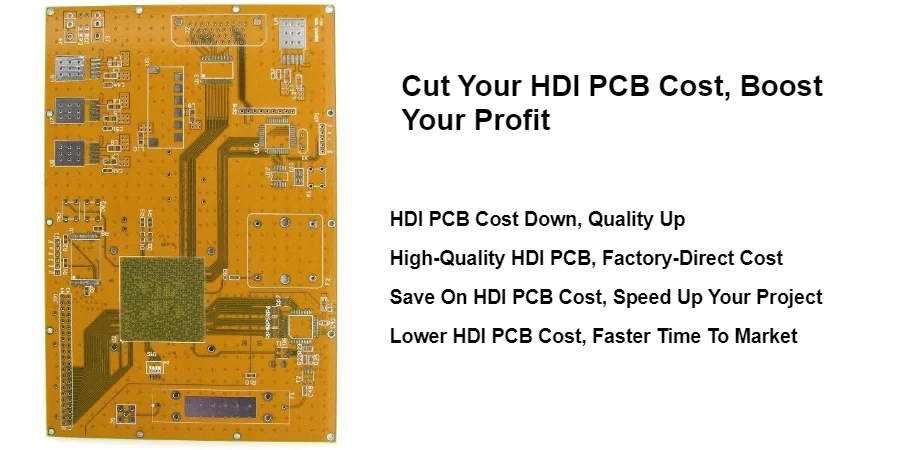
- HDI PCB cost is most useful here as a quote-readiness question, not as a public price lookup.
- The cost boundary usually shifts when microvia structure, lamination scope, stack-up definition, or BOM ownership are still moving.
- A cleaner RFQ starts with a stable HDI route, a controlled file package, and explicit stage assumptions for a validation prototype, a production-intent prototype, or an NPI release package.
Quick Answer HDI PCB cost is less about publishing a universal number and more about understanding when a design moves from a baseline multilayer quote into deeper engineering review. The biggest cost changes usually come from microvia strategy, sequential lamination, stack-up and material definition, fine-feature limits, finish and assembly interaction, and whether the build is still a validation prototype, a production-intent prototype, or an NPI release package.
If you are evaluating manufacturing services and layout rules, start with HDI PCB Manufacturing & Microvia Services. To review structural feasibility, IPC-2226A standards, and engineering gates before tooling, reference HDI PCB Capabilities & DFM Release Gates. For broader cost context, continue to PCB Cost Reduction Guide.
Table of Contents
- What should be reviewed first?
- What does hdi pcb cost mean here?
- What actually drives HDI quote complexity?
- What should be reviewed before RFQ?
- Where do DFM, prototype, and BOM pages fit?
- What should be frozen before quote?
- Next steps
- FAQ
What should be reviewed first?
Before asking what an HDI board should cost, settle three questions:
- Is the design actually committed to an HDI route, or is that still under evaluation?
- Is the interconnect strategy defined enough to describe the real build, not just the board class?
- Is the package mature enough for a commercial review, or is it still primarily an engineering learning build?
Those questions matter because many HDI re-quotes do not start with fabrication failure. They start when the board class is named, but the actual build assumptions are still moving.
| Early review point | What it answers | What it does not prove |
|---|---|---|
| HDI route | Whether the board belongs in a higher-density process family | That every HDI structure is equally practical |
| Interconnect definition | How much lamination, laser-via, and fine-feature complexity is actually being requested | Final pricing by itself |
| Build maturity | Whether the package is ready to be treated as a controlled RFQ input | That the same assumptions will survive the next revision |
What does hdi pcb cost mean here?
This article treats hdi pcb cost as a quote-readiness question.
It covers:
- quote-boundary framing for HDI builds
- the design choices that usually trigger deeper engineering review
- the checks that make an HDI package easier to quote cleanly
- the supporting references that help close common gaps before RFQ
It does not try to provide:
- a universal per-board HDI price
- a public calculator that ignores stack-up, BOM, or build intent
- generic promises about savings, speed, or production outcome
- a manufacturer case study with unsupported customer numbers
That boundary is important. An HDI board may be appropriate and still be expensive to quote if the package leaves microvia, finish, material, or sourcing assumptions unresolved.
What actually drives HDI quote complexity?
The practical way to discuss HDI cost is to focus on complexity drivers rather than on public price claims.
| HDI driver | Why it changes quote scope | What should be explicit before RFQ |
|---|---|---|
| Microvia structure | Blind, buried, stacked, staggered, and via-in-pad choices can change drilling, filling, and build-up review depth | Which via structures are required and where |
| Sequential lamination | More build-up stages usually mean more process decisions and tighter front-end review | The intended HDI order and layer transitions |
| Fine trace and pad geometry | Dense escape routing can push imaging, registration, and inspection assumptions | The actual line-space targets and any critical breakout zones |
| Stack-up and material definition | HDI cost often stays provisional if dielectric, copper, and impedance assumptions are implied rather than released | Stack-up table, material family, thickness target, and impedance notes |
| Via fill and planarization needs | Filled or capped structures can change both fabrication and downstream assembly expectations | Whether filling, capping, or flat pad surfaces are required |
| Surface finish and assembly interaction | Fine-pitch SMT, via-in-pad, contact zones, or special pad duty can change finish discussions | Finish intent and any assembly-sensitive zones |
| Assembly and test scope | HDI fabrication cost is only part of the RFQ if dense BGAs, x-ray dependence, or sourcing constraints are also in play | Whether the request is bare board only or includes assembly context |
One of the most expensive design habits is using stacked microvias for routing convenience where staggered microvias would have done the job. That shows up repeatedly on 3-stage and any-layer HDI layouts. In CAD, stacked structures clean up escape routing. In production, every extra stacked interface becomes a reliability and yield problem during sequential lamination.
The physical risk is not theoretical. Continuous stacked microvias carry high Z-axis stress and are much more likely to separate at the interface during lead-free reflow. Experienced fabricators know that a Gerber file full of aggressive stacked structures can turn into scrap exposure long before shipment. Less experienced suppliers often respond the lazy way: they do not explain the yield risk clearly; they hide it inside the quote. The result is a 200% to 300% risk premium added as a quiet yield tax. That is why many expensive HDI quotes are not really about material cost. They are about the factory pricing the physical risk you forced into the build. Replacing unnecessary stacked structures with staggered microvias before RFQ is often the fastest way to cut HDI cost.
Two patterns cause extra friction repeatedly:
1. The board is labeled HDI, but the exact HDI structure is still negotiable
That is common during design iteration. It is not a problem by itself, but it means the quote should be treated as a boundary review rather than as a final commercial answer.
2. The fabrication data is present, but the build intent is not
Gerbers can show dense routing and drill patterns, but they do not fully explain whether the build is a validation prototype, a production-intent prototype, or an RFQ package that is already being treated as an NPI release package with controlled sourcing and assembly assumptions.
That is the practical failure chain behind many HDI re-quotes: microvia structure, lamination order, via-fill posture, or assembly-sensitive pad assumptions stay implied -> engineering review has to reinterpret the route after quote intake starts -> the build moves into re-quote, schedule slip, or a release hold while the stackup and process window are reopened.
What should be reviewed before RFQ?
Once the HDI route is chosen, the quote package has to show exactly what is being quoted.
1. Define the physical build
Confirm that the released package clearly shows:
- layer count and layer roles
- the intended HDI order such as
1+N+1or a higher build-up route - which vias are through, blind, buried, stacked, or staggered
- whether via fill, cap, or via-in-pad is required
- any impedance-controlled structures that depend on the approved stack-up
2. Close the fabrication notes
Review whether the package makes these items explicit:
- material family or approved alternatives
- board thickness target and copper assumptions
- finish choice
- any controlled-depth, back-drill, cavity, or special pad requirements
- revision-controlled fabrication drawing notes
3. Add the assembly context only if it changes the answer
Even when the request starts from bare-board cost, HDI complexity often interacts with assembly:
- dense BGAs or bottom-terminated packages
- tight escape regions that depend on flat pad surfaces
- x-ray or inspection dependence
- selective component placement constraints
- programming or test-access limitations
If those assumptions are already known, include them early in the package review instead of treating them as a later surprise.
4. Clean the BOM boundary if assembly is in scope
If the RFQ includes assembly or is expected to move toward controlled release soon, confirm:
- exact manufacturer part numbers
- approved alternates
- package consistency with the layout
- any customer-supplied or consigned boundary
- DNP, substitution, and lifecycle notes where relevant
5. Confirm one released revision
Many quote loops are revision loops in disguise. Make sure the RFQ points to one controlled design state, not a mix of current Gerbers, older stack-up notes, and provisional BOM edits.
Where do DFM, prototype, and BOM pages fit?
Use the supporting pages for the specific gap that is still open:
- DFM Guidelines when stack-up notes, via structures, or process-sensitive features still need fabrication review.
- PCB Prototype when the open question is whether the build is still exploratory, should move into a production-intent prototype, or is nearing NPI release posture.
- Components & BOM when the bare-board discussion is no longer the blocker and the real uncertainty sits in sourcing, alternates, or BOM ownership.
If all three are already stable, the package is much closer to a usable RFQ input.
What should be frozen before quote?
By this stage, the goal is not to revisit whether the board should be HDI. The goal is to lock the assumptions that would otherwise force a revision later.
Freeze:
- the HDI route and intended microvia structures
- the released stack-up, material direction, thickness target, and impedance notes
- feature-level requirements that change process selection, such as via fill, fine breakout geometry, or special pad handling
- finish intent and any contact-area or assembly-sensitive requirements
- the build posture, so the request is clearly a validation prototype, a production-intent prototype, or an NPI release package
- BOM ownership and sourcing rules if assembly is in scope
- the active revision state across fabrication data, drawings, and BOM
If those items are still moving, the design may still be quoteable, but the result should be treated as provisional.
Next steps with APTPCB
If you are staring at an HDI quote that looks irrational, if you suspect the supplier is charging against vague yield risk, or if you do not know whether the current microvia structure and lamination count are actually necessary, the right move is to audit the build logic before you accept the price.
Send the Gerber or ODB++, microvia structure map, stack-up intent, and target impedance package to [email protected], or route the job through Online Quote.
APTPCB's advanced CAM and cost-audit team will return an HDI Cost Driver & Microvia Structure Audit within 24 hours. The review will identify unnecessary lamination cycles, optimize stacked microvia exposure, and separate real process cost from hidden yield tax before you pay for a bad HDI route.
Public references
IPC-2581 Consortium, "What is IPC-2581?" Supports the released-package and digital handoff framing used when HDI assumptions must stay explicit through quote review.
APTPCB HDI PCB page Supports the HDI route and interconnect-structure boundary used throughout the article.
APTPCB DFM Guidelines Supports the manufacturability-review posture used before RFQ for stackup, via, and pad-sensitive features.
APTPCB Components and BOM page Supports the sourcing-boundary language used when fabrication cost is no longer the only blocker.
Author and review information
- Author: APTPCB quoting, HDI, and DFM content team
- Technical review: stackup, microvia, and RFQ-intake engineering team
- Last updated: 2026-05-15
FAQ
Is an HDI PCB always more expensive than a standard multilayer board?
Not as a blanket rule. A simple first-order HDI build can be closer to a conventional multilayer quote than a more aggressive HDI stack with stacked microvias, via fill, and tighter escape geometry. The meaningful comparison is structure to structure, not label to label.
Can I estimate HDI PCB cost from layer count alone?
No. Two boards with the same layer count can quote very differently if one uses stacked microvias, via-in-pad, special fill requirements, or tighter material and impedance constraints.
Does 1+N+1 automatically mean a low-cost HDI route?
No. 1+N+1 is still only a structure description. It can be easier to review when the stack-up, via treatment, and breakout geometry are already explicit, but it can still be difficult to quote if those assumptions remain open.
Why do HDI quotes get revised so often?
Because the first package often answers what class of board this is, but not what exact build is being released. Revisions usually follow late clarification on stack-up, via treatment, finish, BOM ownership, or revision control.
When should I use the prototype page instead of going straight to quote?
Use the prototype page when the next build is still meant to learn something fundamental, such as whether the stack-up, component density, or assembly approach should change. If the package is still learning-driven, the commercial answer will usually stay provisional.
What should go into an HDI RFQ package?
At minimum, send released fabrication data, drill data, stack-up intent, fabrication notes, revision references, and any BOM or assembly context that changes the build. If one of those items is intentionally provisional, label it clearly instead of leaving it implied.
When does HDI stop being the main cost question?
Often when fabrication assumptions are already stable and the remaining uncertainty moves to assembly sourcing or component risk. At that point, the BOM can change the commercial answer more than another round of discussion about the bare board.
Should an early RFQ include unresolved alternatives?
It can, but they should be framed as explicit options rather than mixed into one release package. A cleaner RFQ compares defined options better than one package that quietly combines multiple stack-up or sourcing scenarios.