
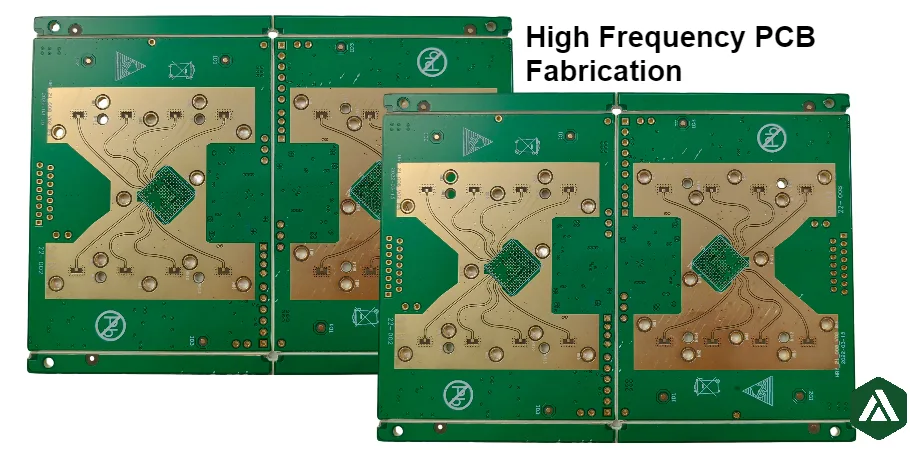
High-frequency PCB fabrication for RF and microwave applications requires coordination between electrical design and manufacturing process control. The PCB material, copper surface, stack-up geometry, via transitions, and inspection methods all influence insertion loss, impedance, phase stability, and repeatability.
A successful RF board starts with a fabrication plan that connects the system requirement to the manufacturing requirement.
Key decisions for high-frequency PCB fabrication
- Select laminate materials from loss, phase, thermal, mechanical, availability, and cost requirements.
- Use documented design Dk and Df values with the applicable test method and construction.
- Freeze the production stack-up before routing is finalized.
- Treat connectors, launches, vias, antipads, and return paths as RF structures.
- Specify copper profile when conductor loss affects performance.
- Define TDR, VNA, coupon, and documentation requirements before fabrication.
- Provide a complete RFQ package containing materials, impedance targets, tolerances, and acceptance criteria.
What makes RF PCB fabrication different from standard PCB manufacturing?
A high-frequency PCB is an electrical transmission structure, not only a mechanical interconnect. As frequency increases, small variations in dielectric thickness, trace width, copper roughness, and reference geometry can affect performance.
The major performance factors are:
| Parameter | Effect on RF performance | Fabrication control |
|---|---|---|
| Dielectric constant (Dk) | Changes impedance and phase velocity | Approved material and construction |
| Dissipation factor (Df) | Influences dielectric loss | Correct laminate selection and documentation |
| Copper roughness | Increases conductor loss at high frequency | Copper foil/profile specification |
| Trace geometry | Changes impedance | Etch compensation and dimensional control |
| Dielectric thickness | Changes field distribution | Stack-up control and measurement |
| Via transitions | Create discontinuities and reflections | Drill, antipad, return-path control |
A high-frequency PCB requires agreement between the electromagnetic model and the finished manufacturing structure.
How do you choose the right RF PCB material?
There is no single best RF laminate. Material selection depends on the signal path, operating environment, manufacturing constraints, and validation requirements.
| Material option | Best fit | Main design considerations |
|---|---|---|
| Low-loss hydrocarbon ceramic laminate | RF communication, antennas, mixed RF/digital systems | Balance loss, cost, mechanical stability, and availability |
| PTFE-based laminate | Microwave and demanding low-loss applications | Requires specialized drilling, handling, and lamination processes |
| Low-loss epoxy systems | Higher-speed mixed-signal designs | Electrical values depend on resin content, glass style, and construction |
| Ceramic-filled RF materials | Thermal or dimensional stability requirements | Confirm processing compatibility |
| Hybrid RF/FR-4 stack-up | Designs needing premium material only on critical layers | Review bonding, registration, and thickness control |
Review the specific laminate data sheet rather than selecting only by brand family. Supplier families such as Rogers material, Taconic material, and PTFE PCB include multiple constructions with different electrical properties.
Which Dk and Df values should be used?
Dk and Df values must be tied to measurement conditions. Record:
- Frequency and test method
- Temperature conditions
- Material grade and thickness
- Design Dk used for simulation
- Glass style and resin content
- Approved substitutions
Using different Dk values between simulation, stack-up calculation, and fabrication can create impedance and phase differences.
How should an RF PCB stack-up be designed?
Finalize the PCB stack-up with the fabricator before layout release. The finished board structure determines the actual transmission-line behavior.
Common RF transmission structures include:
| Structure | Advantages | Manufacturing inputs |
|---|---|---|
| Microstrip | Simple access to components and connectors | Trace width, dielectric height, copper profile, mask condition |
| Stripline | Controlled electromagnetic environment | Core/prepreg thickness, registration, plane spacing |
| Grounded coplanar waveguide | Strong launch and field control | Trace gap, ground vias, reference plane geometry |
For controlled-impedance PCB designs, define:
- Layer and transmission-line type
- Target impedance and tolerance
- Trace width and spacing
- Reference planes
- Finished copper assumptions
- Solder-mask condition
- Coupon requirements
- Production adjustment authority
Continuous reference planes are essential. Signal transitions across layers require controlled return paths, appropriate ground connections, and validated via structures.
How should RF vias, launches, and backdrilling be specified?
Via transitions can introduce inductance, capacitance, reflections, and resonance. Their impact depends on geometry and operating frequency.
| Feature | Required specification | Verification |
|---|---|---|
| Signal via | Drill size, finished hole, pad, antipad, start/end layers | Fabrication records and inspection |
| Return vias | Location and reference connection | CAM review and dimensional inspection |
| Connector launch | Connector model, pad geometry, ground structure | Launch review or RF testing |
| Backdrill | Target layer, drill diameter, residual stub limit | Backdrill documentation |
| Via-in-pad | Fill, cap, planarization requirements | Cross-section when required |
Backdrilling is selected when via stubs affect the operating band. Blind and buried vias can reduce discontinuities but add manufacturing complexity.
For antenna feeds and transitions into an antenna PCB, include connector details, mounting conditions, and reference geometry.
What fabrication processes require RF-specific control?
RF boards require closer coordination during fabrication.
Material handling
Confirm:
- Exact laminate grade
- Thickness
- Copper type
- Approved substitutions
- Material documentation requirements
Imaging and etching
Finished trace geometry determines impedance. Manufacturing review should consider:
- Etch compensation
- Copper thickness
- Critical RF dimensions
- Controlled spacing
Lamination
Hybrid constructions require review of:
- Bond materials
- Press cycle
- Registration
- CTE behavior
- Final dielectric thickness
Drilling and plating
Special materials may require different drilling and hole preparation processes. PTFE-based materials should follow supplier-specific processing requirements.
DFM review
An early DFM review identifies stack-up, machining, registration, and RF geometry issues before production release.
Which RF PCB tests should be requested?
Testing should match the performance requirement.
| Test method | Measures | Required definition |
|---|---|---|
| Electrical test | Opens and shorts | Netlist and acceptance criteria |
| TDR | Impedance versus distance | Coupon geometry, tolerance, reporting format |
| VNA S-parameters | Reflection and transmission behavior | Frequency range, fixtures, calibration, limits |
| Microsection | Physical construction evidence | Location, sampling, acceptance criteria |
| Material documentation | Material identity and values | Lot requirements and documentation scope |
TDR and VNA testing provide different information. TDR identifies impedance variation along a structure. VNA testing measures frequency-domain behavior such as S11 and S21 when the test structure, calibration, and limits are defined.
See PCB quality and testing and quality for broader inspection requirements.
What causes high-frequency PCB failures?
| Failure mode | Typical cause | Control method |
|---|---|---|
| Impedance shift | Dk variation, thickness change, etch variation | Approved stack-up and impedance coupons |
| High insertion loss | Material loss, copper roughness, geometry changes | Loss budget and material control |
| Poor return loss | Launch or via discontinuity | Controlled transition design |
| Via resonance | Excess stub length or weak return path | Via modeling and backdrill analysis |
| Hybrid delamination | Material mismatch or lamination issues | Fabricator construction review |
| Antenna variation | Dielectric or geometry variation | Final assembly validation |
What information should be included in an RF PCB RFQ?
A complete RFQ package reduces quotation delays and manufacturing uncertainty.
Engineering package checklist
- Gerber, ODB++, or IPC-2581 files
- Drill files and netlist
- Fabrication drawing
- Layer stack-up
- Material grade and thickness
- Surface finish requirements
- Controlled impedance table
- RF critical dimensions
RF requirements checklist
- Operating frequency range
- Target impedance and tolerance
- Loss requirements
- Phase requirements
- Copper roughness requirements
- Via and launch details
- Backdrill requirements
- Coupon and test requirements
Commercial requirements checklist
- Prototype or production quantity
- Approved material sources
- Assembly environment
- Qualification requirements
- Documentation requirements
Submit this information through the PCB quote request to allow material availability, fabrication feasibility, and testing requirements to be reviewed together.
High-frequency PCB fabrication FAQ
What is a high-frequency PCB?
A high-frequency PCB is a board where transmission-line effects, dielectric properties, conductor loss, impedance, or phase behavior materially affect circuit performance.
Is FR-4 suitable for RF applications?
Some RF designs can use FR-4 for limited paths when loss and phase requirements allow it. Material suitability depends on frequency, route length, tolerance requirements, and validation needs.
How do Rogers, Taconic, PTFE, and low-loss epoxy compare?
Compare specific products using Dk, Df, test methods, construction availability, thermal behavior, mechanical properties, fabrication requirements, and total project cost.
Why does copper roughness matter?
High-frequency current flows near the conductor surface. Rough copper increases the effective current path and can increase conductor loss.
Does every RF PCB need backdrilling?
No. Backdrilling is used when via stubs create unacceptable electrical effects for the operating frequency range.
What files are needed for RF PCB fabrication quotes?
Provide fabrication files, stack-up details, materials, impedance requirements, controlled features, testing requirements, quantities, and acceptance criteria.
Standards and responsibility boundary
Applicable references may include:
- IPC-2221 — Generic Standard on Printed Board Design
- IPC-2141 — Design Guide for High-Speed Controlled Impedance Circuit Boards
- IPC-6012 — Qualification and Performance Specification for Rigid Printed Boards
- IPC-6018 — Qualification and Performance Specification for High Frequency (Microwave) Printed Boards
- IPC-A-600 — Acceptability of Printed Boards
- IPC-TM-650 — Test Methods Manual
Confirm revision, product class, customer requirements, and acceptance criteria for each program.
Fabrication controls and coupons provide manufacturing evidence but do not replace system-level validation for EMC, antenna behavior, reliability, or final operating performance.
Request a high-frequency PCB fabrication review
Provide the stack-up, material selection, impedance requirements, RF layout, via structures, test plan, quantities, and approved substitutions. APTPCB will review manufacturability and quotation requirements against the released project specification.