
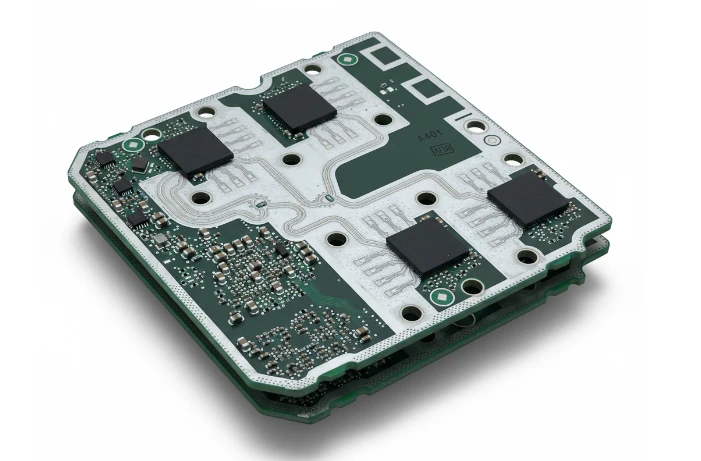
A high-speed beamforming module board is not simply a PCB carrying RF components. It is part of the antenna, signal chain, thermal system, and production reliability strategy. In 5G massive MIMO, automotive radar, satellite terminals, and phased-array systems, small variations in dielectric properties, copper geometry, or layer registration can change phase accuracy and reduce beamforming performance.
Successful designs require coordination between RF architecture, PCB stackup engineering, signal integrity (SI), power integrity (PI), thermal management, and manufacturing validation.
What is a high-speed beamforming module board?
A beamforming module board combines antenna elements, RF front-end devices, phase-control circuits, power amplifiers, low-noise amplifiers, and high-speed digital interfaces into a tightly controlled electrical structure.
Beam steering depends on controlling the phase and amplitude relationship between antenna channels. Because the PCB transmission path contributes directly to this relationship, the board behaves like part of the RF circuit.
Common architectures include:
| Architecture | PCB design priority | Typical applications |
|---|---|---|
| Analog beamforming | RF loss, phase consistency, impedance control | Radar, RF front ends |
| Digital beamforming | High-speed digital routing, power integrity | Baseband processing systems |
| Hybrid beamforming | RF, digital, thermal, and manufacturing balance | 5G massive MIMO and advanced wireless systems |
For high-speed applications, engineers typically manage both:
- RF frequency performance: sub-6 GHz through mmWave bands such as 24 GHz, 28 GHz, 39 GHz, and 77 GHz.
- Digital interface performance: multi-gigabit control and data links including JESD204B/C, CPRI/eCPRI, and Ethernet-based interfaces.
How do you choose the right beamforming PCB stackup?
The stackup determines impedance, propagation delay, loss, thermal behavior, and manufacturing complexity before routing begins.
A practical beamforming stackup separates functions:
| Layer function | Typical material strategy | Primary concern |
|---|---|---|
| Antenna and RF feed layers | PTFE, ceramic-filled hydrocarbon, Rogers or Taconic materials | Low loss and phase stability |
| High-speed digital layers | High-performance FR4 or low-loss FR4 | Controlled impedance and return paths |
| Power layers | FR4, heavy copper, embedded copper structures | Current capacity and heat removal |
| Ground layers | Solid reference planes | SI, EMI, and return current control |
Should a beamforming PCB use FR4 or RF laminate?
The answer depends on operating frequency and phase requirements.
| Application | Recommended material approach | Main design driver |
|---|---|---|
| 28/39 GHz mmWave base station | Hybrid RF laminate + FR4 | Lowest RF loss with controlled cost |
| 77 GHz automotive radar | Ceramic-filled RF material | Dimensional stability and reliability |
| Sub-6 GHz massive MIMO | High-performance FR4 or hybrid stackup | Thermal and routing density |
| LEO satellite terminal | Low-outgassing RF materials with matched CTE | Warpage and phase accuracy |
| Portable phased array | Rigid-flex with RF-capable flex materials | Size and integration |
For many commercial beamforming systems, a hybrid stackup provides the best balance. RF layers use low-loss materials while digital and power layers use cost-effective materials.
Which SI and PI parameters matter most?
Beamforming validation requires more than standard PCB electrical testing. The following parameters directly affect system performance.
| Metric | Why it matters | Typical range / factor | Measurement method |
|---|---|---|---|
| Phase stability | Controls beam pointing accuracy | < ±5 degrees across array channels | VNA testing and RF characterization |
| Insertion loss | Determines efficiency and thermal load | < 0.5 dB/inch depending on material | S-parameter measurement |
| Dk tolerance | Changes impedance and propagation delay | ±0.05 or better for high-end RF laminates | Material testing or ring resonators |
| Copper roughness | Increases high-frequency conductor loss | VLP/HVLP copper preferred for mmWave | Profilometer or material data |
| Layer registration | Controls via and fine-pitch alignment | < 3 mils (75 µm) for high-density designs | X-ray and micro-section |
| Thermal conductivity | Prevents gain and phase drift | Depends on structure and cooling method | Thermal simulation and imaging |
| Passive intermodulation (PIM) | Prevents RF distortion | < -150 dBc for demanding cellular systems | PIM testing |
What causes beamforming PCB failures?
| Failure mode | Root cause | Design impact | Verification method |
|---|---|---|---|
| Beam squint | Phase variation between channels | Incorrect beam direction | RF calibration and VNA testing |
| Excess insertion loss | High-loss dielectric or rough copper | Reduced range and efficiency | S-parameter analysis |
| Via resonance | Long via stubs | Signal reflections and notches | TDR and micro-section |
| Thermal phase drift | Poor heat spreading | Channel mismatch during operation | Thermal profiling |
| Delamination | Hybrid material mismatch | Reliability failure | Thermal cycling testing |
| Impedance variation | Stackup or etching variation | Reflection and signal degradation | Controlled impedance coupons |
How should engineers validate a beamforming module board before production?
A production-ready validation plan should connect design intent with manufacturing acceptance.
Stackup and material approval
Define the stackup before routing. The final fabrication package should include:
- Exact laminate manufacturer and grade
- Dielectric thickness
- Copper weight
- Target impedance values
- RF layer locations
- Surface finish requirements
For RF designs, specify materials based on electrical performance rather than brand preference alone.
Controlled impedance verification
High-speed RF traces require impedance-controlled fabrication.
Typical targets include:
- 50 Ω single-ended RF lines
- 100 Ω differential digital pairs
Production verification should include:
- TDR testing
- Impedance coupons
- Trace geometry confirmation
Use Impedance Calculator tools during early planning, but confirm final values with the fabricator's actual laminate data.
Back-drilling and via optimization
High-speed vias can create unwanted resonances when unused via stubs remain.
Production requirements commonly include:
- Controlled-depth back-drilling
- Micro-section inspection
- Stub length verification
A typical acceptance target is a remaining stub length below 10 mils (0.25 mm).
Grounding and shielding strategy
Maintain continuous reference planes under high-speed signals.
Important design elements include:
- Ground via fences around RF structures
- Nearby return vias during layer transitions
- Avoidance of plane splits under high-speed traces
For mmWave systems, electromagnetic simulation should include the PCB geometry, vias, and manufacturing tolerances.
Thermal validation
Power amplifiers create localized heat that can shift RF performance.
Thermal design may include:
- Thermal vias beneath PA packages
- Embedded copper coins
- Metal-backed structures
- Thermal simulation before fabrication
Validation should combine simulation with prototype thermal measurements.
Which beamforming PCB manufacturing approach fits your application?
5G mmWave base stations at 28 GHz and 39 GHz
Prioritize:
- Low dielectric loss
- Phase stability
- RF layer precision
A hybrid stackup using PTFE-based or hydrocarbon RF materials on RF layers and FR4 on digital layers provides a cost-effective approach.
See related High Frequency PCB manufacturing capabilities.
Automotive radar at 77 GHz
Prioritize:
- Dimensional stability
- Environmental reliability
- Compact antenna integration
Ceramic-filled materials are often selected because they provide better stability than pure PTFE structures.
Satellite communication terminals
Prioritize:
- Low outgassing materials
- CTE matching
- Warpage control
Large phased arrays require symmetrical stackups to maintain flatness during assembly.
Sub-6 GHz massive MIMO
Prioritize:
- Thermal management
- High component density
- Digital routing capacity
HDI structures are often required for routing dense control interfaces. See HDI PCB technologies.
Portable beamforming devices
Prioritize:
- Size and weight
- Mechanical integration
- Antenna placement flexibility
Rigid-flex designs using RF-compatible flexible materials can reduce system size while maintaining controlled impedance.
What should a beamforming PCB supplier checklist include?
Before requesting manufacturing quotes, provide:
| Item | Required information |
|---|---|
| PCB files | Gerber, drill files, drawings, and fabrication notes |
| Stackup | Material grades, thickness, layer order |
| Electrical targets | Impedance values and controlled nets |
| Frequency range | Operating bands including mmWave requirements |
| RF requirements | Copper roughness, loss targets, PIM requirements |
| Manufacturing needs | Back-drilling, edge plating, special finishes |
| Assembly requirements | SMT, flip-chip, wire bonding, or bare-die compatibility |
The supplier should confirm:
- RF laminate availability
- Hybrid lamination capability
- Registration capability
- Thermal process compatibility
- Production test methods
What are the most common beamforming PCB design mistakes?
Treating the PCB as only a mechanical carrier
Beamforming boards behave as RF structures. Trace geometry, dielectric variation, and via transitions contribute directly to antenna performance.
Applying identical tolerances everywhere
RF layers usually require tighter control than low-speed digital layers. Applying expensive RF tolerances to every layer increases cost without improving system performance.
Ignoring copper roughness at high frequency
At mmWave frequencies, conductor surface effects become significant. Low-profile copper options reduce additional insertion loss.
Changing signal reference planes without return paths
Fast signals require continuous return paths. Nearby ground stitching is essential when changing layers.
Ignoring fiber weave effects
High-speed traces can experience phase variation when routed across uneven glass structures. Spread-glass materials or optimized routing angles improve consistency.
FAQ: beamforming module board design and validation
What is the biggest cost driver for a beamforming PCB?
RF laminate selection is usually the largest material cost factor. Layer count, sequential lamination, HDI processing, and testing requirements also affect cost.
Can standard FR4 be used for beamforming designs?
For lower-frequency applications such as some sub-6 GHz systems, high-performance FR4 may be suitable. For mmWave applications above 24 GHz, dedicated RF materials are normally required.
What tests should be requested before shipment?
A complete validation package may include:
- Electrical testing
- Controlled impedance testing
- TDR analysis
- S-parameter testing
- Thermal cycling
- Warpage inspection
- RF functional validation
What surface finish is suitable for RF beamforming boards?
Immersion silver and ENEPIG are commonly considered for RF applications. ENEPIG also supports wire bonding and advanced assembly processes.
How does beamforming module board assembly affect PCB design?
Assembly processes such as flip-chip and bare-die integration require tight surface flatness, suitable finishes, and controlled pad geometry.
Related pages & tools
- Explore RF/Microwave Material options for material selection.
- Review DFM Guidelines before manufacturing release.
- Use the Impedance Calculator for initial planning.
- Learn about Antenna PCB manufacturing capabilities.
Glossary
| Term | Definition |
|---|---|
| Phased Array | An antenna array that electronically steers radio waves by controlling individual elements. |
| MIMO | Multiple Input Multiple Output technology using multiple transmitters and receivers. |
| Hybrid Stackup | PCB construction combining RF laminates with standard PCB materials. |
| Dk | Dielectric constant affecting impedance and propagation speed. |
| Df | Dissipation factor describing dielectric signal loss. |
| Skin Effect | High-frequency current concentration near conductor surfaces. |
| Back-drilling | Removing unused via sections to reduce high-speed signal reflections. |
| CTE | Coefficient of Thermal Expansion describing material expansion with temperature. |
| SerDes | Serializer/Deserializer high-speed communication technology. |
| PIM | Passive Intermodulation caused by nonlinear passive structures. |
| ENEPIG | Surface finish supporting soldering and wire bonding. |
| Beam Squint | Beam direction error caused by frequency-dependent phase variation. |
Conclusion: how to move a beamforming PCB from design to production
A high-speed beamforming module board succeeds when electrical performance, manufacturing capability, and validation requirements are planned together.
The most reliable projects define the stackup early, select materials based on frequency and phase requirements, validate SI/PI behavior, and establish measurable production acceptance criteria.
When requesting a quote or engineering review, provide:
- Gerber files and drill data.
- Stackup requirements or electrical targets.
- Controlled impedance specifications.
- Operating frequency range.
- RF, thermal, and assembly requirements.
Early collaboration between PCB designers and manufacturers reduces redesign cycles and improves production yield for advanced beamforming systems.