
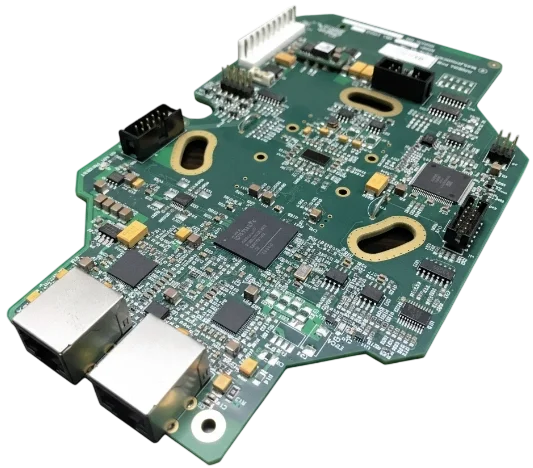
A BOM mismatch occurs when the parts purchased, programmed, kitted, or assembled do not match the approved product configuration. Preventing it in turnkey PCBA requires one controlled BOM revision, explicit substitution authority, engineering evidence, purchasing gates, and traceability—not a last-minute search for parts with similar headline specifications.
Key Takeaways
- Treat the BOM as a controlled manufacturing release shared by engineering, procurement, assembly, and test.
- Include the manufacturer, full MPN, reference designators, quantity, value, footprint, and variant or DNP state.
- Classify parts as exact-only, pre-approved alternates, or controlled commodities with named approval authority.
- Qualify alternates for form, fit, function, process, compliance, provenance, firmware, and system effects as applicable.
- Record each sourcing exception before purchase and link the approved BOM revision to material, build, test, and shipment records.
Table of Contents
- Why do BOM mismatches happen in turnkey PCBA?
- What belongs in a production-ready BOM?
- How should AML, AVL, and approved alternates be defined?
- How do you qualify a component substitute?
- Which checks matter for each component class?
- What controlled workflow prevents unauthorized substitutions?
- How should incoming inspection and first article be used?
- How do lifecycle monitoring and traceability reduce repeat risk?
- Common BOM mismatch symptoms and controls
- Turnkey PCBA RFQ checklist
- Standards and responsibility boundary
- FAQ
Why do BOM mismatches happen in turnkey PCBA?
Turnkey assembly combines sourcing, fabrication, assembly, programming, inspection, and test. One ambiguous line or uncontrolled revision can therefore reach several operations before the error becomes visible.
The core failure is a break in configuration control: engineering, procurement, assembly, or test works from different data, or an emailed approval never enters the released record.
Typical mismatch paths include:
- A value-only description such as “100 nF, 0603” without a manufacturer and full MPN
- A partial MPN that omits package, grade, packing, or programming suffixes
- Different BOM, schematic, centroid, drawing, firmware, and test revisions
- DNP or product-variant states held in an uncontrolled spreadsheet
- An alternate selected by nominal value, voltage, or pin count while secondary behavior is ignored
- A distributor listing treated as proof of identity, lifecycle, or approval
- A quoted MPN replaced during purchasing without a controlled exception
The control objective is simple: every assembled reference designator must resolve to an approved part and revision, and every exception must have an owner and evidence.
What belongs in a production-ready BOM?
A production BOM should let every team identify the same configuration without guessing. Column names may vary, but the data meaning must stay consistent.
| BOM field | Why it matters | Frequent failure |
|---|---|---|
| Manufacturer name | Distinguishes the component maker from the distributor | Supplier name is entered as the manufacturer |
| Full manufacturer part number | Identifies the approved orderable device | Family name or shortened MPN hides a suffix |
| Reference designators | Connects the BOM to schematic, centroid, AOI, and test data | Grouping omits or duplicates a location |
| Quantity per assembly | Supports procurement, kitting, and reconciliation | Quantity does not match reference count |
| Package and PCB footprint | Exposes mechanical and land-pattern risk | Package label is generic or metric/imperial naming is confused |
| Variant and DNP state | Defines which product option is being built | Blank cells are interpreted differently by teams |
| Value, description, and approved alternates | Supports review while limiting purchasing choices | Description conflicts with the MPN or says “equivalent allowed” |
| Criticality or control class | Sets the review and approval route | All parts receive the same shallow check |
| Revision and release status | Establishes the authoritative configuration | Draft and released files share the same filename |
For example, “0603” can refer to an imperial 1.6 × 0.8 mm component or a metric 0.6 × 0.3 mm component. The full MPN and approved footprint should resolve that ambiguity before stencil, placement, or purchasing data are released.
Use component and BOM management to reconcile the BOM with the schematic, centroid data, drawings, variants, and test configuration. Scrubbing can find missing data and conflicts; it cannot qualify an alternate.
How should AML, AVL, and approved alternates be defined?
AML and AVL terminology varies. Define the project terms instead of assuming whether they mean approved manufacturers, part numbers, vendors, or suppliers.
Keep three decisions separate:
- Approved part: Which manufacturer MPNs may satisfy the line?
- Approved source: Which purchasing channels may supply it?
- Substitution authority: Who may accept a new MPN, with what evidence and scope?
A trusted supplier cannot make an unsuitable part equivalent; an approved MPN from an uncontrolled source can still create provenance risk.
Component control and approval matrix
Classify parts by product risk rather than by price alone. The following model is a starting point; the product owner should assign the actual classes.
| Control class | Typical examples | Required review | Approval owner | Release evidence |
|---|---|---|---|---|
| Exact-only | Programmed, secure, calibrated, or certification-linked parts | Identity, source, revision, programming or calibration state | Product owner | Released MPN and required records |
| Engineering-approved alternate | ICs, power, RF, clocks, magnetics, connectors, critical passives | Form, fit, function, process, compliance, provenance, and risk-based validation | Design engineer; quality/compliance if affected | Comparison, tests, deviation or ECO |
| Pre-approved alternate set | Qualified MPNs for one BOM line | Revision, lifecycle, source, and build applicability | Configuration authority | Controlled alternate list |
| Controlled commodity pool | Non-critical passives or hardware where permitted | Technology, value, tolerance, rating, package, environment, and source limits | Authority named in procedure | Commodity specification and purchase record |
“Generic passive allowed” is incomplete. Timing capacitors, current-sense resistors, fuses, precision networks, and power inductors can be function-critical despite low unit cost.
How do you qualify a component substitute?
An alternate is acceptable only when evidence covers the actual circuit and process. A parametric match generates candidates; it does not approve them.
Review these dimensions:
- Form and fit: Body, terminals, pin 1, polarity, land pattern, height, mating, enclosure, stencil, feeder, coating, and rework access
- Function: Limits, tolerances, timing, noise, stability, derating, startup, faults, thermal behavior, and software-visible differences
- Process: Reflow, finish, moisture sensitivity, cleaning, soldering, underfill, and inspection compatibility
- Compliance and provenance: Required declarations or approvals, manufacturer identity, source, packaging, storage, and lot records
- Lifecycle and verification: PCN/PDN status, supply continuity, and risk-based bench, thermal, EMC, functional, reliability, or system tests
Nominal equality is not equivalence. Regulators with the same voltage and current can differ in pinout, stability, startup, EMI, thermal behavior, and faults. Connectors with the same pitch can differ in keying, plating, rating, latch, or height.
Evidence-based substitution record
Record both MPNs, affected references, reason, comparison, footprint and process impact, required tests, approver, scope, date, and implementing BOM/ECO revision. Limit temporary approvals by quantity, lot, build, or time.
Which checks matter for each component class?
Approval depth should follow circuit sensitivity and failure consequence.
| Component class | Checks that commonly decide equivalence |
|---|---|
| Resistors and networks | Resistance, tolerance, tempco, derating, pulse, voltage, noise, package, and failure mode |
| Capacitors | Capacitance at bias, dielectric, tolerance, voltage/temperature, ESR, ripple, aging, polarity, and package |
| Inductors and ferrites | Inductance or impedance versus frequency, DCR, saturation/temperature-rise current, core, shielding, and package |
| Diodes, MOSFETs, and regulators | Pinout, margins, transients, gate drive, charge, SOA, stability, thermal pad, and faults |
| Analog and digital ICs | Pinout, supply/I/O, timing, accuracy, noise, clock/reset, registers, errata, firmware, and tests |
| Crystals and oscillators | Frequency, stability, load capacitance, ESR, drive level, startup, output, jitter where relevant, and package |
| Connectors, magnetics, and optocouplers | Pinout/mate, ratings, plating, retention, transfer characteristics, isolation basis, aging, and geometry |
| LEDs, programmed, calibrated, or security parts | Optical bins or exact order code, firmware/checksum, keys, serialization, calibration, and access control |
For a high-impact change, test credible failure mechanisms rather than only confirming that one sample powers on.
What controlled workflow prevents unauthorized substitutions?
The safest workflow makes it difficult to buy or place a new part before the approval record exists.
- Release one package. BOM, schematic, fabrication/assembly data, firmware, and tests share one revision.
- Scrub before quotation. Flag incomplete MPNs, lifecycle/source concerns, reference or package conflicts, and variant ambiguity.
- Freeze quote assumptions. List exact MPNs, approved alternates, sources, exceptions, and validity conditions.
- Raise a sourcing exception. Record the affected line, quantity, impact, candidate, and decision deadline.
- Review engineering risk. The named owner applies the approval matrix and defines validation.
- Approve the configuration. Use a scoped deviation or update the baseline through an ECO.
- Freeze procurement and kitting. Purchase, receiving, feeders, DNP states, programs, and inspection libraries use the approved release.
- Verify the build. Apply incoming checks, first article, inspection, programming verification, and required tests.
- Close traceability. Link revisions and deviations to material lots, assembly, test, rework, and shipment.
This supports turnkey PCB assembly without turning a sourcing decision into an undocumented design change.
How should incoming inspection and first article be used?
Incoming quality control verifies received material against the approved purchase record. Risk-based checks may cover packaging, labels, MPN, quantity, source documents, lot/date code, moisture controls, condition, dimensions, markings, or targeted sampling.
Do not impose a universal two-year date-code limit. Define limits only when storage, solderability, product, customer, regulatory, or component risk justifies them. Recent material is not automatically authentic or correctly stored.
Handle moisture-sensitive devices to the contractual controls, commonly including J-STD-033. Receiving, storage, exposure, baking, resealing, and floor-life records must match the package and process.
A first article inspection confirms placement, orientation, polarity, value, programming, and workmanship against the release. It does not qualify an alternate. AOI and X-ray inspect assembly features, not electrical equivalence, firmware compatibility, lifecycle, or provenance.
Use the broader PCBA testing and quality process to separate:
- Configuration: Was the approved part fitted correctly?
- Workmanship: Does the assembly meet acceptance criteria?
- Engineering validation: Does the alternate preserve performance and margins?
- Production test: Does each unit meet its limits?
- Qualification: Does the product meet system requirements?
How do lifecycle monitoring and traceability reduce repeat risk?
Lifecycle management starts before shortage or discontinuance. Review manufacturer PCNs/PDNs, lifecycle, authorized availability, constraints, and legacy designs at intervals based on criticality and redesign lead time.
When a PCN changes die, site, package, finish, material, firmware, marking, or test flow, review form, fit, function, process, compliance, and validation impact.
Traceability should connect:
- BOM, ECO, deviation, and alternate revision
- Purchase source, received MPN, quantity, lot/date code as required
- Incoming, storage, MSL, kitting, feeder, assembly, rework, and scrap records
- Firmware/checksum, serialization, provisioning, calibration, inspection, test, disposition, and shipment data as applicable
Traceability depth follows contract and product risk. IPC-1782B provides a framework; it does not require one universal data set.
Common BOM mismatch symptoms and controls
| Symptom or escape | Likely mismatch path | Control that catches it early |
|---|---|---|
| Part does not fit pads | Wrong suffix, footprint mismatch, metric/imperial ambiguity | Full MPN, library link, land-pattern review, dimensional check |
| Performance shifts | Candidate matched only by nominal value | Circuit comparison, margin analysis, targeted test |
| Reset or thermal failure | Power, capacitor, clock, or magnetic behavior differs under stress | Derating, transient, thermal, startup, and fault tests |
| Connector interference | Height, keying, latch, or mate was missed | Mechanical model, approved mate, controlled alternate |
| Wrong variant is built | DNP state differs across files | One variant matrix, revision check, line clearance, FAI |
| Test fails after IC change | Registers, timing, thresholds, errata, or firmware differ | Firmware review, regression, checksum, approved limits |
| Repeat build differs | Prototype deviation never entered the release | Deviation expiry, ECO closure, controlled procurement |
| Suspect material or untraceable field issue | Source, storage, lot, build, and shipment records are incomplete | Approved sources, receiving escalation, linked lot records |
Turnkey PCBA RFQ checklist
A complete RFQ exposes sourcing and substitution risks before price and schedule are committed.
Product and release files
- BOM with manufacturer, full MPN, references, quantity, value, footprint, variant/DNP, alternates, and control class
- Gerber, ODB++, or IPC-2581 data; drills; netlist; drawing; stack-up and impedance requirements
- Schematic, centroid, assembly/paste data, polarity and mechanical notes, plus revision readme
- Variant quantities, forecast, target dates, and end-product environment
Sourcing and change control
- Approved parts/sources, consigned or customer-controlled material, and substitution restrictions
- Lifecycle and PCN/PDN handling, justified lot/date rules, and required declarations
- Approval owners, deviation/ECO flow, quote assumptions, procurement freeze, and notification timing
- Traceability depth, retained records, labels, serialization, and shipment documents
Assembly, programming, and test
- Solder, cleaning, coating, underfill, press-fit, selective solder, MSL, handling, and rework requirements
- Firmware, checksum, configuration, provisioning, calibration, security, and access rules
- FAI, AOI, X-ray inspection, electrical, functional, burn-in, or environmental tests as applicable
- Limits, fixtures, golden units, disposition, sampling, data, and requalification triggers
Require a line-by-line exception list covering incomplete data, alternates, source/lifecycle concerns, order exposure, test gaps, and pending approvals.
Standards and responsibility boundary
References to evaluate may include:
- IPC-1782B — Standard for Manufacturing and Supply Chain Traceability of Electronic Products
- IPC-A-610J — Acceptability for Electronic Assemblies
- J-STD-001 — Requirements for Soldered Electrical and Electronic Assemblies
- J-STD-033 — Handling, Packing, Shipping and Use of Moisture/Reflow Sensitive Surface-Mount Devices
- IEC 62402 — Obsolescence Management
Confirm editions, contractual revisions, product class, customer specifications, and acceptance hierarchy. IPC-A-610 and J-STD-001 do not establish component equivalence.
The supplier can review data, source approved material, control assembly, and provide agreed evidence. Unless contractually delegated, the product owner retains authority for design, alternate qualification, firmware, safety, compliance, system validation, and release.
BOM Mismatch and Component Substitution FAQ
What is a BOM mismatch in PCB assembly?
A purchased, programmed, kitted, or assembled part differs from the approved MPN, reference, quantity, variant, source rule, or revision.
Is a pin-compatible component automatically a valid substitute?
No. Electrical limits, timing, thermal behavior, firmware, package details, process needs, compliance, or lifecycle may differ.
Who should approve component substitutions?
The product owner should assign authority by risk, adding quality, compliance, firmware, test, or customer review when affected.
Can a turnkey PCBA supplier choose equivalent passives?
Only within an approved alternate set or commodity specification that controls every function-critical parameter.
What is the difference between an approved part and an approved source?
The approved part is the permitted MPN; the approved source is the permitted purchasing channel. Both controls are required.
Does BOM scrubbing prevent all substitution errors?
No. Scrubbing finds data and sourcing issues; engineering still qualifies circuit, process, compliance, and system effects.
Does first article inspection qualify an alternate component?
No. FAI verifies the released build. Alternate qualification requires engineering review and risk-based validation.
Should all components have a two-year date-code limit?
No. Base limits on storage, solderability, component, product, customer, or regulatory risk—not a universal age rule.
What records are needed for component traceability?
Link the BOM and deviations to source, MPN, lot/date code, incoming, assembly, programming, test, disposition, and shipment as required.
What should be sent for a turnkey PCBA quote?
Send aligned PCB/assembly files, BOM, variants, approved parts/sources, quantities, programming, tests, change control, and traceability needs.
Request a Controlled BOM and Turnkey PCBA Review
Send your released data package, BOM, approved-part rules, sourcing restrictions, quantities, target dates, programming files, test requirements, and traceability expectations. APTPCB can return sourcing exceptions and manufacturing questions before procurement begins.