
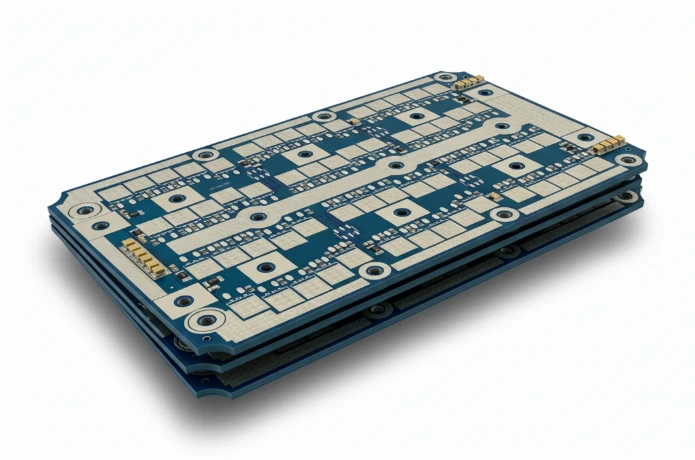
An HPA PCB (High Power Amplifier PCB) is a printed circuit board or PCB assembly designed to support a high-power RF or microwave amplifier. It carries RF matching networks, bias circuits, grounding structures, power distribution, control interfaces, and the thermal path connecting the amplifier device to the cooling system.
A successful HPA PCB design must solve two problems at the same time:
- Preserve the approved RF electrical behavior.
- Move heat away from the active device under real operating conditions.
A low-loss laminate alone does not guarantee RF performance. A thick copper layer alone does not guarantee thermal reliability. The final product depends on the complete electrical, mechanical, thermal, fabrication, assembly, and test system.
Key HPA PCB design decisions
- Define the operating band, output power, modulation, duty cycle, device package, and cooling environment before selecting PCB materials.
- Preserve approved matching-network geometry; internal device impedances are often not 50 ohms.
- Calculate heat from DC input power, RF output power, efficiency, waveform, and operating conditions.
- Select thermal structures from the device package and mechanical design rather than generic via-count rules.
- Freeze stack-up, impedance assumptions, RF geometry, assembly process, and acceptance testing before production.
Table of Contents
- What is an HPA PCB?
- How do engineers choose an HPA PCB architecture?
- Which PCB materials are suitable for RF power amplifiers?
- How are RF matching, grounding, and stability protected?
- How is the HPA thermal path designed?
- What manufacturing controls should an HPA PCB supplier provide?
- What RF tests validate an HPA PCB assembly?
- HPA PCB failure modes
- HPA PCB supplier RFQ checklist
- FAQ
What is an HPA PCB?
An RF power amplifier PCB supports systems such as radar transmitters, satellite terminals, telecom infrastructure, industrial RF sources, and solid-state amplifier modules.
Unlike an audio power board, an RF HPA PCB is part of the amplifier circuit. The transmission lines, matching structures, bias networks, grounding, package mounting, shielding, and thermal interfaces all influence performance.
| HPA design input | Why the PCB supplier needs it |
|---|---|
| Operating frequency and modulation | Defines RF loss, dispersion, matching sensitivity, and test requirements |
| Output power and duty cycle | Determines thermal load, copper requirements, and validation conditions |
| Device package | Defines mounting, grounding, and heat-transfer method |
| Reference layout or EM model | Identifies geometry that cannot change without RF review |
| Bias and sequencing requirements | Controls power routing, decoupling, and stability |
| Cooling interface | Defines chassis, heat sink, TIM, and mechanical requirements |
For related frequency-conversion designs, see the upconverter PCB guide.
How do engineers choose an HPA PCB architecture?
The correct architecture depends on the amplifier device, power density, operating frequency, and mechanical cooling strategy.
| Architecture | Best fit | Main production considerations |
|---|---|---|
| RF laminate board on metal chassis | RF and thermal functions share one assembly | Control stack-up, chassis contact, RF geometry, and mounting |
| Hybrid RF/FR-4 multilayer | RF sections need low-loss material while control uses standard routing | Control lamination compatibility and registration |
| Separate RF and control boards | Simplifies RF layout and digital integration | Validate connectors, grounding, and transitions |
| Copper coin or spreader | High heat density near device package | Control height, bond, flatness, and inspection |
| Flange-mounted transistor | Device transfers heat directly to carrier or chassis | Control machining, torque, contact, and RF launch |
A thermal via array, metal coin, or specialized substrate should be selected only after reviewing the complete junction-to-cooling path.
Which PCB materials are suitable for RF power amplifiers?
Material selection should consider:
- operating frequency
- RF loss budget
- dielectric constant stability
- dielectric thickness tolerance
- copper profile
- thermal behavior
- CTE
- fabrication availability
- assembly compatibility
| Material property | Engineering decision |
|---|---|
| Dk | Match simulation assumptions with the actual construction |
| Df | Confirm dielectric loss at the operating frequency |
| Thickness | Control impedance and phase response |
| Copper profile | Consider conductor loss and RF model accuracy |
| Thermal conductivity | Evaluate the complete heat path, not only laminate data |
| CTE | Review package stress and temperature cycling |
High Tg and thermal conductivity describe different properties. A high-Tg material is not automatically a high-thermal-performance material.
For additional fabrication considerations, see the high-frequency PCB fabrication guide.
How are RF matching, grounding, and stability protected?
The finished PCB must reproduce the electrical behavior of the approved design.
Small changes in:
- trace width
- dielectric thickness
- copper roughness
- via placement
- solder mask
- component position
- package grounding
- connector launch
can change gain, efficiency, harmonic behavior, and device stress.
RF geometry control
Specify controlled regions from the RF model and maintain:
- approved stack-up
- finished dielectric thickness
- copper construction
- transmission-line geometry
- connector transitions
- matching-component locations
The external port may be 50 ohms while the transistor matching network is not.
Grounding and bias stability
Ground structures must support the intended current return paths, RF fields, shielding, and package connection.
Bias networks require:
- correct sequencing
- stable decoupling
- supply isolation
- broadband stability review
An RF layout change made during fabrication requires engineering review because copper edits can alter amplifier behavior.
How is the HPA thermal path designed?
Thermal design begins with dissipated power:
Heat ≈ DC input power − delivered RF output power
The calculation must include efficiency, waveform, duty cycle, mismatch, ambient conditions, and transient operation.
The thermal path should be reviewed from:
- Semiconductor junction
- Package case, flange, or exposed pad
- PCB structure or carrier
- TIM and mechanical contact
- Heat sink, chassis, or cooling system
| Thermal method | Typical application |
|---|---|
| Thermal vias | Device pads transferring heat into copper layers |
| Filled via-in-pad | High-density exposed-pad assemblies requiring flat surfaces |
| Copper coin | Local high-power thermal transfer |
| Direct flange mount | Packages designed for chassis cooling |
| Metal-backed construction | Systems requiring strong mechanical and thermal support |
Thermal design evidence should include the thermal model assumptions, assembly process, mechanical contact conditions, and measured temperature results.
What manufacturing controls should an HPA PCB supplier provide?
Production quality depends on controlling the construction used in the RF model.
| Manufacturing area | Required evidence |
|---|---|
| Material control | Approved laminate, lot records, storage conditions |
| Stack-up control | Released construction, thickness verification, cross-section |
| RF geometry | Trace measurement, impedance data, CAM control |
| Lamination | Press records, registration, material compatibility |
| Thermal structures | Via fill, coin dimensions, flatness, inspection |
| Mechanical interfaces | Datum control, cavity dimensions, machining reports |
An early RF PCB manufacturing review should include PCB, package, chassis, fixture, and test requirements.
What RF tests validate an HPA PCB assembly?
The correct test plan depends on the product requirement.
| Test | Purpose |
|---|---|
| Impedance coupon/TDR | Confirms controlled construction |
| VNA S-parameters | Measures RF transmission and reflection |
| Gain and output power | Confirms amplifier performance |
| Efficiency/PAE | Measures power conversion performance |
| Harmonic testing | Measures unwanted RF output |
| Stability testing | Evaluates oscillation and mismatch behavior |
| Thermal testing | Confirms operating temperature limits |
| X-ray or microsection | Reviews hidden structures |
| PIM testing | Applies where passive RF linearity is required |
A passing impedance coupon does not prove amplifier output power. A small-signal VNA result does not prove thermal reliability.
HPA PCB failure modes
| Symptom | Possible cause | Evidence |
|---|---|---|
| Output power below target | RF geometry shift, mismatch, assembly variation | S-parameters, layout comparison, production records |
| Excess heating | Poor thermal interface, mismatch, bias issue | Thermal data, assembly inspection, RF measurements |
| Oscillation | Grounding, bias, enclosure, or layout issue | Stability analysis, spectrum data, revision history |
| Frequency drift | Material variation or temperature effects | Material data, thermal sweep results |
| Device overheating | Void, poor contact, flatness issue | X-ray, mechanical records, thermal results |
| Lot variation | Uncontrolled material or process change | Traceability and change records |
What should be included in an HPA PCB supplier RFQ?
RF and electrical
- Frequency range
- Output power
- Modulation and duty cycle
- Gain and efficiency targets
- Device part number and package
- Approved RF layout
- Bias requirements
- Impedance requirements
PCB and mechanical
- Gerber or ODB++/IPC-2581
- Stack-up requirements
- Laminate and bondply
- Copper thickness
- RF geometry
- Thermal structures
- Chassis interface
- Connector drawings
Assembly and validation
- BOM and approved vendors
- Assembly process
- Thermal interface requirements
- RF test fixtures
- Calibration method
- Acceptance limits
- Traceability requirements
- Change-control process
Standards and responsibility boundary
Applicable references may include:
- IPC-6018 — Qualification and Performance Specification for High Frequency Printed Boards
- IPC-6012 — Qualification and Performance Specification for Rigid Printed Boards
- IPC-2221 — Generic Standard on Printed Board Design
- IPC-TM-650 — Test Methods Manual
- IPC-A-600 — Acceptability of Printed Boards
- IPC-A-610 — Acceptability of Electronic Assemblies
- J-STD-001 — Requirements for Soldered Electrical and Electronic Assemblies
PCB fabrication evidence does not replace product-level validation for RF performance, EMC, safety, environmental reliability, or system qualification.
FAQ
What is an HPA PCB?
An HPA PCB is a board assembly designed for a high-power RF amplifier, combining RF circuitry, bias networks, grounding, power delivery, and thermal management.
Is an HPA PCB the same as a normal RF PCB?
No. HPA boards add significant thermal, mechanical, and power-handling requirements.
Does every HPA PCB use 50-ohm traces?
No. External interfaces may be 50 ohms while internal transistor matching networks transform complex impedances.
Is a high thermal conductivity PCB material always required?
Not always. The correct solution depends on the full thermal path from device junction to cooling system.
Are thermal vias required?
Not in every design. The correct structure depends on package type, power density, and mechanical cooling method.
What should engineers request from an HPA PCB supplier?
Request material control, stack-up verification, RF fabrication controls, assembly evidence, RF test results, and traceability records.
Request an HPA PCB manufacturing review
Provide the RF layout, stack-up, materials, device package, thermal path, assembly requirements, testing plan, quantities, and change-control requirements.
APTPCB can review the submitted package for manufacturability and quotation against the released project specification.