
Inference Server PCB quick answer (30 seconds)
Designing and manufacturing an Inference Server PCB requires balancing high-speed signal integrity with intense thermal density. Unlike general-purpose compute boards, these PCBs must support sustained throughput for AI workloads without latency spikes caused by signal degradation or thermal throttling.
- Material Selection is Critical: Standard FR-4 is insufficient for PCIe Gen5/6 speeds. You must use ultra-low loss materials (e.g., Panasonic Megtron 6/7/8 or Isola Tachyon) to minimize insertion loss.
- Backdrilling is Mandatory: To reduce signal reflection in high-speed links (>25 Gbps), via stubs must be removed (backdrilled) to within 8-10 mils of the signal layer.
- Heavy Copper for Power Delivery: Inference accelerators draw significant current. Power planes often require 2oz or 3oz copper to minimize IR drop and manage heat spreading.
- Strict Impedance Control: Differential pairs usually require 85Ω or 100Ω ±5% tolerance. Deviations cause jitter and data packet loss in AI processing streams.
- Thermal Management Strategy: High-density layouts in 1U or 2U chassis formats often require copper coin embedding or VIPPO (Via-in-Pad Plated Over) technology to dissipate heat from GPUs or ASICs.
- Layer Count and Stackup: Most inference server boards range from 12 to 24 layers to accommodate dense routing and isolate high-speed signals between ground planes.
When Inference Server PCB applies (and when it doesn’t)
Understanding the specific operational envelope of an Inference Server PCB ensures you don't over-engineer a simple controller or under-spec a mission-critical AI node.
When to use Inference Server PCB standards:
- AI/ML Edge Deployment: You are building servers meant to run pre-trained models (inference) for video analytics, natural language processing, or autonomous driving data processing.
- High-Speed Accelerator Integration: The board must host or connect to multiple PCIe-based accelerators (GPUs, TPUs, FPGAs) requiring PCIe Gen5 or CXL interfaces.
- Dense Compute Nodes: You are designing 1U Server PCB or 2U Server PCB form factors where airflow is restricted, and PCB thermal conductivity is a primary cooling path.
- Low-Latency Requirements: The application demands real-time processing where signal jitter or power integrity noise could cause unacceptable latency (e.g., financial trading or safety systems).
- ARM-Based Architectures: You are utilizing high-core-count ARM Server PCB designs (like Ampere Altra) which require specific power delivery network (PDN) impedances.
When standard PCB rules apply instead:
- General Purpose Web Hosting: Standard commodity servers running basic web traffic do not require the expensive low-loss materials needed for AI inference.
- IoT Sensor Nodes: Low-speed data collection devices do not need impedance-controlled high-layer-count boards.
- Massive Model Training Clusters: While similar, "Training" servers often have even higher power densities (kilowatts per board) and different interconnect topologies (NVLink/Infinity Fabric) compared to standard inference nodes.
- Legacy Industrial Controllers: Systems running on sub-1GHz frequencies or standard Ethernet speeds do not need backdrilling or ultra-smooth copper foil.
Inference Server PCB rules and specifications (key parameters and limits)
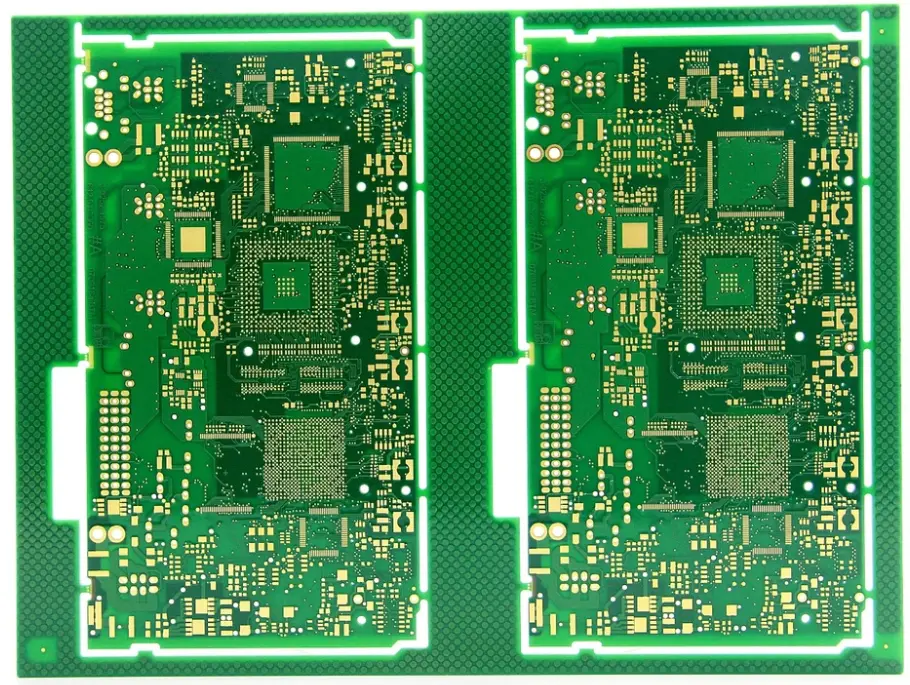
The following table outlines the non-negotiable manufacturing parameters for a high-reliability Inference Server PCB. APTPCB (APTPCB PCB Factory) uses these baselines to ensure boards meet IPC-6012 Class 3 performance levels.
| Rule Category | Recommended Value / Range | Why it matters | How to verify | If ignored (Failure Mode) |
|---|---|---|---|---|
| Base Material | Low Loss / Ultra-Low Loss (Df < 0.005 @ 10GHz) | Prevents signal attenuation over long traces typical in server boards. | IPC-TM-650 test method; check material datasheet (e.g., Megtron 7). | Massive data packet loss; system fails to link up at Gen5 speeds. |
| Layer Count | 12 – 24 Layers | Provides sufficient routing channels and ground shielding for high-speed lanes. | Stackup diagram review; Cross-section analysis (microsection). | Excessive crosstalk; inability to route all signals; EMI failures. |
| Copper Foil Roughness | HVLP (Hyper Very Low Profile) or VLP-2 | Rough copper acts like a resistor at high frequencies (skin effect), increasing loss. | SEM (Scanning Electron Microscope) inspection of foil surface. | Increased insertion loss; signal integrity degradation at >10GHz. |
| Impedance Tolerance | ±5% (Target 85Ω or 100Ω) | Matches driver/receiver impedance to prevent signal reflections. | TDR (Time Domain Reflectometry) coupons on production panel. | Signal reflection (ringing); reduced eye diagram opening; data errors. |
| Backdrilling Depth | Stub length < 10 mils (0.25mm) | Long via stubs act as antennas/capacitors, causing resonance and signal notches. | X-Ray inspection; Cross-section analysis. | "Bit Error Rate" spikes; specific frequencies are completely blocked. |
| Aspect Ratio (Drill) | 10:1 to 12:1 (Standard); up to 16:1 (Advanced) | Ensures plating solution can penetrate and plate the via barrel reliably. | Microsection analysis of plating thickness in center of via. | Open circuits in vias (barrel cracks) during thermal cycling. |
| Plating Thickness | > 25µm (1 mil) average in hole | Provides mechanical strength to withstand thermal expansion of thick boards. | CMI or Cross-section measurement. | Corner cracking or barrel fatigue leading to intermittent failures. |
| Solder Mask Dam | Min 3-4 mils (0.075-0.1mm) | Prevents solder bridging between fine-pitch BGA pads. | AOI (Automated Optical Inspection). | Short circuits under expensive BGA components (GPUs/CPUs). |
| Warpage / Bow & Twist | < 0.5% (IPC Class 3 target) | Large server boards (E-ATX) must remain flat for BGA assembly. | Shadow Moiré measurement tool. | BGA open joints (head-in-pillow defects); assembly failure. |
| Glass Transition (Tg) | High Tg (> 170°C) | Prevents material softening and Z-axis expansion during reflow and operation. | DSC (Differential Scanning Calorimetry). | Pad cratering; delamination during assembly or high-load operation. |
| CAF Resistance | Anti-CAF Materials Required | High voltage bias in server power layers can cause conductive filament growth. | SIR (Surface Insulation Resistance) testing; CAF test coupons. | Catastrophic short circuits developing months after deployment. |
| Via-in-Pad | VIPPO (Plated Over) for BGAs | Allows routing out of fine-pitch BGAs (0.8mm or less) without dog-bone traces. | Visual inspection; Cross-section. | Solder voids in BGA joints if not capped/plated correctly. |
Inference Server PCB implementation steps (process checkpoints)
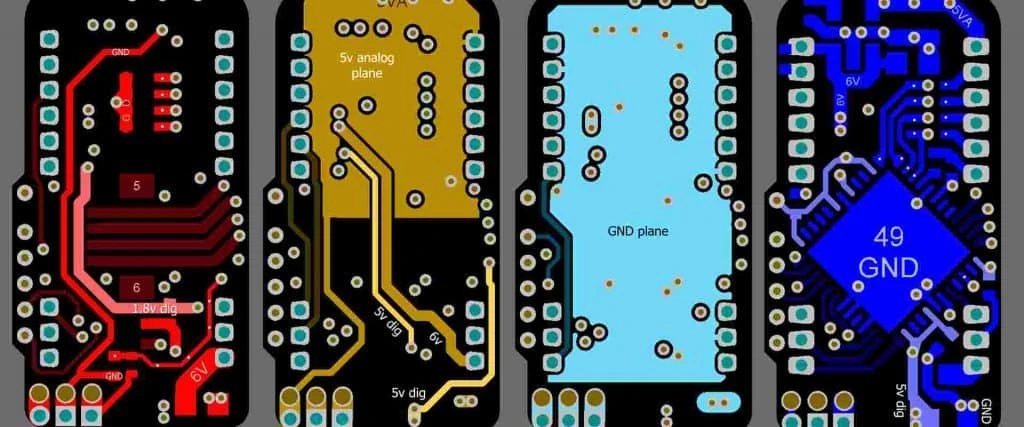
Moving from a schematic to a physical Inference Server PCB requires a disciplined workflow. Each step below includes a specific action and an acceptance check to prevent costly respins.
Stackup Definition & Material Selection
- Action: Define the layer stack (e.g., 16 layers) using a High-Speed PCB material library. Balance copper weight (power) with dielectric thickness (impedance).
- Parameter: Ensure symmetry to prevent warpage. Select prepreg glass styles (e.g., 1035, 1078) to minimize fiber weave effect.
- Check: Run an impedance solver simulation. Confirm line widths are manufacturable (e.g., >3.5 mils).
Floorplanning & Thermal Simulation
- Action: Place high-power components (CPUs, Accelerators, VRMs) to optimize airflow in the 1U/2U chassis.
- Parameter: Keep high-speed transceivers close to edge connectors or backplane interfaces to shorten trace lengths.
- Check: Perform a preliminary thermal simulation. Ensure hot spots do not overlap.
Power Integrity (PI) Analysis
- Action: Design the Power Delivery Network (PDN) to handle high transient currents (di/dt) typical of AI workloads.
- Parameter: Target PDN impedance below 10 mΩ up to 100 MHz.
- Check: Verify DC IR drop is <2% on all major rails.
High-Speed Routing & Backdrill Definition
- Action: Route PCIe Gen5/6 and DDR5 lanes first. Assign specific layers to minimize via transitions.
- Parameter: Mark all high-speed vias for backdrilling. Define the "must-not-cut" layers clearly in the design files.
- Check: Run Signal Integrity (SI) simulation (channel operating margin).
DFM (Design for Manufacturing) Review
- Action: Submit Gerber files to APTPCB for a comprehensive DFM check before fabrication.
- Parameter: Check minimum annular rings, aspect ratios, and clearance on internal power planes.
- Check: Confirm backdrill depth tolerances are achievable (usually ±5 mils).
Fabrication: Lamination & Drilling
- Action: Manufacturer performs sequential lamination (if HDI) or standard lamination.
- Parameter: Control press cycle temperature to ensure full resin cure without voids.
- Check: X-ray verification of layer registration (drill-to-copper alignment).
Fabrication: Plating & Surface Finish
- Action: Apply copper plating followed by surface finish (ENIG, Immersion Silver, or ENEPIG).
- Parameter: Ensure hole wall copper thickness meets Class 3 (>25µm).
- Check: Cross-section analysis of a test coupon to verify plating integrity.
Electrical Testing (BBT & TDR)
- Action: 100% Netlist testing (Flying Probe or Bed of Nails) and Impedance testing.
- Parameter: TDR coupons must pass within ±5% or ±10% as specified.
- Check: Certificate of Conformance (CoC) showing TDR pass results.
Inference Server PCB troubleshooting (failure modes and fixes)
When an Inference Server PCB fails, it is often due to subtle signal integrity issues or thermal stress rather than simple open circuits. Use this guide to diagnose root causes.
Symptom 1: High Bit Error Rate (BER) on PCIe Links
- Possible Causes:
- Incorrect backdrilling depth (stub left too long).
- Fiber weave effect (skew between differential pair legs).
- Impedance mismatch due to over-etching.
- Checks: TDR analysis of the failing link; Cross-section of the via stub; VNA measurement of insertion loss.
- Fix: Respin with tighter backdrill tolerance or use "Zig-Zag" routing (10-degree angle) to mitigate fiber weave effect.
- Prevention: Specify "Spread Glass" or mechanically spread fabric in the material notes.
Symptom 2: Intermittent System Crashes Under Load
- Possible Causes:
- Power Integrity failure (voltage droop) causing CPU/GPU instability.
- Thermal shutdown due to poor heat transfer through the PCB.
- Checks: Measure voltage ripple at the load capacitors with an oscilloscope; Check thermal camera images for hotspots.
- Fix: Add decoupling capacitors; Increase copper weight on power planes; Use Heavy Copper PCB technology.
- Prevention: Perform rigorous PI simulation (DC Drop and AC Impedance) during design.
Symptom 3: BGA Pad Cratering or Joint Fracture
- Possible Causes:
- CTE mismatch between the large BGA package and the PCB material.
- Excessive board flexure during assembly or installation.
- Checks: Dye-and-pry test; Microsectioning of the fractured joint.
- Fix: Use a higher Tg material with lower Z-axis CTE; Add corner glue/underfill to BGAs.
- Prevention: Ensure stackup symmetry to reduce warpage; Use resin-filled vias (VIPPO) for better mechanical support.
Symptom 4: Conductive Anodic Filament (CAF) Shorts
- Possible Causes:
- Moisture ingress into the glass bundles combined with high voltage bias.
- Poor drilling quality (micro-cracks in resin).
- Checks: Insulation resistance testing; Microsection showing copper growth along glass fibers.
- Fix: Scrapped boards cannot be fixed. New production must use Anti-CAF materials.
- Prevention: Specify "Anti-CAF" or "CAF Resistant" grade laminate (e.g., Isola 370HR or Megtron series).
Symptom 5: Delamination after Reflow
- Possible Causes:
- Moisture trapped in the PCB (popcorning).
- Incompatible resin systems in hybrid stackups.
- Checks: Visual inspection for blistering; Scanning Acoustic Microscopy (SAM).
- Fix: Bake boards before assembly (120°C for 4-6 hours).
- Prevention: Store PCBs in vacuum-sealed bags with humidity indicator cards; Follow MSL guidelines.
How to choose Inference Server PCB (design decisions and trade-offs)
Choosing the right specification for an Inference Server PCB involves navigating trade-offs between performance, thermal capacity, and cost.
1. Material: Mid-Loss vs. Ultra-Low Loss
- Mid-Loss (e.g., Isola 370HR): Acceptable for PCIe Gen3 or short Gen4 traces. Lower cost, easier to process.
- Ultra-Low Loss (e.g., Megtron 7, Tachyon): Mandatory for PCIe Gen5/6 and long traces (>10 inches). Significantly more expensive and requires specialized lamination parameters.
- Decision: If your inference server uses Gen5 accelerators, you must use low-loss materials. Do not compromise here.
2. Form Factor: 1U vs. 2U/4U
- 1U Server PCB: Extremely space-constrained. Requires horizontal memory slots and optimized airflow channels. Thermal management relies heavily on the PCB spreading heat to the chassis.
- 2U/4U Server PCB: Allows for vertical riser cards and larger heatsinks. The PCB layout can be slightly less dense, but the sheer size of the board (often E-ATX or custom) introduces warpage challenges.
- Decision: 1U designs often require HDI (High Density Interconnect) to fit routing, increasing board cost but saving rack space.
3. Through-Hole vs. HDI (High Density Interconnect)
- Through-Hole: Standard multilayer boards. Cheaper, but limits routing density under large BGAs.
- HDI (Microvias): Uses laser-drilled blind and buried vias. Essential for routing 0.65mm or smaller pitch BGAs found in modern AI chips.
- Decision: Most high-end AI Server PCB designs now require at least Type 3 HDI (stacked microvias) to break out the high-speed signals from the main processor.
4. Surface Finish: ENIG vs. Immersion Silver vs. OSP
- ENIG: Excellent shelf life and flat surface. Good for most applications but can suffer from "Black Pad" if not controlled.
- Immersion Silver: Better for very high-frequency signals (no nickel skin effect). Common in supercomputer/server boards.
- OSP: Cheapest, but shortest shelf life. Rarely used for high-reliability server boards.
- Decision: Choose Immersion Silver for top-tier signal integrity; choose ENIG for general reliability and shelf life.
Inference Server PCB FAQ (cost, lead time, common defects, acceptance criteria, Design for Manufacturability (DFM) files)
Q: What is the typical layer count for an AI Inference Server PCB? A: Most inference server boards fall between 12 and 24 layers.
- 12-16 Layers: Common for single-socket edge inference servers.
- 18-24 Layers: Required for dual-socket data center servers with multiple accelerator cards to manage the routing density and power planes.
Q: How does backdrilling affect the cost of the PCB? A: Backdrilling increases cost by 10-20% depending on the number of drill hits.
- It adds a secondary CNC drilling process.
- It requires specialized inspection (X-ray) to verify depth control.
- However, it is cheaper than adding more layers to avoid stubs.
Q: Can I use FR-4 for a PCIe Gen5 Inference Server? A: Generally, no. Standard FR-4 has a Dissipation Factor (Df) that is too high (~0.02), causing excessive signal loss at 16-32 GHz.
- You need materials with Df < 0.005 (e.g., Megtron 6/7).
- Using FR-4 will likely result in a channel that fails compliance testing.
Q: What are the acceptance criteria for Class 3 Server PCBs? A: IPC-6012 Class 3 "High Reliability" is the standard.
- Annular Ring: No breakout allowed (tangency is not acceptable).
- Plating: Minimum 25µm average in holes.
- Visual: No exposed copper, no blistering, strict solder mask registration.
- Reliability: Must pass thermal stress tests without delamination.
Q: What files do I need to send for a DFM review? A: To get an accurate quote and DFM, send:
- Gerber Files (RS-274X): All copper layers, solder mask, silkscreen, drill files.
- IPC-356 Netlist: Critical for verifying electrical connectivity against the graphics.
- Fab Drawing: Specifying material, stackup, impedance tables, and drill chart.
- Readme: Noting special requirements like "Backdrill layers X to Y" or "Press-fit connector holes."
Q: How do you handle thermal management for 1000W+ AI servers? A: We use several techniques:
- Heavy Copper: 2oz or 3oz inner layers for power distribution.
- Thermal Vias: Dense arrays of vias under hot components to transfer heat to inner planes.
- Embedded Coins: Inserting a solid copper coin directly into the PCB under the GPU/CPU (advanced capability).
Q: What is the lead time for manufacturing Inference Server PCBs? A: Lead times are longer than standard boards due to material availability and complexity.
- Standard: 15-20 working days.
- Quick Turn: 8-12 working days (if material is in stock).
- Note: High-speed materials (Megtron, Tachyon) may have their own procurement lead times of 2-4 weeks if not stocked.
Q: Why is impedance control so critical for these boards? A: At high speeds, the PCB trace acts as a transmission line.
- If the impedance changes (e.g., trace width varies), part of the signal reflects back.
- This reflection causes noise (jitter) and closes the "eye diagram," making 0s and 1s indistinguishable.
Q: Do you support press-fit connectors for server backplanes? A: Yes, press-fit connectors are standard for server I/O.
- Hole tolerance is extremely tight (e.g., ±0.05mm).
- We control the finished hole size (FHS) strictly to ensure proper pin retention without damaging the barrel.
Q: What is the difference between "Core" and "Foil" construction in stackups? A: This affects cost and registration.
- Core Construction: Uses cured laminate cores. Better dimensional stability.
- Foil Construction: Uses more prepreg. Can be cheaper but may have more movement during lamination.
- Recommendation: For high-layer server boards, we recommend specific core constructions to minimize warpage.
Resources for Inference Server PCB (related pages and tools)
To further assist in your design and procurement process, APTPCB provides detailed guides on related technologies:
- Server Data Center PCB: Overview of our capabilities for the broader data center market.
- High Speed PCB: Deep dive into signal integrity, materials, and design rules.
- Multilayer PCB: Understanding stackups, lamination, and registration for high-layer counts.
- Megtron PCB: Specifics on the Panasonic material family essential for AI servers.
- Backplane PCB: For designs involving large passive interconnect boards.
- HDI PCB: If your inference server requires microvias for dense BGA routing.
Inference Server PCB glossary (key terms)
| Term | Definition | Context in Inference Server PCB |
|---|---|---|
| PCIe Gen5 | Peripheral Component Interconnect Express, Generation 5. | The standard interface for connecting AI accelerators, running at 32 GT/s. Requires ultra-low loss PCB. |
| Insertion Loss | The loss of signal power as it travels down a trace. | Measured in dB/inch. Must be minimized to ensure signals reach the receiver intact. |
| Backdrilling | Controlled depth drilling to remove the unused portion of a plated through-hole (stub). | Essential for reducing signal reflection in high-speed vias (>10 Gbps). |
| Df (Dissipation Factor) | A measure of how much energy is absorbed by the insulating material. | Lower is better. Standard FR4 is ~0.02; Server grade is <0.005. |
| Dk (Dielectric Constant) | A measure of the material's ability to store electrical energy. | Affects signal propagation speed and impedance. Stable Dk is crucial. |
| PAM4 | Pulse Amplitude Modulation 4-level. | A coding scheme used in high-speed links (like PCIe Gen6/Ethernet) that is very sensitive to noise. |
| CTE (Coefficient of Thermal Expansion) | How much the material expands when heated. | Mismatch between PCB and components causes solder joint cracks. |
| Tg (Glass Transition Temperature) | The temperature at which the PCB resin turns from hard to soft. | Server boards need High Tg (>170°C) to survive assembly and heat. |
| VIPPO | Via-in-Pad Plated Over. | A technology where vias are placed in pads, filled with resin, and plated over. Used for dense BGAs. |
| Fiber Weave Effect | Signal skew caused by the glass fiber pattern in the PCB laminate. | Can cause timing errors in differential pairs. Mitigated by "Zig-Zag" routing or spread glass. |
| Impedance Control | Manufacturing process to ensure trace resistance matches design (e.g., 85Ω). | Critical for preventing signal reflection. |
| Press-Fit | A solderless connection method using compliant pins pushed into PCB holes. | Standard for server connectors (RJ45, cages) to avoid thermal stress of soldering. |
Request a quote for Inference Server PCB (Design for Manufacturability (DFM) review + pricing)
Ready to move your Inference Server PCB from design to production? APTPCB specializes in high-layer, high-speed server boards with strict Class 3 compliance.
Send us your data for a comprehensive DFM review:
- Gerber Files: Complete set including drill files.
- Stackup Diagram: Specifying material type (e.g., Megtron 7) and layer order.
- Drill Drawing: Clearly marking backdrill locations and depths.
- Impedance Requirements: Target values and specific layers.
- Volume & Lead Time: Prototype quantity vs. mass production targets.
Conclusion (next steps)
Successfully manufacturing an Inference Server PCB is a feat of precision engineering, requiring a perfect synchronization of low-loss materials, controlled depth drilling, and rigorous impedance testing. Whether you are building a compact 1U Server PCB for edge analytics or a massive AI Server PCB for the data center, the difference between success and failure often lies in the manufacturing details. By adhering to strict design rules and partnering with a capable fabricator, you ensure your hardware delivers the low latency and high throughput required for modern AI workloads.