
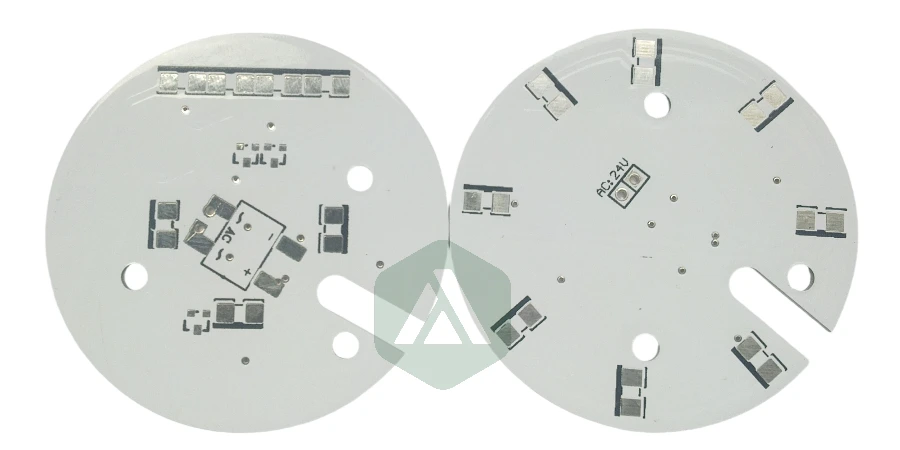
High-power LED designs succeed or fail based on thermal control.
A 1W, 5W, 10W or higher-power LED does not only require the correct driver and optical design. The PCB becomes part of the thermal system. Heat generated at the LED junction must travel through the package, solder joint, copper layer, dielectric layer, metal core, thermal interface material and finally into the housing or heatsink.
A well-designed LED MCPCB keeps junction temperature under control, improves lumen maintenance, reduces color shift and extends operating life. A poorly selected board material can create hotspots even when the LED, driver and heatsink appear correctly specified.
Metal core PCBs (MCPCB), especially aluminum PCBs for LED applications, are widely used because they provide a controlled thermal path that standard FR-4 cannot deliver.
At APTPCB, we design and manufacture metal core PCBs and high-thermal PCB solutions for LED, automotive, industrial and UV applications. This guide explains the engineering decisions behind reliable LED MCPCB selection. For aluminum-board basics (what an aluminum PCB is, standard stack-ups, and common uses), see the aluminum PCB guide; for very high-power modules, the high power LED PCB guide covers thermal budgets and substrate escalation.
How do I choose the right LED MCPCB for a high-power LED module?
The correct LED MCPCB depends on the complete thermal system, not only LED wattage.
The main design inputs are:
- LED package type and power density
- Maximum allowed junction temperature
- Ambient operating temperature
- Heatsink or housing design
- Electrical isolation requirements
- Mechanical constraints
- Required product lifetime
The PCB decision should start with the heat path:
LED junction → package → solder joint → copper → dielectric → metal core → heatsink → ambient
Every layer contributes thermal resistance. In many LED MCPCB designs, the dielectric layer is the largest PCB-level thermal bottleneck because it must provide both electrical insulation and thermal conduction.
LED MCPCB material selection matrix: aluminum, copper and dielectric options
Engineers selecting an MCPCB usually balance thermal performance, cost, weight and manufacturing complexity.
| Design requirement | Recommended solution | Reason |
|---|---|---|
| General LED lighting modules | Aluminum MCPCB | Best balance of thermal performance, weight and cost |
| High-density LED arrays | High-thermal aluminum MCPCB | Improves heat spreading and reduces hotspots |
| Extreme power density or compact thermal paths | Copper core MCPCB or copper inlay | Provides higher thermal conductivity |
| High-voltage LED systems | Thicker dielectric system | Improves electrical insulation margin |
| Automotive or industrial environments | Controlled thermal dielectric + robust mechanical design | Supports temperature cycling and reliability requirements |
Aluminum remains the most common metal core because it provides good heat spreading with lower cost and weight. Aluminum cores typically provide approximately 180–220 W/m·K thermal conductivity, while copper provides higher conductivity but increases material cost and mass.
What is the standard LED MCPCB stack-up and heat path?
Most LED aluminum PCBs use a three-layer construction:
1. Copper circuit layer
Typical thickness:
- 1 oz copper: approximately 35 μm
- 2 oz copper: approximately 70 μm
- 3 oz copper: approximately 105 μm
The copper layer provides electrical routing and lateral heat spreading.
For high-power LEDs, copper area around the thermal pad directly affects temperature distribution. Larger copper spreading areas help reduce local temperature concentration before heat moves through the dielectric.
2. Thermally conductive dielectric layer
The dielectric layer provides electrical isolation between copper and metal core while transferring heat.
Typical characteristics:
- Thickness: approximately 50–150 μm
- Thermal conductivity: approximately 1–8 W/m·K depending on material grade
A thinner, higher-conductivity dielectric generally lowers thermal resistance, but the design must still meet voltage isolation and reliability requirements.
3. Metal core
Common choices:
- Aluminum: 1.0–3.0 mm thickness for most applications
- Copper: used for extreme thermal requirements
The metal core spreads heat across the board and transfers it into the external cooling structure.
What dielectric thermal conductivity should an LED MCPCB use?
The dielectric specification is one of the most important MCPCB decisions.
A basic comparison:
| Material type | Typical thermal conductivity | Typical use |
|---|---|---|
| Standard FR-4 | ~0.2–0.5 W/m·K | Low-power electronics |
| Standard MCPCB dielectric | ~1–2 W/m·K | General LED lighting |
| High-thermal dielectric | ~3–8+ W/m·K | High-power LED, compact thermal designs |
Higher thermal conductivity is not automatically the correct choice. The correct dielectric depends on:
- LED heat flux
- Board area
- Required lifetime
- Electrical insulation requirements
- Cost target
For example, a compact 50W LED module with limited heatsink area may justify a higher thermal dielectric, while a larger low-cost lighting panel may perform well with a standard aluminum MCPCB.
For high-thermal applications, APTPCB provides high-thermal PCB solutions designed around heat-flow requirements. Available dielectric grades and base thicknesses are listed under metal core PCB material capabilities.
What are the most important LED MCPCB design parameters?
Copper weight and LED pad design
The copper layer performs two functions:
- Electrical current carrying.
- Initial lateral heat spreading.
Important considerations include:
- Copper weight.
- Thermal pad geometry.
- Copper area around LED packages.
- Trace width for current requirements.
- Solder void control.
Large thermal pads improve heat transfer into the copper layer, but assembly quality remains critical. Excessive solder voids increase thermal resistance.
Metal core thickness
A thicker aluminum core improves:
- Mechanical stiffness.
- Heat spreading capacity.
- Mounting stability.
However, increasing core thickness has diminishing thermal returns if the main bottleneck remains the dielectric or heatsink interface.
Surface finish and solder mask
LED MCPCBs often use white solder mask because of optical reflectivity advantages in lighting applications.
Surface finish selection depends on:
- Assembly process.
- Reliability requirements.
- Cost.
- Storage requirements.
Common finishes include ENIG and OSP.
LED MCPCB failure analysis: symptoms, causes and design checks
| Field symptom | Possible PCB-related cause | Design check |
|---|---|---|
| LED brightness drops over time | Excessive junction temperature | Review thermal path and dielectric selection |
| Hotspots under individual LEDs | Poor copper spreading or uneven thermal transfer | Inspect pad design and copper distribution |
| Prototype passes but fails reliability testing | Insufficient thermal margin | Validate at maximum ambient conditions |
| LED color shifts during operation | Junction temperature instability | Measure thermal performance under load |
| Heatsink improvements produce little benefit | PCB is limiting heat transfer | Review dielectric thickness and conductivity |
Thermal problems are often caused by the weakest part of the complete path. A larger heatsink cannot fully compensate for a PCB structure that restricts heat flow before the heat reaches the mechanical system.
When should you use advanced LED MCPCB structures?
Standard single-layer aluminum MCPCB designs work for many lighting products. More demanding applications may require specialized structures.
Multilayer MCPCB
Used when the LED module also requires:
- Additional routing density.
- Integrated controls.
- Compact mechanical layouts.
Because additional layers increase thermal distance, stack-up design must balance routing requirements with heat transfer.
Multilayer MCPCB construction is a metal-core build, so confirm layer count, dielectric, and base options against the metal core capability data above rather than a standard FR-4 multilayer route.
Copper coin and copper inlay structures
For extreme hotspots, embedded copper structures create a lower thermal resistance path directly below the heat source.
Applications include:
- High-power LEDs.
- UV LEDs.
- Specialized industrial lighting.
Hybrid MCPCB and FR-4 designs
A common architecture separates functions:
- MCPCB handles LED thermal management.
- FR-4 handles control electronics.
This approach allows thermal optimization without forcing all electronics onto a metal core.
How are reliable LED MCPCBs manufactured?
LED MCPCB performance depends on manufacturing consistency as much as material selection.
Important production controls include:
- Controlled dielectric lamination.
- Uniform dielectric thickness.
- Copper etching accuracy.
- Metal core flatness.
- Drilling and routing control.
- Surface finish consistency.
APTPCB applies its standard PCB fabrication process with adaptations for metal core manufacturing.
For complete LED modules requiring assembly, turnkey PCB assembly can combine PCB production, component placement and module integration.
How should engineers evaluate an LED MCPCB supplier?
Before releasing a design, request these details from the manufacturer:
| Supplier information | Why it matters |
|---|---|
| Dielectric thermal conductivity value | Determines thermal resistance |
| Dielectric thickness | Affects heat transfer and insulation |
| Aluminum or copper core specification | Defines spreading performance |
| Copper weight capability | Supports current and heat spreading |
| Flatness capability | Ensures heatsink contact |
| Cross-section verification | Confirms layer quality |
| Thermal testing capability | Validates actual performance |
A supplier should be able to explain the complete thermal stack-up, not only quote a board thickness and material name.
How is LED MCPCB thermal performance tested?
Reliable validation combines material, board and application-level testing.
Common checks include:
- Thermal conductivity verification.
- Thermal resistance measurement.
- Dielectric breakdown testing.
- Insulation testing.
- Flatness inspection.
- Cross-section analysis.
- Thermal cycling.
- Burn-in testing.
Testing should reflect the final operating environment, including:
- Maximum ambient temperature.
- Actual LED drive current.
- Mounting method.
- Heatsink or enclosure design.
APTPCB supports LED thermal validation through its broader PCB quality processes.
What information should you provide when requesting an LED MCPCB design review?
A complete engineering review should include:
- LED model and power rating.
- Number of LEDs and arrangement.
- Board dimensions and shape.
- Target junction temperature.
- Maximum ambient temperature.
- Cooling method.
- Voltage and insulation requirements.
- Lifetime target.
- Certification requirements.
With this information, engineers can select:
- Aluminum vs copper core.
- Dielectric thermal grade.
- Copper thickness.
- Stack-up structure.
- Manufacturing process.
For high-power LED modules used in lighting, automotive, industrial, UV or display applications, the right LED MCPCB design turns thermal management from a reliability problem into a controlled engineering parameter.