
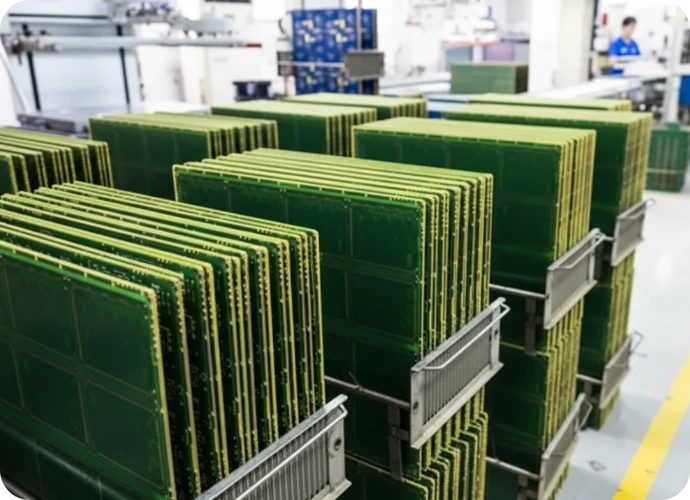
What is an LED Projector PCB and why does selection matter?
An LED Projector PCB combines high-current LED control, power conversion, video signal routing, and thermal management in a compact electronic system. Unlike general consumer PCBs, projector boards must maintain image quality while managing heat generated by high-power LEDs, switching regulators, processors, and optical engines.
A reliable design depends on balancing several engineering requirements:
- Thermal performance for LED brightness and lifetime
- Signal integrity for HDMI, DisplayPort, memory, and processor interfaces
- Mechanical accuracy for optical alignment
- Manufacturing capability for fine-pitch components and multilayer structures
- Long-term reliability under continuous operation
This guide helps hardware engineers, procurement teams, and product managers choose the correct PCB structure before production.
When does a projector need a specialized LED Projector PCB?
A specialized LED Projector PCB is typically required when the design includes:
- High brightness output: LED modules above approximately 20W create concentrated thermal loads requiring efficient heat spreading.
- 4K or 8K video processing: High-speed interfaces require controlled impedance and stable multilayer stackups.
- Compact projector designs: Portable and pico projectors often require HDI technology to fit processors, memory, drivers, and connectors into limited space.
- DLP optical engines: Fine-pitch BGA packages and strict alignment requirements increase PCB complexity.
- Commercial operation: Education, business, and industrial projectors may require thousands of operating hours with minimal degradation.
A simpler FR4 PCB may be suitable for low-lumen products, large enclosures, or basic 720p applications where thermal density and signal speed are limited.
How do you choose the right LED Projector PCB structure?
The correct PCB architecture depends on brightness, resolution, mechanical design, and reliability requirements.
| Design requirement | Recommended PCB approach | Key reason |
|---|---|---|
| High brightness LED engine | Aluminum or copper MCPCB | Provides a direct thermal path away from LED junctions |
| Compact 4K projector | 6–12 layer HDI PCB | Supports dense routing and controlled high-speed signals |
| Standard 1080p projector | 4-layer FR4 PCB | Balances cost and signal performance |
| DLP chipset integration | HDI with microvias | Supports fine-pitch BGA escape routing |
| Long service life | High-Tg FR4 or MCPCB | Improves thermal and mechanical reliability |
What materials and specifications should an LED Projector PCB use?
Thermal materials
High-power LED sections commonly use:
- Aluminum MCPCB (5052/6061) or copper core (C1100)
- Thermal conductivity targets around 2.0 W/mK to 5.0 W/mK
- Dielectric layer thickness typically 75µm to 100µm
- Dielectric breakdown strength above 3kV AC for isolation
Logic and processing sections generally use:
- High-Tg FR4 with Tg above 170°C
- Stable dielectric properties for high-speed routing
- Controlled expansion during thermal cycling
Copper weight and stackup
Typical requirements include:
- Power layers: 2oz to 4oz copper (70µm to 140µm)
- Signal layers: 0.5oz to 1oz copper (18µm to 35µm)
- Logic boards: commonly 6–12 layers for advanced projector systems
- LED boards: single-layer or 2-layer MCPCB structures
Signal integrity requirements
For high-resolution projector designs:
- HDMI/DisplayPort differential pairs: 100Ω ±10%
- USB differential pairs: 90Ω ±10%
- General high-speed single-ended routing: 50Ω ±10%
A controlled impedance stackup should be confirmed with fabrication drawings and test coupons.
Surface finish and solder mask
Common choices:
- ENIG for BGA packages and fine-pitch components because of its flat surface
- OSP for cost-sensitive LED sections where storage conditions are controlled
- High-reflectivity white solder mask for LED optical areas
- Green or black solder mask for logic boards
White LED-board solder masks should provide high reflectivity, commonly above 85%, while maintaining resistance to heat and UV exposure.
What are the major LED Projector PCB failure modes?
| Failure mode | Root cause | Engineering control |
|---|---|---|
| LED overheating | Poor thermal transfer or insufficient copper | Use MCPCB, heavy copper, and thermal simulations |
| Image artifacts | Impedance variation on HDMI/DP routes | Require controlled impedance and TDR testing |
| BGA cracking | Thermal expansion mismatch | Use High-Tg materials and appropriate assembly processes |
| Color shift | White mask degradation from heat or UV | Specify optical-grade white solder mask |
| PCB warping | Unbalanced copper or stackup stress | Maintain symmetrical stackup design |
| High-voltage failure | Insufficient isolation spacing | Verify creepage, clearance, and Hi-Pot testing |
| MCPCB delamination | Poor bonding or moisture control | Control lamination process and material handling |
| Microvia failures | Poor plating reliability | Validate HDI processes with reliability testing |
| Connector damage | Mechanical stress on solder joints | Add anchor tabs and mechanical support |
| EMI failures | Poor grounding and switching noise control | Optimize return paths and shielding |
How should LED Projector PCB validation be performed?
A production-ready board should pass electrical, thermal, mechanical, and reliability verification.
Thermal validation
Test method:
- Run the projector at maximum brightness for four hours.
- Measure LED pads, driver ICs, and hotspot temperatures.
Acceptance target:
- Temperature rise below 40°C above ambient.
- Components remain below rated junction temperatures.
Impedance testing
Test method:
- Measure high-speed differential pairs using TDR coupons.
Acceptance target:
- Controlled impedance within ±10% of design values.
Electrical safety testing
Test method:
- Perform Hi-Pot testing between isolated circuits.
Acceptance target:
- No breakdown, arcing, or excessive leakage.
Mechanical accuracy testing
Test method:
- Use CMM inspection for mounting holes and optical alignment features.
Acceptance target:
- Board outline tolerance approximately ±0.10mm.
- Hole position tolerance approximately ±0.075mm.
Reliability testing
Include:
- IST thermal cycling from -40°C to +125°C where applicable
- AOI inspection
- X-ray inspection for BGA/QFN packages
- Ionic cleanliness testing
- Solder mask adhesion testing
- Warpage measurement
Target bow and twist should remain below 0.75% across the board diagonal.
What should be included in an LED Projector PCB supplier RFQ?
A complete supplier package should include:
Manufacturing files
- Gerber RS-274X or X2 files
- Fabrication drawing
- Layer stackup requirements
- Drill chart
- Impedance requirements
- Surface finish requirements
- Assembly drawings if applicable
Performance requirements
- Material grade and Tg
- Thermal conductivity requirements
- Copper weight
- IPC class requirement
- Testing requirements
- Packaging requirements
Supplier capability checklist
| Capability | Qualification question |
|---|---|
| MCPCB manufacturing | Can the supplier provide aluminum/copper core samples? |
| HDI production | Can they manufacture blind/buried vias for DLP designs? |
| Signal testing | Do they provide TDR reports? |
| Quality control | Is AOI and electrical testing available? |
| Traceability | Can raw materials be traced by batch? |
| Reliability | Can they provide cross-section and test reports? |
How do you balance cost and performance for LED Projector PCB?
MCPCB vs FR4
Choose MCPCB when brightness and thermal reliability are primary concerns. High-power LED systems benefit from the shorter thermal path.
FR4 with thermal vias can be suitable for lower-power systems where cost and manufacturing simplicity are priorities.
4-layer PCB vs HDI PCB
Use HDI when:
- The projector requires compact packaging
- The design uses advanced processors or DLP chips
- High-speed routing density exceeds conventional layers
Use standard multilayer FR4 when:
- Space is available
- Resolution requirements are moderate
- Cost reduction is important
ENIG vs OSP
ENIG is preferred for:
- Fine-pitch BGA
- Long storage periods
- Higher assembly reliability
OSP may be selected for cost-sensitive high-volume applications.
LED Projector PCB FAQ
What is the main cost driver of an LED Projector PCB?
Material selection, layer count, HDI requirements, and testing requirements usually have the largest impact. HDI manufacturing with blind and buried vias can increase cost significantly compared with standard through-hole structures.
How long does LED Projector PCB manufacturing take?
Standard FR4 production may complete in approximately 5–7 days, while specialized MCPCB and HDI projector boards often require around 10–15 days depending on material availability and process complexity.
Can standard FR4 support HDR projector designs?
High-brightness HDR projector systems usually require improved thermal management. MCPCB, heavy copper designs, or advanced thermal via structures are commonly required.
What files are needed for a 4K Projector PCB quotation?
Provide Gerbers, fabrication drawings, impedance requirements, stackup information, material specifications, and volume forecasts.
Resources for LED Projector PCB
- Metal Core PCB Capabilities: Explore the thermal management solutions essential for high-brightness LED drivers.
- HDI PCB Technology: Learn how high-density interconnects enable compact 4K and 8K projector designs.
- High Tg PCB Materials: Understand why high glass transition temperature materials are critical for projector reliability.
- DFM Guidelines: Access design rules to ensure your projector board is manufacturable and cost-effective.
- High Thermal PCB Solutions: Deep dive into advanced thermal dissipation techniques for projection systems.
Request a quote for LED Projector PCB (Design for Manufacturability (DFM) review + pricing)
Ready to move from design to production? APTPCB provides DFM review and quotation support to identify thermal, material, and manufacturability issues before production.
Prepare:
- Gerber files
- Fabrication drawings
- Stackup requirements
- Thermal specifications
- Volume requirements
- Required validation tests
Click here to Request a Quote & DFM Review
Conclusion
Selecting an LED Projector PCB requires decisions across thermal design, signal integrity, manufacturing capability, and validation strategy. A board that supports brightness, resolution, and long operating life begins with the correct material system, stackup, supplier capability, and acceptance testing plan.
For portable DLP systems, 4K home projectors, and commercial HDR platforms, the right PCB partner helps convert complex electrical requirements into reliable production hardware.