
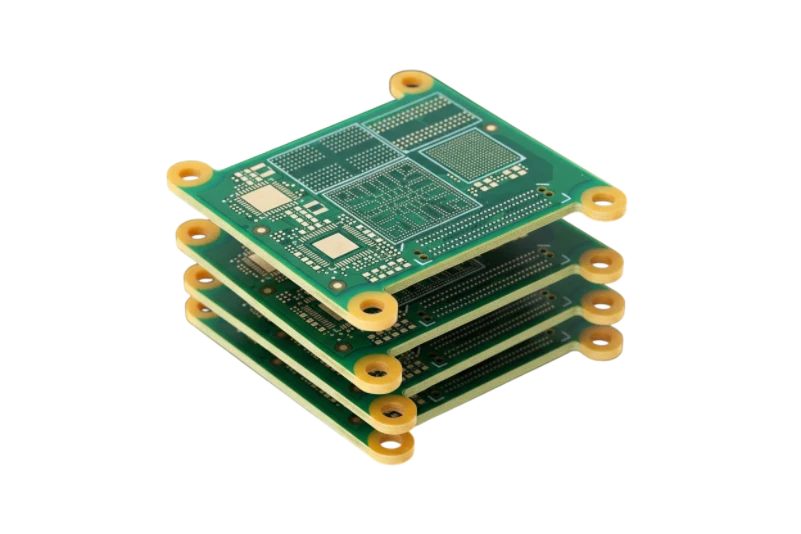
LiDAR interface board assembly converts a sensor design into a production-ready electronic module. The challenge is not only placing components correctly. A production supplier must preserve signal integrity, thermal performance, mechanical alignment, and reliability from prototype builds through volume manufacturing.
The right manufacturing partner must understand the interaction between:
- high-speed data interfaces such as Ethernet, LVDS, and MIPI;
- laser driver power switching;
- sensitive receiver electronics;
- thermal constraints around processors and power components;
- vibration and temperature requirements for automotive, robotics, and industrial systems.
The key supplier-selection question is:
Can this manufacturer provide the process control and evidence required to produce reliable LiDAR assemblies at production scale?
What makes LiDAR interface board assembly different from standard PCBA?
LiDAR boards combine demanding electrical and mechanical requirements in a compact form factor. Unlike many general-purpose PCB assemblies, LiDAR designs often require tighter control of impedance, thermal paths, and component placement.
| Decision area | LiDAR requirement | Manufacturing impact |
|---|---|---|
| Signal integrity | Controlled impedance for high-speed links | Stackup control, impedance coupons, TDR verification |
| Thermal performance | Heat concentration from processors, laser drivers, and power circuits | Thermal vias, copper structures, solder coverage control |
| Mechanical reliability | Resistance to vibration, temperature cycling, and connector stress | Assembly fixtures, inspection controls, mechanical validation |
| Optical module integration | Stable alignment between electronics and sensing components | Tight dimensional control and repeatable assembly processes |
A standard PCB assembler may support early prototypes. Production LiDAR programs usually require stronger process controls, traceability, and validation capability.
Which LiDAR PCB technology should you choose?
The correct PCB technology depends on electrical performance, mechanical constraints, and production goals.
LiDAR PCB technology selection matrix
| Requirement | Recommended approach | Supplier capability to verify |
|---|---|---|
| High component density | HDI PCB with microvias | Laser drilling, sequential lamination, microvia reliability data |
| Compact sensor packaging | Rigid-flex PCB | Flex handling, bend controls, reliability testing |
| Moderate-speed digital processing | High-performance FR4 | Stackup control and impedance verification |
| Critical high-speed analog paths | Low-loss laminate such as Rogers, Panasonic Megtron, or Isola materials | Material sourcing and fabrication experience |
| Production cost optimization | Conventional multilayer FR4 | Yield history and volume capability |
HDI PCB or Rigid-Flex PCB solutions can reduce board size and connector count, but they also require stronger fabrication and assembly controls.
How should materials and stackups be specified for LiDAR boards?
Material selection should follow the electrical requirements of each circuit section.
High-Tg FR4 is commonly suitable for many digital processing areas where thermal performance and mechanical stability are important. Low-loss materials may be appropriate for critical signal paths where insertion loss, timing, or impedance stability are important.
A supplier RFQ should define:
- layer stackup;
- dielectric thickness;
- copper weight;
- material grade;
- impedance targets;
- acceptable substitutions;
- test coupon requirements.
Common controlled impedance targets include:
- 50Ω single-ended signals;
- 90Ω or 100Ω differential pairs.
The final values should follow the design requirements rather than being selected automatically.
What manufacturing risks should LiDAR PCBA suppliers control?
LiDAR assemblies require a process-control approach that identifies failure mechanisms before production.
| Failure mode | Primary cause | Verification method | Prevention approach |
|---|---|---|---|
| Signal integrity failure | Stackup variation or routing changes | TDR testing and impedance coupons | Freeze fabrication parameters before production |
| BGA solder defects | Reflow variation, warpage, insufficient process control | X-ray inspection | Validate stencil, placement, and thermal profile |
| Thermal overheating | Poor thermal path or solder voiding | Thermal analysis and X-ray inspection | Optimize thermal pads and copper structures |
| Connector misalignment | Placement variation or mechanical movement | Mechanical inspection | Add assembly alignment controls |
| Ionic contamination | Process residue or handling issues | ROSE testing or contamination analysis | Control cleaning and material handling |
| Mechanical damage | Depanelization stress or handling errors | Visual inspection and stress analysis | Optimize tooling and packaging |
A qualified supplier should demonstrate how defects are prevented, detected, documented, and corrected.
What LiDAR PCBA testing should be included before production release?
Testing should match the product environment and reliability requirements.
| Test | Purpose | Typical application |
|---|---|---|
| AOI | Detect placement, polarity, and solder defects | Standard production inspection |
| X-ray inspection | Verify hidden joints and thermal pads | BGA, QFN, fine-pitch assemblies |
| Flying probe testing | Verify electrical connections | Prototype and low-volume production |
| Functional testing | Confirm communication and system behavior | Production acceptance |
| TDR impedance testing | Validate controlled impedance performance | High-speed designs |
| Cleanliness testing | Detect harmful residues | Humidity-sensitive systems |
| Environmental testing | Confirm temperature and vibration performance | Automotive and industrial systems |
For automotive LiDAR applications, qualification planning may include thermal cycling, vibration exposure, humidity testing, and component-level qualification requirements.
See the automotive electronics PCB page for additional automotive manufacturing considerations.
Related manufacturing validation capabilities are available through Testing and Quality Assurance.
How do you evaluate a LiDAR interface board assembly supplier?
Supplier selection should be based on demonstrated capability rather than a quotation price alone.
LiDAR assembly supplier qualification checklist
| Evaluation area | Questions to ask | Evidence to request |
|---|---|---|
| PCB capability | Can the supplier support HDI, fine-pitch packages, and advanced materials? | Example builds, process capability data |
| SMT capability | Can the factory support BGA, QFN, and thermal-pad assemblies? | Equipment list and inspection records |
| Process control | How are soldering and reflow parameters managed? | Process profiles and manufacturing records |
| Testing capability | Can the supplier perform required electrical and functional tests? | Test plans, fixtures, and sample reports |
| Traceability | Can each board be linked to material and process history? | MES records and traceability examples |
| Engineering support | Does the supplier provide DFM feedback before production? | Previous DFM reports |
A production-ready supplier should be able to explain not only what equipment they own, but how that equipment supports your specific LiDAR risks.
What should be included in a LiDAR assembly RFQ package?
A complete RFQ package reduces quotation delays and prevents manufacturing assumptions.
Prepare:
PCB fabrication information
- Gerber, ODB++, or IPC-2581 manufacturing files;
- BOM with manufacturer part numbers;
- pick-and-place coordinates;
- stackup documentation;
- material requirements;
- impedance specifications.
Assembly requirements
- assembly drawings;
- polarity and orientation requirements;
- special handling instructions;
- soldering requirements;
- coating or protection requirements;
- programming and functional test requirements.
Production requirements
- prototype quantity;
- annual production volume;
- packaging requirements;
- delivery expectations;
- revision control process.
Quality requirements
- inspection requirements;
- acceptance criteria;
- traceability expectations;
- required documentation.
For design release preparation, review applicable DFM Guidelines before submitting manufacturing files.
How should buyers compare LiDAR assembly approaches?
Different applications require different manufacturing strategies.
| Design priority | Preferred approach | Trade-off |
|---|---|---|
| Maximum reliability in compact spaces | Rigid-flex PCB | Higher fabrication complexity |
| Lowest manufacturing cost | Rigid multilayer PCB | More connectors and mechanical interfaces |
| Highest routing density | HDI PCB | Higher process requirements |
| Fast prototype iteration | Conventional PCB assembly | Less optimization for final production |
The best solution balances engineering performance, supplier capability, and lifecycle cost.
LiDAR interface board assembly FAQ
Can a standard PCB assembler manufacture LiDAR boards?
A standard assembler may support simple prototypes, but production LiDAR boards often require controlled impedance processing, advanced inspection, traceability, and functional testing.
What increases LiDAR interface board assembly cost?
Major cost factors include PCB layer count, HDI structures, material selection, component availability, testing requirements, and production volume.
When should DFM review happen?
DFM review should happen before tooling, material purchasing, and production scheduling. Early review allows suppliers to identify assembly, test access, and manufacturability concerns.
Does every LiDAR board require high-frequency laminate materials?
No. Material selection depends on electrical performance requirements. Many designs use high-performance FR4, while specialized signal paths may require low-loss materials.
What documentation should suppliers provide after production?
Depending on project requirements, suppliers may provide inspection results, test reports, traceability records, process documentation, and production quality data.
Request a LiDAR interface board assembly review
A reliable LiDAR manufacturing process begins before the first production build. The supplier must understand how electrical design decisions affect fabrication, assembly yield, testing, and long-term reliability.
Prepare:
- Gerber or ODB++ data;
- BOM with manufacturer part numbers;
- assembly drawings;
- test requirements;
- expected production volume.
Request a Quote for LiDAR interface board assembly support, including DFM review and manufacturing evaluation.
Conclusion
LiDAR interface board assembly requires coordinated decisions across PCB design, manufacturing process control, testing, and supplier qualification.
The strongest manufacturing partners provide more than assembly capacity. They provide evidence that their processes can maintain signal performance, thermal stability, mechanical reliability, and production consistency.
By defining technical requirements clearly, evaluating supplier capability with measurable criteria, and preparing a complete RFQ package, engineering teams can reduce production risk and move LiDAR designs from prototype to reliable manufacturing.