
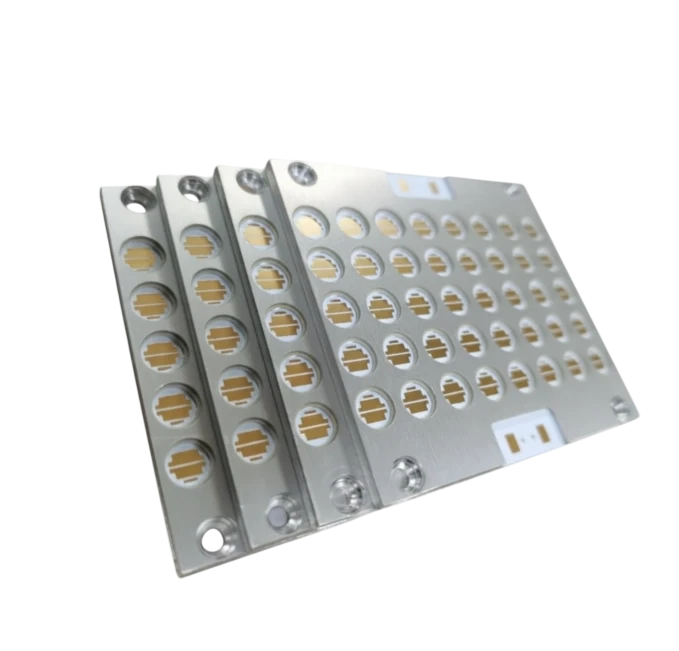
Modern lighting systems are no longer simple power switches. A Lighting Control PCB integrates power conversion, LED current regulation, communication interfaces, sensing, and protection functions into a compact electronic platform.
From smart home RGB lighting to industrial high-bay fixtures and automotive adaptive headlights, the PCB determines whether the lighting product achieves stable brightness, accurate color control, long service life, and reliable operation under thermal stress.
A successful design requires balancing four engineering priorities:
- Thermal performance for LED drivers and power components.
- Signal integrity for PWM, DALI, DMX, Bluetooth, and wireless communication.
- Electrical safety for high-voltage input systems.
- Manufacturing reliability for repeatable mass production.
What is a Lighting Control PCB and what does it control?
A Lighting Control PCB is the electronic control platform responsible for managing LED operation, power delivery, and communication functions.
The board may be:
- A dedicated LED driver PCB controlling current output.
- A smart controller PCB integrating MCU, sensors, and wireless connectivity.
- A combined power and control board inside a lighting fixture.
- A separate controller connected to an LED light engine.
A typical Lighting Control PCB contains:
- LED driver ICs for constant-current regulation.
- MOSFETs and power conversion circuits.
- Microcontrollers for dimming and system logic.
- Communication interfaces such as DALI, DMX512, Zigbee, Bluetooth, or Wi-Fi.
- EMI filtering and surge protection components.
The board architecture depends heavily on application requirements. A smart residential bulb and a 400W industrial floodlight may both use LEDs, but their PCB requirements are completely different.
Which PCB type should be selected for a Lighting Control PCB?
The main selection decision is whether the design priority is thermal dissipation, routing density, communication capability, or mechanical durability.
| Application | Recommended PCB Structure | Main Reason | Primary Design Consideration |
|---|---|---|---|
| Smart LED bulb | High-Tg FR4 multilayer PCB | Supports MCU and wireless circuits | RF isolation and compact routing |
| Industrial floodlight | Aluminum MCPCB | Removes LED heat efficiently | Thermal resistance and power handling |
| Automotive headlamp | Ceramic or hybrid rigid-flex PCB | Handles extreme temperature cycles | Reliability and vibration resistance |
| Horticulture lighting | FR4 with heavy copper and coating | Humidity resistance | Corrosion protection |
| Architectural strip lighting | Flexible PCB | Enables curved installation | External heat spreading |
How do you choose between FR4 and Metal Core PCB for lighting applications?
Thermal management is the most important PCB decision in high-power lighting systems.
Standard FR4 has relatively low thermal conductivity, typically around 0.3 W/mK. It works well for control electronics and moderate-power LED drivers when combined with thermal vias, copper areas, and proper airflow.
Metal Core PCB (MCPCB) uses an aluminum or copper base layer to transfer heat away from LEDs and power components. Typical thermal conductivity ranges from approximately 1.0 to 4.0+ W/mK depending on construction.
The correct choice depends on actual heat generation rather than LED wattage alone.
For example:
- A 50W LED driver operating at 95% efficiency dissipates approximately 2.5W of heat.
- If airflow and heatsinking are available, FR4 may be acceptable.
- In sealed fixtures with limited cooling, MCPCB or hybrid construction becomes more appropriate.
What Lighting Control PCB parameters determine reliability?
Engineers should evaluate electrical, thermal, and mechanical specifications together.
| Parameter | Why It Matters | Typical Range / Evaluation Method |
|---|---|---|
| Thermal Conductivity | Determines heat removal capability | FR4: ~0.3 W/mK; MCPCB: 1.0–4.0+ W/mK |
| Tg | Controls high-temperature stability | Standard FR4: ~130°C; High-Tg materials: >170°C |
| Copper Weight | Supports current carrying capacity | Signal: 1oz (35µm); Power: 2oz–4oz (70µm–140µm) |
| CTI | Reduces surface tracking risk | Level 0: >600V |
| Dielectric Breakdown | Prevents insulation failure | >3kV AC commonly used for safety validation |
| Surface Finish | Influences assembly reliability | ENIG preferred for fine-pitch components |
How do DALI, DMX, and wireless lighting protocols affect PCB design?
Communication requirements directly influence PCB layout.
DALI lighting control PCB design
DALI is commonly used in building automation systems. It uses a two-wire digital communication bus and supports addressing, grouping, and lighting management.
PCB considerations include:
- Proper isolation between mains power and communication circuits.
- Protection against transients.
- Stable signal routing.
DMX512 lighting control PCB design
DMX512 is based on RS-485 differential communication and is widely used in stage and entertainment lighting.
PCB requirements include:
- Controlled impedance routing.
- Differential pair layout.
- Noise isolation from switching regulators.
A typical RS-485 design targets approximately 120-ohm termination impedance.
Wireless smart lighting PCB design
Bluetooth, Wi-Fi, Zigbee, and similar systems require careful separation between RF and power electronics.
Important layout decisions include:
- Keeping antennas away from switching nodes.
- Maintaining RF keep-out zones.
- Using continuous ground reference planes.
- Controlling antenna trace impedance.
What are the major Lighting Control PCB failure modes?
| Failure Mode | Root Cause | Engineering Solution |
|---|---|---|
| LED flickering | PWM noise or unstable power supply | Improve decoupling and separate noisy switching paths |
| Driver overheating | Insufficient thermal design | Increase copper area, thermal vias, or use MCPCB |
| EMI interference | Poor grounding and switching layout | Separate power and signal domains |
| Startup failure | Excessive inrush current | Add NTC thermistors or soft-start circuits |
| Electrical breakdown | Incorrect creepage distance | Follow IEC/UL spacing requirements |
| Corrosion | Humidity exposure | Apply conformal coating |
How should a Lighting Control PCB be designed for manufacturing?
A production-ready design requires more than a working schematic.
Electrical and thermal validation
Validate:
- LED driver voltage and current compatibility.
- Maximum operating temperature.
- Thermal hotspot locations.
- PWM stability at minimum brightness.
- Power efficiency under maximum load.
If component junction temperature exceeds approximately 85°C during normal operation, thermal redesign should be considered.
PCB stackup planning
Define:
- Copper thickness.
- Dielectric thickness.
- Isolation requirements.
- Controlled impedance requirements.
High-voltage lighting systems require careful creepage and clearance planning.
Component placement
Keep:
- Analog control signals away from switching nodes.
- RF circuits away from power converters.
- Thermal-sensitive components away from heat sources.
Manufacturing review
Before production:
- Complete DFM review using DFM Guidelines.
- Confirm panelization strategy.
- Perform first article inspection.
- Validate functional performance under real load conditions.
What supplier information is required for Lighting Control PCB production?
A complete supplier package should include:
PCB manufacturing files
- Gerber RS-274X files.
- Drill files.
- Stackup information.
- Copper weight requirements.
Assembly information
- BOM.
- Pick-and-place files.
- Approved component alternatives.
Performance requirements
Include:
- Maximum operating temperature.
- Required communication protocols.
- Thermal testing requirements.
- Functional test procedures.
For lighting products exposed to humidity or outdoor conditions, specify conformal coating requirements such as acrylic or silicone coating.
Why do Lighting Control PCB designs need functional testing?
AOI inspection can detect assembly defects, but it cannot confirm real operating performance.
Lighting control boards should be tested for:
- Output current stability.
- Dimming response.
- Communication reliability.
- Thermal behavior.
- Startup performance.
A first article batch of approximately 5–10 units can verify thermal behavior and dimming performance before mass production.
FAQ: Lighting Control PCB engineering decisions
Can standard FR4 be used for a 50W LED driver?
Yes, depending on efficiency, airflow, and thermal design. A highly efficient driver may generate manageable heat, while sealed environments may require aluminum PCB construction.
What is the difference between DALI and DMX PCB requirements?
DALI focuses on building automation communication using a two-wire bus. DMX512 uses RS-485 differential signaling and requires stronger attention to impedance and signal integrity.
Why do LEDs flicker at low brightness?
Common causes include PWM noise, unstable supply regulation, insufficient filtering, or poor grounding between digital control and power sections.
What solder mask should be used for lighting PCBs?
White solder mask is commonly selected for reflective LED applications. Internal controller boards may use standard solder mask colors.
Which surface finish is suitable for LED wire bonding?
ENEPIG provides excellent flatness and corrosion resistance for wire bonding applications.
Glossary
| Term | Definition |
|---|---|
| MCPCB | Metal Core Printed Circuit Board used for improved thermal transfer |
| PWM | Pulse Width Modulation used for LED dimming control |
| DALI | Digital Addressable Lighting Interface |
| DMX512 | RS-485 based lighting communication protocol |
| Junction Temperature | Internal semiconductor temperature affecting lifetime |
| TIM | Thermal Interface Material between PCB and heatsink |
| Creepage | Surface distance between conductive parts |
| Clearance | Air distance between conductive parts |
| Driver | Circuit converting input power into controlled LED current |
| ENIG | Electroless Nickel Immersion Gold surface finish |
Conclusion: How to select the right Lighting Control PCB supplier
A reliable Lighting Control PCB requires coordinated decisions across thermal design, electrical architecture, communication requirements, and manufacturing capability.
The best solution depends on the lighting application:
- Smart lighting products need RF-friendly multilayer FR4 designs.
- High-power systems require advanced thermal structures.
- Industrial environments require mechanical and environmental protection.
- Mass production requires validated manufacturing processes.
APTPCB supports Lighting Control PCB projects from material selection and DFM review through fabrication and assembly. For an engineering review, provide:
- Gerber files.
- PCB stackup requirements.
- Copper thickness specifications.
- BOM information.
- Functional testing requirements.
A complete specification allows manufacturers to optimize reliability, cost, and production yield before volume manufacturing begins.