
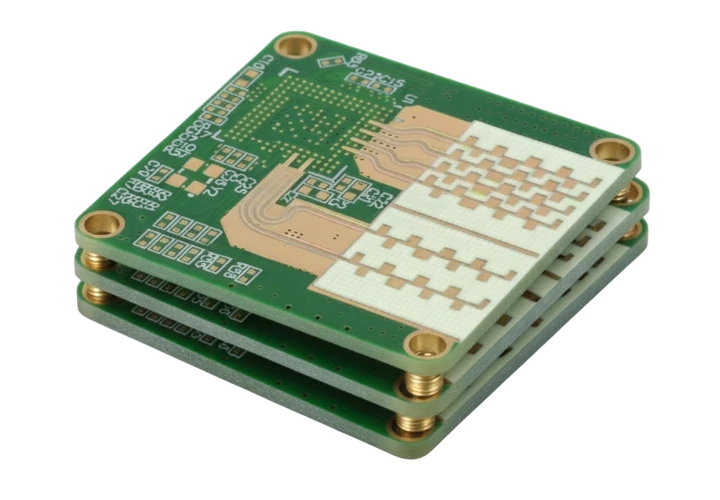
An LTE-V2X PCB is the circuit board platform for an LTE cellular vehicle-to-everything radio, its RF front end, antennas or coax interfaces, timing, processing, security, vehicle networks, power, and environmental controls. It may be used in a vehicle on-board unit (OBU), roadside unit (RSU), telematics controller, or integrated connectivity domain controller.
LTE-V2X generally refers to 3GPP Release 14/15 cellular V2X, including direct PC5 sidelink communication. NR-V2X was introduced later and has different radio and system requirements. Do not treat “LTE-V2X,” “5G V2X,” and IEEE 802.11p/DSRC as interchangeable PCB specifications.
Key takeaways
- Freeze the radio/module, regional spectrum, antenna architecture, RF power/loss budget, GNSS timing, interfaces, environment, and validation targets before selecting the PCB stack-up.
- High-frequency laminate, hybrid construction, very-low-profile copper, HDI, and backdrilling are design options—not universal requirements for every LTE-V2X board.
- Preserve each RF path from device pin or module pad through matching, filter, switch, connector, cable, and antenna; a controlled-impedance coupon cannot prove the installed link.
- Evaluate coexistence among V2X, cellular, GNSS, Wi-Fi/Bluetooth, clocks, processors, switching regulators, and vehicle networks.
- AEC-Q100 and AEC-Q200 qualify components. They do not certify a PCB or complete V2X assembly.
- OBU and RSU products need different environmental, power, surge, mechanical, antenna, service, and qualification plans.
What functions sit on an LTE-V2X PCB?
The board may host a certified or prequalified radio module, a discrete transceiver/baseband design, or a mix of modules and external front-end components. That choice determines the RF layout burden, software boundary, certification reuse, supply risk, and test access.
| Block | Main function | PCB risks |
|---|---|---|
| LTE-V2X modem or module | Baseband and PC5 radio operation | Power integrity, clock noise, package escape, thermal concentration |
| RF front end | Filtering, switching, gain and protection | Insertion loss, compression, mismatch, leakage and self-interference |
| Antenna or coax launch | Transfer RF energy to the installed antenna | Poor return path, connector launch error, cable loss, enclosure detuning |
| GNSS and timing | Position and time reference | Receiver desense, clock coupling, antenna isolation, supply noise |
| Processor and security | Applications, message handling, credentials and diagnostics | Thermal load, memory integrity, secure provisioning, debug exposure |
| Vehicle or infrastructure I/O | Automotive Ethernet, CAN, RS-485, Ethernet, PoE or other links | Transients, isolation, common-mode noise and connector EMC |
| Power management | Convert vehicle or infrastructure supply rails | Load transients, conducted noise, surge, reverse polarity and startup |
| Sensors and supervision | Temperature, voltage, tamper and health monitoring | Threshold error, poor placement and incomplete diagnostics |
An OBU must fit the vehicle power, temperature, vibration, network, antenna-cable, EMC, and service environment. An RSU may add outdoor surge exposure, lightning protection, PoE or mains-powered interfaces, enclosure heating, condensation, remote maintenance, and different antenna mounting.
Requirements to freeze before layout
Start with the radio link and product architecture rather than a laminate brand.
| Requirement | PCB or assembly consequence | Release evidence |
|---|---|---|
| LTE-V2X chipset/module and release | Footprint, RF reference design, clocks, software and certification boundary | Approved part number, datasheet and vendor layout package |
| Region, ITS band and channel plan | Filter, antenna, RF front end and regulatory test | Market matrix and radio configuration |
| Conducted power and link-loss budget | Trace, matching, filter, connector, cable and antenna limits | Per-path gain/loss budget with margin |
| Antenna architecture and placement | On-board keep-out or external coax launch, diversity and isolation | Antenna/cable drawing and installed-system assumptions |
| OBU or RSU environment | Material, coating, connectors, support, cooling and protection | Temperature, humidity, vibration, ingress and transient profile |
| Coexisting radios and clocks | Placement, shielding, filtering, reference planes and test modes | Frequency plan and coexistence test matrix |
| Digital and vehicle interfaces | Stack-up, impedance, isolation and transient protection | Interface list, topology and signal limits |
| Compute and thermal load | Copper spreading, vias, heatsink or enclosure path | Power states, loss model and thermal boundary |
| Security and provisioning | Secure element, key injection, debug control and traceability | Provisioning flow, access policy and recovery plan |
| Manufacturing acceptance | Materials, impedance, assembly, RF test and environmental gates | Inspection/test plan and serialized records |
This matrix prevents a common failure: selecting an expensive RF material before the antenna length, module loss budget, enclosure, cable, or test boundary is known.
RF stack-up and material selection
Material selection depends on RF path length, allowable insertion loss, phase consistency, temperature range, stack-up geometry, copper roughness, moisture behavior, availability, cost, and fabrication capability. Short module-to-connector routes may be feasible on a characterized low-loss FR-4 family; longer or lower-margin paths may justify a dedicated RF laminate.
A hybrid stack-up can put RF material only where the loss budget requires it while using another material for digital, power, or mechanical needs. However, hybrid construction adds resin-flow, bond, dimensional-stability, drill, plating, thermal-expansion, registration, and material-availability questions. Release the exact material family, thickness, copper type, bonding system, and approved substitute rules.
Use high-frequency PCB controls when RF loss and phase require them. Relevant fabrication variables can include:
- Design Dk and Df at the frequency and test method used by the model
- Pressed dielectric thickness and copper thickness
- Copper profile where conductor loss is material to the budget
- Trace-width and gap capability after etch compensation
- Solder-mask presence and thickness on exposed transmission lines
- Surface finish across the actual RF current path
- Via geometry, antipads, reference transitions and backdrill depth if used
- Lot traceability, coupons, cross-sections and material certificates
Do not specify low-profile copper, a particular finish, or a fixed impedance tolerance without linking it to analysis and measurement. The nominal impedance and tolerance come from the radio, antenna, connector, digital interface, and loss/return-loss budgets.
Route antenna feeds and RF transitions as one path
Every discontinuity contributes to the RF path: package escape, matching pads, component lands, bends, reference-plane edges, vias, layer changes, test structures, switches, filters, connectors, cable, and antenna feed. Review them together.
Keep RF traces over a continuous reference, control their geometry, and place ground-return vias around transitions where the field structure requires them. Avoid routing across plane splits or reference changes without a defined return. Minimize stubs, but use backdrilling only when the via model shows that the remaining stub affects the required response.
Connector launches should follow the connector supplier's footprint and be tuned to the real stack-up. Edge-launch, board-to-board, and miniature coax connectors create different return and mechanical constraints. Include connector torque, cable bend radius, retention, vibration, and assembly access in the board review.
For an on-board antenna, enforce the antenna keep-out through copper, components, cables, shields, battery, enclosure, and mounting hardware. The final antenna match and radiation pattern must be verified in the installed configuration. For external antennas, include cable and connector loss plus antenna location in the link budget.
Coexistence, power integrity, and EMC
V2X hardware often combines several transmitters and sensitive receivers. A design can meet the V2X feed-line target yet fail because a cellular harmonic, GNSS clock, processor bus, display cable, Ethernet common-mode current, or switching regulator desensitizes the receiver.
Create a frequency and operating-mode matrix covering every radio, oscillator, high-speed interface, and converter. Use it to plan placement, shielding, filtering, antenna isolation, grounding, and validation modes. Separate high-current converter loops from RF and timing sections, and keep noisy power nodes small with controlled returns.
Power integrity review should cover module transmit bursts, processor states, startup sequencing, brownout, sleep/wake, load dump or infrastructure surge, reverse polarity where applicable, and fault recovery. Verify rails at the device under the worst simultaneous operating mode, not only at the regulator output.
Automotive Ethernet, CAN, USB, PCIe, memory, camera, or other high-speed interfaces may share the board. Route each to its own interface specification; do not apply the RF feed rule to every differential pair. A multilayer or HDI PCB can help escape dense modules, but microvias are justified by routing and reliability analysis, not by the V2X label.
Thermal, mechanical, and environmental design
Build a power-state table for radio transmit/receive, processor load, cellular activity, GNSS, interfaces, and ambient conditions. Map heat from packages through solder joints, copper, vias, thermal interfaces, heatsinks, enclosure, and airflow. Antenna and RF performance can also shift with temperature and enclosure materials.
OBU review should include vehicle mounting location, connector and cable loading, shock/vibration, supply transients, temperature cycling, condensation, service access, and electromagnetic environment. RSU review should include wind/vibration, solar heating, cold start, water paths, pressure equalization, corrosion, lightning/surge interfaces, and remote-recovery behavior.
Coating may protect conductors but can change RF structures, antenna matching, connector mating, shielding contact, and rework. Define keep-outs and validate the coated assembly. Ingress protection applies to the enclosure, not the PCB alone.
LTE-V2X PCB manufacturing and verification matrix
| Risk | Manufacturing control | Acceptance evidence |
|---|---|---|
| Wrong RF material or copper foil | Controlled stack-up and approved material identities | Lot record, certificate and cross-section if specified |
| RF geometry drift | Fabricator-reviewed capability and etch compensation | Coupon/cross-section dimensions and impedance result |
| Hybrid lamination defect | Qualified material combination and controlled press cycle | Visual, ultrasonic or section evidence as agreed |
| Via/backdrill error | Controlled-depth program, target layer and residual-stub limit | X-ray/section and depth report where required |
| Hidden package defect | Package-specific stencil, profile and handling | SPI, AOI and targeted X-ray criteria |
| RF component or orientation error | Controlled BOM, placement and identity inspection | First article and serialized assembly record |
| Firmware/calibration mismatch | Controlled programming and calibration versions | Per-unit software and calibration record |
| RF path out of limit | Calibrated fixture and defined reference plane | S-parameter or functional RF result |
A practical verification ladder is:
- Bare-board netlist, dimensions, stack-up and material verification
- Impedance coupons where the process specification requires them
- SPI, AOI and targeted X-ray for module, BGA, QFN or shielded joints
- Power-off resistance, shorts and interface checks
- Current-limited rail sequencing, programming and secure provisioning
- Conducted RF path loss/return loss or functional radio test at defined reference planes
- GNSS, cellular, V2X, network and coexistence tests in controlled modes
- Thermal, vehicle/infrastructure transient, EMC and environmental qualification
- Over-the-air antenna and installed-enclosure validation
PCBA testing and quality planning should state which measurements are performed per unit, by sample, or during design qualification. Retain fixture revision, calibration status, software version, limits, and unit serial number.
Failure and reaction matrix
| Symptom | Possible contributors | First evidence to inspect |
|---|---|---|
| Low V2X range or high packet loss | Feed loss, mismatch, cable, antenna placement, obstruction | Conducted path, cable and installed antenna result |
| Receiver desense | Coexisting transmitter, clock, converter or digital interface | Frequency/mode matrix and near-field investigation |
| Impedance coupon passes but radio fails | Connector launch, package escape, matching or antenna not represented | Full RF path and reference-plane definition |
| GNSS position/timing instability | Antenna isolation, supply noise, clock harmonic or cable issue | GNSS spectrum, rail noise and antenna path |
| Intermittent module startup | Rail sequence, brownout, reset, solder joint or firmware | Startup rails, reset log and X-ray/assembly record |
| Temperature-dependent RF drift | Component variation, matching, cable, antenna or enclosure | Chamber RF data and thermal map |
| OBU resets during vehicle event | Supply transient, ground shift, EMC coupling or protection | Supply/reset capture and transient test setup |
| RSU field corrosion or leakage | Enclosure path, condensation, coating gap or connector seal | Ingress path, residue and environmental history |
LTE-V2X PCB RFQ checklist
- System: OBU/RSU role, markets, 3GPP release, channels, conducted power, antenna architecture, cable/connector and link budget
- Electronics: Module/chipset, RF front end, GNSS, cellular/Wi-Fi, compute, clocks, vehicle/infrastructure interfaces and power states
- PCB: Gerber, ODB++, or IPC-2581; netlist; stack-up; material/copper identities; impedance table; loss coupons; vias/backdrill; profile and revisions
- Assembly: Controlled BOM and alternates, placement, MSL handling, shields, coax/connectors, thermal hardware, coating, programming and calibration
- Test: RF reference planes and limits, fixtures, VNA/TDR or functional coverage, provisioning, GNSS/coexistence, thermal, EMC and environmental scope
- Quality: First article, lot/serial traceability, test-data retention, failure analysis, substitution control, change notification, quantities and delivery target
Use the DFM guidelines to close fabrication-data gaps, then submit the controlled package through the PCB quotation page.
Standards, references, and scope
Relevant references may include:
- 3GPP Release 14 and Release 15 specifications for LTE-V2X
- Regional ITS spectrum and radio-equipment regulations
- ISO 16750 — Environmental conditions and testing for road vehicle electrical/electronic equipment
- ISO 7637-2 — Electrical transient conduction along vehicle supply lines
- CISPR 25 — Radio disturbance characteristics for vehicle components
- ISO 11452 series — Vehicle component immunity to narrowband radiated electromagnetic energy
- ISO/SAE 21434 — Road vehicle cybersecurity engineering
- IPC-2221 — Generic Standard on Printed Board Design
- IPC-6012 and IPC-6012DA — Rigid printed board qualification, including automotive addendum where specified
- J-STD-001 and IPC-A-610 — Soldered assembly and acceptability requirements
AEC-Q100 and AEC-Q200 apply to integrated circuits and passive components. IATF 16949 is a quality-management-system requirement, not a V2X PCB performance certificate. ISO 26262 applies only where the product's safety concept allocates relevant safety requirements. Confirm customer, market, OEM, regulatory, cybersecurity, and certification-body requirements for the complete product.
LTE-V2X PCB FAQ
What is an LTE-V2X PCB?
It is the hardware platform connecting an LTE-V2X modem or module to its RF front end, antennas, GNSS timing, processor, security, power, and vehicle or roadside interfaces.
Is LTE-V2X the same as 5G NR-V2X?
No. LTE-V2X was defined in earlier 3GPP releases, while NR-V2X was introduced later with different radio capabilities and implementation requirements. Confirm the exact modem and release.
Does every LTE-V2X PCB require Rogers material?
No. Select material from path length, loss and phase budget, geometry, temperature, availability, cost, and manufacturing capability. Some short paths can use characterized low-loss FR-4; others need RF laminate.
Is the V2X frequency always 5.9 GHz?
Many deployments use region-specific ITS spectrum near 5.9 GHz, but allocations, channels, power, and coexistence rules vary. Design and test against each target market.
What impedance tolerance should an LTE-V2X PCB use?
The radio, antenna, connector, digital interface, return-loss budget, and manufacturing capability set the nominal impedance and tolerance. Do not apply one percentage to every controlled structure.
Does an LTE-V2X PCB always need backdrilling?
No. Model the via transition and remaining stub against the required bandwidth and loss/return-loss limits. Use backdrilling only when it materially improves the path and can be manufactured and verified.
Can a TDR coupon prove RF performance?
No. A coupon monitors selected impedance structures. It does not include every package escape, matching component, via, connector, cable, antenna, enclosure, or coexistence effect.
Do AEC-Q100 and AEC-Q200 certify the PCB?
No. They are component qualification standards. PCB and PCBA acceptance requires its own fabrication, assembly, environmental, electrical, RF, and product-level requirements.
How should an LTE-V2X antenna path be tested?
Define reference planes and measure the required conducted path characteristics, then validate antenna match, efficiency, pattern, isolation, coexistence, and communication performance in the installed enclosure.
What files are needed for an LTE-V2X PCB quote?
Provide controlled PCB and assembly data plus radio/module details, markets, link budget, stack-up/materials, antenna/coax design, impedance/loss limits, programming, RF tests, environment, traceability, quantities, and change control.