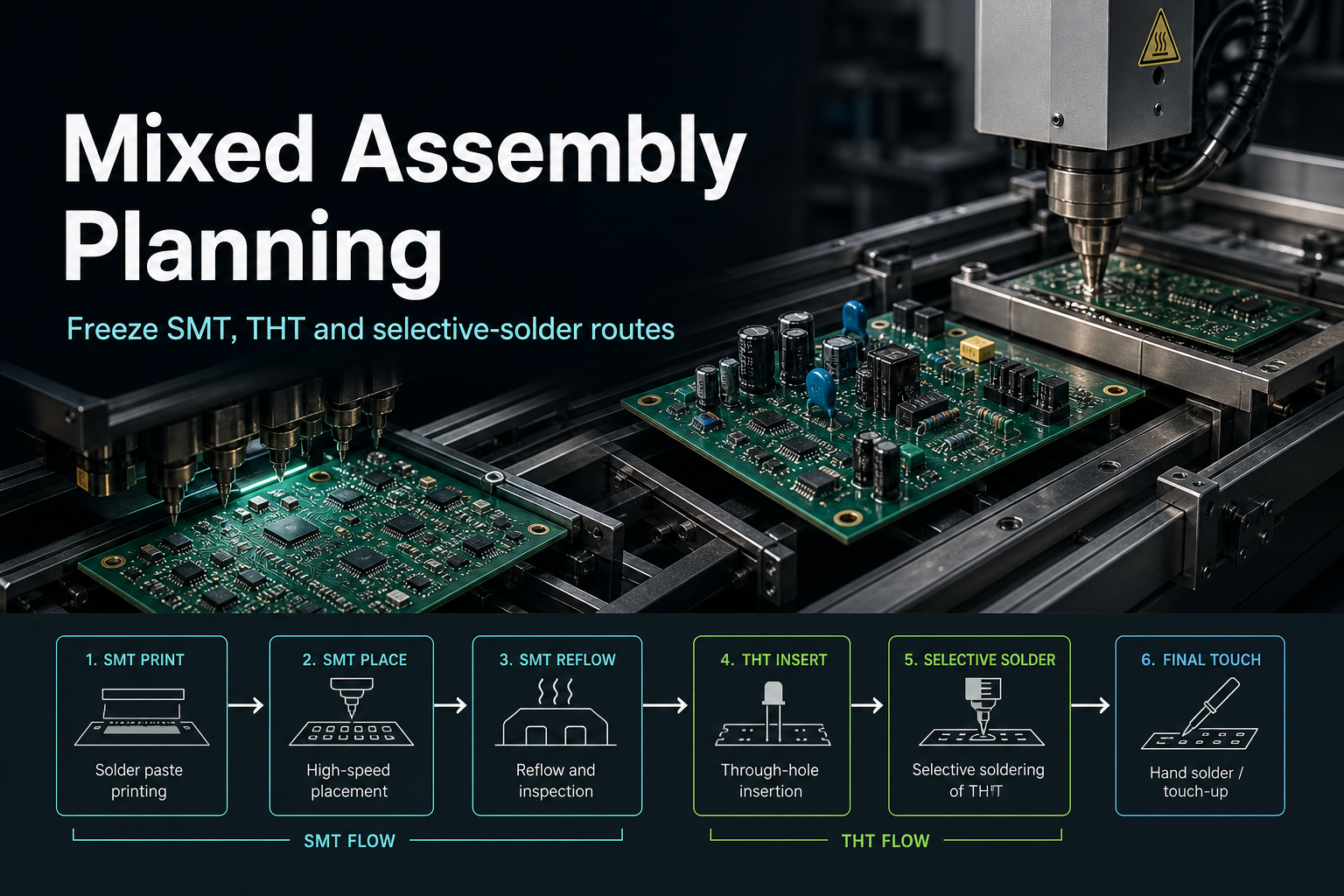
Mixed assembly planning is the strategic coordination of manufacturing processes for Printed Circuit Board Assemblies (PCBA) that contain both Surface Mount Technology (SMT) and Through-Hole Technology (THT) components. Unlike single-technology boards, mixed technology requires careful sequencing to prevent thermal damage, ensure solder joint reliability, and accommodate physical fixtures like wave solder pallets. Engineers must define keep-out zones, component orientation, and thermal profiles early in the design phase to avoid costly rework.
At APTPCB (APTPCB PCB Factory), we see that successful mixed assembly relies heavily on Design for Manufacturing (DFM) validation before the first board is populated. This guide provides the specifications, checklists, and troubleshooting steps necessary to execute a robust mixed assembly strategy.
Mixed assembly planning quick answer (30 seconds)
If you are designing a board with both SMT and THT parts, follow these core principles to ensure manufacturability:
- Process Sequence: The standard hierarchy is SMT Top Side (Reflow) → SMT Bottom Side (Reflow/Glue) → THT (Wave, Selective, or Hand Soldering).
- Clearance Zones: Maintain a minimum clearance of 3mm to 5mm around THT pads if using wave solder pallets to allow the fixture walls to seal against the PCB.
- Component Orientation: Align SMT passive components perpendicular to the wave direction to minimize solder bridging and shadowing effects.
- Thermal Hierarchy: Ensure THT components can withstand the cumulative heat cycles if they are placed near high-mass SMT parts.
- Secondary Side Limits: Avoid placing heavy or tall SMT components on the secondary side (bottom) if that side will pass over a wave solder bath; they may fall off or require complex shielding.
- Validation: Always review the "shadow effect" where large THT parts might block the solder wave from reaching smaller SMT pads behind them.
When mixed assembly planning applies (and when it doesn’t)
Understanding when to trigger a full mixed assembly workflow helps optimize cost and lead time.
When mixed assembly planning is critical:
- High-Power Applications: Designs requiring robust mechanical connectors or large capacitors that are only available in THT packages.
- Legacy Components: Projects utilizing older integrated circuits or specific sensors that do not have surface mount equivalents.
- Mechanical Stress Points: I/O ports (USB, Ethernet, Power Jacks) that require the physical strength of through-hole anchoring.
- Double-Sided Population: Boards with active components on both top and bottom layers requiring selective soldering or wave fixtures.
When mixed assembly planning is unnecessary (or should be avoided):
- Pure SMT Designs: If all components have SMT alternatives, stick to a single reflow process to reduce cost and defect rates.
- Low Volume Prototypes: For <10 boards, manual soldering of THT parts is often more cost-effective than designing complex wave pallets.
- Heat-Sensitive Components: If a board contains parts that cannot survive wave soldering temperatures, a mixed process may be too risky; manual or selective soldering is preferred.
- Ultra-High Density: If the board lacks the 3-5mm clearance required for wave pallets, the design forces a shift to selective soldering or manual labor, changing the planning scope.
Mixed assembly planning rules and specifications (key parameters and limits)

The following table outlines the critical design rules for mixed technology boards. Adhering to these values prevents common manufacturing failures.
| Rule | Recommended Value/Range | Why it matters | How to verify | If ignored |
|---|---|---|---|---|
| Wave Pallet Clearance | > 3.0 mm (5.0 mm preferred) | Allows fixture walls to seal the PCB bottom without hitting SMT parts. | CAD Distance Check | SMT parts near THT pads get crushed or flooded with solder. |
| SMT Component Orientation | Perpendicular to wave | Reduces "shadowing" where the component body blocks solder flow. | Visual Inspection / DFM | Open joints or insufficient solder on trailing pads. |
| Thieving Pads | 1.5x to 2x pad size | Pulls excess solder away from the last pins of a connector to prevent bridges. | Gerber Review | Solder bridges on the last row of pins in wave soldering. |
| THT Lead Length | 1.5 mm - 2.0 mm (post-cut) | Prevents leads from hitting the wave nozzle or causing shorts. | Physical Measurement | Short circuits or nozzle damage during wave soldering. |
| Solder Mask Dam | > 0.1 mm (4 mil) | Prevents solder bridging between closely spaced SMT and THT pads. | CAM Engineering | High bridging rate requiring manual rework. |
| Via Plugging (Tented) | 100% under BGA/SMT | Prevents solder theft or vacuum leakage during assembly. | Fabrication Drawing | Solder voids or weak joints on SMT parts. |
| Component Height (Bottom) | < 5.0 mm (for wave) | Tall parts on the bottom interfere with the solder wave height. | 3D Model Check | Components drag in the solder bath; parts fall off. |
| Thermal Relief | 4-spoke connection | Ensures heat stays at the joint during soldering without dissipating into planes. | Layout Settings | Cold solder joints; inability to heat the barrel fully. |
| Fiducial Marks | 3 per side (Global) | Essential for machine alignment for both SMT placement and automated THT insertion. | Optical Inspection | Misaligned components; placement shifts. |
| Panelization Edge Rails | > 5.0 mm width | Provides grip for conveyors and wave solder fingers. | Panel Drawing | Board falls into the machine or warps significantly. |
Mixed assembly planning implementation steps (process checkpoints)

Implementing a mixed assembly line requires a strict sequence to protect components processed in earlier stages.
BOM Segmentation and Analysis
- Action: Separate the Bill of Materials (BOM) into SMT Top, SMT Bottom, and THT groups.
- Key Parameter: Identify moisture-sensitive devices (MSD) and heat-sensitive THT parts.
- Check: Confirm no THT part is specified for a reflow cycle unless it is "Pin-in-Paste" compatible.
Footprint and Layout Verification
- Action: Verify that THT footprints have adequate annular rings and hole sizes for wave penetration.
- Key Parameter: Hole size = Lead diameter + 0.25mm (+/- 0.05mm).
- Check: Run a DFM check for wave pallet clearances around THT zones.
Fixture and Pallet Design
- Action: Design the wave solder fixture intro document or CAD file. This fixture shields bottom-side SMT parts while exposing THT leads to the wave.
- Key Parameter: Wall thickness minimum 1.5mm; material usually Durostone or synthetic stone.
- Check: Simulate the pallet fit to ensure no SMT component interference.
SMT Assembly (Primary and Secondary Side)
- Action: Populate and reflow SMT components. If double-sided, the heavier components usually go on the first pass (top side).
- Key Parameter: Reflow profile peak temperature (typically 245°C - 260°C).
- Check: Perform Automated Optical Inspection (AOI) to verify SMT placement before THT begins.
Through-Hole Component Insertion
- Action: Insert THT components manually or via automated insertion machines.
- Key Parameter: Lead protrusion length and polarity alignment.
- Check: Visual inspection to ensure components are seated flush against the PCB.
Wave or Selective Soldering
- Action: Pass the board (in its pallet) through the wave solder machine or use a selective soldering robot.
- Key Parameter: Solder pot temperature (255°C - 265°C) and dwell time (2-4 seconds).
- Check: Verify hole fill (vertical fill) meets IPC Class 2 or 3 standards (usually 75% or 100%).
Cleaning and Final Inspection
- Action: Remove flux residues if using water-soluble flux; inspect for solder balls.
- Key Parameter: Ionic contamination levels.
- Check: X-ray inspection if THT parts obscure SMT pads or if Pin-in-Paste was used.
Mixed assembly planning troubleshooting (failure modes and fixes)
Mixed technology lines introduce unique defects where the two processes interact.
Symptom: Solder Skips (Shadowing)
- Cause: Large THT component body or thick pallet wall blocks the solder wave from hitting a pad.
- Check: Review component orientation relative to wave direction.
- Fix: Rotate the component 90 degrees or increase the distance between the obstacle and the pad.
- Prevention: Use through hole soldering basics to design "thieving pads" or adjust wave turbulence.
Symptom: Secondary Side SMT Parts Falling Off
- Cause: Reflowed solder on bottom-side SMT parts remelts during the wave process.
- Check: Verify if the wave pallet fully covers these SMT parts.
- Fix: Apply adhesive (red glue) to bottom-side SMT parts prior to wave soldering or improve pallet shielding.
- Prevention: Keep bottom-side SMT parts at least 5mm away from THT holes.
Symptom: Cold Solder Joints on THT
- Cause: Heavy ground planes dissipate heat faster than the wave can supply it.
- Check: Inspect thermal relief connections on the PCB layout.
- Fix: Increase dwell time or preheat temperature (carefully, to avoid damaging SMT parts).
- Prevention: Use thermal spokes on all ground pins in the design phase.
Symptom: PCB Warpage
- Cause: Thermal mismatch between multiple reflow cycles and wave soldering.
- Check: Measure bow and twist against IPC-610 standards (<0.75%).
- Fix: Use a stiffer pallet material or add board stiffeners during the wave process.
- Prevention: Balance copper distribution on the PCB layers.
Symptom: Solder Bridges on Fine-Pitch Connectors
- Cause: Wave drag-out leaves excess solder on the last pins.
- Check: Look for "thieving pads" on the trailing edge of the connector.
- Fix: Manually rework bridges with a soldering iron and wick.
- Prevention: Add solder thieves to the footprint; orient the connector parallel to the wave.
How to choose mixed assembly planning (design decisions and trade-offs)
Deciding on the specific mixed assembly strategy involves balancing volume, cost, and complexity.
Option A: Wave Soldering with Pallets
- Best for: Medium to high volume production where THT components are grouped together.
- Trade-off: Requires expensive custom pallets (fixtures) and strict clearance rules (3-5mm) around THT parts.
- Decision Trigger: If you have >500 boards and THT parts are clustered, choose this.
Option B: Selective Soldering
- Best for: High-density boards where SMT parts are too close to THT pins for a pallet.
- Trade-off: Slower cycle time per board compared to wave; higher machine programming time.
- Decision Trigger: If clearance is <3mm or components are tall on both sides, choose selective soldering.
Option C: Manual (Hand) Soldering
- Best for: Prototypes, very low volume, or heat-sensitive parts that cannot survive a machine process.
- Trade-off: Inconsistent quality (operator dependent) and high labor cost.
- Decision Trigger: If you have <50 boards or only 1-2 THT connectors, manual assembly is often cheaper than tooling.
Option D: Pin-in-Paste (Intrusive Reflow)
- Best for: Eliminating the wave step entirely. THT parts are pasted and reflowed with SMT.
- Trade-off: Requires high-temperature THT parts and precise stencil design to get enough solder volume.
- Decision Trigger: If THT parts are compatible and you want to reduce process steps, investigate this SMT and THT integration.
Mixed assembly planning FAQ (cost, lead time, common defects, acceptance criteria, we see that successful mixed assembly relies heavily on Design for Manufacturing (DFM) files)
How does mixed assembly affect the total project cost? Mixed assembly is generally 15-30% more expensive than pure SMT due to the extra process steps (wave/selective soldering), manual insertion labor, and fixture tooling costs.
What is the impact on lead time? It typically adds 2-3 days to the production schedule. Time is needed for fixture fabrication (pallets), manual insertion, and the secondary soldering process.
Can I use mixed assembly for double-sided boards? Yes, but it requires careful planning. Usually, SMT is placed on both sides (reflow), and then THT is soldered. If THT is on both sides, it often requires hand soldering for the second side or complex selective soldering.
What data do I need to provide for DFM review? You must provide Gerber files, a BOM indicating which parts are THT vs SMT, and assembly drawings showing component polarity. Specifically, highlight any "Do Not Populate" (DNP) parts.
What are the acceptance criteria for THT solder joints? According to IPC-A-610, a Class 2 THT joint requires at least 75% vertical fill of the barrel and 180-degree wetting on the destination side. Class 3 requires 270-degree wetting.
Why is "selective soldering" often recommended over wave soldering? Selective soldering uses a mini-wave nozzle that moves to specific points. It eliminates the need for expensive pallets and reduces thermal shock to the rest of the board, making it safer for dense mixed-technology boards.
How do I prevent "solder balls" in mixed assembly? Solder balls often occur during wave soldering if the preheat is insufficient or flux is excessive. Ensuring proper PCB stencil design for the SMT process and correct wave parameters helps minimize this.
Is Pin-in-Paste a viable alternative? Yes, but only if the THT component body can withstand 260°C reflow temperatures. It simplifies the process by treating THT parts like SMT parts.
What is the minimum clearance for a wave solder pallet? You generally need 3mm to 5mm of free space around the THT pads on the solder side. This space accommodates the pallet wall that shields nearby SMT parts.
Does APTPCB handle the fixture design? Yes, APTPCB engineers design and fabricate the necessary wave solder pallets or selective soldering programs based on your Gerber files.
Resources for mixed assembly planning (related pages and tools)
- DFM Guidelines: Detailed design rules for spacing and layout.
- SMT & THT Assembly: Overview of our mixed technology capabilities.
- Selective Soldering: Deep dive into the alternative to wave soldering.
- Turnkey Assembly: How we manage the entire supply chain for mixed boards.
Mixed assembly planning glossary (key terms)
| Term | Definition |
|---|---|
| Wave Pallet | A custom fixture made of heat-resistant material (like Durostone) that holds the PCB and shields SMT parts during wave soldering. |
| Selective Soldering | A process using a small, programmable solder fountain to solder specific THT joints without affecting nearby SMT parts. |
| Reflow Soldering | The process of melting solder paste to attach SMT components; usually the first step in mixed assembly. |
| Shadowing | A defect where a component body blocks the flow of the solder wave, causing skips or open joints on pads behind it. |
| Thieving Pad | An extra dummy pad added to the end of a connector footprint to "steal" excess solder and prevent bridging. |
| Pin-in-Paste (PiP) | A technique where THT components are soldered using SMT reflow ovens by printing paste into the holes. |
| Annular Ring | The ring of copper around a plated through-hole; critical for THT joint strength. |
| Thermal Relief | A spoke pattern connecting a pad to a copper plane, preventing heat from dissipating too quickly during soldering. |
| Flux | A chemical cleaning agent used before and during soldering to remove oxidation and improve wetting. |
| Durostone | A heavy-duty glass fiber reinforced plastic used to manufacture wave solder pallets due to its thermal stability. |
Request a quote for mixed assembly planning (we see that successful mixed assembly relies heavily on Design for Manufacturing (DFM) review + pricing)
Getting an accurate quote for mixed assembly requires a clear understanding of your process needs. At APTPCB, we perform a complimentary DFM review to identify potential wave soldering issues or clearance conflicts before pricing.
To get a fast and accurate quote, please prepare:
- Gerber Files: Including all copper layers, drill files, and paste layers.
- Bill of Materials (BOM): Clearly marking SMT vs. THT parts.
- Assembly Drawings: Highlighting any special mounting or masking requirements.
- Volume & Lead Time: Estimated annual usage and required delivery date.
Conclusion (next steps)
Effective mixed assembly planning bridges the gap between compact surface mount designs and rugged through-hole requirements. By adhering to strict clearance rules, optimizing process sequences, and utilizing the right fixtures, you can achieve high-reliability production without excessive rework. Whether your project demands wave soldering pallets or precise selective soldering, early planning ensures your design is ready for the manufacturing floor.