
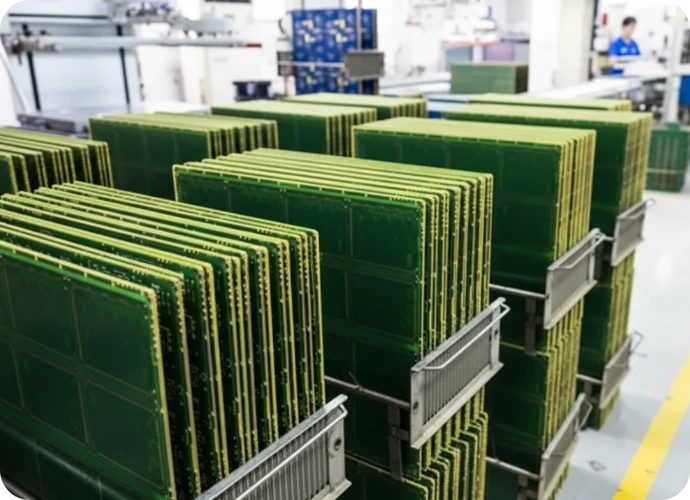
A Neurofeedback PCB is not designed like a typical embedded controller board. EEG systems measure electrical signals in the microvolt range, meaning the PCB itself becomes part of the measurement instrument. Layer construction, grounding, electrode routing, leakage control, and manufacturing cleanliness directly affect signal quality.
The right PCB architecture depends on whether the product is a research EEG platform, wearable neurofeedback headset, clinical device, or consumer biofeedback system. Engineers must balance noise performance, manufacturability, size, cost, and safety requirements.
What are the most important Neurofeedback PCB design requirements?
A reliable Neurofeedback PCB normally requires:
- High-input-impedance analog front-end (AFE) circuitry.
- Controlled separation between analog acquisition and digital processing.
- Low-noise power distribution.
- Short electrode-to-amplifier signal paths.
- Stable reference and bias electrode design.
- Manufacturing controls that prevent leakage paths and assembly defects.
EEG acquisition commonly uses high-impedance inputs because electrode interfaces can vary significantly. Input impedance above 1 GΩ is often required for dry electrode systems and sensitive bio-signal acquisition.
Which PCB stackup is best for EEG and neurofeedback applications?
A 4-layer PCB is the common starting point for Neurofeedback PCB designs because it provides dedicated reference and power layers while keeping fabrication cost manageable.
A typical stackup:
| Layer | Function | Design purpose |
|---|---|---|
| Layer 1 | Analog signals and components | Short AFE input routing and precision components |
| Layer 2 | Solid ground plane | Low-impedance return path and EMI reduction |
| Layer 3 | Power planes and digital signals | Power distribution and controlled digital routing |
| Layer 4 | Digital signals/components | MCU, communication, and support circuitry |
Research EEG acquisition systems commonly use multilayer boards with dedicated reference planes to reduce interference and improve stability.
For compact wearable headsets, rigid-flex PCB technology can reduce electrode cable length and improve mechanical integration.
See our Rigid-Flex PCB capabilities for wearable applications.
How do you reduce noise on a Neurofeedback PCB?
Noise reduction requires controlling every coupling path between the environment, digital electronics, power supply, and EEG inputs.
Key layout decisions include:
- Place the AFE and ADC close to electrode inputs.
- Keep high-impedance traces short.
- Route sensitive analog inputs away from clocks, switching regulators, and digital buses.
- Use continuous ground reference planes.
- Add guard traces around sensitive input nodes.
- Filter power entering analog sections.
- Minimize cable movement and connector-related artifacts.
Guard traces are especially important because leakage currents through contamination, humidity, and PCB surface residue can create measurable EEG errors.
Neurofeedback PCB design decision matrix
| Design choice | Best fit | Main benefit | Manufacturing impact |
|---|---|---|---|
| 4-layer rigid PCB | Desktop EEG systems and prototypes | Cost-effective noise control | Standard PCB fabrication |
| 6-layer rigid PCB | Dense clinical or multi-channel systems | Additional routing isolation | Higher fabrication cost |
| Rigid-flex PCB | Wearable headsets | Shorter electrode connections and improved comfort | Requires controlled flex manufacturing |
| Integrated AFE chip | Compact EEG devices | Lower noise and smaller analog path | Requires precise SMT assembly |
| Discrete amplifier design | Specialized research systems | Maximum circuit customization | Larger PCB area and validation effort |
| ENIG finish | Fine-pitch AFE components | Flat contact surface and oxidation resistance | Higher cost than basic finishes |
What Neurofeedback PCB specifications should manufacturers receive?
The fabrication package should define electrical, mechanical, and inspection requirements before production.
| Rule | Recommended value/range | Why it matters | Verification |
|---|---|---|---|
| Analog trace width | 6–8 mil (0.15–0.2 mm) | Balances impedance and manufacturability | DFM review |
| PCB layer count | Minimum 4 layers | Provides reference plane isolation | Stackup review |
| Copper weight | 1 oz (35 µm) | Suitable for low-current EEG circuits | Fabrication report |
| Surface finish | ENIG | Supports fine-pitch AFE assembly | XRF inspection |
| Dielectric material | High-Tg FR4, Tg >170°C | Improves thermal reliability | Material certificate |
| Input impedance | >1 GΩ | Supports high-impedance electrodes | Electrical testing |
| Guard ring spacing | Approximately 6 mil (0.15 mm) | Reduces leakage coupling | PCB inspection |
| Isolation clearance | >8 mm where required for mains patient protection | Supports safety design | CAD review |
| Via type | Tented or plugged near fine-pitch devices | Reduces solder defects | Assembly inspection |
How should engineers place components on a Neurofeedback PCB?
Component placement should follow the signal path.
The recommended sequence is:
- Place electrode connectors and AFE input components.
- Place amplifiers and ADC devices.
- Route differential EEG paths with matched environments.
- Place power regulation away from sensitive analog areas.
- Place MCU, wireless, and digital interfaces after analog routing is complete.
Digital switching currents should not share return paths with sensitive EEG acquisition signals. Grounding strategies must be planned at the schematic stage rather than corrected after routing.
What manufacturing checklist should a Neurofeedback PCB supplier follow?
A production-ready supplier review should include:
PCB fabrication checklist
- Confirm controlled stackup documentation.
- Confirm material grade and thickness.
- Verify impedance requirements where applicable.
- Confirm ENIG thickness and surface finish requirements.
- Review minimum trace, spacing, and drill capability.
- Perform electrical net testing.
Assembly checklist
- Confirm AFE component sourcing and traceability.
- Validate SMT placement accuracy.
- Inspect fine-pitch packages using AOI.
- Confirm reflow profile control.
- Clean flux residues from high-impedance analog areas.
Engineering review checklist
Provide:
- Gerber RS-274X files.
- NC drill files.
- PCB fabrication drawing.
- Stackup specification.
- BOM.
- Pick-and-place files.
- Assembly drawings.
- Test requirements.
What are common Neurofeedback PCB failures and how are they fixed?
| Failure symptom | Likely cause | Investigation | Design correction |
|---|---|---|---|
| 50/60 Hz mains interference | Ground coupling or insufficient isolation | Measure grounding paths and noise spectrum | Improve grounding, isolation, filtering, and shielding |
| Baseline drift | Leakage current or electrode polarization | Check PCB cleanliness and electrode interface | Improve cleaning process and input protection |
| Signal spikes | Cable motion or connector artifacts | Monitor during mechanical movement | Improve connector retention and strain relief |
| High-frequency noise | Digital clock coupling or switching regulator noise | Probe power rails and routing paths | Separate digital sections and improve filtering |
Should you use 3D Printing PCB technology for Neurofeedback devices?
Additive manufacturing and 3D Printing PCB methods can help validate curved wearable designs, mechanical fit, and non-critical interconnect concepts.
However, precision EEG acquisition sections usually require traditional copper PCB fabrication because the amplifier input stage operates near the noise floor. Copper traces provide more predictable electrical characteristics than many printed conductive materials.
Use HDI PCB Technology when miniaturization requires higher routing density.
What files are needed for a Neurofeedback PCB quote?
A supplier quote should include:
- Gerber files.
- Drill files.
- Layer stackup.
- Board thickness.
- Surface finish requirement.
- Material specification.
- Quantity.
- Assembly requirements.
- BOM and placement files for PCBA.
For medical-oriented designs, include inspection expectations and testing requirements during quotation.
Neurofeedback PCB FAQ
What is the typical prototype lead time?
Standard rigid PCB prototypes commonly require several business days. Complex rigid-flex designs, special materials, or assembly requirements may require additional manufacturing time.
Are Neurofeedback PCBs more expensive than standard PCBs?
Yes. Costs increase because of higher layer counts, ENIG finishing, tighter inspection requirements, controlled impedance, and specialized assembly processes.
Is conformal coating required?
Wearable EEG systems often benefit from conformal coating because sweat and humidity can create leakage paths across high-impedance inputs.
Can a Neurofeedback PCB use standard FR4?
High-Tg FR4 is commonly suitable for many designs. Specialized RF materials may be required when wireless sections need different electrical characteristics. See Rogers materials for RF applications.
Can APTPCB help with assembly?
APTPCB provides Turnkey Assembly services for PCB assembly workflows including component sourcing and manufacturing support.
Resources for Neurofeedback PCB design
Conclusion: selecting the right Neurofeedback PCB manufacturing approach
A successful Neurofeedback PCB design combines precision analog engineering with disciplined manufacturing control. The strongest designs begin with the electrode interface, define the stackup early, isolate sensitive signals, and validate production requirements before fabrication.
Whether the goal is a research EEG platform, wearable neurofeedback headset, or commercial bio-signal product, PCB decisions determine the quality of the final brainwave data.