
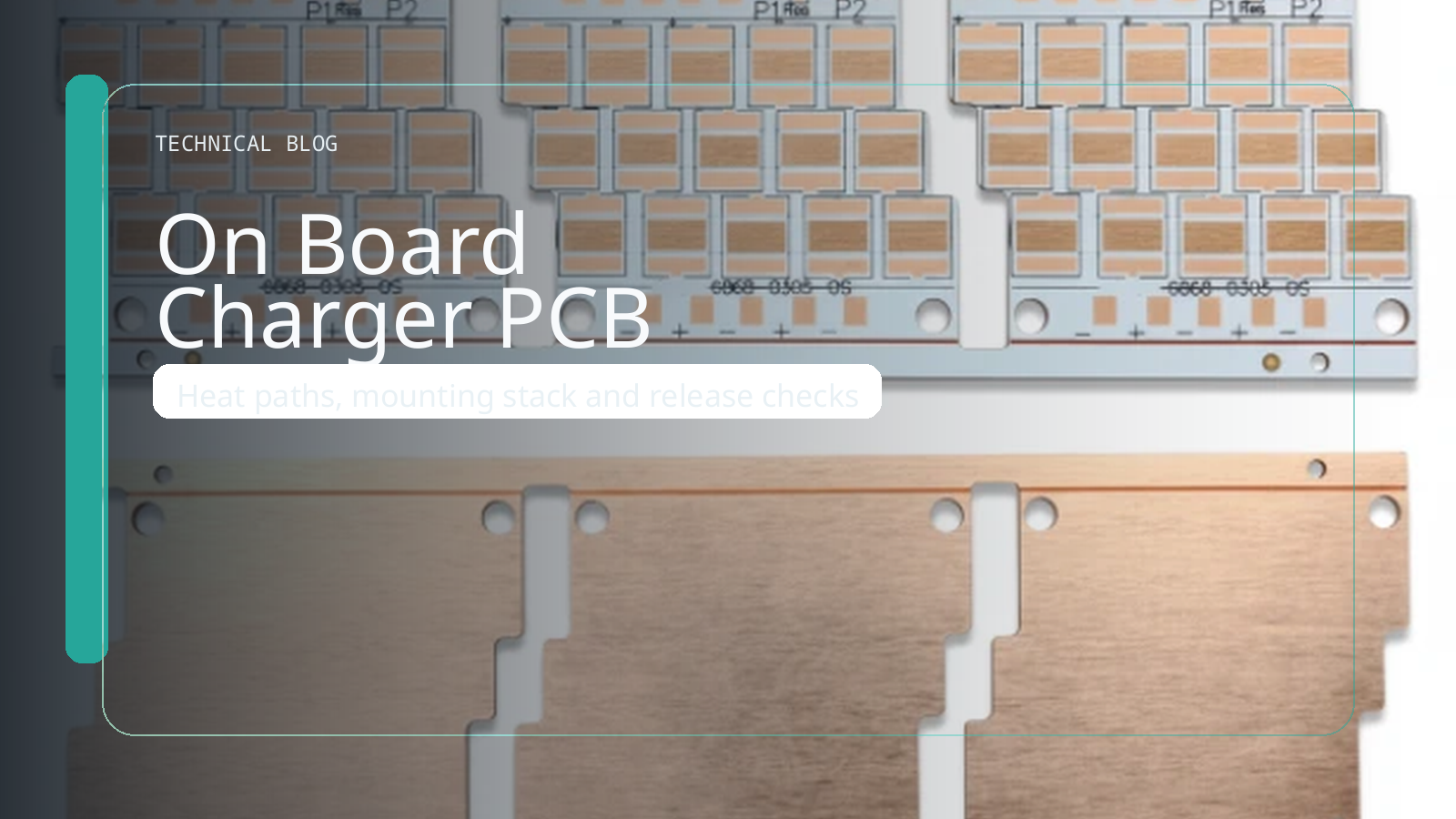
An EV on-board charger (OBC) PCB is a high-voltage power subassembly that must simultaneously manage energy conversion, electrical isolation, heat removal, mechanical loading, and production repeatability.
A successful design review does not only ask whether the circuit operates. It asks whether the PCB structure, assembly process, cooling interface, and verification plan support the intended vehicle environment.
Modern OBC designs may include:
- AC input filtering and protection;
- power-factor correction (PFC);
- isolated DC/DC conversion;
- gate drivers and switching devices;
- voltage and current sensing;
- communication interfaces;
- auxiliary power;
- thermal monitoring; and
- mechanical interfaces to cold plates, housings, busbars, and connectors.
The PCB should therefore be released as a coordinated electrical, thermal, and mechanical system.
What decisions define an OBC PCB design?
The first design decision is the PCB architecture. Power density, cooling method, voltage class, assembly method, and manufacturing capability determine whether a conventional multilayer board, heavy copper construction, hybrid structure, or thermally enhanced substrate is appropriate.
| Design choice | Typical application | Key evaluation factors |
|---|---|---|
| Standard multilayer FR-4 power PCB | Lower-power control or auxiliary sections | Voltage rating, temperature, copper loss, switching noise |
| Heavy copper PCB | High-current power paths | Copper thickness, current density, thermal spreading, manufacturability |
| High-thermal PCB | Heat-sensitive semiconductor regions | Thermal conductivity, interface resistance, mechanical fit |
| Hybrid PCB construction | Mixed control and power density requirements | Material transitions, assembly complexity, qualification effort |
| Metal-backed or insulated-metal construction | Direct heat extraction requirements | Dielectric properties, grounding strategy, mechanical integration |
Use high-thermal PCB or heavy copper PCB where measured current and heat paths justify the construction.
The correct selection depends on the complete loss model and mechanical environment, not copper thickness alone.
How should an OBC PCB be partitioned by function?
A reliable OBC layout separates areas with different electrical and thermal behavior.
| Functional block | PCB design priority | Evidence for release |
|---|---|---|
| Input and EMI filter | Surge handling, common-mode paths, spacing | EMI review and conducted-noise results |
| PFC stage | Switching loop, current path, magnetic placement | Efficiency, waveform, thermal data |
| Isolated DC/DC stage | Transformer interface, insulation boundary, timing | Isolation review and load testing |
| Gate drive | Low-inductance loop, isolation supply, transient immunity | Gate waveform measurement |
| Current and voltage sensing | Kelvin routing, noise immunity, calibration | Accuracy and fault tests |
| Control and communication | Separation from switching noise | Functional and communication tests |
| Auxiliary supply | Startup and transient behavior | Input-range testing |
| Thermal/mechanical interface | Heat path and mounting stability | Temperature map and mechanical checks |
The board outline should not hide these functional boundaries. Each region has different current density, electromagnetic behavior, inspection needs, and reliability risks.
What isolation requirements should be reviewed before PCB release?
High-voltage spacing is a design calculation, not a fixed PCB rule.
Creepage and clearance requirements depend on:
- working voltage;
- transient overvoltage environment;
- insulation category;
- pollution degree;
- altitude;
- laminate material group;
- coating qualification;
- slot geometry;
- contamination control; and
- applicable safety requirements.
The fabrication package should define:
- isolation boundary locations;
- controlled creepage and clearance paths;
- slot and cutout requirements;
- dielectric thickness requirements;
- prohibited copper features near HV boundaries;
- material requirements;
- insulation testing method; and
- acceptance criteria.
A high-Tg laminate alone does not demonstrate electrical reliability. Material selection must consider thermal cycling, voltage stress, CAF risk, mechanical stability, and production process capability.
How should switching loops and sensing circuits be laid out?
The highest-current switching paths should be treated as controlled electromagnetic structures.
Important layout decisions include:
- minimizing high-di/dt commutation loop area;
- placing DC-link capacitors close to switching devices;
- controlling switch-node copper area;
- separating gate-drive return paths from power current paths;
- maintaining isolation between power and control domains; and
- protecting measurement circuits from common-mode noise.
For current sensing, route Kelvin connections from defined measurement points rather than relying on large copper areas.
For voltage sensing:
- verify resistor voltage sharing;
- maintain spacing between high-voltage nodes;
- consider contamination effects;
- derate components appropriately.
Simulation can identify risks, but representative hardware measurement remains necessary. Switching overshoot, ringing, dead time, current accuracy, and protection response should be measured with documented probe methods.
How is the thermal path validated in an OBC PCB?
Thermal performance depends on the complete path from semiconductor junction to vehicle cooling boundary.
Review the complete chain:
- semiconductor package or exposed power terminal;
- solder interface;
- thermal vias and copper spreading;
- PCB dielectric or thermal substrate;
- thermal interface material (TIM);
- heatsink, cold plate, or housing;
- fasteners and mechanical compression;
- coolant or airflow boundary.
A thermal design can fail when one interface becomes the dominant resistance.
| Failure mode | Design cause | Verification evidence |
|---|---|---|
| Semiconductor overheating | Interrupted heat path or insufficient spreading | Thermal imaging and temperature measurement |
| Solder fatigue | Thermal cycling and mechanical strain | Cross-section analysis and cycling tests |
| Via reliability issues | Excessive thermal stress | Microsection and reliability testing |
| TIM performance loss | Incorrect compression or flatness | Mechanical tolerance review |
| Board warpage | Copper imbalance or assembly stress | Flatness measurement |
Thermal simulation should be correlated with physical measurements from representative assemblies.
What assembly risks affect OBC PCB reliability?
Power assemblies combine large copper areas, heavy components, high temperatures, and strict mechanical requirements.
| Risk | Why it matters | Control method |
|---|---|---|
| Exposed-pad voiding | Increases thermal resistance | X-ray inspection and process validation |
| Large thermal-mass solder joints | Can reduce wetting quality | Profile verification and inspection |
| Mounting distortion | Changes TIM pressure | Mechanical stack review |
| Residue near HV areas | Can increase leakage risk | Cleanliness testing |
| Coating variation | Can affect protection and contacts | Masking and coating inspection |
| Incorrect power components | Changes electrical and thermal behavior | BOM control and traceability |
Reflow profiles must be qualified for the actual board design, component mass, alloy, and production tooling.
What validation evidence should accompany an OBC PCB release?
A complete release package separates board evidence from vehicle-level qualification.
| Level | Evidence |
|---|---|
| Bare PCB | Material certificates, stackup verification, electrical test, microsection, cleanliness data |
| PCBA | SPI, AOI, X-ray, solder inspection, coating inspection, programming records |
| Power stage | Efficiency, switching waveforms, current/voltage accuracy, thermal mapping |
| Environmental | Thermal cycling, vibration, humidity, connector and mounting checks |
| Vehicle integration | EMC, electrical safety, diagnostics, functional safety, certification activities |
PCB fabrication and assembly evidence supports the manufacturing scope. The OEM or system owner remains responsible for complete charger qualification.
What information should be included in an OBC PCB supplier RFQ?
A supplier can provide a more accurate manufacturing review when the package includes:
- Gerber or ODB++ files;
- drill files;
- stackup definition;
- impedance requirements;
- fabrication drawing;
- BOM and approved alternatives;
- centroid data;
- isolation boundaries;
- working and transient voltages;
- current maps;
- thermal model inputs;
- cold plate or heatsink drawings;
- TIM specifications;
- torque and flatness requirements;
- soldering requirements;
- coating requirements;
- cleanliness requirements;
- test procedures;
- traceability requirements; and
- production forecast.
The testing and quality, PCB conformal coating, and DFM guidelines resources provide additional manufacturing preparation guidance.
FAQ
Is an OBC PCB always a single circuit board?
No. An OBC may use multiple boards or integrated assemblies depending on power level, thermal architecture, mechanical packaging, and manufacturing strategy.
Does heavy copper automatically solve thermal problems?
No. Thermal performance depends on semiconductor losses, copper spreading, dielectric resistance, solder interfaces, TIM behavior, cooling hardware, and mechanical tolerances.
Can conformal coating replace creepage and clearance design?
Only when the applicable standard, coating qualification, environment, and design calculation permit that approach.
What does X-ray inspection prove on an OBC assembly?
X-ray can evaluate hidden solder conditions, voiding, and alignment issues. It does not prove insulation performance, thermal capability, switching behavior, or vehicle reliability.
What is the most important supplier handoff document?
The most valuable package combines electrical requirements, stackup information, isolation boundaries, thermal interfaces, mechanical references, and validation expectations.
Release the OBC PCB as an electrical and mechanical system
A production-ready on-board charger PCB requires alignment between power architecture, insulation design, switching layout, thermal management, assembly controls, and verification evidence.
The strongest releases make every critical path visible: current flow, heat flow, insulation boundaries, mechanical interfaces, and manufacturing acceptance criteria.