
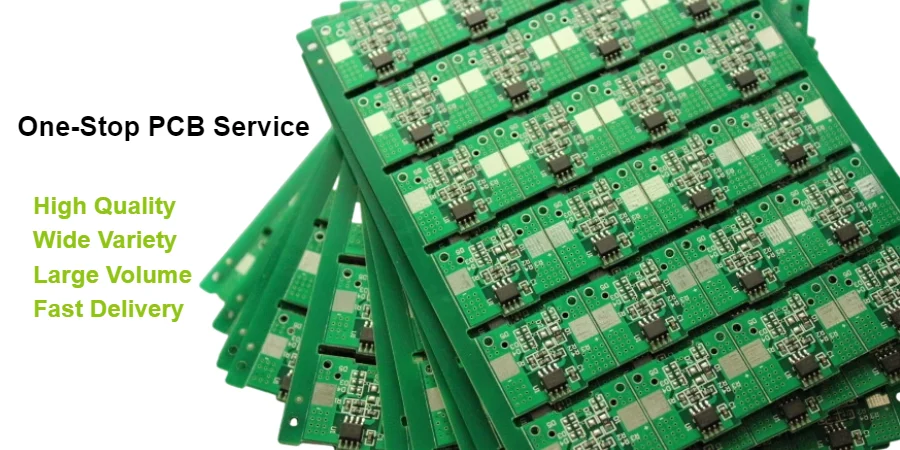
Choosing a PCB manufacturing partner is no longer only about comparing board prices. Modern electronic products require coordination between PCB fabrication, component sourcing, assembly, testing, and delivery. A supplier that only produces bare boards may not provide enough support when projects move from prototype validation into stable production.
A one-stop PCB service combines PCB manufacturing, component procurement, PCBA assembly, inspection, testing, and logistics under one controlled workflow. For engineering teams, the value is not simply convenience. The value is reducing manufacturing uncertainty while keeping product quality, schedule, and cost under control.
This guide explains what a complete turnkey PCB & PCBA service should include, how to evaluate suppliers, and which technical factors determine whether a manufacturing partner can support your project.
What does a one-stop PCB service include?
A complete one-stop PCB service connects the entire manufacturing chain:
- PCB fabrication
- Component sourcing
- SMT and THT assembly
- Inspection and testing
- Programming and functional verification
- Packaging and shipment support
Instead of managing separate PCB factories, distributors, assembly houses, and testing providers, customers work with one project team responsible for the complete delivery.
A typical project package includes:
- Gerber files or PCB manufacturing data
- BOM with manufacturer part numbers
- Pick-and-place files
- Assembly drawings
- Test requirements
- Delivery requirements
The supplier reviews the complete package before production to identify manufacturability issues, component risks, and process requirements.
Why do engineers choose turnkey PCB assembly instead of multiple suppliers?
The traditional multi-supplier model creates several coordination points:
| Manufacturing stage | Traditional approach | One-stop approach |
|---|---|---|
| PCB fabrication | Separate PCB supplier | Managed by integrated supplier |
| Component purchasing | Customer manages vendors | Supplier manages sourcing |
| Assembly | Separate EMS provider | Controlled PCBA process |
| Testing | Separate responsibility | Defined test ownership |
| Quality issues | Multiple parties investigate | Single engineering owner |
The main advantage of a one-stop PCB partner is accountability. When PCB fabrication, assembly, and testing are connected, engineering teams can identify problems faster and maintain better revision control.
What services should a reliable turnkey PCB partner provide?
PCB fabrication capability
The PCB supplier should match the complexity of your design requirements.
Important capability areas include:
- Layer count support
- HDI capability
- Blind and buried vias
- Rigid-flex manufacturing
- Controlled impedance
- Surface finish options
- Copper thickness control
- Material selection
For high-speed or high-frequency designs, specify exact materials and electrical requirements. For example, RF and signal-integrity-sensitive designs may require controlled dielectric properties and impedance targets rather than standard FR-4 assumptions.
Component sourcing and BOM management
A strong turnkey partner supports:
- Manufacturer part number verification
- Authorized sourcing channels
- Lifecycle checking
- Obsolescence review
- Approved alternate suggestions
- Lot traceability
A BOM review should identify risks before production begins, including:
- End-of-life components
- Long lead-time parts
- Package compatibility problems
- Incorrect footprints
- Supply shortages
SMT and THT assembly
Assembly capability determines whether a supplier can support modern electronic products.
Key evaluation points include:
- Minimum component size capability
- Fine-pitch QFN and BGA assembly
- Double-sided assembly
- Lead-free soldering processes
- Reflow profile control
- Selective soldering
- Through-hole assembly
Inspection capability should include appropriate methods for the design:
- SPI for solder paste quality
- AOI for placement defects
- X-ray inspection for hidden joints such as BGA connections
- ICT or functional testing when required
How do you compare one-stop PCB suppliers?
Use a supplier evaluation matrix before selecting a manufacturing partner.
| Evaluation area | Questions to ask | Project impact |
|---|---|---|
| Manufacturing capability | Can they build your layer count, materials, and assembly complexity? | Determines technical feasibility |
| Engineering support | Do they provide DFM/DFT feedback before production? | Reduces redesign cycles |
| Component control | How are parts sourced and verified? | Reduces counterfeit and shortage risks |
| Quality system | Are inspection records and traceability available? | Improves production consistency |
| Testing capability | Can they support ICT, FCT, programming, or custom fixtures? | Improves field reliability |
| Production scalability | Can they move from prototype to volume production? | Supports long-term growth |
A suitable supplier should demonstrate both manufacturing capability and engineering ownership.
What information should you provide for an accurate PCB or PCBA quotation?
A complete technical package improves quotation accuracy.
For PCB fabrication, provide:
- Gerber or ODB++ files
- Layer count
- Finished board thickness
- Copper weight
- Material requirements
- Surface finish
- Hole specifications
- Impedance requirements
- Inspection requirements
For PCBA assembly, provide:
- BOM with manufacturer part numbers
- Approved alternatives
- Pick-and-place files
- Assembly drawings
- Component sourcing requirements
- Testing procedures
- Programming files if applicable
Clear requirements reduce unexpected engineering changes after production starts.
What are the most common turnkey PCBA failure points?
| Failure mode | Typical cause | Prevention method |
|---|---|---|
| Component shortage delays | BOM contains unavailable parts | Lifecycle review and approved alternates |
| Assembly defects | Incorrect footprints or weak process control | DFM review and AOI inspection |
| BGA reliability issues | Hidden solder joint problems | X-ray inspection and process control |
| Signal integrity problems | Incorrect stack-up or impedance planning | Controlled impedance review |
| Production inconsistency | Missing process records | Traceability and quality documentation |
A reliable supplier addresses these issues before shipment rather than only reacting after failures occur.
What is the typical one-stop PCB manufacturing workflow?
A professional turnkey PCB project usually follows these stages:
1. Engineering review
The supplier reviews:
- PCB files
- BOM
- assembly data
- test requirements
- production goals
DFM and DFT feedback is provided before manufacturing release.
2. Quotation and process confirmation
The project team confirms:
- Materials
- Manufacturing route
- Component sourcing scope
- Inspection requirements
- Delivery schedule
3. PCB fabrication
The manufacturing process includes:
- Inner layer processing
- Lamination
- Drilling
- Plating
- Imaging
- Solder mask
- Surface finishing
- Electrical testing
4. Assembly and inspection
The PCBA process includes:
- Solder paste printing
- Component placement
- Reflow soldering
- AOI inspection
- THT assembly if required
- Functional verification
5. Final testing and shipment
The completed assemblies are prepared with:
- Test records
- Inspection reports
- ESD-safe packaging
- Shipping documentation
How should you select a PCB partner for prototype, NPI, and mass production?
Different project stages require different capabilities.
| Project stage | Main requirement | Supplier capability needed |
|---|---|---|
| Prototype | Fast learning and engineering feedback | Quick response, DFM support |
| Pilot production | Process stability | Repeatable manufacturing and testing |
| Mass production | Cost and reliability | Supply chain control and quality systems |
A supplier experienced only in prototypes may not have the process discipline required for volume manufacturing. Likewise, a large-volume manufacturer may not provide enough engineering support during early development.
What quality controls should a turnkey PCB supplier provide?
A professional manufacturing partner should support:
- Incoming quality inspection (IQC)
- In-process inspection (IPQC)
- Final quality inspection (FQC)
- Outgoing quality inspection (OQC)
- Manufacturing traceability
- Defect analysis and corrective actions
Quality should be demonstrated through records, not only statements.
Useful documentation includes:
- Inspection reports
- Test results
- Material certificates
- Process records
- Reliability reports when required
FAQ: One-stop PCB and PCBA services
Is turnkey PCB assembly more expensive?
The quoted unit price may not always be lower than using multiple suppliers. However, integrated manufacturing can reduce hidden costs caused by communication delays, rework, purchasing problems, and production coordination.
Can I provide my own components?
Yes. Many suppliers support partial turnkey models where customers provide selected components while the manufacturer manages PCB fabrication, assembly, and testing.
Can one-stop PCB services support small quantities?
Many providers support prototype builds, pilot runs, and production quantities. The right supplier depends on your technical requirements and expected production volume.
What files are needed to start?
Most projects begin with Gerber files, BOM data, assembly files, and testing requirements. The supplier then performs engineering review and provides a manufacturing proposal.
Conclusion: Choose a PCB partner that manages manufacturing risk
A reliable one-stop PCB service provider does more than combine PCB fabrication and assembly. The right partner provides engineering support, supply chain control, quality assurance, and a clear path from prototype to production.
For hardware teams, the goal is not simply receiving assembled boards. The goal is building a repeatable manufacturing process that supports product reliability and business growth.
When evaluating turnkey PCB & PCBA partners, focus on technical capability, engineering communication, quality systems, and production readiness. A strong manufacturing partner becomes an extension of your engineering team and helps transform designs into reliable products.