
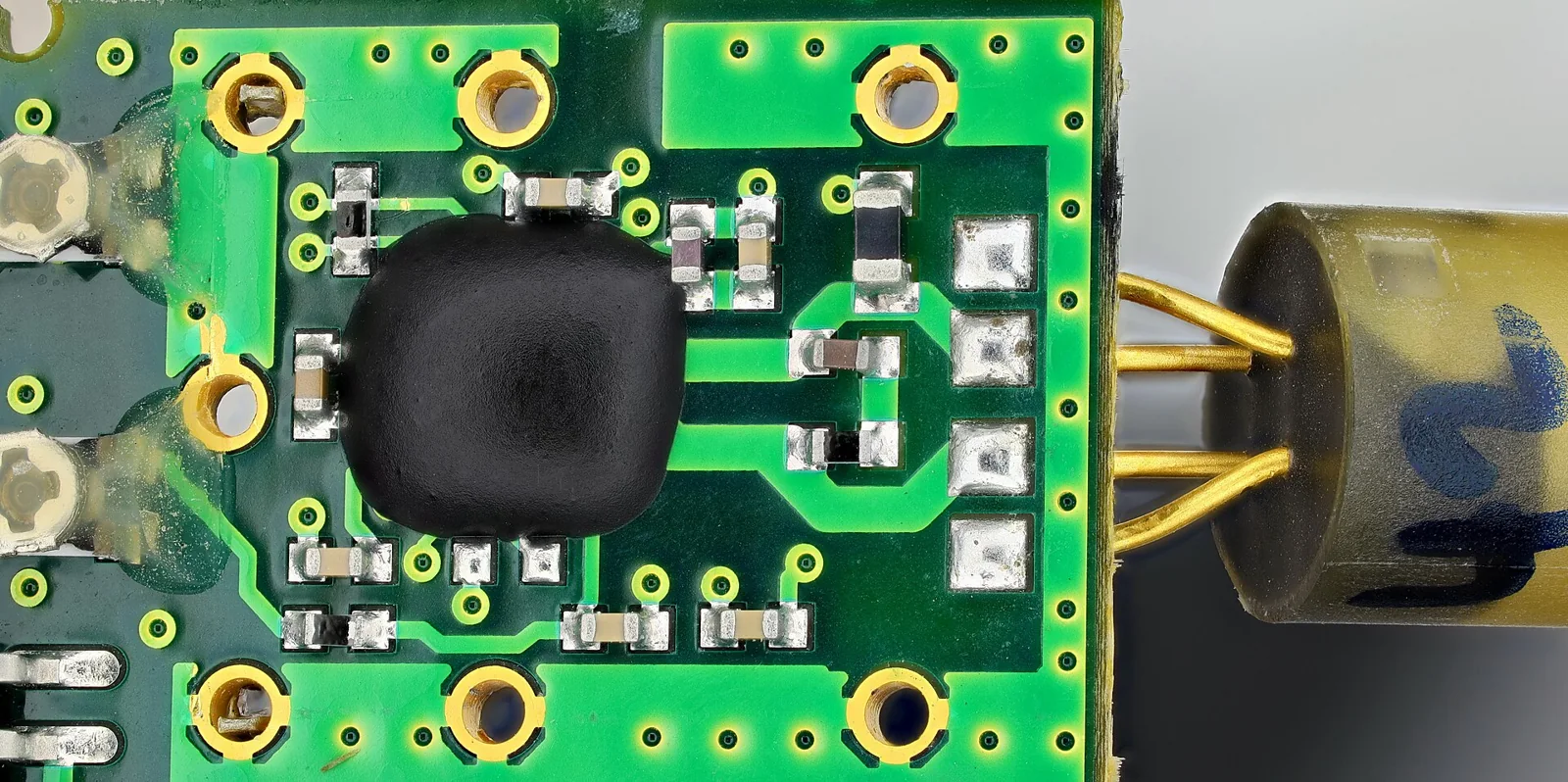
An optical interconnect PCB is not a board that carries light through copper. In most architectures, the PCB carries high-speed electrical signals from an ASIC, switch, or processor interface to an optical engine, where electrical-to-optical conversion occurs.
The critical engineering decision is whether the PCB portion of that electrical channel can preserve enough signal margin after accounting for:
- laminate properties
- trace geometry
- copper roughness
- routing length
- vias and layer transitions
- connectors or footprints
- manufacturing tolerances
- thermal and mechanical constraints
A successful review connects design intent to measurable fabrication requirements.
What does an optical interconnect PCB actually carry?
The PCB normally carries electrical differential lanes. The optical engine performs optical conversion.
That distinction defines the review boundary.
A PCB manufacturer can control and verify:
- finished stackup construction
- dielectric thickness
- copper features
- controlled impedance structures
- drill and via geometry
- registration
- dimensional tolerances
A PCB manufacturer does not independently prove:
- optical coupling efficiency
- end-to-end bit-error-rate performance
- protocol compliance
- complete system eye performance
- assembled optical-module qualification
The first review question should therefore be:
Which electrical lanes physically exist on this PCB, and what requirements must they satisfy before reaching the optical engine?
This applies across different architectures:
| Architecture | PCB review focus |
|---|---|
| Pluggable optics | Longer electrical paths make laminate loss, routing distance, connectors, and transitions critical |
| On-board optics | Shorter paths reduce loss but increase sensitivity to breakout, thermal structures, and local geometry |
| Co-packaged optics | The electrical path may move closer to the package, but remaining PCB interfaces still require controlled design |
For related design considerations, see high-speed PCB practices and high-frequency PCB material guidance.
How should ASIC-to-optical-engine lanes be reviewed?
Review the lane as a complete channel rather than as an individual trace.
A typical path may include:
- ASIC package escape
- BGA breakout
- controlled-impedance routing
- layer transitions
- via fields
- optical-engine footprint
- connector or assembly interface
Each transition can introduce:
- impedance discontinuity
- reflection
- insertion loss
- skew
- return-path disruption
- mode conversion
Continuity testing only confirms that copper connections exist. It does not confirm that the high-frequency channel maintains signal integrity.
Optical interconnect PCB decision matrix: what should be verified?
| Design element | Primary risk | Engineering decision | Evidence to request |
|---|---|---|---|
| Laminate selection | Excess dielectric and conductor loss | Select material based on channel loss budget, not application name alone | Material grade and finished stackup |
| Differential routing | Impedance variation | Define target impedance and manufacturing tolerance | Impedance coupon results or verification plan |
| Reference planes | Return-path discontinuity | Maintain continuous references under critical lanes | Layer review and stackup documentation |
| Via transitions | Stub resonance and reflection | Define transition strategy and back-drill requirements where needed | Drill and back-drill records |
| Breakout geometry | Local discontinuities | Include pads, neck-downs, and escape routing in SI analysis | Artwork review |
| Thermal copper | Changed electromagnetic environment | Coordinate thermal structures with SI layout | Plane and copper review |
| Manufacturing variation | Margin loss | Use realistic fabrication tolerances | Process capability and inspection records |
The strongest optical-interconnect PCB reviews treat each design feature as a parameter, risk, and evidence relationship.
How do stackup and laminate choices affect optical interconnect PCB performance?
Material selection starts with the electrical channel.
A laminate choice should consider:
- data rate
- lane length
- allowed insertion loss
- dielectric thickness
- copper profile
- trace geometry
- number of transitions
Dielectric constant affects impedance and propagation behavior. Dissipation factor affects dielectric loss. Copper surface roughness influences conductor loss at high frequencies.
A material family alone is not enough.
For example, a low-loss laminate may improve margin, but a poorly designed transition field can still dominate channel performance. Conversely, a shorter electrical path may allow a less aggressive material solution.
Common stackup decisions include:
Reference-plane assignment
Critical differential pairs should have defined reference relationships. Layer assignment should happen before routing, not after signal-integrity problems appear.
This is a PCB stack-up decision.
Hybrid constructions
Some designs use higher-performance materials only where loss sensitivity requires them while using standard materials elsewhere.
Hybrid stackups require review of:
- lamination compatibility
- thickness control
- resin systems
- manufacturing process limits
Material options discussed in Megtron PCB and RF Rogers applications depend on the exact grade, construction, and fabrication process.
Via structures
Layer transitions are often among the highest-risk locations.
Review:
- via barrel length
- unused via stub length
- back-drill requirements
- transition layer count
- return-via placement
A trace can meet impedance targets while the via transition creates unacceptable discontinuity.
What thermal issues should be reviewed near an optical engine?
Optical engines combine high-speed electrical requirements with thermal and mechanical constraints.
Thermal solutions can affect signal integrity when they change:
- reference planes
- copper distribution
- dielectric environment
- routing availability
Review these areas together:
| Thermal feature | PCB review consideration |
|---|---|
| Thermal vias | Confirm they do not interrupt critical return paths |
| Copper spreading areas | Check impact on nearby differential lanes |
| Heat sinks or mechanical supports | Verify keep-outs and assembly constraints |
| Fiber routing area | Protect optical access while preserving electrical routing |
| Local plane changes | Recheck SI assumptions after mechanical changes |
A thermal modification introduced after SI review can invalidate previous assumptions.
What should PCB suppliers provide before fabrication?
A supplier review should connect every critical requirement to a verification record.
Recommended RFQ and fabrication inputs include:
- approved material family or acceptable alternatives
- complete stackup requirements
- finished board thickness
- controlled-impedance requirements
- critical differential-pair identification
- via and back-drill requirements
- dimensional tolerances
- flatness requirements near optical assemblies
- thermal/mechanical constraints affecting copper
Supplier evidence may include:
- stackup confirmation
- material identification
- impedance measurements
- drill verification
- dimensional inspection
- electrical test records
Use DFM guidelines when preparing fabrication documentation and testing and quality references when defining board-level verification expectations.
Optical interconnect PCB supplier checklist
Before approving a PCB supplier, confirm:
| Question | Why it matters |
|---|---|
| Can the supplier build the required stackup? | High-performance materials require controlled fabrication capability |
| How is impedance verified? | Calculated impedance is not the same as finished-board verification |
| How are critical vias controlled? | Transition structures can consume channel margin |
| Are material substitutions controlled? | Different dielectric properties can change performance |
| Are thermal features included in review? | Late mechanical changes can affect SI |
| Are acceptance records defined? | Compliance requires measurable evidence |
For server and AI infrastructure applications, optical-interconnect requirements often appear in server and data center PCB and communication equipment PCB programs, but acceptance criteria should always come from the actual electrical channel requirements.
FAQ: Optical interconnect PCB design review
Does an optical interconnect PCB carry optical signals?
Usually no. The PCB carries electrical signals to an optical engine or transceiver assembly. Optical waveguide boards are a separate technology.
Can standard FR4 be used?
Possibly. The correct choice depends on the electrical channel budget. Lower-loss materials may be required when routing length, data rate, or transition count reduces available margin.
Does passing continuity testing prove the board works?
No. Continuity confirms electrical connection. High-speed performance requires analysis and verification of impedance, loss, transitions, and return paths.
Who validates optical-link performance?
System and module teams validate complete optical performance. The PCB supplier verifies the board requirements assigned to fabrication.
What is the most important optical interconnect PCB review step?
Define the complete PCB electrical channel first. Once the lane boundary, loss allocation, stackup, transitions, and evidence requirements are clear, supplier decisions become measurable.
Public references
High-Speed PCB
Support-page context for high-speed electrical channel design.PCB Impedance Control
Support-page context for controlled impedance requirements.High-Frequency PCB
Support-page context for loss-sensitive materials.PCB Stack-Up
Support-page context for controlled construction.Server & Data Center PCB
Application context for optical-interconnect hardware.Testing & Quality
Board-level inspection and validation context.
Author and review information
- Author: APTPCB editorial team
- Technical review: High-speed / high-frequency PCB engineering review team
- Review scope: Optical interconnect PCB channel definition, stackup selection, impedance control, via transitions, thermal integration, and supplier evidence requirements