
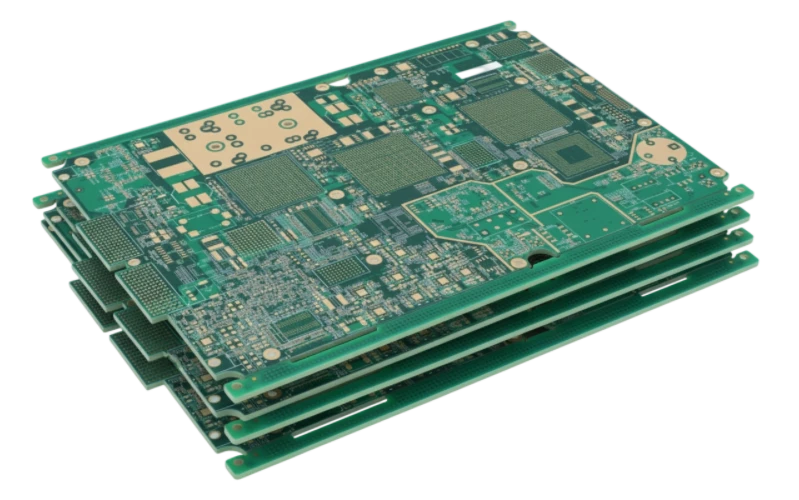
The oscilloscope is the fundamental tool for any electronics engineer, acting as the "eyes" that visualize electrical signals. At the heart of this equipment lies the Oscilloscope PCB, a highly specialized printed circuit board designed to handle high-speed signal acquisition, precise analog-to-digital conversion, and complex data processing without introducing noise or distortion.
Designing and manufacturing an Oscilloscope PCB is one of the most challenging tasks in the electronics industry. It requires a perfect balance between analog signal integrity and high-speed digital processing. Whether you are building a rugged Handheld Oscilloscope for field work or a high-precision Benchtop Oscilloscope for a laboratory, the PCB foundation dictates the accuracy of the measurement.
At APTPCB (APTPCB PCB Factory), we understand that the performance of test equipment is only as good as its weakest link. This guide covers the entire lifecycle of an Oscilloscope PCB, from defining the scope and selecting materials to validating the final assembly.
Key Takeaways
- Signal Integrity is Paramount: The primary function of an Oscilloscope PCB is to transport signals from the probe tip to the Oscilloscope ADC without alteration.
- Material Selection: High-bandwidth scopes often require hybrid stackups (e.g., Rogers combined with FR4) to minimize dielectric loss.
- Layer Stackup Strategy: Proper grounding and layer isolation are critical to prevent digital noise from corrupting sensitive analog front-end signals.
- Thermal Management: High-speed ADCs and FPGAs generate significant heat, requiring advanced thermal vias and heat sink integration.
- Manufacturing Precision: Controlled impedance and backdrilling are often mandatory to prevent signal reflection at high frequencies.
- Validation: Testing goes beyond standard connectivity; it involves Time Domain Reflectometry (TDR) and eye diagram analysis.
What Oscilloscope PCB really means (scope & boundaries)
Having established the core takeaways, it is essential to define exactly what constitutes an Oscilloscope PCB system, as it is rarely a single board.
An Oscilloscope PCB is not just a standard circuit board; it is a high-performance interconnect system. In modern Digital Storage Oscilloscopes (DSO), the PCB architecture is usually divided into three distinct functional zones, often physically separated or carefully isolated on a single board:
- The Analog Front End (AFE): This is the most critical section. It contains attenuators, amplifiers, and signal conditioning circuits. The PCB layout here must mimic RF design principles to maintain flat frequency response.
- The Digital Acquisition & Processing Zone: This area houses the Oscilloscope ADC (Analog-to-Digital Converter), memory buffers, and the FPGA or ASIC processor. The challenge here is managing extremely fast rise times and massive data throughput.
- The User Interface & Power Management: This section drives the Oscilloscope Display, handles button inputs, and regulates power. While lower speed, switching power supplies here can be a major source of noise if not filtered correctly.
The boundary of an Oscilloscope PCB project extends beyond the copper etching. It includes the selection of low-roughness copper foils, the calculation of precise dielectric constants, and the mechanical integration with shielding cans to block EMI (Electromagnetic Interference).
Oscilloscope PCB metrics that matter (how to evaluate quality)
Understanding the scope of the system leads directly to the specific metrics used to evaluate the board's performance. If the PCB cannot support the theoretical limits of the components, the oscilloscope will fail to meet its specifications.
| Metric | Why it matters | Typical Range / Factors | How to Measure |
|---|---|---|---|
| Bandwidth Integrity | Determines the maximum frequency the PCB can transmit without significant attenuation (-3dB point). | 50 MHz to 100+ GHz. Dependent on material Dk/Df and trace length. | Vector Network Analyzer (VNA) S21 parameters. |
| Impedance Control | Mismatched impedance causes signal reflections, creating "ghosting" or measurement errors. | Typically 50Ω ±5% or ±10% for single-ended traces. | Time Domain Reflectometry (TDR) coupons. |
| Signal-to-Noise Ratio (SNR) | A noisy PCB raises the noise floor, masking small signals and reducing the Effective Number of Bits (ENOB). | High-end scopes aim for >50dB. Influenced by crosstalk and grounding. | Spectrum Analysis with inputs terminated. |
| Propagation Delay Skew | In multi-channel scopes, signals must arrive at the ADC at the exact same time. | < 10ps mismatch for high-speed scopes. Controlled by trace length matching. | TDR or high-speed pulse measurement. |
| Thermal Conductivity | ADCs and processors can exceed 100°C; poor heat dissipation causes drift or failure. | > 1.0 W/mK for dielectrics; use of metal core or heavy copper. | Thermal imaging cameras under load. |
| Dielectric Loss (Df) | High loss materials absorb signal energy, reducing bandwidth and rounding square waves. | Standard FR4: ~0.02; High-speed (Rogers/Megtron): < 0.005. | Material datasheet verification & VNA testing. |
How to choose Oscilloscope PCB: selection guidance by scenario (trade-offs)
Metrics provide the data, but the correct Oscilloscope PCB design choice depends entirely on the intended application. Below are common scenarios and the necessary trade-offs.
1. The High-Frequency Lab Benchtop (1GHz+)
- Requirement: Extreme signal fidelity and low jitter.
- Recommendation: Use a Hybrid Stackup. Combine high-frequency laminates (like Rogers 4000 series) for signal layers with standard FR4 for power/mechanical layers.
- Trade-off: Higher manufacturing cost and complex lamination cycles, but essential for bandwidth.
- APTPCB Insight: For frequencies above 1GHz, standard FR4 is too lossy.
2. The Portable Handheld Oscilloscope
- Requirement: Compactness, battery efficiency, and durability.
- Recommendation: Utilize HDI PCB (High Density Interconnect) technology. Use blind and buried vias to reduce board size and integrate the Oscilloscope Display driver tightly.
- Trade-off: Higher density increases crosstalk risks; requires careful thermal planning since fans are often absent.
3. The Educational / Hobbyist Scope (<100MHz)
- Requirement: Low cost and durability.
- Recommendation: Standard multi-layer FR4 (Tg150 or Tg170).
- Trade-off: Signal attenuation is acceptable at these lower frequencies. Focus shifts to robust mechanical connectors for frequent student use.
4. The Automotive / Industrial Scope
- Requirement: High voltage isolation and noise immunity.
- Recommendation: Thick copper weights (2oz+) for power handling and wider spacing for creepage/clearance rules.
- Trade-off: Larger board footprint required to maintain safety isolation distances.
5. The PC-Based USB Oscilloscope
- Requirement: Small form factor and USB noise rejection.
- Recommendation: 4-6 layer board with dedicated ground planes shielding the USB interface from the analog inputs.
- Trade-off: Reliance on host PC for processing reduces board complexity but increases reliance on clean USB power filtering.
6. Mixed-Signal Oscilloscope (MSO)
- Requirement: Simultaneous analog and digital logic analysis.
- Recommendation: Strict partitioning. Use "moats" or gaps in power planes to prevent fast digital logic switching noise from bleeding into the Analog Oscilloscope channels.
- Trade-off: Complex routing paths; often requires more layers to bridge signals across isolated zones.
Oscilloscope PCB implementation checkpoints (design to manufacturing)
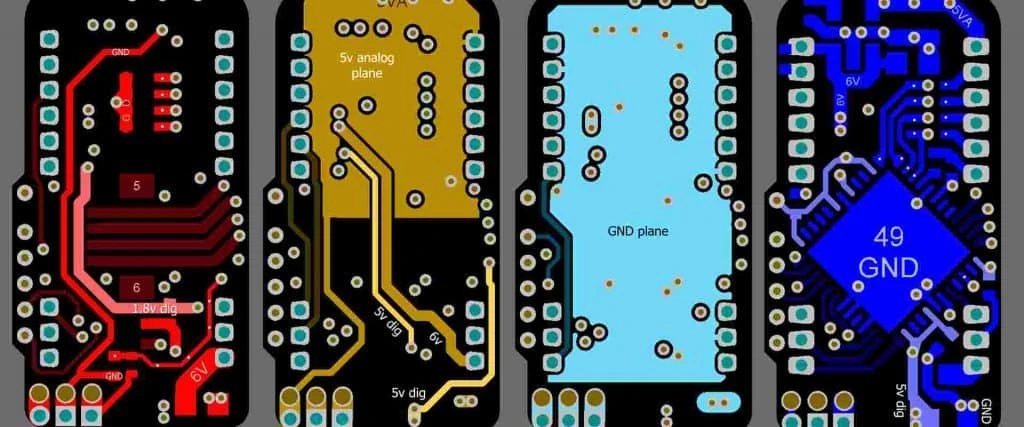
After selecting the right approach for your scenario, the project moves to the execution phase. The following checkpoints ensure the design intent survives the manufacturing process.
Stackup Definition:
- Recommendation: Define the layer stackup before routing. Consult with APTPCB engineering to verify material availability.
- Risk: Redesigning traces because the factory cannot stock the specific prepreg thickness.
- Acceptance: Approved stackup diagram with calculated impedance.
Material Selection Verification:
- Recommendation: For High Frequency PCB designs, specify the exact laminate series (e.g., Isola 370HR vs. FR408HR).
- Risk: "Generic FR4" substitution leading to high dielectric loss.
- Acceptance: Material datasheet confirmation in the quote.
Analog-Digital Partitioning:
- Recommendation: Physically separate the AFE from the digital processing. Do not route analog traces over digital ground planes.
- Risk: Digital switching noise coupling into the measurement trace.
- Acceptance: Design Rule Check (DRC) and visual inspection of split planes.
Impedance Simulation:
- Recommendation: Use field solvers to calculate trace widths for 50Ω (single) and 100Ω (diff pair).
- Risk: Signal reflections causing measurement inaccuracies.
- Acceptance: Impedance Calculator verification.
Via Stub Removal (Backdrilling):
- Recommendation: For signals >1Gbps, apply backdrilling to remove unused via barrels (stubs).
- Risk: Stubs act as antennas, causing resonance and signal notches.
- Acceptance: Fabrication drawing specifying backdrill locations.
Power Distribution Network (PDN):
- Recommendation: Use interplane capacitance (power and ground layers close together) to filter high-frequency noise.
- Risk: Voltage ripple affecting the Oscilloscope ADC reference voltage.
- Acceptance: PDN simulation or decoupling capacitor audit.
Shielding and Grounding:
- Recommendation: Add stitching vias along the board edge (Faraday cage) and around sensitive analog blocks.
- Risk: EMI entering or leaving the device.
- Acceptance: Via fencing inspection in Gerber files.
Surface Finish Selection:
- Recommendation: Use ENIG (Electroless Nickel Immersion Gold) or ENEPIG for flat pads and good solderability on fine-pitch components.
- Risk: HASL surface unevenness causing BGA soldering defects on the FPGA.
- Acceptance: Specification in fabrication notes.
Thermal Via Placement:
- Recommendation: Place vias directly in the thermal pads of hot components (ADC/FPGA).
- Risk: Component overheating and thermal shutdown.
- Acceptance: Solder mask definition (plugged/capped vias).
Final DFM Review:
- Recommendation: Submit data for a comprehensive Design for Manufacturing review.
- Risk: Production hold due to tight tolerances or acid traps.
- Acceptance: Clean DFM report from the manufacturer.
Oscilloscope PCB common mistakes (and the correct approach)
Even with a solid plan, specific errors frequently occur in Oscilloscope PCB designs. Recognizing these pitfalls saves time and money.
Mistake 1: Splitting Ground Planes Incorrectly.
- Issue: Creating a full split between Analog and Digital grounds but routing traces across the gap. This creates a massive return current loop and radiates noise.
- Correction: Use a solid, continuous ground plane whenever possible. If splits are necessary, bridge them only where signals cross, or use differential pairs that carry their own reference.
Mistake 2: Ignoring the "Return Path".
- Issue: Thinking of signals as one-way streets. High-speed signals return through the path of least inductance (directly underneath the trace).
- Correction: Ensure every high-speed signal has an uninterrupted reference plane immediately below it.
Mistake 3: Overlooking Fiber Weave Effect.
- Issue: On high-speed scopes, the glass weave in the PCB material can cause skew if one part of a differential pair runs over glass and the other over resin.
- Correction: Use "spread glass" materials or route traces at a slight angle (zig-zag) relative to the weave.
Mistake 4: Poor BNC Connector Layout.
- Issue: The transition from the BNC connector to the PCB trace is a common impedance discontinuity point.
- Correction: Optimize the landing pad footprint and ground voiding to match 50Ω right at the entry point.
Mistake 5: Neglecting Mechanical Stress.
- Issue: Handheld Oscilloscope PCBs flex during button presses, cracking ceramic capacitors.
- Correction: Keep sensitive components away from mounting holes and button areas, or use flex-cracking resistant capacitors.
Mistake 6: Inadequate Test Points.
- Issue: Designing a board that cannot be debugged or calibrated.
- Correction: Include accessible test points for critical voltages and signals, but ensure they don't act as stubs on high-speed lines.
Oscilloscope PCB FAQ (cost, lead time, materials, testing, acceptance criteria)
To clarify remaining doubts, here are answers to the most frequent questions regarding Oscilloscope PCB manufacturing.
1. What factors drive the cost of an Oscilloscope PCB the most? The primary cost drivers are the material (High-frequency laminates like Rogers are significantly more expensive than FR4), the layer count (needed for isolation), and advanced features like blind/buried vias or backdrilling.
2. How does lead time differ for standard vs. high-frequency oscilloscope boards? Standard FR4 boards can be produced in 24-48 hours. However, boards requiring hybrid stackups or special materials often have a lead time of 5-10 days due to material procurement and complex lamination cycles.
3. Can I use standard FR4 for a 500MHz Oscilloscope PCB? It is risky. While high-performance FR4 (like Isola FR408) might work, standard FR4 has high dielectric loss at 500MHz, which will attenuate the signal and degrade the rise time accuracy. A hybrid approach is safer.
4. What are the acceptance criteria for impedance control on these boards? Typically, manufacturers offer IPC Class 2 or Class 3 standards. For oscilloscopes, we recommend specifying ±5% tolerance for impedance traces rather than the standard ±10%, verified via TDR coupons included on the production panel.
5. How do you test the reliability of the Oscilloscope ADC connection? We use Automated Optical Inspection (AOI) for surface defects and X-Ray inspection for BGA components (like the ADC and FPGA) to ensure no solder bridges or voids exist under the chips.
6. What surface finish is best for high-frequency signal integrity? Immersion Silver or ENIG are preferred. HASL (Hot Air Solder Leveling) is not recommended because the uneven surface changes the thickness of the solder, slightly altering the impedance of surface traces.
7. Why is "Backdrilling" mentioned frequently for oscilloscope boards? Backdrilling removes the unused portion of a plated through-hole (via stub). In high-speed scopes, these stubs reflect signals. Removing them is essential for maintaining signal integrity above 1-2 GHz.
8. How does APTPCB handle the sourcing of specialized laminates? For specific high-frequency laminates from Rogers, Isola, Panasonic, or another named manufacturer, confirm the exact grade, availability, source documents, and lead time during the quoting phase.
9. Is it necessary to simulate the PCB thermal profile? Yes. The Oscilloscope Display drivers, ADCs, and FPGAs generate heat. If the PCB cannot dissipate this heat through thermal vias to inner planes, the measurement accuracy will drift as the device warms up.
10. What data files are required for a quote? We need Gerber files (RS-274X), a drill file, a detailed stackup drawing specifying material types and layer order, and an IPC netlist for electrical testing.
Resources for Oscilloscope PCB (related pages and tools)
- High Frequency PCB Manufacturing: Deep dive into materials like Rogers and Teflon.
- HDI PCB Capabilities: Learn about blind and buried vias for compact designs.
- Impedance Calculator: A tool to estimate trace width and spacing for your stackup.
- Testing and Quality Control: Details on how we validate complex PCBA assemblies.
Oscilloscope PCB glossary (key terms)
Finally, here is the terminology essential for communicating your design requirements effectively.
| Term | Definition |
|---|---|
| ADC (Analog-to-Digital Converter) | The chip that converts continuous analog voltage into digital numbers. The most critical component on the board. |
| Backdrilling | A manufacturing process to drill out the unused portion of a via barrel to reduce signal reflection. |
| Bandwidth | The frequency range where the signal is attenuated by less than 3dB. |
| Blind Via | A via that connects an outer layer to an inner layer but does not go through the entire board. |
| Buried Via | A via connecting inner layers only, invisible from the outside. |
| Crosstalk | Unwanted signal transfer between adjacent traces due to electromagnetic coupling. |
| Dk (Dielectric Constant) | A measure of a material's ability to store electrical energy; affects signal speed and impedance. |
| Df (Dissipation Factor) | A measure of how much signal energy is lost as heat in the PCB material. |
| ENOB (Effective Number of Bits) | A measure of the dynamic performance of the ADC, heavily influenced by PCB noise. |
| Hybrid Stackup | A PCB layer structure that mixes different materials (e.g., Rogers and FR4) to balance cost and performance. |
| Jitter | The deviation from true periodicity of a presumably periodic signal, often caused by poor power integrity. |
| Rise Time | The time it takes for a signal to go from 10% to 90% of its final value; faster rise times require better PCBs. |
| TDR (Time Domain Reflectometry) | A measurement technique used to determine the impedance of traces on the manufactured PCB. |
Conclusion (next steps)
Designing an Oscilloscope PCB is a rigorous exercise in signal integrity, thermal management, and material science. Whether you are developing a next-generation Benchtop Oscilloscope or a specialized Oscilloscope ADC module, the board itself is an active component in your measurement chain.
To ensure your design transitions smoothly from simulation to reality, early engagement with your manufacturer is vital. When you are ready to move forward, prepare your Gerber files, define your target impedance, and specify your material requirements.
Ready to manufacture your high-precision test equipment? Contact APTPCB today for a comprehensive DFM review and quote. We specialize in the complex, high-reliability boards required for the test and measurement industry.
Model input impedance matching and front-end attenuator stages with our free circuit simulation tools.
Once the front-end layout is fixed, match the planned stackup and impedance tolerances to what our circuit board production lines actually support.