
Key Takeaways
- Definition Scope: A PA Speaker PCB encompasses both the high-current crossover networks in passive systems and the complex amplifier/DSP circuits in active systems.
- Critical Metric: Copper weight is often more important than layer count; 2oz or 3oz copper is standard to handle high wattage without voltage sag.
- Mechanical Stability: Unlike standard electronics, these boards endure constant, high-intensity vibration; component layout and adhesive usage are mandatory for reliability.
- Thermal Management: For active speakers, the PCB often acts as a primary thermal path; material selection (Tg and CTI) dictates the lifespan of the amplifier.
- Misconception: "Thicker is always better." While thickness helps rigidity, incorrect stackups in multi-layer boards can increase capacitance, affecting high-frequency audio clarity.
- Validation: Electrical testing is not enough; burn-in testing under load and vibration simulation are required to approve a design for mass production.
- Partnership: Working with a manufacturer like APTPCB (APTPCB PCB Factory) ensures that specific audio-grade requirements—like heavy copper plating and strict impedance control—are met during fabrication.
What Power Amplifier (PA) Speaker PCB really means (scope & boundaries)
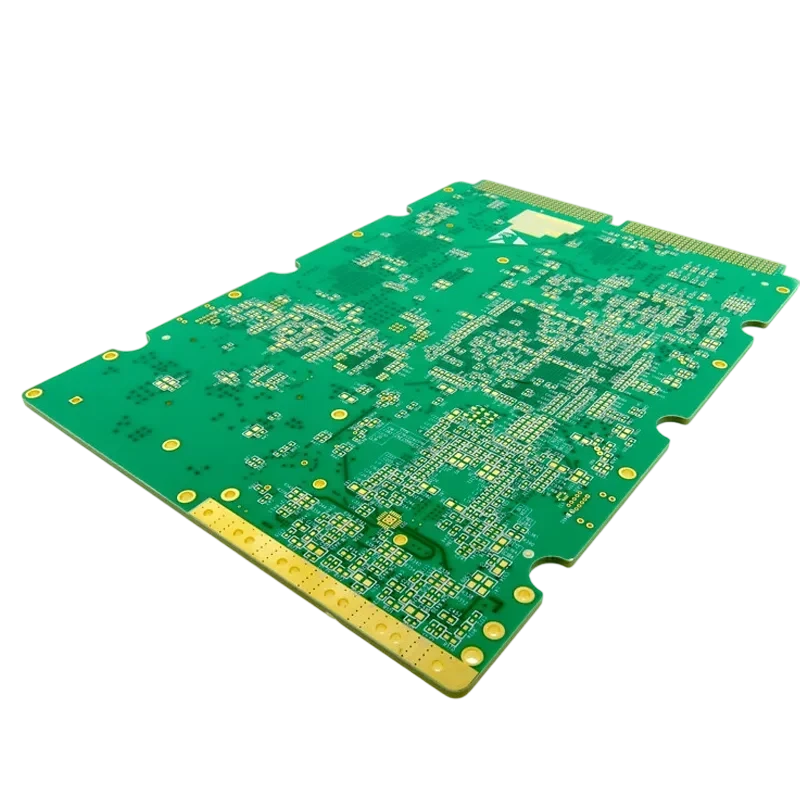
Understanding the core definition is the first step before diving into the technical metrics of a PA Speaker PCB. In the context of professional audio, a PA Speaker PCB (Public Address Speaker Printed Circuit Board) is the central hub that manages signal distribution, power amplification, and frequency division within a loudspeaker enclosure.
These boards operate in environments far harsher than consumer electronics. A PA system at a concert venue or a stadium installation faces extreme vibration, fluctuating temperatures, and demands for high continuous power output. Therefore, the manufacturing focus shifts from miniaturization to durability, thermal capacity, and signal integrity.
There are two primary categories to consider:
- Passive Speaker PCB: These are primarily crossover networks. They take a single amplified signal and split it into high, mid, and low frequencies using large inductors and capacitors. The PCB must handle high voltage and current without introducing resistance that would alter the speaker's tuning.
- Active Speaker PCB: These are integrated systems containing power supplies, Class-D or Class-AB amplifiers, and DSP (Digital Signal Processing) chips. These are complex, often multi-layer boards requiring a mix of high-power traces and sensitive low-voltage digital signal paths.
Whether you are designing a rugged touring monitor or a permanent ceiling installation, the PCB is the foundation of the audio performance.
Power Amplifier (PA) Speaker PCB metrics that matter (how to evaluate quality)
Once the scope of the project is defined, engineers must evaluate specific physical and electrical metrics to ensure the board can survive the operating environment. The following table outlines the critical parameters for a high-performance PA Speaker PCB.
| Metric | Why it matters for Audio | Typical Range / Factors | How to Measure |
|---|---|---|---|
| Copper Weight | Determines current carrying capacity. Thin traces cause resistance, heating, and power loss (compression) during bass peaks. | 2oz to 4oz (Standard is 1oz, which is often insufficient for PA woofers). | Micro-section analysis or resistance testing under load. |
| Glass Transition Temp (Tg) | Indicates when the PCB material begins to soften. Active speaker amps generate significant heat inside sealed boxes. | Tg150 to Tg170 (High Tg). Standard Tg130 may warp over time. | TMA (Thermomechanical Analysis) data from material datasheet. |
| CTI (Comparative Tracking Index) | Measures resistance to electrical breakdown/arcing. vital for high-voltage rails in high-power amplifiers. | PLC 0 or 1 (600V+). Essential for safety in high-wattage active speakers. | IEC 60112 standard testing. |
| Peel Strength | Measures how well the copper adheres to the substrate. Heavy components (inductors) can rip pads off during vibration. | > 1.4 N/mm. Enhanced by using high-quality prepreg materials. | Peel test (IPC-TM-650). |
| Dielectric Constant (Dk) | Affects signal propagation speed and capacitance. Critical for the DSP/Digital sections of active speakers. | 3.8 to 4.5 (Stable over frequency). FR4 is standard; Rogers used for high-end RF links. | Impedance testing (TDR). |
| Solder Mask Thickness | Provides insulation and prevents oxidation. Too thin exposes copper; too thick can crack under vibration. | 10µm to 25µm. | Cross-section microscopy. |
How to choose Power Amplifier (PA) Speaker PCB: selection guidance by scenario (trade-offs)
With the metrics established, the next step is selecting the right board architecture based on the specific application of the loudspeaker. Different audio scenarios require prioritizing different PCB attributes.
1. The Touring Line Array (Passive)
- Scenario: Large-format speakers flown in stadiums. High power, extreme vibration, frequent transport shock.
- Selection: Rigid 2-layer FR4 with 3oz or 4oz Heavy Copper.
- Trade-off: Higher cost for heavy copper, but essential to prevent trace burnout during 1000W+ peaks.
- Why: Reliability is paramount; a failure 50 feet in the air is unacceptable.
2. The Powered Studio Monitor (Active)
- Scenario: Critical listening, low noise floor, integrated Class-AB or Class-D amps.
- Selection: 4-layer or 6-layer PCB with separate ground planes.
- Trade-off: Higher manufacturing complexity to isolate the noisy power supply from the sensitive audio input.
- Why: Signal fidelity takes precedence over raw power handling.
3. The Portable Battery-Powered PA
- Scenario: Busking amps, portable event speakers. Space is tight; efficiency is key.
- Selection: High-density interconnect (HDI) or Rigid-Flex PCB.
- Trade-off: Significantly higher unit cost than standard rigid boards.
- Why: Allows the PCB to fold around battery compartments and fit into compact, molded enclosures.
4. High-Power Subwoofer (Active Class-D)
- Scenario: Generating massive low-end frequencies. The amplifier generates heat bursts.
- Selection: Metal Core PCB (MCPCB) or FR4 with massive thermal via arrays.
- Trade-off: MCPCB limits component routing to one layer (usually), requiring careful layout.
- Why: Efficient heat dissipation is the only way to keep the amp from entering thermal protection mode.
5. Installed Ceiling/Wall Speaker (70V/100V Systems)
- Scenario: Background music, safety paging. Low current, high voltage (step-down transformers).
- Selection: Standard CEM-3 or FR4, 1oz copper, high CTI rating.
- Trade-off: Lower mechanical strength, but cost-effective for mass production.
- Why: Cost sensitivity drives the decision, provided safety (high voltage isolation) is met.
6. Outdoor Stadium Horn (Weatherproof)
- Scenario: Permanent outdoor installation. Humidity, salt spray, temperature cycling.
- Selection: High-Tg FR4 with specialized Conformal Coating (parylene or silicone).
- Trade-off: Reworking the board later is difficult due to the coating.
- Why: Corrosion resistance is the primary failure mode to prevent.
Power Amplifier (PA) Speaker PCB implementation checkpoints (design to manufacturing)
After selecting the right board type, the project moves into the detailed design and fabrication phase where specific checkpoints ensure the theoretical design works in reality.
Design Phase Checkpoints:
- Trace Width Calculation: Do not rely on standard defaults. Use an IPC-2221 calculator. For a PA Speaker PCB handling 10A, traces must be significantly wider than digital logic traces.
- Component Placement for Vibration: Place heavy inductors and capacitors near the mounting holes (screws), not in the center of the board where flex is greatest.
- High-Voltage Isolation: For active speakers with mains power, ensure creepage and clearance distances meet UL/IEC 60065 or 62368 standards (often >3mm primary to secondary).
- Thermal Reliefs: Ensure thermal reliefs are used on ground pads to facilitate soldering, but ensure the "spokes" are thick enough to handle the current.
Manufacturing Phase Checkpoints (with APTPCB): 5. Material Verification: Confirm the fab house uses the specified High-Tg laminate. Substitution with standard FR4 is a common cause of field failure. 6. Heavy Copper Etching: Verify the manufacturer has Heavy Copper PCB capabilities. Etching thick copper requires precise chemical control to avoid undercutting (trapezoidal traces). 7. Solder Mask Dam: Ensure there is a solder mask dam between fine-pitch pads on DSP chips to prevent solder bridging. 8. Silkscreen Legibility: In PA systems, serviceability is key. Ensure polarity markings (+/-) for speakers are large and clearly visible for technicians.
Assembly & Post-Processing Checkpoints: 9. Adhesive Application: Specify RTV silicone or epoxy staking for large capacitors and inductors to bond them to the PCB surface. 10. Conformal Coating: If the speaker is for outdoor use, verify the coating thickness under UV light. 11. Connector Robustness: Through-hole connectors are preferred over Surface Mount (SMT) for the main speaker wire inputs due to the mechanical stress of plugging/unplugging. 12. First Article Inspection (FAI): Always perform a physical fit check and a thermal stress test on the first unit before mass production.
Power Amplifier (PA) Speaker PCB common mistakes (and the correct approach)
Even with a solid checklist, engineers often fall into specific traps when designing for audio applications. Avoiding these mistakes saves costly revisions.
1. Ignoring the "Ground Loop" in Layout
- Mistake: Daisy-chaining ground connections or creating large loops that act as antennas for hum and RF interference.
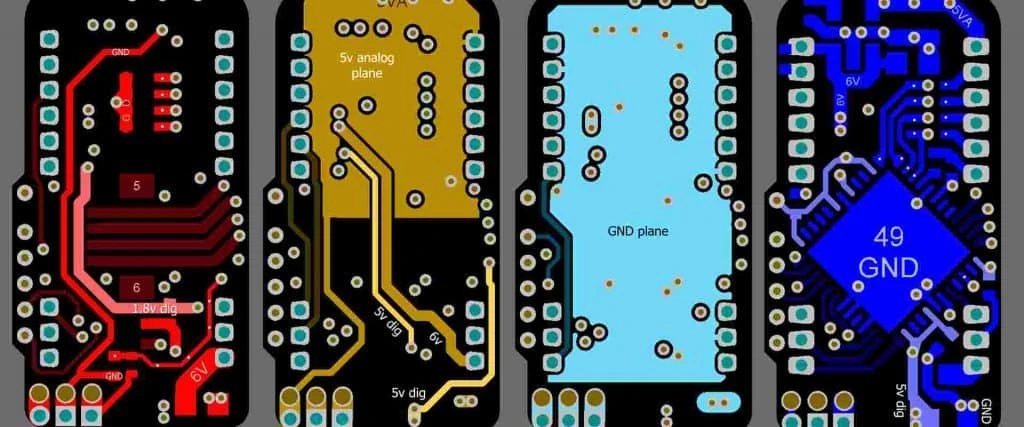
- Correction: Use a Star Ground topology or a dedicated ground plane. In Active Speaker PCB designs, strictly separate the noisy Class-D switching ground from the clean analog input ground.
2. Underestimating Mechanical Resonance
- Mistake: Designing the PCB size such that its natural resonant frequency matches the speaker's operating range (e.g., 100Hz-200Hz).
- Correction: Change the aspect ratio of the board or add additional mounting points to shift the resonant frequency higher, outside the danger zone of the woofer's main energy.
3. Insufficient Thermal Vias
- Mistake: Placing a power amplifier chip on the board but using tiny, sparse vias to transfer heat to the bottom layer.
- Correction: Use dense arrays of stitched vias. For high-power applications, consider Metal Core PCBs to maximize thermal transfer efficiency.
4. Placing Connectors in Hard-to-Reach Spots
- Mistake: Putting input connectors in the center of the board, making assembly inside the speaker cabinet difficult.
- Correction: Place all user-interface and power connectors at the board edge. This simplifies the Box Build Assembly process and reduces cable strain.
5. Using Standard Capacitors for Audio Paths
- Mistake: Using Class 2 ceramic capacitors (like X7R) in the audio signal path, which can introduce microphonic distortion (piezoelectric effect).
- Correction: Use C0G/NP0 dielectrics or film capacitors for analog signal paths to ensure audio purity.
6. Neglecting Inrush Current
- Mistake: Thin traces leading to the main power capacitors. When the amp turns on, the inrush current can blow these traces like a fuse.
- Correction: Calculate trace width based on peak inrush current, not just steady-state current.
Power Amplifier (PA) Speaker PCB FAQ (cost, lead time, materials, testing, acceptance criteria)
Addressing the most frequent questions helps clarify the logistics and technical nuances of ordering these boards.
Q1: What is the main cost driver for a PA Speaker PCB? The primary cost driver is usually copper weight. Moving from 1oz to 3oz copper can increase the board cost by 30-50% due to the raw material cost and the slower etching process required. However, this is an unavoidable cost for high-power passive crossovers.
Q2: How does lead time differ for Heavy Copper PCBs? Standard PCBs might take 3-5 days. Heavy copper boards (3oz+) often require 7-10 days because they need specialized lamination cycles and slower plating processes to ensure uniformity.
Q3: Can I use standard FR4 for a 1000W Active Speaker PCB? You can, provided you manage the heat. However, standard FR4 has a lower thermal conductivity (~0.3 W/mK). For 1000W amps, you typically need High-Tg FR4 combined with aggressive thermal via stitching, or you must switch to an Aluminum or Copper-based Metal Core PCB (1.0-3.0 W/mK).
Q4: What are the acceptance criteria for PA Speaker PCBs regarding warping? Because these boards are often large and carry heavy components, IPC Class 2 standard allows for 0.75% bow and twist. However, for speaker manufacturing, we recommend specifying <0.5% to ensure the board sits flat against heatsinks or mounting brackets without stress.
Q5: How do you test a PA Speaker PCB for vibration resistance? Electrical testing (E-Test) isn't enough. You must perform HALT (Highly Accelerated Life Testing) on the assembled unit. This involves placing the PCB (inside the speaker) on a vibration table and running it at high volume to see if solder joints crack or components detach.
Q6: What surface finish is best for PA Speaker PCBs? HASL (Hot Air Solder Leveling) is excellent for through-hole components and heavy copper boards due to its robust solderability. However, for Active Speaker PCBs with fine-pitch DSP chips, ENIG (Electroless Nickel Immersion Gold) is preferred for its flat surface.
Q7: Why is "Active Speaker PCB" design more difficult than Passive? Active designs involve "Mixed Signal" challenges. You have high-voltage power switching (Class D) occurring inches away from micro-volt level analog audio signals. Preventing the switching noise from bleeding into the audio path requires advanced layout techniques and often 4+ layer stackups.
Q8: Do I need impedance control for a PA Speaker PCB? For a purely passive crossover, no. However, for an Active Speaker PCB with digital inputs (Dante, AES/EBU, USB) or DSP memory buses, impedance control (usually 50Ω or 90Ω/100Ω differential) is mandatory to prevent data errors and audio dropouts.
Resources for Power Amplifier (PA) Speaker PCB (related pages and tools)
To further assist in your design and procurement process, utilize these specific resources from APTPCB:
- For High Power Handling: Explore Heavy Copper PCB Manufacturing to understand the capabilities for 3oz+ copper.
- For Thermal Management: Review Metal Core PCB Solutions if you are designing high-wattage Class-D amplifier modules.
- For Reliability Standards: Check our PCB Quality Control page to see how we validate boards against industry standards.
- For Full Assembly: If you need the board populated with components, look into our Box Build Assembly services.
Power Amplifier (PA) Speaker PCB glossary (key terms)
| Term | Definition |
|---|---|
| Crossover | A circuit (passive or active) that splits the audio signal into frequency bands (Low, Mid, High) for specific drivers. |
| Class D Amplifier | A highly efficient switching amplifier topology common in active speakers; requires careful PCB layout to minimize EMI. |
| Heavy Copper | PCB copper thickness generally considered to be ≥ 3oz (105µm), used for high current carrying capacity. |
| Tg (Glass Transition) | The temperature at which the PCB substrate changes from a rigid state to a deformable state. |
| Microphonics | The phenomenon where mechanical vibration is converted into unwanted electrical noise in the signal path. |
| DSP (Digital Signal Processor) | A chip used in active speakers for EQ, limiting, and time alignment; requires fine-pitch PCB fabrication. |
| Thermal Relief | A spoke pattern on a PCB pad connecting to a copper plane, allowing for easier soldering by reducing heat sinking. |
| Creepage | The shortest distance between two conductive parts along the surface of the insulation; vital for safety in powered speakers. |
| Clearance | The shortest distance between two conductive parts through the air. |
| BOM (Bill of Materials) | The list of all components (capacitors, resistors, chips) to be assembled onto the PCB. |
| Gerber Files | The standard file format sent to the manufacturer (like APTPCB) containing the PCB layer data. |
| Stackup | The arrangement of copper layers and insulating material in a multi-layer PCB. |
Conclusion (next steps)
Designing a successful PA Speaker PCB requires balancing electrical performance with extreme mechanical and thermal durability. Whether you are building a simple passive crossover or a complex active line array module, the board must withstand the very vibrations it helps create.
To move from concept to production, ensure your data package is complete. When submitting your design for a DFM (Design for Manufacturing) review or quote, please provide:
- Gerber Files: Including all copper, soldermask, and drill layers.
- Stackup Requirements: Specify copper weight (e.g., 2oz inner/outer) and material Tg.
- Assembly Drawings: Highlighting heavy components that require adhesive staking.
- Test Requirements: Specify if impedance control or specific voltage breakdown tests are needed.
By focusing on these details and partnering with an experienced manufacturer like APTPCB, you ensure your audio system delivers clear, powerful sound, show after show.