
In modern electronics, the difference between a design that “works on the bench” and a product that remains stable in the field is often determined by the quality of the PCB assembly solutions behind it. As systems move toward higher component density, tighter pitches, faster interfaces, and more demanding operating environments, assembly is no longer a simple manufacturing step—it becomes an engineering discipline that directly impacts yield, performance margin, reliability, and compliance.
At APTPCB, we deliver end-to-end PCB assembly solutions built for repeatability and verifiable quality—combining engineering review, controlled assembly processes, layered inspection and testing, and scalable production systems. For a full capability overview, visit the APTPCB homepage.
Menu Navigation
To help you quickly find the specific PCB assembly methods and quality controls you need, here is a structured directory of the core topics covered in this guide:
- DFM/DFA Engineering That Prevents Assembly Defects Before Production
- Controlling SMT and THT Process Windows for Complex Packages and Mixed Technology
- Building a Layered Quality Assurance System with SPI, AOI, X-Ray, and First-Article Discipline
- Verifying Electrical and Functional Performance with ICT, Flying Probe, and FCT Testing
- Delivering Turnkey PCB Assembly Solutions That Scale from NPI to Mass Production
Design for Manufacturability (DFM)/DFA Engineering That Prevents Assembly Defects Before Production
As product complexity increases, many PCBA failures are “designed in” long before manufacturing starts—through footprint decisions, solder mask definitions, thermal imbalance, or missing test access. A professional PCB assembly solution begins with DFM/DFA that targets the real root causes of yield loss and field returns.
At APTPCB, our engineers apply a production-intent DFM/DFA workflow to minimize rework loops, stabilize first-pass yield, and shorten NPI cycles.
Key DFM/DFA Techniques That Improve Yield
- Footprint and Pad Geometry Review: Fine-pitch pad spacing, solder mask registration, and toe/heel fillet targets are checked to prevent bridging and opens.
- BTC (QFN/LGA) Thermal Pad Strategy: Aperture segmentation and outgassing control are planned to reduce voiding and improve thermal/mechanical reliability.
- Via-in-Pad Risk Control: Decisions around filling/planarization are made to prevent solder wicking and weak joints under BGAs and dense packages.
- Thermal Balance and Tombstoning Prevention: Copper symmetry and localized thermal mass are evaluated to reduce tombstoning on small passives.
- Component Polarity and Assembly Documentation: Polarity marks, refdes clarity, and assembly notes are verified to reduce human and program-loading errors.
- Design-for-Test Planning: Test point access, spacing, and fixture feasibility are reviewed to enable ICT or efficient flying probe coverage.
When customers require rapid build-and-learn cycles, APTPCB supports structured new-product introduction through NPI assembly, ensuring early prototypes are built with production discipline rather than “prototype-only” shortcuts.
Controlling SMT and THT Process Windows for Complex Packages and Mixed Technology
Modern electronics rarely use “easy” components. A single board may include 01005 passives, BTC packages, high-I/O BGAs, RF shields, connectors, and through-hole power devices. In these designs, assembly success depends on controlling the process window across printing, placement, reflow, and through-hole soldering—so the same build quality can be repeated across lots and scaling stages.
APTPCB maintains stable assembly output by combining automation with measurable control points and documented parameters.
Key Manufacturing Controls for Advanced PCBA
- Solder Paste Printing Discipline: Paste type, working life, environmental conditions, and printer parameters are governed to reduce drift during long runs.
- Placement Accuracy and Changeover Governance: Vision alignment, feeder verification, and program control reduce misplacement and polarity escapes.
- Reflow Profiling by Thermal Mass: Profiles are engineered around board copper distribution and component heat sensitivity to reduce head-in-pillow, non-wet opens, and thermal damage.
- BTC and BGA Assembly Engineering: Solder volume strategy and warpage management are aligned to protect hidden joints and long-term reliability.
- Mixed Technology Coordination: SMT joints are protected during downstream through-hole operations through sequencing and localized soldering strategies.
- Selective Soldering for Dense Boards: For tight layouts, localized soldering reduces thermal impact on nearby SMT components and improves hole-fill consistency.
For assemblies involving fine pitch, BTCs, and BGAs, process requirements and controls are typically governed by package constraints and inspection needs; APTPCB summarizes these capabilities under BGA/QFN/fine pitch assembly and supports localized through-hole control via PCB selective soldering.
Building Layered Quality Assurance System with SPI, Automated Optical Inspection (AOI), X-Ray, and First-Article Discipline
In high-reliability electronics, inspection must be designed as a system—not a single checkpoint. The most effective approach uses layered gates that catch defects early, reduce the cost of correction, and prevent escapes into functional test or the field.
APTPCB structures inspection around high-leverage detection points—especially for hidden-joint packages where visual inspection alone is insufficient.
Key Inspection Gates That Reduce Escapes
- SPI (Solder Paste Inspection): Verifies paste volume/height/area before placement, catching insufficient paste and offset that often cause opens or shorts after reflow.
- AOI (Automated Optical Inspection): Provides 100% SMT inspection for presence, polarity, alignment, and visible solder quality indicators, enabling rapid process feedback.
- X-Ray for Hidden Joints: Essential for BGA and many BTC assemblies to detect internal bridging, opens, insufficient solder, and voiding that AOI cannot see.
- First-Article Verification: Confirms feeder loading, polarity, program accuracy, and critical settings before production ramp, reducing early-run scrap and rework.
- Defect Trend Feedback Loops: Inspection results are used to tune print, placement, and profile parameters, reducing repeated defects across builds.
- Final Visual Workmanship Check: A final gate catches cosmetic issues and subtle workmanship anomalies that automated methods may miss.
For hidden-joint verification and high-density assembly control, APTPCB formalizes this capability through X-ray inspection to support consistent quality in advanced package builds.
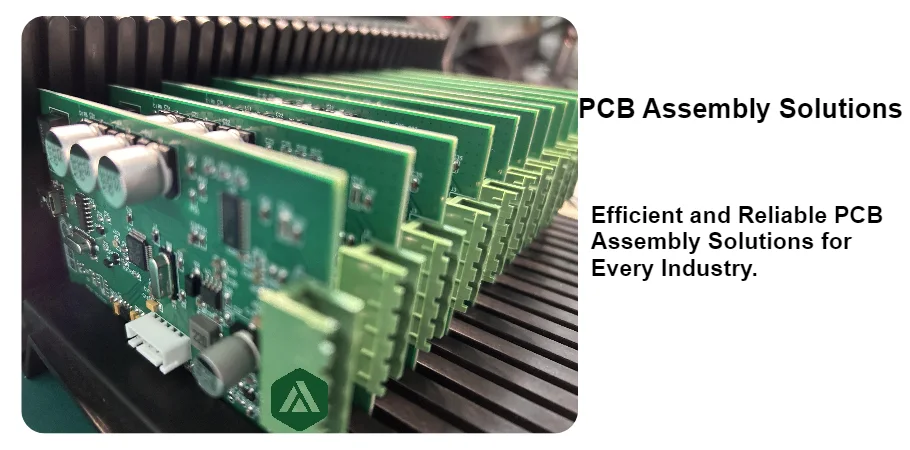
Verifying Electrical and Functional Performance with In-Circuit Test (ICT), Flying Probe, and FCT Testing
Inspection confirms workmanship—but testing proves correctness. A complete PCB assembly solution should verify electrical integrity and functional behavior in a way that matches production volume, product risk, and acceptance criteria.
APTPCB supports multi-stage validation approaches that combine structural coverage and real-world functional proof.
Key Test Methods Used in Professional PCB Assembly Solutions
- ICT (In-Circuit Test): High-speed structural testing for opens/shorts and many component-level faults in volume production when fixtures are feasible.
- Flying Probe Testing: Fixtureless electrical verification ideal for prototypes and small batches where design iterations are frequent.
- FCT (Functional Circuit Test): Simulates real operating conditions to validate interfaces, power behavior, communications, and system outputs.
- Programming and Configuration Checks: Reduces firmware mismatch risk and improves shipment consistency for connected devices and controllers.
- Test Coverage Planning: Test point strategy and acceptance criteria are aligned early to avoid expensive redesign for testability.
- Traceable Test Records: Test results can be linked to lot/serial traceability to support quality audits and faster failure analysis.
A layered strategy—Flying Probe for early builds, ICT for production screening, and FCT for final acceptance—often delivers the best balance of speed, cost, and reliability confidence.
Delivering Turnkey PCB Assembly Solutions That Scale from NPI to Mass Production
Many PCBA programs struggle not because the assembly line is weak, but because the supply chain and change control are unstable. Shortages, uncontrolled alternates, and inconsistent incoming quality can quickly cause line stoppages or latent reliability issues. A turnkey PCB assembly solution must therefore combine manufacturing with disciplined BOM governance and scalable production systems.
APTPCB supports customers from early prototypes to volume ramp with controlled sourcing, traceability, and repeatable production execution.
Key Capabilities That Enable Scalable Turnkey PCBA
- BOM and AVL Governance: Controlled alternates policy and lifecycle/lead-time risk review reduce unplanned substitutions and schedule disruption.
- Component Sourcing and Authenticity Controls: Procurement discipline and traceability reduce counterfeit risk and improve build consistency.
- Incoming Quality Control: Risk-based inspection prevents defective or wrong components from entering production.
- NPI-to-Volume Change Management: Revision alignment across BOM, programs, and work instructions prevents “silent drift” between builds.
- Mass Production Process Stability: Standardized work instructions, SPC monitoring, and consistent inspection/test gates protect yield at scale.
- Harsh-Environment Reliability Options: When moisture or contamination is a concern, conformal coating improves field stability and reduces corrosion risk.
For OEMs preparing for stable volume output, APTPCB supports production scaling through PCBA mass production, ensuring capacity planning and quality controls remain consistent as throughput increases.