
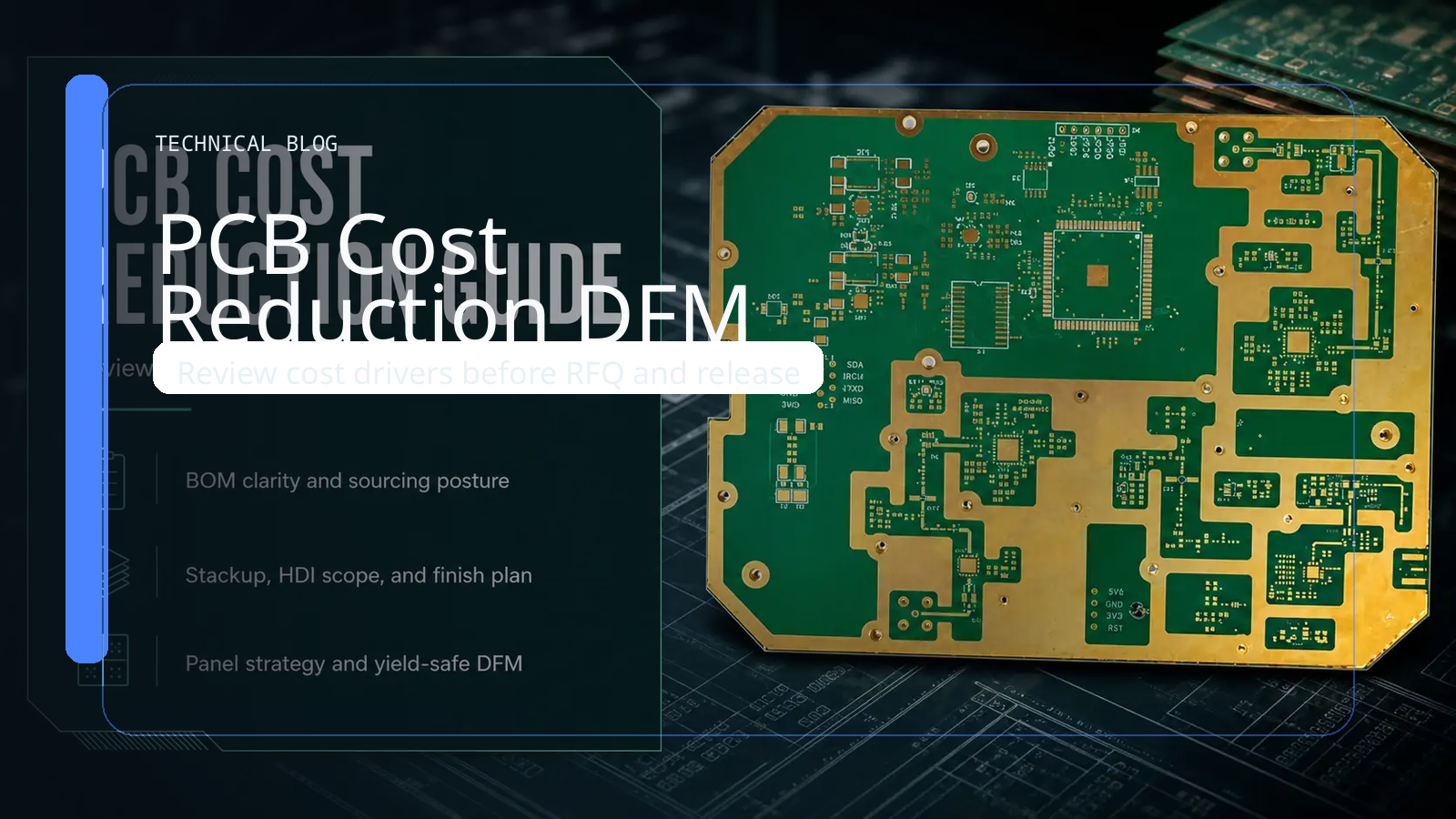
- Treat cost reduction as a design-review problem before formal quoting, not as a public price list.
- The narrow goal is to remove avoidable re-quote triggers caused by open stack-up, via, finish, prototype-stage, and BOM decisions.
- For the broader cost context, see the PCB Cost Reduction Guide.
Quick Answer PCB cost reduction through DFM is most useful before RFQ, re-quote, and release, when the team can still remove avoidable complexity or document it clearly. The biggest gains usually come from freezing the right design decisions early, not from chasing generic price claims after the package is already unstable.
Table of Contents
- What should be reviewed first?
- What does pcb cost reduction dfm mean here?
- Which DFM choices reduce avoidable cost?
- Where do cost-reduction claims usually go wrong?
- What should be reviewed before RFQ?
- Where do the DFM, prototype, and BOM pages fit?
- What should be frozen before quote?
- Next steps
- FAQ
What should be reviewed first?
Before asking how to lower PCB cost, review four boundaries:
- Is the board still a learning build, or is it already being packaged for quote and release?
- Which design choices are truly required, and which ones remain historical defaults or convenience calls?
- Do the fabrication files, notes, stack-up direction, and BOM context describe one build intent?
- Are there any features that are acceptable technically but still undefined commercially?
That order matters because many cost problems start as definition problems. A board may be fully buildable and still generate avoidable quote churn when the package leaves key decisions implied.
| Review boundary | What it answers | What it does not prove |
|---|---|---|
| Build stage | Whether the request is still exploratory or ready for controlled review | Final quote stability by itself |
| Required design choices | Which features belong to the product and which can still be simplified | That every simplification is acceptable electrically or mechanically |
| Package consistency | Whether files, notes, and sourcing context describe the same build | That no further engineering review is needed |
| Commercial clarity | Whether the cost discussion can stay attached to one released intent | That the first quote will never be revised |
What does pcb cost reduction dfm mean here?
Here, pcb cost reduction dfm is used in a narrow, practical way.
It covers:
- DFM decisions that reduce avoidable cost before RFQ
- the design and documentation gaps that often trigger re-quote
- the related pages that help close those gaps before release
- what to freeze so the quote can stay attached to one controlled revision
It does not try to provide:
- a universal price formula
- one universally preferred stack-up, finish, or via strategy for every board
- marketing claims about savings, lead time, or production outcome
- a duplicate of the broader cost-reduction guide
The distinction matters. The pillar guide covers wider cost topics across materials, structure, quantity context, and fabrication scope. The scope here is tighter: which DFM choices reduce avoidable cost and quote churn before the package is released.
Which DFM choices reduce avoidable cost?
The safest cost-reduction discussion starts with choices that often change quote scope when they stay unresolved.
| DFM choice | Why it changes cost posture | What should be explicit before RFQ |
|---|---|---|
| Layer and stack-up definition | Extra quote loops often start when the board class is named but the actual stack-up direction is still moving | Released layer count, layer roles, thickness direction, and any impedance-sensitive intent |
| Via strategy | Through vias, blind or buried structures, via-in-pad, fill, and back-drill notes can change review depth | Which via structures are required and where they are truly necessary |
| Material direction | Material family assumptions can stay hidden until the quote reaches engineering review | Intended material family or approved alternatives when the design depends on them |
| Finish duty | A finish choice may be driven by assembly planarity, contact wear, bondability, or storage posture rather than habit | What the finish needs to do on this board, not just the finish name |
| Copper and feature choices | Local heavy copper, dense breakout regions, or fine-feature areas may be real requirements or avoidable carryover | Which dense or process-sensitive areas are essential to the design |
| Panel and outline assumptions | Unclear rails, tabs, coupons, or array ownership can move the discussion later than it should | Whether the board should be quoted as a single, array, or panel-managed release |
| Assembly-linked layout choices | Cost churn often appears when fabrication looks stable but assembly constraints are still hidden | Any package, pad, clearance, or test-access issue that changes the build plan |
Three DFM habits usually help most:
1. Remove optional complexity before it becomes a quote assumption
If a feature was added for routing convenience, historical reuse, or an earlier prototype experiment, confirm that it still belongs in the release package.
2. Document required complexity instead of leaving it implied
Some features should stay. The cost problem is often not the feature itself, but that it appears in Gerbers without the supporting notes that explain the intended route.
3. Separate learning-build decisions from release-build decisions
A prototype may tolerate provisional stack-up choices, temporary part substitutions, or relaxed documentation discipline. A quote-ready package usually cannot.
The practical failure chain is straightforward: optional complexity or undocumented required complexity stays inside the release package -> quote review treats that ambiguity as an engineering hold -> the board is re-costed or re-routed once stackup, finish, or BOM ownership is clarified -> the program absorbs re-quote churn instead of a stable RFQ handoff.
Another common cost-reduction failure starts when the hardware team tries to save substrate money by forcing the board outline smaller and driving panel utilization harder than the manufacturing margin can tolerate. To keep routing alive inside that compressed area, the design pushes vias and annular rings to the edge of acceptability, for example 0.15 mm drill size with a 3 mil annular ring on a multilayer board. On paper, the board is cheaper because the area shrinks by a few dollars. In the real lamination and drilling process, the board stack still sees material movement, registration shift, and Drill wander. That is where the math collapses. The reduced ring no longer has enough margin to absorb process variation, so the hole breaks out of the pad, cuts the intended inner-layer connection, or clips into nearby ground copper. The result is Inner-layer breakout, open circuits, or hard shorts created before assembly even starts. The black humor is obvious: the customer saved $2 in area cost and destroyed the manufacturing yield. A board that might have run at 98% yield now suffers a Yield drop toward 40%, and the factory responds the only way it can: the unit price doubles, or the process is escalated into a much more expensive HDI or laser-drill route just to recover manufacturability. That is not cost reduction. It is a budget failure created by geometric over-compression.
Where do cost-reduction claims usually go wrong?
Cost-reduction articles become unreliable when they blur design review with generic pricing advice.
Common mistakes:
- treating every tighter feature as automatically unjustified without checking the product requirement first
- claiming that one material, finish, or via structure is always the low-cost answer
- mixing prototype-stage experimentation with release-stage quote guidance
- assuming fabrication simplification always lowers the total program cost when BOM or assembly risk may become the real blocker
- presenting cost reduction as a manufacturer ranking exercise instead of a package-readiness exercise
The stronger question is not Which board looks lowest in price at first glance? It is Which design choices are necessary, which ones are avoidable, and which ones must be documented before commercial review starts?
That is also why the scope here is narrower than the broader cost-reduction guide. This companion article stays focused on pre-RFQ DFM decisions.
What should be reviewed before RFQ?
Once the team decides to reduce avoidable cost through DFM, the package review becomes the next gate.
1. Review the physical board definition
Confirm that the released package clearly identifies:
- layer count and board outline
- stack-up direction and any controlled structures
- required via types and any special hole treatment
- finish intent where assembly or contact function depends on it
- fabrication notes that match the actual released data
2. Review whether any complexity is still optional
Ask whether the current revision still needs:
- specialized via structures in every region where they appear
- the current layer count and copper distribution
- process-sensitive outline or panel assumptions
- feature-level notes carried over from an earlier iteration
If the answer is uncertain, the quote may be evaluating design ambiguity rather than final cost posture.
3. Review assembly-linked cost triggers
Bare-board simplification does not always settle the commercial answer. Review whether the design also depends on:
- fine-pitch or dense-package placement
- pad conditions that affect assembly planarity or inspection
- hidden-joint coverage or x-ray dependence
- test-access limits
- revision-sensitive assembly notes
4. Review the sourcing package if assembly is in scope
If the RFQ includes assembly or is moving toward release, confirm that the BOM package identifies:
- exact manufacturer part numbers where required
- approved alternates if they exist
- package consistency with the layout
- do-not-fit logic and reference consistency
- which materials are customer-supplied versus manufacturer-managed
5. Review one controlled revision only
Many re-quotes are revision-control problems in disguise. The stack-up notes, fabrication files, drawings, and BOM should point to one released build state.
Where do the DFM, prototype, and BOM pages fit?
Use the related pages according to the gap that is still open:
- DFM Guidelines when the unresolved issue is stack-up, via treatment, fabrication notes, assembly-sensitive layout, or another manufacturability review point.
- PCB Prototype when the design is still in a validation stage and the main question is whether the next build is exploratory or production-intent.
- Components & BOM when the board definition is stable enough but the sourcing package still creates re-quote or release friction.
What should be frozen before quote?
Before a quote is expected to stay commercially meaningful, freeze:
- the board class and released stack-up direction
- the via strategy, including any filled, capped, buried, or back-drilled structures that are actually required
- the finish intent and any contact, soldering, or assembly-sensitive duty
- feature-level notes that change fabrication route or inspection expectations
- the build stage, so the request is clearly validation prototype, production-intent prototype, or release-ready RFQ
- the BOM boundary if assembly is included
- one active revision state across fabrication data, drawings, and BOM
If those items are still moving, the design may still be reviewed, but the cost answer should be treated as provisional rather than as a stable release input.
Next steps with APTPCB
When the main manufacturability, build-stage, and sourcing questions are already settled, move to Online Quote with one controlled revision package. If the remaining question is no longer DFM cleanup but what the released fabrication package reveals commercially, continue to How to Estimate PCB Cost from Gerber Before RFQ.
If the package still needs DFM-side cleanup, send the fabrication files, stackup direction, via requirements, finish duty, BOM scope, and build-stage note through the PCB cost and DFM review request. APTPCB can review which features are essential, which ones remain optional, and which package gaps are most likely to force re-quote before release.
Next steps with APTPCB
If you are about to issue a volume-production RFQ and you suspect the design still contains over-specified tolerances, unnecessary blind or buried via structures, or quiet DFM traps that can destroy yield after quote approval, do not wait for the supplier to discover them after the budget is already committed. This is where many apparently efficient designs still hide the features that make the commercial answer unstable.
Send the full quote and design package, including Gerber or ODB++, stackup intent, and BOM, to [email protected] or through the PCB cost and DFM review request.
APTPCB's CAM and quoting engineering team will return a Cost-Driver & DFM Blind-spot Review within 24 hours. We will identify process features that are expensive without being necessary, expose the DFM traps most likely to reduce First-Pass Yield, and help you lock a cleaner RFQ posture before tolerance overreach or avoidable process escalation gets priced into the build.
FAQ
Is PCB cost reduction through DFM mostly a fabrication question?
Not always. Many avoidable quote changes start in fabrication choices, but assembly assumptions, BOM instability, and revision control can change the commercial answer just as much.
Should every complex feature be removed to reduce cost?
No. The goal is not to flatten the design into the simplest possible board. The goal is to remove optional complexity and document required complexity before RFQ.
Why do re-quotes happen even when the Gerbers are complete?
Because Gerbers alone may not explain build intent, stack-up direction, finish duty, BOM scope, or release stage. The files can be complete and still leave the quote boundary unclear.
When is this page more useful than the main cost-reduction guide?
Use this page when the narrow problem is pre-RFQ DFM cleanup. Use the broader cost-reduction guide when you need the wider context across materials, quantity posture, and fabrication scope.
What usually blocks a stable quote after DFM cleanup?
Often it is no longer the bare board. The blocking issue shifts to build-stage ambiguity, revision drift, or a BOM package that still leaves sourcing ownership and alternates unclear.
Public references
IPC-2581 Consortium, "What is IPC-2581?" Supports the one-controlled-package framing used when DFM cleanup depends on digital release clarity.
APTPCB DFM Guidelines Supports the manufacturability-review posture used throughout the page.
APTPCB PCB Prototype page Supports the build-stage boundary used to separate exploratory and release-ready package states.
APTPCB Components and BOM page Supports the sourcing-boundary discussion used when BOM ownership changes the commercial answer.
Author and review information
- Author: APTPCB quoting, DFM, and release-package content team
- Technical review: manufacturability, RFQ-intake, and document-control engineering team
- Last updated: 2026-05-15