
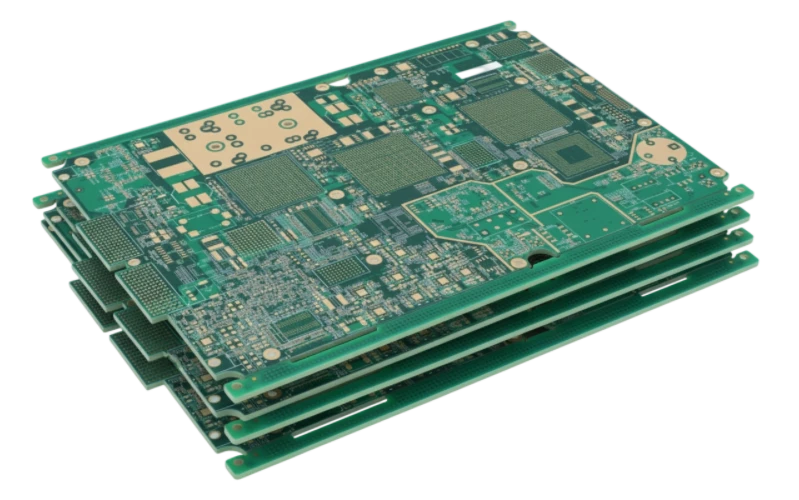
PCB delamination is the mechanical separation of bonded interfaces within a multilayer printed circuit board, typically occurring between copper foil and prepreg, core dielectric and prepreg, or across laminate weaves. During lead-free reflow soldering (peak temperatures of 245°C to 260°C), vapor pressure from absorbed moisture can exceed internal laminate bond strength. This forces adjacent layers apart, resulting in internal voids, localized blistering, dielectric breakdown, and catastrophic electrical opens.
Because the same appearance can come from different failure mechanisms, the correct response depends on where the separation occurred, when it appeared, and which process created the weak interface.
A blister discovered after reflow may originate from:
- moisture absorbed during storage,
- weak core/prepreg bonding,
- contamination before lamination,
- poor resin flow,
- drilling or plating damage,
- solder mask adhesion problems,
- excessive thermal exposure during assembly.
The fastest path to root cause is not assuming the board was “wet.” It is identifying the failed interface and matching evidence to the manufacturing history.
What is delamination? Delamination vs blistering vs measling
Delamination means "coming apart in layers." In a PCB it is a separation between layers of laminate, or between laminate and copper, so the board no longer acts as one bonded stack. Engineers and inspectors often use three related words, and they point to different evidence. In German the same defect is called Delamination or Delaminierung of the Leiterplatte.
| Condition | What you see | Where it sits | Typical driver |
|---|---|---|---|
| Delamination | Separation between layers, sometimes visible as a light area or a bulge; often only found by microsection or acoustic scan | Between core, prepreg, and copper layers | Weak bond, contamination, moisture, excessive heat |
| Blistering | Localized raised bubble on or near the surface | Under solder mask, finish, or a near-surface layer | Trapped moisture or gas expanding during heat |
| Measling | White spots or crosses inside the laminate at glass-weave intersections | Inside the base material, at fiber bundles | Thermal or mechanical stress separating glass and resin |
| Crazing | Connected white spots or lines inside the laminate | Glass-resin interface | Mechanical stress, often from machining |
IPC-A-600 describes how each condition is judged on bare boards. Measling and crazing can be acceptable within limits depending on class and spacing to conductors, while delamination and blistering that reduce spacing between conductors are typically rejects. Confirm the exact criteria against the revision and class in your purchase order. For how inspection evidence feeds into supplier release, see our PCB quality assurance and inspection page.
How do you identify whether PCB delamination or blistering occurred?
Start with the physical location of the separation.
| Failure location | Likely contributors | Useful confirmation |
|---|---|---|
| Core-to-prepreg interface | Moisture, contamination, resin flow, cure, press conditions | Microsection, lamination records, material traceability |
| Inner-layer copper interface | Bond treatment, oxide process, handling contamination, resin starvation | Cross-section, peel/bond evaluation, process review |
| Via wall or plated hole | Drill damage, smear, desmear, plating adhesion, trapped chemistry | Hole microsection, plating records |
| Solder mask over copper | Surface preparation, contamination, cure, chemical compatibility | Adhesion testing, microscopy, cure records |
| Surface finish interface | Pretreatment, plating chemistry, thermal stress | Surface analysis and process history |
| Flex adhesive or coverlay | Material compatibility, lamination cycle, bending stress | Construction review and flex-area inspection |
Photograph the defect before destructive testing. Record:
- panel position,
- layer location,
- board revision,
- lot number,
- assembly history,
- reflow profile,
- bake history,
- storage exposure.
Destructive analysis performed too early can remove evidence about the original failure interface.
Why does moisture cause PCB blistering during reflow?
PCB laminates are moisture-sensitive materials. Absorbed moisture can remain inside resin systems and interfaces until a thermal event causes rapid expansion.
During soldering or rework, temperatures can exceed 200°C. If moisture or volatile material is trapped near a weak interface, vapor pressure can exceed local bond strength and create:
- internal delamination,
- surface blistering,
- resin cracking,
- plated-hole stress.
At what temperature does a PCB delaminate?
There is no single temperature. Delamination resistance is a laminate property measured as time to delamination at a fixed temperature: T260 and T288 report how many minutes a sample survives at 260°C or 288°C before it separates, and Td reports the temperature at which the resin loses 5% of its weight. Lead-free reflow peaks of roughly 245–260°C sit close to these test points, which is why moisture and repeated reflow cycles matter. If a board must survive several lead-free reflows or rework, specify a laminate with suitable Td and T260/T288 values, such as a High-Tg PCB for lead-free reflow, and take the actual numbers from the laminate datasheet.
Moisture increases risk, but moisture alone does not explain every failure. A well-bonded board can normally tolerate assembly heating. Repeated failures after a normal reflow profile indicate that material, lamination, adhesion, or process controls should also be reviewed.
What PCB material and lamination factors increase delamination risk?
Material selection and multilayer construction determine how much thermal and mechanical stress a board can tolerate.
Specify:
- exact laminate family and grade,
- dielectric thickness,
- resin system,
- glass style,
- Tg and Td requirements,
- copper weight,
- heavy-copper areas,
- controlled-impedance requirements,
- thermal cycling requirements.
Tg, Td, T260, and T288 describe different material behaviors. A higher value in one category does not automatically guarantee resistance to delamination.
| Risk factor | Engineering impact | Verification evidence |
|---|---|---|
| Unapproved material substitution | Changes thermal and mechanical behavior | Material certificate and lot records |
| Incorrect resin content | Weakens bonding or changes dielectric structure | Stack-up review and microsection |
| Poor resin flow | Creates voids or weak interfaces | Lamination coupons and inspection |
| Contaminated copper surfaces | Reduces adhesion strength | Process records and surface inspection |
| Incorrect press cycle | Produces incomplete cure or poor bonding | Temperature, pressure, vacuum history |
| Heavy copper features | Increase local thermal stress | Stack-up review and thermal analysis |
For how press cycles, material storage, and lay-up are controlled on multilayer builds, see multilayer PCB lamination services.
Lamination quality depends on controlled:
- temperature ramp,
- pressure profile,
- vacuum conditions,
- resin viscosity behavior,
- cure time,
- material storage.
Can drilling, desmear, or plating create PCB blistering?
Yes. Not all blisters begin in lamination.
Desmearing removes resin smear from the hole wall after drilling so electroless copper can bond to the inner-layer copper. Too little desmear leaves smear that blocks the bond; too much etches back resin and glass and creates voids or stress points that can open up as blisters around the hole. Hole-related failures may result from:
- excessive drill wear,
- damaged glass bundles,
- poor smear removal,
- aggressive desmear chemistry,
- incomplete conditioning,
- weak electroless copper adhesion,
- plating stress.
A plated-hole investigation should include representative microsections, especially for:
- high-aspect-ratio vias,
- buried/blind vias,
- thermally stressed locations,
- failed and passing comparison samples.
Surface blisters also require separate evaluation. A raised area near solder mask or finish does not automatically indicate internal laminate delamination.
How should PCB storage, baking, and reflow be controlled?
Moisture prevention starts before assembly.
Control:
- unopened material storage,
- humidity exposure,
- package opening time,
- floor life,
- bake requirements,
- rework exposure.
Baking a bare board before assembly (German: Platine tempern) drives out absorbed moisture. Bake conditions depend on board thickness, surface finish, and laminate, so take them from the fabricator or the applicable handling standard, not from a generic rule. If baking is required, define:
- temperature,
- duration,
- board thickness limitations,
- surface-finish limitations,
- maximum time before assembly.
Baking removes absorbed moisture but cannot repair:
- weak laminate bonding,
- under-cured resin,
- poor plating adhesion,
- damaged interfaces.
Review the complete thermal history:
- reflow ramp rate,
- soak region,
- peak temperature,
- time above liquidus,
- cooling rate,
- number of thermal cycles,
- rework events.
What failure-analysis process finds the root cause fastest?
A structured investigation should separate observation from assumption.
PCB delamination failure analysis workflow
- Contain the affected lot and preserve failed and unfailed samples.
- Record material, storage, fabrication, assembly, and thermal history.
- Map defect location across panels and boards.
- Identify the separation interface using microscopy or scanning acoustic methods.
- Perform microsection analysis through the suspect area and a control area. Our PCB microsection analysis guide covers coupon selection and what to read in the cross-section.
- Compare findings with laminate, lamination, drilling, plating, and assembly records.
- Confirm corrective action using representative validation builds.
| Failure mode | Possible cause | Confirmation method |
|---|---|---|
| Blister after first reflow | Moisture, weak bond, volatile material | Moisture history, microsection, thermal review |
| Repeated failure at same layer | Lamination or material issue | Stack-up and press records |
| Failure near vias | Hole preparation or plating issue | Via cross-section |
| Failure after rework | Local thermal stress | Rework history and thermal profile |
| Intermittent panel locations | Contamination or process variation | Panel mapping and lot review |
How do you prevent PCB delamination and blistering before production?
The most effective prevention combines design, fabrication, assembly, and supplier documentation.
| Risk | Preventive control | Evidence |
|---|---|---|
| Wrong laminate | Material approval and substitution control | Lot/certificate record |
| Resin starvation or voids | Stack-up and press qualification | Microsection inspection |
| Weak inner-layer bonding | Surface treatment and hold-time control | Process records and coupons |
| Moisture before assembly | Packaging, storage, bake instructions | Handling records |
| Hole-wall adhesion failure | Drill, desmear, plating control | Microsections and electrical results |
| Solder-mask blistering | Surface preparation and cure control | Adhesion/cure records |
| Excess assembly heat | Released thermal profile and rework limits | Profile records |
What should be included in a PCB delamination RFQ?
A supplier cannot control reliability risks that are not defined during quotation.
Include:
- Exact material system and approved substitutions
- Tg, Td, and thermal-performance requirements
- Layer count and stack-up requirements
- Copper weights and heavy-copper features
- Hole structures and aspect ratios
- Surface finish requirements
- Assembly thermal exposure
- Storage and bake requirements
- Reliability testing requirements
- Acceptance criteria
- First article expectations
- Traceability requirements
- Microsection and inspection reports
Use the PCB stack-up service and DFM guidelines to reduce material and process risks before production.
Which standards apply to PCB delamination and blistering?
Common references include:
- IPC-4101 — Base materials for rigid and multilayer printed boards
- IPC-6012 — Rigid printed board qualification and performance
- IPC-A-600 — Acceptability of printed boards
- IPC-TM-650 — Test Methods Manual
- J-STD-020 — Moisture/reflow sensitivity classification for nonhermetic surface-mount devices
- J-STD-033 — Handling, packing, shipping and use of moisture/reflow-sensitive devices
Confirm current revisions and whether the document applies to the PCB, component, or assembly scope.
PCB delamination and blistering FAQ
What is delamination in a PCB?
It is the separation of bonded layers inside the board, for example between core and prepreg or between copper and resin. It weakens the board mechanically and can open conductors or reduce insulation spacing.
What is measling in a PCB?
Measling is white spots or crosses inside the laminate where glass fibers have separated from the resin at weave intersections. It is usually caused by thermal or mechanical stress, and it is judged against IPC-A-600 criteria rather than treated as automatic delamination.
Are PCB delamination and blistering the same?
No. Delamination describes separation between bonded interfaces. Blistering describes a visible raised area that may result from delamination, trapped gas, moisture expansion, or other adhesion failures.
Does baking fix a delaminated PCB?
No. Baking can reduce moisture before assembly, but it cannot restore a damaged bond interface or correct poor lamination, cure, or plating adhesion.
Can a PCB pass electrical testing and still have delamination?
Yes. Electrical continuity may remain intact until thermal cycling, vibration, humidity, or assembly stress expands the damaged area.
What tests are used to investigate PCB delamination?
Common methods include microscopy, microsection analysis, scanning acoustic microscopy, thermal-profile review, and review of manufacturing records.
What information should be sent to a PCB supplier for failure analysis?
Provide failed and control samples, board revision, lot information, defect photographs, location mapping, assembly history, storage conditions, bake history, reflow profile, and acceptance requirements.