
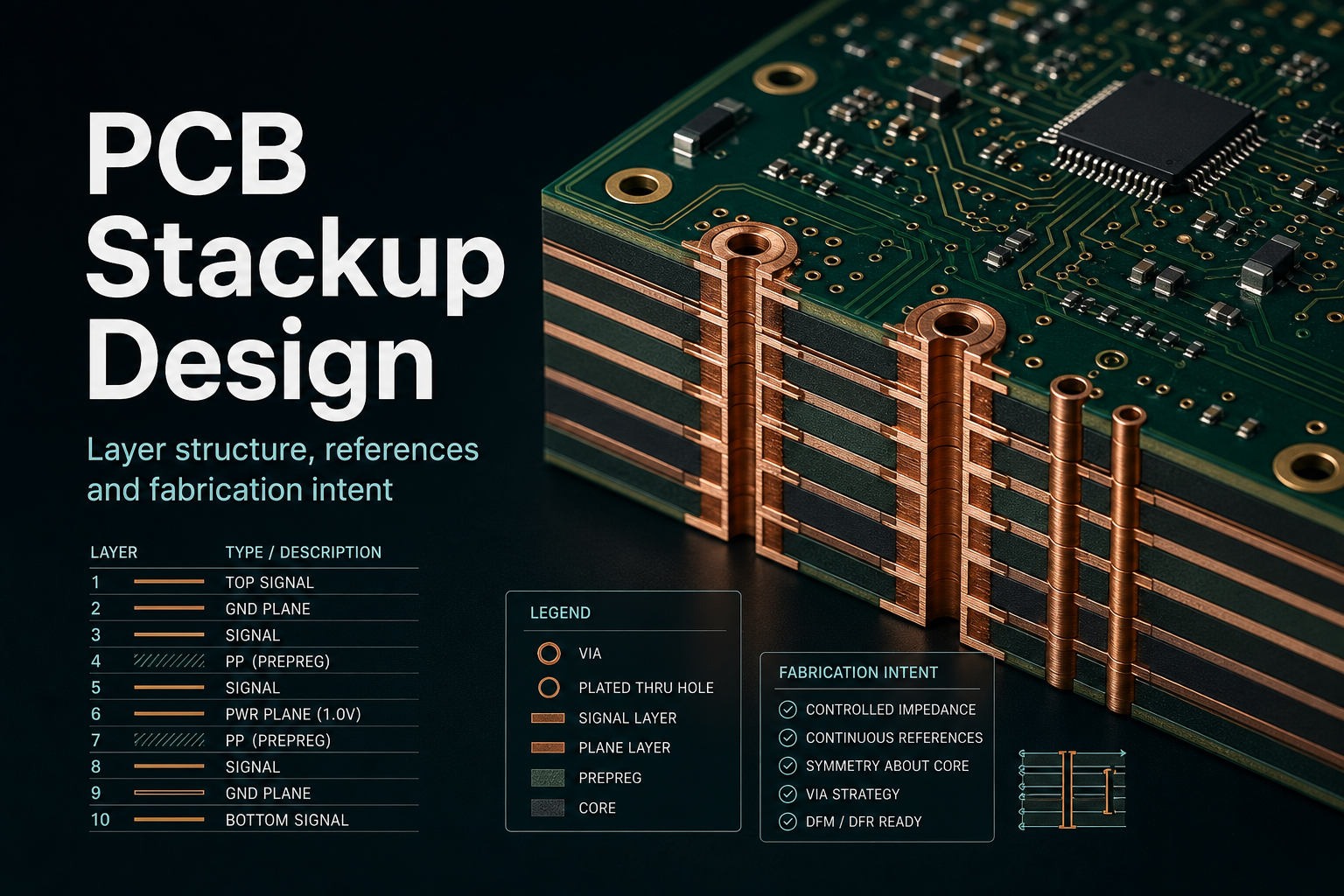
- PCB stackup design should be treated as an architecture decision before it becomes a fabrication drawing.
- The stackup decides how routing, reference continuity, controlled structures, and manufacturing review will be interpreted later.
- A board often becomes harder to build not because it has more layers, but because the wrong board structure was assumed too late.
Quick Answer Good PCB stackup design starts by classifying the board into the right structure, then aligning layer roles, reference behavior, material direction, and planned testing needs before fabrication review begins. A stackup is not only a layer count. It is the build story the factory must follow.
Table of Contents
- What PCB stackup design actually controls
- Start by choosing the right board structure
- What inputs are needed before stackup planning stabilizes
- How reference behavior and impedance planning fit in
- How stackup intent should move into fabrication review
- What usually breaks stackup planning
- Next steps with APTPCB
- FAQ
- Public references
- Author and review information
What PCB stackup design actually controls
Stackup design is the point where several board decisions stop being independent.
It controls:
- which layers carry signals, planes, or mixed roles
- how return paths remain continuous
- whether controlled structures are even plausible in the intended build
- which material family or build type the board enters
- how fabrication and engineering teams interpret the release package
That is why a stackup article should stay focused on planning and board-type selection. It should not flatten every project into one universal stackup recipe.
Start by choosing the right board structure
The first stackup question is not how many layers. It is what kind of board is this becoming.
| Board situation | Planning path | What changes next |
|---|---|---|
| Baseline rigid multilayer | Standard stackup architecture | Layer roles, plane continuity, general fabrication route |
| HDI density pressure | Build-up or HDI path | Microvia planning, lamination sequence, denser breakout logic |
| Controlled high-speed path | Impedance-planning path | Reference behavior, material direction, planned testing needs |
| Hybrid RF and digital mix | Mixed-material path | Material-family separation and selective critical-path focus |
| High-layer rigid build | Registration-sensitive path | Lamination planning and fabrication sensitivity |
| Thermal or power-driven platform | Thermal path | Platform choice, copper strategy, and process-family separation |
| Rigid-flex mechanics | Flex-mechanical path | Bend-sensitive stackup behavior and handling context |
This split matters because a board should not be described as ordinary multilayer work if it has already crossed into HDI, hybrid, high-layer, or another special build type.
What inputs are needed before stackup planning stabilizes
A stackup usually becomes unstable when the team starts routing before the real inputs are visible.
The most useful inputs are:
- board type and application pressure
- layer-role intent
- critical-path definition
- mechanical thickness or enclosure context
- manufacturing assumptions
- downstream testing approach
For example, a design that only says 8-layer board is still missing much of the stackup story. The factory still needs to understand whether the board is baseline digital, impedance-sensitive, HDI-heavy, or mixed-material.
How reference behavior and impedance planning fit in
Stackup design becomes more important when routing depends on reference continuity and controlled structures.
The safe planning posture is:
- keep critical paths tied to an explicit reference story
- separate reference behavior from generic layer-count language
- treat controlled structures as a combination of geometry, dielectric direction, and testing needs
- avoid presenting a sample stackup as if it were production-ready for every project
This is also where DFM Guidelines for PCB Layout and PCB Design Review Checklist intersect with stackup planning. A stackup is not complete if the later manufacturing package still leaves teams guessing about layer roles or controlled-path expectations.
How stackup intent should move into fabrication review
Once the stackup direction is stable, it should move into fabrication review as part of a broader release package.
That package should make clear:
- the intended construction family
- the layer-role model
- any controlled or special-process structures that affect review
- whether the build remains baseline or requires a path such as HDI or hybrid material handling
- what later testing or correlation work the team expects
The goal is not to claim that the board is already proven. The goal is to let fabrication review see the same stackup story the design team believes it is releasing.
For the service-side support path, the main commercial page is PCB Stack-Up.
What usually breaks stackup planning
Common failure modes include:
- the board type changes but the stackup description does not
- routing starts before the stackup direction is named clearly
- controlled-path language is used without a matching testing approach
- material direction is implied but not documented
- special-process assumptions are hidden inside generic multilayer wording
- the released stackup is treated as universal instead of project-specific
A common stackup failure chain starts when a board is still described as a generic multilayer build after it has already become an impedance-sensitive, HDI, or mixed-material structure. Routing then proceeds on the wrong layer-role story, reference continuity and controlled-path assumptions drift away from the real build, and fabrication review or first-build correlation has to discover that the released stackup no longer matches the electrical field and return-path burden the board actually carries. What looked like a documentation shortcut becomes stackup rework, rerouting, or late release delay.
Another failure chain is mechanical, not electrical. Engineers sometimes chase routing room by releasing a strongly asymmetric stackup: dense GND planes concentrated in the upper half of the board, sparse signal layers in the lower half, or very uneven prepreg and core thickness from top to bottom. That may look acceptable on a layer table, but lamination and later 245 C lead-free reflow do not see a spreadsheet. They see an imbalanced structure with mismatched copper distribution, thermal expansion, and resin behavior. Internal shear stress rises through the build and then unloads as bow and twist after reflow, until the assembled board distorts like a potato chip. At that point the damage is no longer abstract stackup theory. Large BGA joints can open, bridge, or tear under strain, the assembly may no longer fit the enclosure, and early solder-fatigue risk is already built into the product. Stackup planning is therefore not only an SI problem. It is also a mechanical-symmetry problem.
These failures are usually more important than publishing example recipes. A strong stackup article should help teams frame the right structure and the right questions early.
Next steps with APTPCB
If your hardware team is moving into a 10+ layer stackup, mixed-material lamination, or any build where asymmetric copper distribution can turn into post-reflow warpage, do not wait for first build to tell you the stackup story was physically unstable. The same applies if you are not sure whether the current material combination, resin system, or thickness split can survive lamination without bow, twist, or delamination risk.
Send the layer-role definition, copper-thickness intent, target overall thickness, and any high-frequency or thermal-management constraints to [email protected], or start through the PCB stackup design review request. APTPCB's stackup engineering and CAM review team will return a Stackup Symmetry & Lamination Audit within 24 hours.
That audit is meant to catch the failures before expensive lamination is committed: copper-balance asymmetry, thermal-expansion mismatch, hybrid-material delamination risk, and layer-role structures that look routable in CAD but are mechanically unstable in the press and after lead-free reflow. The goal is simple: balance copper distribution, check thermal compatibility, and lock the flattest, most stable physical build story before the board enters a high-risk fabrication run.
FAQ
Is PCB stackup design mainly about layer count?
No. Layer count matters, but stackup design is more fundamentally about board structure, layer roles, reference behavior, and file clarity.
Can one reference stackup be reused across every project?
Not safely. Reference stackups help start the discussion, but the final build still depends on board type, critical paths, materials, and the planned review flow.
Should a stackup article publish universal impedance or layer-recipe tables?
Not by default. Those details depend on project-specific geometry, dielectric direction, fabrication compensation, and stronger source scope.
What usually creates stackup confusion first?
The most common problem is that the routing team and the fabrication review team are not reading the same construction story.
Public references
TI High-Speed Interface Layout Guidelines Supports reference-plane continuity and layer-transition discipline when stackup planning includes controlled paths.
Analog Devices: Basic Guidelines for Mixed-Signal PCB Layout Design Supports the need to define layer planning and return-path structure before layout details are treated as stable.
PCB Stack-Up Support-page context for stackup structure and fabrication discussion.
DFM Guidelines for PCB Layout Companion article for layout-level manufacturability review.
PCB Design Review Checklist Companion article for staged pre-release review.
Author and review information
- Author: APTPCB multilayer planning and fabrication-review content team
- Technical review: stackup architecture, reference behavior, and release-package engineering team
- Last updated: 2026-05-15