
Key Takeaways
- Definition: A People Counting PCB is a specialized circuit board designed to host sensors (optical, IR, or ToF) and processing units for accurate foot traffic analysis.
- Critical Metrics: Signal integrity and thermal management are the top priorities due to the high processing load of counting algorithms.
- Integration: These boards often interface with high-bandwidth modules, such as a 4K Camera PCB, requiring precise impedance control.
- Environment: Selection depends heavily on the deployment scenario, ranging from climate-controlled retail spaces to vibrating public transit vehicles.
- Validation: Automated Optical Inspection (AOI) and functional testing are non-negotiable for maintaining accuracy over time.
- Manufacturing: Choosing the right stackup and surface finish prevents long-term oxidation and signal loss.
- Partnership: Early DFM engagement with your manufacturer ensures the design is viable for mass production.
What People Counting PCB really means (scope & boundaries)
To understand the specific requirements of this technology, we must first define what a People Counting PCB actually does within a system. It is not merely a standard interconnect board; it is the hardware foundation that supports complex data acquisition and real-time processing.
These printed circuit boards serve as the central hub for various sensor technologies, including Time-of-Flight (ToF) sensors, stereoscopic cameras, and thermal imagers. Unlike a generic controller, a People Counting PCB must handle high-speed data transmission without latency. The accuracy of the headcount depends as much on the board's electrical stability as it does on the software algorithm.
APTPCB (APTPCB PCB Factory) often manufactures these boards using High-Density Interconnect (HDI) technology. This allows for the miniaturization required to fit powerful processors into discreet ceiling-mounted housings. Modern systems frequently integrate a 360 Degree Camera PCB to cover wider areas, which increases the complexity of the layout. The board must route multiple high-speed video lanes while managing the heat generated by the image signal processor (ISP).
Metrics that matter (how to evaluate quality)
Once the scope is defined, the next step is understanding the specific metrics that determine if a board is fit for purpose. A People Counting PCB is judged by its ability to maintain signal purity and physical durability under constant load.
| Metric | Why it matters | Typical range or influencing factors | How to measure |
|---|---|---|---|
| Dielectric Constant (Dk) | Affects signal propagation speed, crucial for real-time counting data. | 3.4 to 4.5 (FR4 standard); lower for high-speed materials. | Time Domain Reflectometry (TDR). |
| Thermal Conductivity | Processors analyzing video feeds generate significant heat. | 0.3 W/mK (Standard) to 2.0+ W/mK (Metal Core or specialized FR4). | Thermal imaging during load testing. |
| Impedance Control | Mismatched impedance causes data reflection, leading to counting errors or video artifacts. | ±10% tolerance (typically 50Ω single-ended, 90Ω/100Ω differential). | TDR testing coupons on the production panel. |
| Glass Transition Temp (Tg) | Determines the board's ability to withstand assembly heat and operating temperature. | Tg > 150°C (High Tg) is recommended for reliability. | Differential Scanning Calorimetry (DSC). |
| CTE (z-axis) | Expansion during thermal cycling can crack copper plating in vias. | < 3.5% expansion (50-260°C). | Thermomechanical Analysis (TMA). |
| Surface Insulation Resistance | Prevents electrochemical migration in humid environments (e.g., outdoor entrances). | > 100 MΩ. | Humidity/Temperature chamber testing. |
Selection guidance by scenario (trade-offs)
Understanding the metrics allows engineers to select the right board configuration based on where the device will be installed. Different environments impose unique stresses on a People Counting PCB.
1. Retail Entrances (Standard Indoor)
- Requirement: High aesthetics, compact size, moderate processing.
- Trade-off: Prioritize miniaturization (HDI) over extreme ruggedness.
- Recommendation: Standard FR4 High Tg, ENIG finish for flat pads.
2. Outdoor Public Spaces
- Requirement: Weather resistance, wide temperature range.
- Trade-off: Higher cost for materials to prevent delamination.
- Recommendation: High-reliability materials (e.g., Isola or Panasonic), conformal coating is mandatory.
3. Public Transit (Buses/Trains)
- Requirement: Vibration resistance, unstable power supply.
- Trade-off: Thicker copper and robust connectors increase weight and cost.
- Recommendation: IPC Class 3 standard for vibration reliability; locking connectors.
4. High-Ceiling Warehouses
- Requirement: Long-range sensing, high-power active sensors (ToF).
- Trade-off: Increased power consumption requires better thermal management.
- Recommendation: Thicker copper (2oz) for power planes; thermal vias under the main processor.
5. High-Resolution Analytics (4K Integration)
- Requirement: Handling massive data streams from a 4K Camera PCB.
- Trade-off: Signal integrity is paramount; cannot use standard low-cost FR4 for high-speed lines.
- Recommendation: Low-loss laminate materials; strict controlled impedance on differential pairs.
6. Privacy-Centric Areas (Thermal/IR only)
- Requirement: No optical cameras; relies on heat signatures.
- Trade-off: Lower data bandwidth but higher sensitivity to thermal noise on the PCB.
- Recommendation: Careful layout separation between power supplies and analog sensor inputs.
From design to manufacturing (implementation checkpoints)
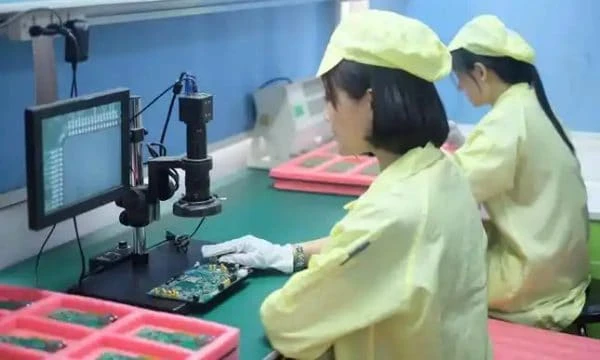
After selecting the scenario, the project moves to the execution phase where design files are converted into physical boards. This checklist ensures the People Counting PCB is manufacturable and reliable.
For detailed specifications on preparing your files, refer to our DFM Guidelines.
1. Stackup Design
- Recommendation: Use a balanced stackup (e.g., 4 or 6 layers) to prevent warping.
- Risk: Unbalanced copper distribution leads to bowing during reflow.
- Acceptance: Bow and twist < 0.75%.
2. Material Selection
- Recommendation: Specify High Tg (170°C) FR4.
- Risk: Standard Tg (130°C) may delaminate during multi-step assembly or rework.
- Acceptance: Material datasheet verification.
3. Via Design (HDI)
- Recommendation: If using BGA components with pitch < 0.5mm, use laser-drilled microvias.
- Risk: Mechanical drills can damage pads on tight pitches.
- Acceptance: Cross-section analysis (microsection).
4. Impedance Traces
- Recommendation: Clearly mark impedance lines for USB, Ethernet, or MIPI CSI interfaces.
- Risk: Signal degradation causes video lag or sensor disconnects.
- Acceptance: TDR report included with shipment.
5. Thermal Relief
- Recommendation: Ensure thermal pads for the main processor have sufficient ground vias.
- Risk: Overheating causes the CPU to throttle, missing counts during peak traffic.
- Acceptance: X-ray inspection of solder coverage on thermal pads.
6. Surface Finish
- Recommendation: Electroless Nickel Immersion Gold (ENIG).
- Risk: HASL (Hot Air Solder Leveling) is too uneven for fine-pitch sensors.
- Acceptance: Visual inspection for flat, uniform pads.
7. Silkscreen Clarity
- Recommendation: Ensure QR codes or serial numbers are legible for asset tracking.
- Risk: Blurred text makes field maintenance difficult.
- Acceptance: Visual check against Gerber files.
8. Panelization
- Recommendation: Add breakaway rails (5mm-10mm) with fiducials for assembly machines.
- Risk: Irregular shapes cannot be conveyed through pick-and-place machines.
- Acceptance: Fit check in assembly line simulation.
9. Solder Mask Dams
- Recommendation: Maintain minimum dams between pads (approx. 4 mil).
- Risk: Solder bridging between pins on the sensor chip.
- Acceptance: AOI (Automated Optical Inspection).
10. Test Points
- Recommendation: Place test points on the bottom side for ICT (In-Circuit Test).
- Risk: Lack of access prevents electrical validation before final housing assembly.
- Acceptance: 100% netlist testing coverage.
Common mistakes (and the correct approach)
Even with a checklist, engineers often encounter specific pitfalls when designing a People Counting PCB. Avoiding these errors saves time and reduces scrap.
Ignoring Thermal Simulations:
- Mistake: Assuming the enclosure will dissipate heat naturally.
- Correction: Run thermal simulations early. The PCB acts as the primary heatsink for the sensor module.
Placing High-Speed Lines Near Power Inductors:
- Mistake: Routing video data lines (MIPI/LVDS) too close to switching regulators.
- Correction: Keep sensitive signal traces at least 20 mils away from noisy power components.
Over-specifying the Drill Chart:
- Mistake: Using 10 different drill sizes when 4 would suffice.
- Correction: Consolidate drill sizes to reduce manufacturing cost and time.
Neglecting the "Keep-Out" Zone for Antennas:
- Mistake: Pouring copper ground planes under the Wi-Fi/Bluetooth antenna area.
- Correction: Remove all copper on all layers under the antenna to ensure connectivity.
Inadequate Decoupling Capacitors:
- Mistake: Placing capacitors too far from the sensor power pins.
- Correction: Place decoupling caps as close as possible to the power pins to filter noise effectively.
Forgetting Mechanical Constraints:
- Mistake: Placing tall capacitors where the lens housing needs to sit.
- Correction: Import the 3D STEP file of the enclosure into the PCB design tool to check for collisions.
Using the Wrong Surface Finish for High Frequency:
- Mistake: Using HASL for boards operating above 3GHz.
- Correction: Use ENIG or Immersion Silver for better skin-effect performance.
Underestimating Data Throughput:
- Mistake: Designing for 1080p bandwidth when the sensor is a 4K Camera PCB.
- Correction: Calculate the maximum data rate and design the differential pairs accordingly.
FAQ
Q: What is the standard lead time for a People Counting PCB prototype? A: Standard prototypes typically take 3-5 days. Complex HDI boards may take 7-10 days depending on the layer count and lamination cycles.
Q: Can APTPCB assist with the component sourcing for these boards? A: Yes, we offer turnkey services including PCB fabrication, component sourcing, and assembly.
Q: Why is impedance control so critical for people counting? A: These devices transmit high-speed video or depth data. Impedance mismatches cause data loss, resulting in inaccurate counts or system freezes.
Q: Is it necessary to use flexible PCBs (Flex or Rigid-Flex)? A: Rigid-flex is often used if the sensor needs to be mounted at a specific angle (e.g., a 360 Degree Camera PCB) while the main processor sits flat.
Q: How do you ensure the board survives outdoor humidity? A: We recommend applying a conformal coating after assembly and using a high-quality solder mask to protect the copper traces.
Q: What is the difference between a standard camera PCB and a people counting PCB? A: A people counting PCB includes onboard processing (Edge AI) to analyze the video locally, whereas a standard camera PCB just streams the video.
Q: Can you manufacture boards with blind and buried vias? A: Yes, this is common for compact designs where board real estate is limited.
Q: Do I need to provide specific test requirements? A: Yes, providing a test fixture design or specific functional test instructions helps ensure zero defects upon delivery.
Q: What file formats do you accept for manufacturing? A: We accept Gerber RS-274X, ODB++, and IPC-2581 formats.
Q: How does the layer count affect the cost? A: More layers require more material and processing steps (lamination, plating), which increases the cost. Optimizing the layout to reduce layers can save money.
For more details on our capabilities, please visit our PCB Manufacturing page.
Glossary (key terms)
| Term | Definition |
|---|---|
| AOI | Automated Optical Inspection. A camera-based system used to check PCBs for assembly errors like missing parts or solder bridges. |
| BGA | Ball Grid Array. A type of surface-mount packaging used for high-performance processors. |
| BOM | Bill of Materials. A comprehensive list of all components required to assemble the PCB. |
| Crosstalk | Unwanted signal transfer between communication channels, causing data corruption. |
| DFM | Design for Manufacturing. The practice of designing boards to be easy and cheap to manufacture. |
| Differential Pair | Two complementary signals used to transmit data with high noise immunity (e.g., USB, HDMI). |
| Edge AI | Artificial Intelligence algorithms processed locally on the PCB rather than in the cloud. |
| ENIG | Electroless Nickel Immersion Gold. A flat, durable surface finish ideal for fine-pitch components. |
| Gerber File | The standard file format used by the PCB industry to describe the board images (copper, mask, legend). |
| HDI | High-Density Interconnect. PCBs featuring microvias and fine lines to pack more functionality into less space. |
| IPC Class 2/3 | Manufacturing standards. Class 2 is for general electronics; Class 3 is for high-reliability/critical systems. |
| MIPI CSI | Mobile Industry Processor Interface Camera Serial Interface. A high-speed protocol for connecting cameras to the processor. |
| Stackup | The arrangement of copper layers and insulating material (dielectric) in a multi-layer PCB. |
| ToF | Time-of-Flight. A sensor technology that measures distance based on the time it takes for light to travel to an object and back. |
| Via | A plated hole that connects copper tracks on different layers of the PCB. |
Conclusion (next steps)
A People Counting PCB is a sophisticated piece of hardware that balances high-speed data processing with environmental durability. Whether you are integrating a 360 Degree Camera PCB for a retail mall or a ruggedized sensor for public transit, the success of your product relies on the quality of the printed circuit board.
From selecting the right dielectric materials to ensuring precise impedance control during manufacturing, every detail matters. APTPCB is ready to support your project from the initial prototype phase through to mass production.
Ready to start your project? To get an accurate DFM review and pricing, please prepare your Gerber files, Bill of Materials (BOM), and layer stackup specifications. If you have specific impedance or testing requirements, include those in your documentation.