
Definition, scope, and who this guide is for
A personal air quality sensor pcb is the foundational circuit board designed to host sensitive environmental sensing components—such as particulate matter (PM2.5), volatile organic compounds (VOCs), CO2, and humidity sensors—within a portable or wearable form factor. Unlike stationary industrial monitors, these PCBs must balance extreme miniaturization with the signal integrity required to detect parts-per-billion (ppb) concentrations of gases. They often integrate microcontrollers, Bluetooth/Wi-Fi modules, and power management circuits into a device no larger than a key fob or a badge.
This guide is written for hardware engineers, product designers, and procurement leads who are transitioning a prototype into mass production. It addresses the specific challenges of integrating chemical and optical sensors onto a PCB where thermal noise, mechanical stress, and manufacturing residues can render the device inaccurate. The scope covers rigid, rigid-flex, and HDI (High Density Interconnect) technologies used in these compact devices.
Readers will gain a decision-making framework to define specifications that prevent field failures, a risk assessment matrix specific to sensor integration, and a supplier qualification checklist. Whether you are building a consumer-grade pollution tracker or a safety-critical gas leak personal monitor pcb, this playbook ensures your manufacturing data package is robust enough for scalable production with partners like APTPCB (APTPCB PCB Factory).
When to use personal air quality sensor pcb (and when a standard approach is better)
Deciding between a custom personal air quality sensor pcb and a modular off-the-shelf solution depends on your volume, form factor, and accuracy requirements.
Use a custom sensor PCB when:
- Form Factor is Critical: The device must be wearable (wrist, lapel, helmet) and standard breakout boards are too bulky.
- Thermal Isolation is Required: You need to physically separate heat-generating components (battery chargers, MCUs) from temperature-sensitive gas sensors using custom board cutouts or rigid-flex isolation.
- Signal Integrity: The analog signals from electrochemical sensors are in the nano-amp range and require short, shielded traces that only a custom layout can provide.
- Integration Density: You are combining multiple functions—such as a personal alarm siren pcb circuit for emergency alerts—onto the same board as the air monitor to save space and cost.
- Power Consumption: You need to optimize the power delivery network (PDN) to extend battery life in a portable device, which is difficult with generic modules.
Stick to standard modules/breakout boards when:
- Proof of Concept: You are only validating the sensor technology and do not care about size.
- Low Volume: Production runs are under 100 units, where NRE (Non-Recurring Engineering) costs for custom PCBs outweigh the per-unit savings.
- Non-Critical Accuracy: The device is for educational purposes where thermal drift and noise are acceptable.
personal air quality sensor pcb specifications (materials, stackup, tolerances)
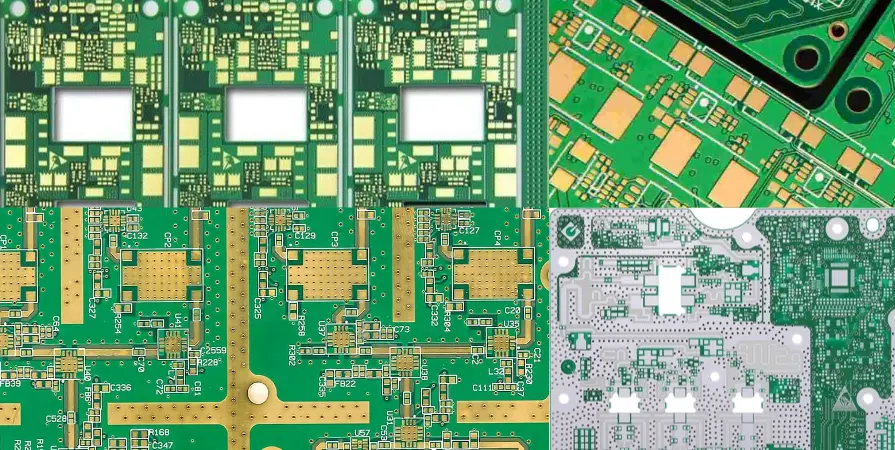
To ensure your personal air quality sensor pcb functions correctly in the field, you must lock down specific parameters before requesting a quote.
- Base Material: High-Tg FR4 (Tg > 170°C) is recommended to prevent board warping during reflow, which can stress surface-mount sensors. For wearables, Polyimide is required for flex sections.
- Surface Finish: Electroless Nickel Immersion Gold (ENIG) is mandatory. It provides the flat surface needed for fine-pitch sensor packages (LGA/QFN) and prevents oxidation that could affect sensitive contact pads.
- Copper Weight: Standard 1oz (35µm) is usually sufficient, but specify 0.5oz for inner layers if using HDI to allow for finer trace widths (3/3 mil).
- Stackup & Impedance: 4 to 6 layers are typical. Define controlled impedance (50Ω single-ended, 90Ω/100Ω differential) for Bluetooth/Wi-Fi antenna traces.
- Thermal Management: Specify thermal vias under the power management IC (PMIC) but strictly forbid copper pours under the gas sensor area to reduce thermal mass and improve response time.
- Solder Mask: Use Matte Green or Black. Matte finishes reduce solder bridging. Ensure the mask dam is at least 3-4 mil to prevent sensor pad shorting.
- Cleanliness Standards: Specify IPC-6012 Class 2 or 3. Crucially, require ionic contamination testing (ROSE test) as flux residues can poison chemical sensors.
- Dimensional Tolerances: Outline profile tolerances of ±0.1mm or tighter if the PCB must snap-fit into a compact enclosure.
- Via Protection: Tented or plugged vias are preferred to prevent gas leakage through the board if the sensor relies on a sealed airflow path.
- Component Clearance: Define a "keep-out" zone around the sensor of at least 2-3mm to allow for airflow and prevent mechanical stress from adjacent tall components.
- Flexibility (if Rigid-Flex): If using rigid-flex, specify the bend radius (usually 10x thickness) and the number of dynamic flex cycles required (e.g., >10,000 cycles).
- Markings: Silkscreen must not overlap with sensor ports or pads. Specify "Do Not Wash" or "No Conformal Coating" zones clearly in the Gerber files.
personal air quality sensor pcb manufacturing risks (root causes and prevention)
Moving from prototype to mass production introduces risks that are often invisible in the lab.
- Sensor Poisoning from Outgassing:
- Why: Volatile chemicals from cheap solder mask, adhesives, or flux residues release gases that permanently damage VOC or CO2 sensors.
- Detect: Sensor baseline drifts significantly immediately after assembly.
- Prevent: Use "low-outgassing" materials. Mandate a "no-clean" flux process or a thorough wash before sensor mounting if the sensor is not washable.
- Thermal Drift:
- Why: Heat from the battery charging circuit transfers through the copper planes to the sensor, causing false readings.
- Detect: Readings spike when the device is plugged in to charge.
- Prevent: Use PCB cutouts (slots) to thermally isolate the sensor region. Place the sensor as far as possible from the PMIC.
- Mechanical Stress on Ceramic Sensors:
- Why: Board flexing during assembly or enclosure snap-fitting cracks the ceramic substrate of MEMS sensors.
- Detect: Intermittent signal or open circuit after housing assembly.
- Prevent: Place sensors away from mounting holes and V-score lines. Use stress-relief slots around the sensor area.
- Microphonic Noise:
- Why: High-impedance analog traces pick up vibrations as electrical noise (piezoelectric effect in MLCC capacitors).
- Detect: Noise floor increases when the device is tapped or vibrated.
- Prevent: Keep analog traces short. Use soft-termination capacitors in sensitive signal paths.
- RF Interference:
- Why: Wi-Fi/Bluetooth transmission bursts induce noise into the sensor's analog-to-digital converter (ADC).
- Detect: Periodic spikes in sensor data correlating with radio transmission intervals.
- Prevent: Use a 4-layer stackup with a solid ground plane separating the RF section from the analog sensor section. Shield the sensor if necessary.
- Flux Residue Leakage:
- Why: Hygroscopic flux residues absorb moisture, creating leakage paths that alter the resistance of electrochemical sensors.
- Detect: Readings fluctuate wildly with humidity changes.
- Prevent: Enforce strict IPC-J-STD-001 cleanliness standards. Use aggressive washing protocols before sensor attachment.
- Connector Failure in Wearables:
- Why: Constant movement causes board-to-board connectors or flex cables to unseat or crack.
- Detect: Device resets or loses sensor connection during movement.
- Prevent: Use rigid-flex PCBs to eliminate connectors. If connectors are used, apply underfill or locking mechanisms.
- Conformal Coating Ingress:
- Why: Protective coating flows into the sensor port, blocking airflow.
- Detect: Sensor becomes unresponsive to gas concentration changes.
- Prevent: Design a physical dam or use high-precision selective coating equipment. Masking tape is often insufficient for high volume.
- Battery Leakage Corrosion:
- Why: Electrolyte from a failing battery corrodes nearby PCB traces.
- Detect: Green/white residue on traces near battery contacts.
- Prevent: Use gold-plated battery contacts. Design a physical barrier or slot between the battery and the main circuit.
- Blind Via Reliability:
- Why: In HDI boards, poorly plated blind vias fail under thermal cycling.
- Detect: Open circuits appear after a few weeks of use.
- Prevent: Require cross-section analysis (microsectioning) from the supplier for every batch.
personal air quality sensor pcb validation and acceptance (tests and pass criteria)
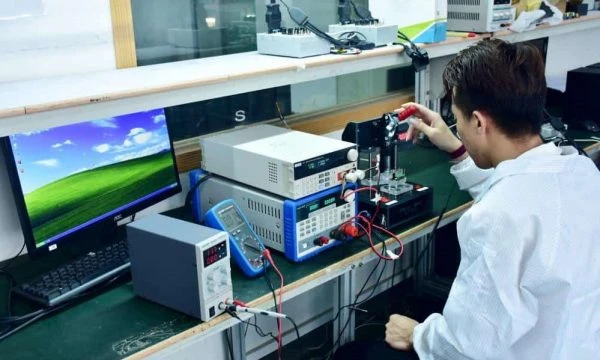
A robust validation plan ensures that the personal air quality sensor pcb meets performance standards before shipping.
- Bare Board Electrical Test (E-Test):
- Objective: Verify continuity and isolation.
- Method: Flying probe or bed-of-nails.
- Criteria: 100% pass. No opens/shorts.
- Ionic Contamination Test:
- Objective: Ensure board cleanliness to prevent sensor poisoning.
- Method: ROSE testing (Resistivity of Solvent Extract).
- Criteria: < 1.56 µg/cm² NaCl equivalent (or stricter based on sensor datasheet).
- Impedance Control Verification:
- Objective: Ensure RF antenna performance.
- Method: TDR (Time Domain Reflectometry) on test coupons.
- Criteria: Within ±10% of target impedance.
- Solderability Test:
- Objective: Ensure pads will accept solder reliably.
- Method: Dip and look / wetting balance.
- Criteria: > 95% coverage, smooth coating.
- Thermal Stress Test:
- Objective: Simulate reflow conditions.
- Method: Float in solder pot at 288°C for 10 seconds.
- Criteria: No delamination, blistering, or measles.
- Microsection Analysis:
- Objective: Verify plating quality and layer stackup.
- Method: Cross-sectioning a sample board.
- Criteria: Copper thickness meets spec; no cracks in barrel plating.
- Warpage Measurement:
- Objective: Ensure flatness for sensor mounting.
- Method: Optical inspection or feeler gauge on surface plate.
- Criteria: Bow and twist < 0.75% (standard) or < 0.5% (for fine pitch).
- X-Ray Inspection (Post-Assembly):
- Objective: Check soldering of LGA/QFN sensors and BGAs.
- Method: Automated X-Ray Inspection (AXI).
- Criteria: Voiding < 25% of pad area.
- Functional Gas Test:
- Objective: Verify sensor response.
- Method: Expose assembled PCB to known gas concentration in a chamber.
- Criteria: Output within ±X% of calibrated reference.
- Drop Test (for Wearables):
- Objective: Simulate user dropping the device.
- Method: Drop from 1.5m onto concrete (in enclosure).
- Criteria: Device remains functional; no cracked solder joints.
- Humidity Soak:
- Objective: Check for leakage currents.
- Method: 85°C / 85% RH for 168 hours.
- Criteria: No corrosion; sensor baseline remains stable.
- Outgassing Verification:
- Objective: Ensure PCB materials don't affect sensors.
- Method: Seal PCB in a jar with a reference sensor for 24 hours.
- Criteria: Reference sensor shows no drift compared to ambient.
personal air quality sensor pcb supplier qualification checklist (RFQ, audit, traceability)
Use this checklist to vet suppliers like APTPCB or others for your personal air quality sensor pcb project.
Group 1: RFQ Inputs (What you must provide)
- Gerber files (RS-274X or X2) with clear outline and cutouts.
- Drill file with plated vs. non-plated holes clearly defined.
- Stackup drawing specifying material type (e.g., FR4 Tg170) and dielectric thickness.
- Impedance requirements table (Layer, Trace Width, Target Impedance).
- Pick-and-place file (Centroid) for assembly quotes.
- BOM (Bill of Materials) with specific sensor part numbers and approved substitutes.
- "Keep-out" and "No-Clean" areas marked on assembly drawings.
- Test procedure document (if functional test is required).
- Volume projections (EAU) and batch sizes.
- Packaging requirements (e.g., vacuum sealed, ESD trays).
Group 2: Capability Proof
- Can they handle the specific BGA/LGA pitch of your chosen sensor?
- Do they have experience with Rigid-Flex manufacturing (if applicable)?
- Can they achieve the required aspect ratio for microvias (e.g., 0.8:1)?
- Do they offer ENIG surface finish in-house or outsourced?
- What is their minimum trace/space capability (e.g., 3/3 mil)?
- Do they have equipment for selective conformal coating?
- Can they perform X-Ray inspection for leadless sensor packages?
- Do they have experience with "low-outgassing" soldering processes?
Group 3: Quality System & Traceability
- Are they ISO 9001 and ISO 13485 (if medical) certified?
- Do they perform 100% AOI (Automated Optical Inspection) on inner layers?
- Can they provide a Certificate of Conformance (CoC) with every shipment?
- Do they store production records and X-ray images for at least 2 years?
- Is there a system to trace raw materials (copper, laminate) back to the source?
- Do they have an in-house lab for microsectioning and solderability testing?
Group 4: Change Control & Delivery
- What is the standard lead time for prototypes vs. production?
- Do they have a formal PCN (Product Change Notification) process?
- Can they support buffer stock or consignment inventory?
- How do they handle Engineering Change Orders (ECOs) during production?
- What is their policy on scrap allowance and yield reporting?
- Do they offer DFM (Design for Manufacturing) reviews prior to fabrication?
How to choose personal air quality sensor pcb (trade-offs and decision rules)
Engineering is about compromise. Here is how to navigate common trade-offs in sensor PCB design.
- Rigid vs. Rigid-Flex:
- If you prioritize lowest cost: Choose a standard Rigid PCB and use cables for connections.
- If you prioritize reliability and size: Choose Rigid-Flex to eliminate connectors, even though it costs 2-3x more.
- HDI vs. Standard Tech:
- If you prioritize extreme miniaturization: Choose HDI (blind/buried vias) to shrink the board by 30-40%.
- If you prioritize cost and supply chain simplicity: Stick to standard through-hole vias if space permits.
- Battery Life vs. Sampling Rate:
- If you prioritize data density: Increase sampling, but require a larger battery and better thermal management on the PCB.
- If you prioritize longevity: Duty-cycle the sensor and MCU, allowing for a simpler, lower-power PCB design.
- Conformal Coating vs. No Coating:
- If you prioritize moisture protection: Use selective coating, but accept higher NRE and process complexity to avoid sensor damage.
- If you prioritize manufacturing speed: Skip coating, but design a water-tight enclosure (IP67) instead.
- Integrated vs. Modular Sensors:
- If you prioritize flexibility: Use a socketed sensor or module (easy to replace/upgrade).
- If you prioritize Z-height (thickness): Solder the sensor directly to the PCB (LGA/QFN package).
- Local Sourcing vs. Offshore:
- If you prioritize speed of iteration: Prototype locally.
- If you prioritize unit cost: Move to volume production with an offshore partner like APTPCB once the design is stable.
personal air quality sensor pcb FAQ (cost, lead time, Design for Manufacturability (DFM) files, stackup, impedance, Automated Optical Inspection (AOI) inspection)
Q: Can I wash the PCB after assembling the gas sensor? A: Generally, no. Most chemical sensors (MOX, electrochemical) are sensitive to water and solvents. Use a "no-clean" flux process or wash the board before the sensor is mounted (using selective soldering or hand assembly for the sensor).
Q: How do I prevent the PCB from heating up the sensor? A: Place the sensor as far as possible from heat sources (MCU, LDO, Battery). Use PCB cutouts (milling slots) to create a thermal break in the FR4 material, effectively isolating the sensor island.
Q: What is the best surface finish for these PCBs? A: ENIG (Electroless Nickel Immersion Gold) is the standard. It offers a flat surface for small sensor pads and excellent corrosion resistance without the shelf-life issues of OSP.
Q: Do I need impedance control for a simple air quality sensor? A: Not for the sensor signals themselves (which are usually I2C, SPI, or analog), but absolutely yes if your board includes a Bluetooth or Wi-Fi antenna for connectivity.
Q: Can I use a standard stencil for the sensor pads? A: You may need to reduce the aperture size (e.g., 10-20% reduction) to prevent excess solder paste from lifting the sensor or creating shorts under the low-profile package.
Q: How does a gas leak personal monitor pcb differ from a standard air quality PCB?
A: A gas leak monitor is a safety-critical device. It requires higher reliability standards (IPC Class 3), redundant circuitry, and often more robust protection against explosion (Intrinsically Safe design principles).
Q: Why are my sensor readings drifting over time? A: This could be due to "aging" of the sensor, but often it is due to PCB contamination (flux residue) or mechanical stress relaxation. Ensure the PCB is clean and stress-free.
Q: What file format should I send for fabrication? A: Gerber X2 is preferred as it contains stackup and attribute data. ODB++ is also excellent. Standard RS-274X is acceptable if accompanied by a detailed fabrication drawing.
Resources for personal air quality sensor pcb (related pages and tools)
- Rigid-Flex PCB Manufacturing: Essential for wearable sensors where space is limited and reliability is paramount.
- HDI PCB Technology: Learn how high-density interconnects enable smaller, lighter personal monitoring devices.
- SMT & THT Assembly Services: Details on how we handle mixed assembly technologies, crucial for boards combining tiny sensors with larger connectors.
- PCB Conformal Coating: Understand the options for protecting your circuitry without compromising sensor airflow.
- Testing & Quality Assurance: A deep dive into the validation methods that prevent field failures in sensitive electronics.
Request a quote for personal air quality sensor pcb (Design for Manufacturability (DFM) review + pricing)
Ready to move your design from concept to reality? The APTPCB engineering team provides a comprehensive DFM review to catch thermal and layout issues before you pay for tooling.
What to send for an accurate quote:
- Gerber Files: Complete set including drill and outline layers.
- BOM: With specific sensor part numbers.
- Assembly Drawing: Clearly marking sensor orientation and "keep-out" zones.
- Volume: Estimated batch sizes (e.g., 100 prototypes, 5k production).
- Special Requirements: Impedance control, specific stackup, or cleanliness standards.
Get Your Quote & DFM Review Now
Conclusion (next steps)
Successfully manufacturing a personal air quality sensor pcb requires more than just connecting components; it demands a holistic approach to thermal management, mechanical stability, and strict cleanliness. By defining clear specifications for materials and validation early in the process, you can avoid the common pitfalls of sensor drift and field failure. Whether you are building a consumer wearable or a critical safety device, following this playbook ensures your product is built on a reliable, scalable foundation.