
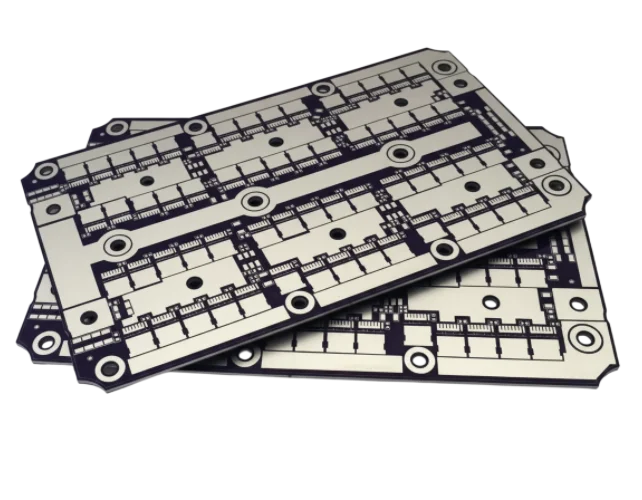
What PCB materials should you choose for a PMBus monitor?
PMBus monitor PCB materials directly affect power telemetry reliability. Although PMBus communication uses relatively low-speed digital signaling, the PCB still operates in an electrically noisy environment near switching regulators, MOSFETs, inductors, and high-current power paths.
A reliable PMBus monitor design typically starts with:
- High-Tg FR4 laminate: Tg ≥170°C for industrial, server, and automotive environments.
- Copper weight matched to current paths: 1 oz (35µm) for most signal layers; 2 oz or higher for power-carrying areas.
- ENIG or ENEPIG surface finish: Suitable for fine-pitch QFN/BGA packages and reliable test contacts.
- Stable dielectric properties: Important for controlling noise coupling and mixed-signal performance.
- High-quality LPI solder mask: Reduces leakage risk around sensitive sensing nodes.
The correct material choice depends on the operating environment, current level, sensing accuracy requirement, assembly process, and reliability target.
Which PMBus applications require High-Tg PCB materials?
High-Tg materials become important when the monitor PCB experiences sustained heat, repeated thermal cycling, or precision measurement requirements.
| Application | Recommended Material Direction | Primary Reason |
|---|---|---|
| Server and data center power supplies | High-Tg FR4 (170–180°C) | Continuous operation and thermal cycling reliability |
| FPGA/ASIC voltage monitoring | High-Tg FR4 with stable moisture and CTE properties | Protects millivolt-level measurement accuracy |
| Automotive and aerospace electronics | High-Tg FR4 or advanced materials | Wide temperature cycling and mechanical reliability |
| High-voltage DC-DC monitoring | High-Tg FR4 with appropriate CTI rating | Electrical insulation and tracking resistance |
| Consumer 5V/12V monitoring | Standard FR4 may be sufficient | Lower thermal and accuracy requirements |
| Prototype validation boards | Standard FR4 acceptable | Cost efficiency during early development |
PMBus monitor PCB material selection matrix
Use the following matrix when converting system requirements into PCB fabrication specifications.
| Design Requirement | Material Specification | Verification Method |
|---|---|---|
| Operation near hot VRMs or MOSFETs | High-Tg FR4, Tg ≥170°C | Laminate datasheet |
| Multiple lead-free reflow cycles | Td ≥340°C preferred | Material certificate |
| High-current sensing paths | 2 oz+ copper where required | Stackup review |
| Fine-pitch PMBus controller packages | ENIG or ENEPIG finish | Surface finish report |
| High-voltage monitoring | CTI rating appropriate for voltage class | UL documentation |
| Long thermal cycling life | Low Z-axis CTE laminate | TMA data |
| Sensitive VSENSE measurements | Solid ground reference plane | Stackup inspection |
What PCB material parameters matter most for PMBus accuracy?
The following specifications determine whether a PMBus monitor remains stable throughout its service life.
| Parameter | Recommended Value/Range | Why It Matters | If Ignored |
|---|---|---|---|
| Glass Transition Temp (Tg) | >170°C | Reduces resin softening and thermal expansion near hot components | Via stress, warpage, delamination |
| Decomposition Temperature (Td) | >340°C | Improves resistance to repeated assembly heating | Laminate degradation |
| Inner Copper Weight | 1 oz minimum | Supports grounding and noise control | Increased voltage noise |
| Outer Copper Weight | 1 oz or 2 oz | Balances routing density and current capacity | Trace heating and resistance drift |
| Surface Finish | ENIG or ENEPIG | Supports fine-pitch assembly | Solder defects and contact issues |
| Dielectric Constant (Dk) | Approximately 3.8–4.5 @ 1MHz | Helps maintain predictable electrical behavior | Increased noise coupling variation |
| Loss Tangent (Df) | <0.02 | Indicates suitable dielectric quality | Higher dielectric losses |
| Moisture Absorption | <0.3% | Reduces leakage and reflow damage | Popcorning and insulation problems |
| Z-axis CTE | <3.0% (50–260°C) | Protects plated through holes | Via fatigue failures |
| Solder Mask | LPI, qualified material | Protects fine-pitch sensing areas | Leakage and contamination |
| CTI | PLC 3 (175V–249V) or better where applicable | Prevents tracking failures | Electrical breakdown |
| Peel Strength | >1.05 N/mm | Supports rework durability | Pad lifting |
How should you design the PMBus PCB stackup?
A PMBus monitor board benefits from a stackup that separates noisy power paths from sensitive measurement signals.
A common industrial approach is a four-layer PCB:
- Layer 1: Components, PMBus routing, sensing connections.
- Layer 2: Continuous ground plane for shielding.
- Layer 3: Power distribution and secondary signals.
- Layer 4: Additional routing and ground support.
For precision voltage monitoring:
- Keep VSENSE traces short.
- Use Kelvin connections for shunt measurement circuits.
- Maintain a clean return path.
- Place switching nodes away from measurement traces.
- Use the PCB material to support the layout strategy rather than attempting to compensate for poor routing.
A multilayer PCB structure is typically preferred for industrial PMBus designs because it provides controlled grounding and improved noise isolation.
How do copper weight and surface finish affect PMBus monitor performance?
Copper selection depends on whether the board only monitors power rails or also carries significant current.
For digital PMBus communication:
- 1 oz copper is generally sufficient.
- Ground planes benefit from adequate copper thickness for noise reduction.
For current measurement:
- Heavy copper reduces resistive heating.
- Lower trace resistance improves measurement stability.
- 2 oz or higher copper may be required for high-current paths.
Use heavy copper solutions when the PCB carries substantial current rather than only monitoring external power paths.
For surface finish:
- ENIG provides a flat surface for QFN and BGA packages.
- ENEPIG provides additional protection where reliability requirements justify the added cost.
- HASL is less suitable for very small-pitch PMBus controller packages because of surface unevenness.
See PCB Surface Finishes for finish comparisons.
What PMBus PCB failures are caused by incorrect material selection?
| Failure Symptom | Likely Material Cause | Corrective Action |
|---|---|---|
| Random ACK errors or communication loss | Weak grounding, insufficient shielding, noisy return path | Improve stackup and ground plane design |
| Voltage telemetry drift during heating | Thermal expansion stressing sensing connections | Use lower-CTE High-Tg materials |
| Delamination near power components | Operating temperature exceeds laminate capability | Increase Tg and Td rating |
| Phantom voltage readings | Moisture absorption or contamination leakage | Improve laminate and cleaning controls |
| Open VSENSE connections after cycling | Excessive Z-axis expansion | Select lower-CTE material and stronger via structure |
Should PMBus use Rogers, metal core, or High-Tg FR4?
For most PMBus monitoring applications, High-Tg FR4 provides the best balance of cost, reliability, and manufacturability.
Standard FR4 (Tg 130–140°C)
Suitable for:
- Room-temperature electronics.
- Low-power monitoring.
- Early prototypes.
Limitations:
- Higher thermal expansion.
- Lower long-term reliability near power components.
High-Tg FR4 (Tg 170–180°C)
Suitable for:
- Server power supplies.
- Industrial converters.
- Automotive electronics.
- Dense QFN/BGA assemblies.
Advantages:
- Better thermal stability.
- Improved dimensional reliability.
- Better support for repeated thermal cycling.
Halogen-Free Materials
Suitable for:
- Environmental compliance requirements.
- Reliability-focused products requiring reduced halogen content.
Metal Core PCB (MCPCB)
Suitable for:
- Heat spreading applications.
Limitations:
- Usually not ideal for complex PMBus routing because multilayer signal routing is restricted.
Low-loss RF materials
Materials such as Rogers laminates are generally unnecessary for PMBus because PMBus operates at 100kHz, 400kHz, or up to 1MHz. The main challenge is switching noise management, not RF dielectric loss.
What should you send a PCB manufacturer for a PMBus monitor quote?
A complete manufacturing package should include:
- Gerber files (RS-274X preferred).
- PCB layer count and thickness.
- Laminate requirement (example: High-Tg FR4, Tg ≥170°C).
- Copper weights for each layer.
- Surface finish requirement.
- IPC Class requirement.
- Operating temperature range.
- Controlled impedance requirements if applicable.
- BOM and Pick-and-Place files for assembly.
For assembly sourcing, include component information for PMBus controllers and monitoring ICs.
Component Sourcing can support controller and assembly requirements.
PMBus monitor PCB materials FAQ
Does PMBus speed determine PCB material selection?
Usually not. PMBus speeds from 100kHz to 1MHz are low compared with high-speed interfaces. Material selection is mainly driven by thermal conditions, switching noise environment, sensing accuracy, and reliability requirements.
Can standard FR4 support a 100A power monitoring design?
Yes, but copper heating and thermal cycling must be controlled. High-current designs generally require heavy copper PCB features and High-Tg laminate selection.
Is ENIG better than HASL for PMBus boards?
For fine-pitch PMBus controllers, ENIG is usually preferred because it provides a flatter surface for assembly.
How does board thickness affect PMBus routing?
A standard 1.6mm PCB can work, but stackup planning is important. Positioning signal layers near a ground reference improves noise immunity.
Do PMBus boards need impedance control?
Strict impedance control is rarely required, but controlled routing and grounding are important for reliable communication.
Can flex materials be used for PMBus monitoring?
Yes. Battery management systems often use polyimide flex circuits. Add stiffeners where component support is required.
Related PMBus PCB resources
PMBus monitor PCB materials glossary
| Term | Definition |
|---|---|
| PMBus | Power Management Bus standard for digital power management communication. |
| Tg | Glass transition temperature where PCB resin changes mechanical behavior. |
| Td | Decomposition temperature of the laminate system. |
| CTI | Comparative Tracking Index measuring insulation tracking resistance. |
| VSENSE | Voltage sensing input used for rail measurement. |
| Kelvin Connection | Four-wire sensing method that removes trace resistance effects. |
| ENIG | Electroless Nickel Immersion Gold surface finish. |
| CTE | Coefficient of thermal expansion. |
| Prepreg | Resin-coated fiberglass bonding layer between PCB cores. |
| Stackup | Arrangement of PCB copper and dielectric layers. |
| SDA/SCL | PMBus communication lines based on the I2C interface. |
Conclusion: selecting the right PMBus PCB material specification
A reliable PMBus monitor PCB requires more than choosing a laminate by cost. The material system must support accurate sensing, stable communication, thermal cycling, and manufacturable assembly.
For most industrial designs, High-Tg FR4, appropriate copper thickness, ENIG surface finish, strong grounding, and verified laminate specifications provide the right foundation. A clear material checklist during design review prevents field failures caused by thermal stress, leakage, and signal integrity problems.