
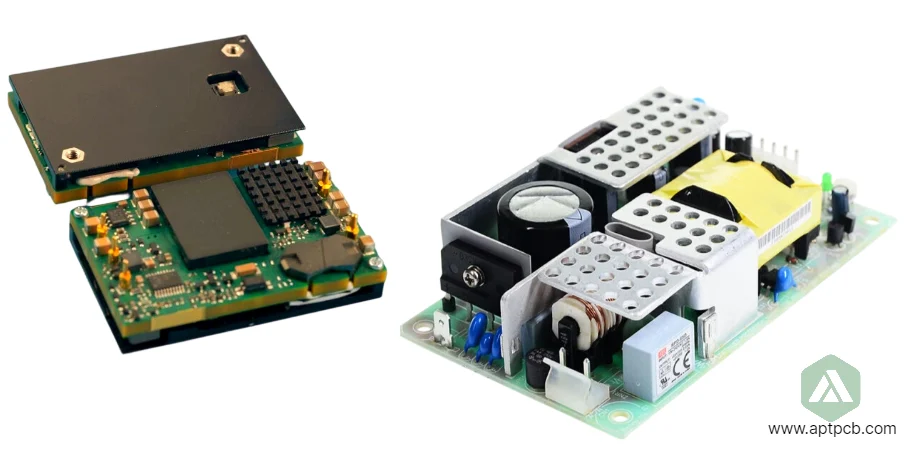
Power control board assemblies combine embedded processors, power measurement circuits, switching devices, protection systems, and communication interfaces to manage electrical loads in industrial automation, renewable energy, building management, and smart grid applications.
Selecting the right assembly partner requires more than verifying SMT capability. Engineers must evaluate current handling, voltage isolation, sensing accuracy, thermal performance, firmware integration, safety protection, and production testing requirements.
APTPCB provides power control board assembly solutions for systems from 100W through 100kW+ across 12VDC to 480VAC three-phase applications, including turnkey manufacturing, component sourcing, functional validation, and production support through turnkey assembly services.
What specifications should be evaluated for a power control PCB assembly?
A power control PCB supplier should demonstrate capability across five critical areas: electrical performance, switching reliability, thermal management, connectivity, and manufacturing validation.
| Design requirement | Typical specification range | Supplier capability to verify |
|---|---|---|
| Operating voltage | 12VDC to 480VAC three-phase | Isolation design, clearance, creepage, safety testing |
| Measurement accuracy | ±0.5% class applications | ADC selection, calibration process, sensing validation |
| Operating temperature | -40 to +85°C typical industrial range | Thermal testing, component qualification, environmental protection |
| Switching performance | Millions of mechanical cycles or extended solid-state operation | Relay selection, MOSFET/TRIAC design, life testing |
| Communication | Modbus, BACnet, KNX, MQTT, wireless interfaces | Protocol integration and firmware support |
| Production validation | AOI, ICT, FCT, calibration testing | Traceability and functional verification process |
How do you select the right power control PCB architecture?
The correct architecture depends on load type, measurement requirements, environmental conditions, and communication needs.
Power control PCB selection matrix
| Application | Key requirements | Recommended design features |
|---|---|---|
| Building automation | Reliable switching and network integration | BACnet/KNX support, relay outputs, local HMI |
| Renewable energy systems | Energy measurement and protection | Current sensing, MPPT support, battery monitoring |
| Industrial motor control | High current switching and noise resistance | Heavy copper PCB, isolation, thermal monitoring |
| Smart grid equipment | Accurate measurement and remote management | Power quality analysis, secure communication, calibration storage |
A well-designed assembly integrates hardware and firmware as one system. Microcontrollers coordinate measurement algorithms, switching decisions, communication functions, and fault responses while maintaining safe operating states.
How does a power control PCB achieve accurate energy measurement?
Power measurement accuracy depends on sensing components, signal conditioning, sampling performance, and calibration.
APTPCB implements measurement architectures using:
- High-resolution ADC integration: 16-24 bit delta-sigma ADCs with simultaneous sampling capture voltage and current waveforms at 4-8kHz rates for real-time calculations.
- Precision current sensing: Calibrated shunt resistors (±0.1%) or Hall effect sensors with temperature compensation maintain accuracy across -40 to +85°C operating conditions.
- Voltage isolation and conditioning: Transformer-based or resistive divider networks with precision amplification provide safe measurement while maintaining accuracy.
- Power quality analysis: FFT processing can evaluate harmonic content through the 40th harmonic, power factor, and electrical disturbances.
- Multi-channel synchronization: Coordinated sampling reduces phase errors in three-phase measurement systems.
- Factory calibration: Stored correction factors compensate for component tolerance and temperature variation through testing quality procedures.
These techniques support IEC 62053-22 Class 0.5S accuracy applications requiring dependable energy monitoring and control.
What switching technology should a power control board use?
Switching architecture directly affects lifetime, efficiency, noise performance, and maintenance requirements.
| Switching method | Suitable applications | Engineering considerations |
|---|---|---|
| Mechanical relays | Industrial loads, HVAC, general load switching | Contact rating, arc suppression, switching cycles |
| TRIAC/SCR switching | AC loads requiring frequent switching | Heat generation, zero-crossing control, EMC performance |
| MOSFET switching | DC systems and high-speed control | Thermal resistance, gate drive design, conduction losses |
Reliable switching requires correct component selection and protection design.
Key implementation methods include:
- Relay selection with 2-3× steady-state current margin.
- RC or RCD snubber circuits for inductive load protection.
- Zero-crossing detection to reduce inrush current and electromagnetic interference.
- Sequential startup control to manage peak demand.
- Current feedback monitoring for detecting abnormal load conditions.
Validated designs can achieve more than 10 million mechanical switching cycles or over 100,000 hours of solid-state operation depending on architecture.
How is thermal management handled in high-current power control boards?
High-current assemblies generate heat through relays, switching semiconductors, regulators, and current sensing components. Thermal design must maintain component temperatures within rated limits during continuous operation.
APTPCB power control assemblies use:
- Heavy copper PCB construction with 4-6oz copper layers for improved current capacity and heat spreading.
- Strategic component placement separating heat-generating devices.
- Thermal via arrays transferring heat between PCB layers.
- Aluminum or copper heat sink integration when required.
- NTC thermistors or digital temperature sensors for monitoring and protection.
- Thermal simulation and validation before production through NPI assembly services.
A thermal review should evaluate worst-case current load, ambient temperature, enclosure airflow, and component lifetime effects.
How do communication interfaces improve smart power management?
Modern power control boards frequently connect to building systems, industrial networks, cloud platforms, and mobile interfaces.
Common communication implementations include:
- Modbus RTU/TCP for industrial automation.
- BACnet and KNX for building management systems.
- WiFi, Zigbee, LoRaWAN, and cellular connectivity for remote monitoring.
- MQTT and REST APIs for cloud data integration.
- Secure boot and encrypted communication for connected infrastructure.
- OTA firmware updates for lifecycle improvements.
Through mass production support, manufacturers can deploy connected power management products with consistent hardware and firmware configurations.
What protection features should a power control PCB include?
Protection circuits determine how safely a system responds to electrical faults.
| Failure condition | Protection approach | Validation method |
|---|---|---|
| Overcurrent | Current sensing and adjustable trip thresholds | Functional fault simulation |
| Overvoltage | Voltage monitoring with shutdown control | Voltage variation testing |
| Ground fault | Residual current detection | Safety verification |
| Overtemperature | Thermal monitoring and derating | Temperature chamber testing |
| Software failure | Hardware watchdog and safe-state control | Firmware fault testing |
| Communication loss | Failsafe operating modes | System integration testing |
Protection design must coordinate with upstream breakers, application requirements, and certification targets including UL, CE, and IEC standards.
Component selection through component sourcing ensures safety-rated parts are available for production requirements.
What should engineers include in a power control PCB assembly RFQ?
A complete supplier evaluation package should include:
Electrical requirements
- Input voltage range.
- Maximum current per channel.
- Load type and switching frequency.
- Measurement accuracy requirements.
- Isolation requirements.
Mechanical requirements
- PCB dimensions.
- Connector specifications.
- Mounting method.
- Environmental conditions.
- Conformal coating requirements.
Manufacturing requirements
- BOM and approved component list.
- PCB stack-up and copper requirements.
- Inspection standards.
- Functional test requirements.
- Calibration procedures.
Compliance requirements
- Target certifications.
- Safety standards.
- Operating temperature range.
- Documentation requirements.
A supplier that reviews these details during engineering review can identify manufacturing risks before production begins.
Which industries use intelligent power control board assemblies?
Power control boards support applications requiring automated energy management, reliable switching, and continuous monitoring.
Building automation applications
Typical implementations include:
- Lighting control systems.
- HVAC management.
- Elevator and access control systems.
- DIN rail and wall-mounted controllers.
- Occupancy-based energy optimization.
- Local and remote override functions.
Industrial and renewable energy applications
Common requirements include:
- Three-phase power monitoring.
- Motor and equipment control.
- Solar MPPT management.
- Battery energy storage control.
- Predictive maintenance monitoring.
- Ruggedized construction for harsh environments.
Industrial deployments may require conformal coating through PCB conformal coating processes and specialized manufacturing support through special PCB manufacturing capabilities.
Power control PCB supplier evaluation checklist
Before selecting an assembly partner, verify:
- ✓ Experience with high-voltage and high-current PCB assemblies.
- ✓ Capability for mixed SMT and through-hole components.
- ✓ Functional testing and calibration capability.
- ✓ Thermal and reliability validation experience.
- ✓ Communication protocol integration support.
- ✓ Component traceability and quality systems.
- ✓ Prototype-to-production manufacturing support.
A qualified power control PCB assembly partner helps reduce field failures, improve product reliability, and accelerate deployment of intelligent energy management systems.