
Key Takeaways
- A Power Factor Meter measures the relationship between real power and apparent power by analyzing voltage and current together.
- Meter selection depends on the electrical environment: industrial motors, smart energy systems, renewable systems, laboratories, and field inspection have different accuracy and sensing requirements.
- True power factor measurement must account for harmonic distortion, not only voltage-current phase displacement.
- The PCB design directly affects measurement accuracy through isolation, grounding, thermal stability, sensing layout, and calibration access.
- Production-ready designs require supplier validation covering electrical testing, material control, current handling, and manufacturing repeatability.
How does a Power Factor Meter work?
A Power Factor Meter evaluates how effectively an electrical system converts supplied power into useful work.
The fundamental relationship is:
Power Factor (PF) = Real Power (kW) / Apparent Power (kVA)
A power factor close to 1.0 indicates efficient power usage. Lower values indicate that reactive power or waveform distortion increases the current required to deliver the same useful output.
Electrical loads affect power factor in different ways:
- Inductive loads such as motors and transformers create lagging power factor.
- Capacitive loads create leading power factor.
- Non-linear loads such as switching power supplies create harmonic distortion.
Modern systems require true power factor measurement because true PF includes harmonic effects, while displacement PF only evaluates the fundamental frequency component.
A Power Factor Meter differs from a standard multimeter because it must measure voltage and current simultaneously and calculate their relationship over time.
How do you measure power factor?
There are three common ways, from simplest to most complete:
| Method | How it works | Limitation |
|---|---|---|
| Phase-angle (cos φ) meter | Measures the time shift between the voltage and current zero crossings and reports cos φ | Gives displacement PF only; wrong on distorted (non-sinusoidal) loads |
| Separate wattmeter and V/A readings | PF = measured real power ÷ (VRMS × IRMS) | Needs true-RMS instruments and simultaneous readings |
| Digital power analyzer or power factor analyzer | Samples voltage and current waveforms together and calculates real, apparent and reactive power, PF and harmonics | Higher cost; accuracy depends on sampling, CTs and calibration |
For three-phase systems the meter needs a voltage and current input per phase (or the two-wattmeter method on three-wire systems), and reports PF per phase and in total. Correct CT orientation and phase pairing matter as much as the meter itself, as the failure-mode table below shows.
Which Power Factor Meter specifications should I compare?
Selecting a meter requires evaluating the complete measurement system rather than a single accuracy number.
| Metric | Why it matters | Typical considerations | Verification method |
|---|---|---|---|
| Accuracy Class | Determines measurement confidence | 0.5% to 2.5% common; higher precision systems require tighter control | Compare against calibrated reference equipment |
| Current Range | Prevents saturation and thermal stress | 5A to 100A direct measurement; higher currents typically use CTs | Load testing across operating range |
| Voltage Range | Determines insulation and measurement margin | 110V, 220V, 480V systems commonly require isolation planning | Dielectric withstand testing |
| Frequency Response | Affects distorted waveform measurement | 50Hz/60Hz systems require appropriate bandwidth | Compare against reference analyzer |
| CT Burden | Influences current measurement accuracy | Wiring resistance and input impedance affect error | Measure secondary loading |
| Resolution | Determines smallest detectable change | 0.01 to 0.001 PF resolution is common | Controlled phase-angle testing |
| Phase Error | Directly affects PF calculation | Small timing errors create PF deviation | Compare voltage/current timing |
| Temperature Range | Prevents measurement drift | Industrial designs commonly target -10°C to +55°C operation | Thermal cycling |
Accuracy specifications must always be evaluated with operating range, load conditions, and environmental conditions because measurement error changes across the measurement range.
How do I choose a Power Factor Meter for my application?
Industrial motor and automation systems
Industrial motor applications typically include high current, electrical noise, and inductive loads.
A suitable architecture usually includes:
- Digital panel meter design.
- External CT support.
- Strong electromagnetic compatibility.
- Industrial enclosure protection.
- Reliable operation across temperature variation.
The primary design priority is stable measurement under changing load conditions.
Smart energy monitoring systems
Smart meters and building energy systems require compact designs with communication capability.
A suitable design includes:
- Compact Demand Meter PCB architecture.
- MCU-based calculation.
- Communication interfaces such as RS485, Wi-Fi, or Zigbee.
- Long-term calibration stability.
Smaller PCB designs require careful isolation and thermal planning because measurement circuits operate close to power electronics.
Renewable energy inverter systems
Solar and grid-connected systems require measurement during changing power flow conditions.
Important capabilities include:
- Bidirectional measurement.
- Four-quadrant power calculation.
- Fast sampling.
- Digital signal processing.
The design must handle changing waveform characteristics and harmonic content.
Laboratory measurement systems
Laboratory environments prioritize accuracy and repeatability.
Typical requirements include:
- High-precision digital analyzers.
- Harmonic analysis.
- Stable calibration references.
- Controlled environmental conditions.
RF measurement applications
An RF Power Meter measures high-frequency signal power rather than utility AC power factor.
RF designs require:
- Controlled impedance routing.
- Low-loss transmission structures.
- Appropriate RF materials.
For RF-related PCB calculations, use an Impedance Calculator.
What PCB design factors affect Power Factor Meter accuracy?
A Power Factor Meter is a measurement instrument, so PCB decisions directly influence final accuracy.
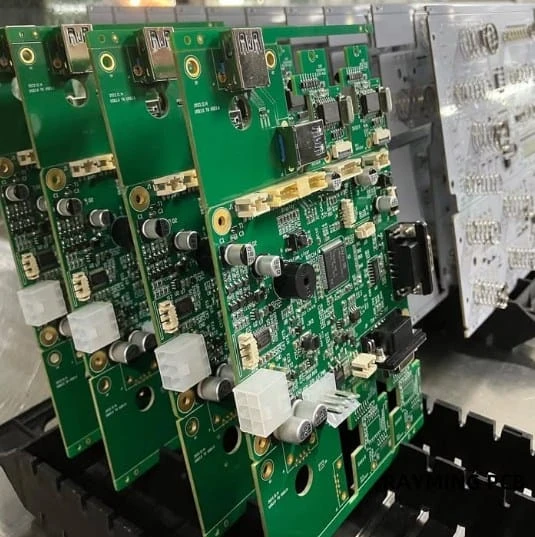
On the board side, most power factor meters are 4- to 6-layer multilayer PCB designs with an isolated measurement front end, an MCU or metering IC, and a communication section. The same design rules apply to grid, solar and storage equipment covered under power and energy PCB applications.
| PCB Design Area | Engineering Requirement | Result if Incorrect |
|---|---|---|
| High Voltage Isolation | Maintain correct creepage and clearance distances | Arcing, safety failure, insulation breakdown |
| Current Sensing Paths | Match copper thickness and current capacity to load requirements | Heating, resistance changes, measurement drift |
| Analog/Digital Separation | Keep sensitive measurement circuits away from switching noise | Unstable readings and increased error |
| Grounding Strategy | Control return paths and avoid unwanted loops | Offset errors and noise injection |
| Component Selection | Use precision resistors and stable references | Scaling errors and calibration drift |
| Thermal Management | Separate heat sources from measurement components | Temperature-related accuracy changes |
| Input Protection | Include surge and transient protection | Damage from electrical events |
| Calibration Access | Provide test points and production fixtures | Difficult manufacturing calibration |
What is the Power Factor Meter selection decision matrix?
| Application | Measurement Priority | Recommended Features | Main Design Focus |
|---|---|---|---|
| Industrial motors | Stable operation under inductive loads | CT input, EMI resistance, industrial enclosure | Current path and isolation |
| Smart meters | Compact monitoring and communication | MCU processing, RS485/Wi-Fi/Zigbee | PCB integration and calibration |
| Renewable energy | Dynamic power flow measurement | Bidirectional measurement, DSP processing | Sampling and firmware accuracy |
| Laboratory testing | Maximum measurement accuracy | High-resolution analyzer, harmonic analysis | Reference stability |
| Field inspection | Portable measurement | Rugged enclosure, wide operating range | Sensor reliability |
What are the most common Power Factor Meter failure modes?
| Failure Mode | Cause | Measurement Impact | Corrective Action |
|---|---|---|---|
| Incorrect CT polarity | Sensor installed in reverse orientation | Negative or incorrect PF values | Verify P1/P2 and S1/S2 orientation |
| Harmonic measurement error | Displacement PF used for distorted loads | Incorrect efficiency assessment | Use true PF measurement |
| Poor PCB grounding | Mixed signal and power returns | Noise and unstable readings | Separate measurement references |
| Excessive CT burden | High wiring resistance or unsuitable sensor loading | CT accuracy degradation | Verify burden specification |
| Missing calibration process | Component aging or tolerance drift | Long-term accuracy loss | Add production calibration |
| Incorrect phase pairing | Voltage and current channels mismatched | Invalid PF calculation | Validate phase relationships |
What supplier checklist should I use before manufacturing?
Before releasing a Power Factor Meter PCB for production, verify that the manufacturing partner can support both electrical performance and production repeatability.
| Supplier Evaluation Item | Required Evidence |
|---|---|
| High-voltage PCB capability | Isolation capability, inspection records, and Hi-Pot testing support |
| Current handling capability | Copper weight documentation and thermal validation |
| Calibration support | Test points, fixtures, and production calibration workflow |
| Material control | Dielectric specifications and CTI requirements |
| Quality control process | AOI, electrical testing, inspection reports |
| Environmental validation | Temperature testing and reliability evaluation |
Power Factor Meter FAQ
What is the difference between true power factor and displacement power factor?
Displacement PF measures only the phase relationship of the fundamental waveform. True PF includes harmonic distortion and is more suitable for modern electronic loads.
Can a Power Factor Meter reduce electricity costs?
The meter does not directly reduce consumption. It provides measurement data used for identifying inefficient loads and planning correction systems.
Why does a Power Factor Meter show leading or lagging values?
Lagging PF occurs when current follows voltage, commonly from inductive loads. Leading PF occurs when current moves ahead of voltage, commonly from capacitive loads.
Is a digital meter better than an analog meter?
Digital meters generally provide higher accuracy, communication features, and data logging capability. Analog meters remain useful for simple visual indication.
Can standard PCB material be used for a Power Factor Meter?
Low-voltage isolated designs may use standard FR4. Direct mains-connected systems require careful evaluation of insulation rating, creepage, clearance, and dielectric performance.
What is the difference between a power factor meter and a power quality analyzer?
A power factor meter reports PF, and usually voltage, current and power. A power quality analyzer also records harmonics, flicker, sags, swells and transients over time. The PCB requirements overlap, but analyzers need faster sampling and more storage; see the power quality analyzer PCB guide.
What is a Demand Meter PCB?
A Demand Meter PCB calculates average electrical consumption over a defined period and is commonly integrated into energy monitoring equipment.
How often should calibration be performed?
Critical industrial and billing applications commonly require annual calibration. Less demanding monitoring systems may use longer intervals depending on accuracy requirements.
Glossary
| Term | Definition |
|---|---|
| Active Power (kW) | Useful electrical power that performs work |
| Apparent Power (kVA) | Combination of active and reactive power |
| Reactive Power (kVAR) | Energy exchanged between source and reactive loads |
| Phase Angle | Difference between voltage and current waveforms |
| Leading PF | Current leads voltage due to capacitive behavior |
| Lagging PF | Current follows voltage due to inductive behavior |
| CT | Current transformer used for measurement scaling |
| PT | Potential transformer used for voltage scaling |
| True RMS | Measurement method for distorted waveforms |
| Creepage | Surface insulation distance between conductors |
| Clearance | Air distance between conductors |
How do I move from Power Factor Meter design to production?
A reliable Power Factor Meter requires coordination between measurement algorithms, sensing hardware, PCB layout, and manufacturing processes.
When the bare board, components, calibration fixtures and assembly are handled by one supplier, turnkey PCB assembly keeps component lots, calibration data and Hi-Pot records tied to each meter's serial number.
Engineering teams preparing for production should provide:
- Gerber Files: Copper layers, solder mask, and drill information.
- Stackup Specifications: Copper thickness and dielectric information.
- Material Requirements: CTI rating and insulation requirements.
- Test Requirements: Hi-Pot testing, impedance control, and validation procedures.
A production-ready Power Factor Meter is not only a measurement device. It is a complete reliability system where electrical accuracy, PCB design, and manufacturing control work together.