
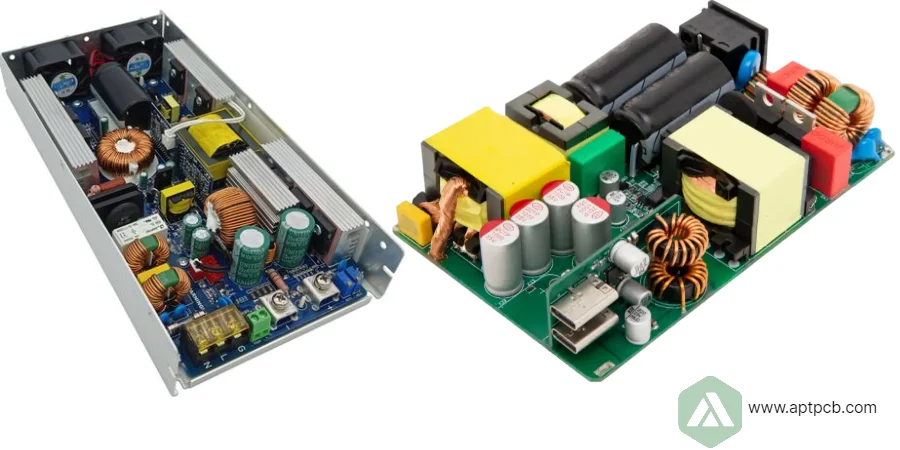
Searching for a power supply PCB manufacturer usually sounds like a supplier shortlisting task, but the real decision is narrower: can the manufacturer support the board architecture, thermal route, interface mix, and test handoff that the product actually needs?
For power-conversion projects, start with the related page for power and energy PCB manufacturing. If the build includes cabinet control, PLC-adjacent I/O, or monitoring boards beside the power stage, bring in the industrial control PCB route early instead of treating the whole job as one generic power board.
This guide is for engineering-commercial evaluation, not for ranking converter topologies or making protocol, compliance, or performance claims.
Quick Answer The right power supply PCB manufacturer is the one that can review your board as a controlled manufacturing package: partitioned power and control regions, a defined thermal route, a realistic connector strategy, and a clear path into inspection and powered test. If those inputs are vague, supplier selection turns into generic capability claims, and the first build usually slips when the real assembly or test constraints appear too late.
What To Check Before Comparing Manufacturers
A useful supplier review starts with the product boundary. Ask:
- Is this one power board, or a family of power, control, and interface boards?
- Does the design need a special thermal route, or only disciplined placement and heat-path planning?
- Are the external interfaces board-mounted, press-fit style, or part of a cable or harness integration step?
- Will the assembly require mixed technology, heavier hardware, shielding, or manual secondary operations?
- Is there already a defined handoff into powered verification or FCT?
Without those answers, a supplier comparison turns into marketing language instead of a buildability review.
That is also the common failure chain: the buyer asks for pricing before the board family, connector route, thermal attachment, and powered-test method are frozen; suppliers quote against different hidden assumptions; the selected build path then collides with heavier hardware, blocked inspection access, or missing fixture inputs; and the program loses time reconciling package gaps after the vendor is already chosen.
Look For Board Partitioning Discipline, Not Generic Power Claims
The first sign of a good fit is whether the manufacturer can discuss the design as separate board functions instead of one undifferentiated "power supply PCB."
For industrial and power-energy builds, that usually means understanding:
- the compact noisy power stage
- the quieter control or monitoring area
- connector and harness handoff zones
- thermal interfaces to heatsinks, chassis, or enclosure walls
- inspection and test access after full assembly
A capable review partner should be comfortable talking about how those regions affect fabrication, placement, assembly order, and test setup. If the conversation jumps immediately to broad efficiency or standards language, it is usually skipping the actual manufacturing risk.
Check Whether The Thermal Route Matches The Product
Not every power board needs the same construction route. Some products mainly need clean placement and copper-spreading discipline. Others need a more explicit thermal platform review because the main heat path leaves the board through a base, chassis, or dedicated mechanical surface.
That is why the thermal conversation should map to real route options such as high thermal PCB builds or metal core PCB programs, rather than defaulting to a single recipe.
Use supplier evaluation to ask:
- Which thermal-route options are realistic for this board class?
- How will assembly steps interact with heatsinks, interface materials, or mechanical fastening?
- Can the layout and fabrication route support the intended heat path without creating service or inspection conflicts?
- Is the thermal strategy attached to the power board itself, or split across board and enclosure design?
The point is not to force a named platform. The point is to verify that the manufacturer understands why the chosen route exists.
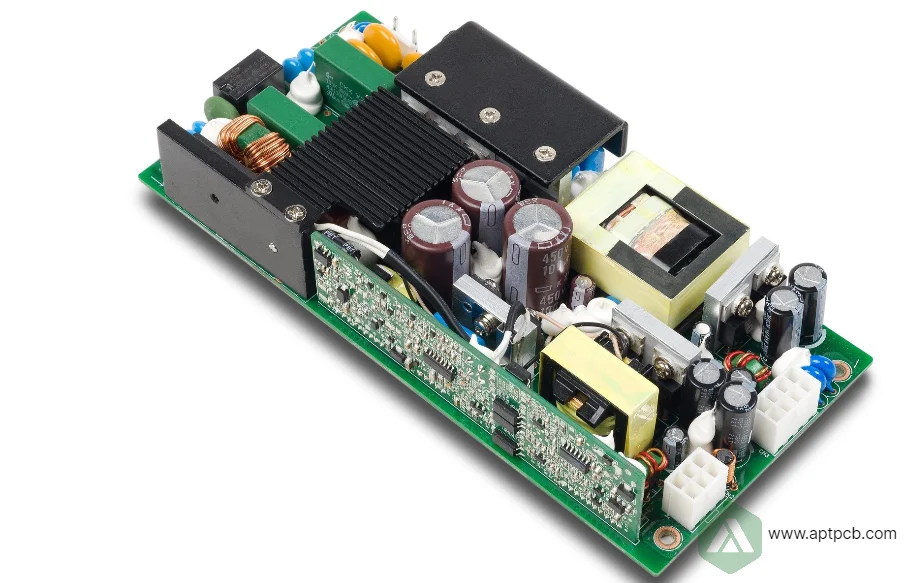
Verify Interface And Connector Handling Early
Many power builds fail sourcing review because connector strategy is treated too late. A useful manufacturer discussion separates:
- soldered board interfaces
- mechanically sensitive connector zones
- off-board cable or harness integration
Those routes drive different drilling, assembly, inspection, and system-integration needs.
For industrial power hardware, confirm that the supplier can review:
- heavy or mechanically stressed connector hardware
- power versus control connector separation
- cable-exit planning relative to shields, covers, or heatsinks
- labeling and polarity checks during assembly
- whether wiring integration belongs in PCB assembly scope or later box-build scope
This matters especially when the product combines power conversion with cabinet wiring or external monitoring modules.
Ask How Manufacturability Review Is Actually Run
A strong power supply PCB manufacturer should be able to explain the review flow before production starts. The core question is not "can you build power boards?" It is "how do you screen this exact board for the right fabrication and assembly route?"
The review should usually cover:
- board partitioning and component density
- copper and thermal-platform implications
- mixed SMT/THT requirements
- heavier magnetic or mechanical hardware
- fixture and probe access after assembly
- expected inspection sequence for visually crowded areas
This is where a supplier earns trust. A generic capability list is much less useful than a clear explanation of how the design will be reviewed before release.
A recurring disaster pattern sits exactly here. Low-end suppliers with no real industrial-power experience will often accept a 3 oz or 4 oz heavy-copper requirement just to win the order. On the quote sheet, that sounds harmless. In production, thick copper is much harder to etch cleanly. If the CAM team cannot apply disciplined etch compensation, the copper sidewall undercut becomes severe and the finished trace necks down at its base. A 4 oz rail that was designed to carry 50 A may still look acceptable from the top view while its real cross-section has already been cut down where the current density matters most.
The failure is lethal because bare-board continuity testing will not catch it. At room temperature and low voltage, the trace still reads electrically continuous. Once the assembled power board is installed in an industrial cabinet and driven at full-load peak current, that weakened section starts behaving like a fuse. Local heating rises fast, the copper discolors or opens, the surrounding FR-4 chars and delaminates, and the fault can escalate into an electrical fire inside the cabinet. That is why heavy-copper capability cannot be judged by a checked box on a quotation form. A serious manufacturer should be able to show the DFM-stage etch-compensation method and the plating-thickness standard for thermal vias and high-current copper features before release.
Make Functional Test Part Of Supplier Selection
Power boards should not be evaluated only on fabrication and placement capability. They also need a credible path into powered verification.
If the supplier will support assembly-level powered checks, the conversation should connect to FCT test planning. That does not require system-level performance promises. It requires agreement on how the assembled board will be powered, loaded, observed, and released.
Useful evaluation questions include:
- Can the supplier support fixture planning for the final connector and mechanical state?
- Will the test step check startup, shutdown, status, or monitoring behavior?
- Are test access points still available after larger hardware is installed?
- Does the build package distinguish in-process inspection from final powered verification?
If those answers are vague, the project may be under-scoped even if the bare manufacturing capability looks acceptable.
Match The Supplier To The Application Fit
Not every manufacturer that builds low-power consumer boards is the right fit for industrial power hardware. The better filter is application fit:
- cabinet or enclosure-mounted industrial power boards
- power boards paired with industrial control or monitoring sections
- assemblies with larger magnetic parts or mechanically stressed interfaces
- builds that need a deliberate handoff into electrical validation and FCT
That fit matters more than generic claims about covering every market from telecom to medical to consumer products. Narrower fit usually leads to better manufacturability conversations and fewer late surprises.
Quote Only After The Build Package Is Coherent
The quote step works best after the manufacturer review package includes:
- Gerber or current layout files
- BOM with critical sourcing notes
- stackup intent
- thermal-route notes
- interface and harness assumptions
- assembly route
- powered-test expectations
With that package ready, move to the quote request page. Without it, supplier comparison is usually premature and price discussions are detached from the real build path.
Next steps with APTPCB
If you are moving an industrial power supply, inverter, or energy-storage PCBA program to a new manufacturer, the real risk is not only price. It is hidden cost-cutting inside heavy-copper fabrication, unstable yield around high-power connectors, and assembly decisions that look acceptable at sample stage but fail under cabinet-level current and heat.
Send the Gerber or ODB++ package, BOM, stack-up intent, and peak and continuous current specifications to [email protected], or open the project through the quote request page.
APTPCB's power-manufacturing and DFM team will return a Power Supply Manufacturing & Process Audit within 24 hours. The audit will screen heavy-copper undercut risk, confirm the SMT thermal profile for high-power devices, and expose weak process assumptions before you commit to a high-risk supplier transfer. The goal is simple: lock a manufacturing baseline that is real, transparent, and not capable of turning a power rail into a fire source.
Summary
The right power supply PCB manufacturer is the one that can review the board as an industrial power build, not as a generic converter category. Check how the supplier handles board partitioning, thermal route choices, interface strategy, manufacturability review, and assembly-to-FCT handoff before treating the quote as meaningful.
Public references
IPC, "Design for Manufacturing Overview" Supports the article's DFM-first framing for supplier evaluation and release-package clarity.
Texas Instruments, "AN-1149 Layout Guidelines for Switching Power Supplies" Supports the review focus on compact power-stage layout and separation from quieter control areas.
Infineon, "PCB Design Guidelines For Switching Power Supplies" Supports the article's board-partitioning and thermal-route evaluation criteria for power-board manufacturing partners.
Keysight, "Functional Test Systems for Electronics Manufacturing" Supports the supplier-selection criterion that assembly partners must support a credible powered-test handoff.
Author and review information
- Author: APTPCB sourcing and power-electronics content team
- Technical review: PCB manufacturing, PCBA process, supplier-engineering, and functional-test review team
- Last updated: 2025-03-19