
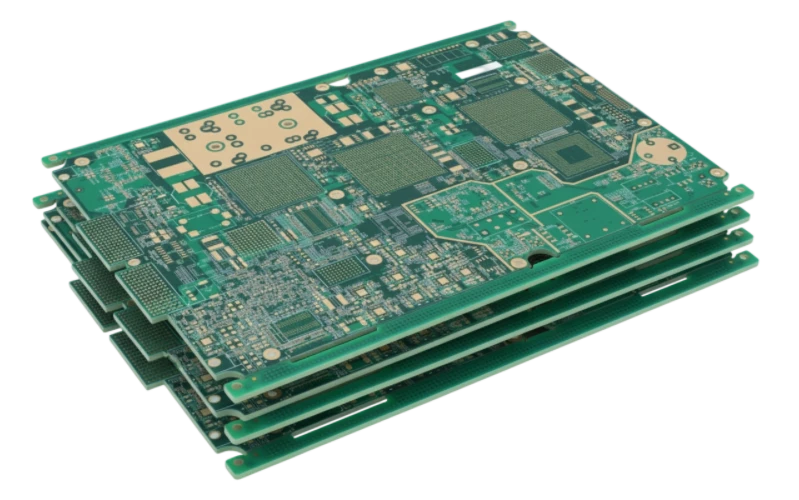
A PLC PCB design review should determine whether the board architecture, isolation strategy, manufacturing package, and verification evidence are ready for pilot production.
A PLC board is not simply a microcontroller PCB with more terminals. A CPU module, digital input card, analog measurement board, communication module, relay output board, and backplane PCB each create different design decisions.
The central review question is:
Where do field energy, logic, communication, power, and service interfaces cross boundaries—and what evidence proves those boundaries are controlled?
A production-ready PLC PCB review connects:
design requirement → PCB architecture → manufacturing control → test evidence → release approval
What type of PLC PCB is being reviewed?
The first decision is identifying the module role. The board function determines the electrical risks, layout priorities, and validation plan.
| PLC board family | Typical responsibility | Review priority |
|---|---|---|
| CPU / control board | Processor, memory, timing, local interfaces | Power integrity, return paths, processor routing, service access |
| Digital I/O board | Sensors, switches, transistor outputs, relays | Input characteristics, protection, isolation, output fault behavior |
| Analog I/O board | 4–20 mA, voltage, RTD, measurement channels | Accuracy, filtering, references, calibration, noise control |
| Communication board | RS-485, CAN, industrial Ethernet interfaces | Protection, termination, grounding, isolation, controlled routing |
| Relay / power board | Load switching and power conversion | Current paths, thermal rise, switching transients, spacing |
| Base / backplane board | Module interconnection | Connector geometry, power distribution, signal grouping |
A PLC PCB review becomes more effective when the module role is frozen before selecting stackup, copper weight, isolation components, or test methods.
How should field-side and logic-side zones be defined?
For PLC I/O hardware, review the board from the connector inward:
Field interface → protection/filtering → isolation boundary → logic domain
Field wiring can introduce switching transients, ESD events, common-mode disturbances, and wiring faults. The PCB architecture should make these energy paths visible.
A zoning review should identify:
- Field connector region.
- Protection component placement.
- High-current switching area.
- Isolation barrier location.
- Logic processing area.
- Communication interface area.
- Test points and service access.
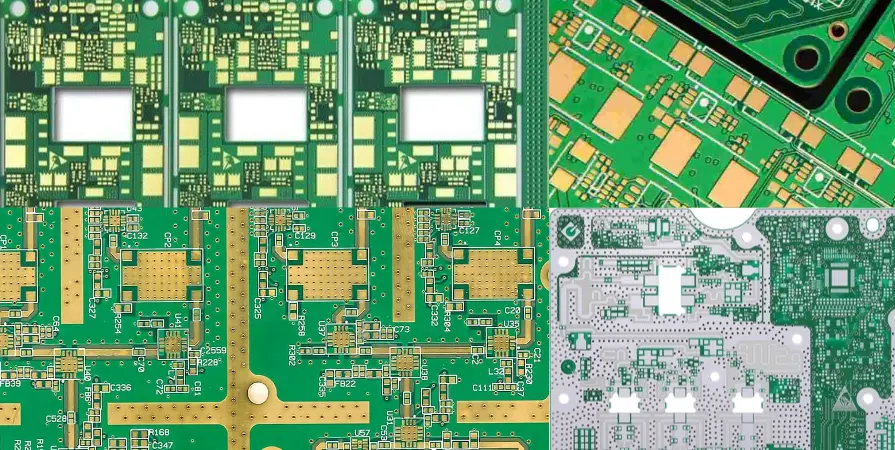
The isolation boundary must exist through the complete PCB structure. A clean top-layer gap is not sufficient if internal copper planes, vias, mounting hardware, or copper pours cross the intended separation.
Which PLC PCB isolation decisions need approval before layout release?
Isolation should be reviewed as a complete architecture rather than as a single component selection.
| Decision item | Engineering question | Release evidence |
|---|---|---|
| Isolation boundary | Which circuits belong to field side and logic side? | Approved block diagram and schematic review |
| Isolation method | Optocoupler, digital isolator, transformer, isolated power, or other method? | Component specification and design record |
| Creepage and clearance | What spacing is required for the application conditions? | PCB layout review and fabrication notes |
| Barrier routing | Are planes, vias, and copper features clear? | Layer-by-layer inspection |
| Protection placement | Does external energy encounter protection first? | Schematic and placement review |
| Verification | How will isolation performance be checked? | Defined inspection or test method |
IEC 60664-1 provides the insulation-coordination framework used to determine clearances, creepage distances, and insulation requirements based on application conditions. The required values depend on factors including voltage, environment, material properties, and system requirements rather than a generic PLC label.
How should PLC I/O protection be reviewed?
Each interface type should be reviewed according to its electrical behavior.
Digital inputs
Confirm:
- Input type and operating range.
- Threshold behavior.
- Filtering requirements.
- Polarity handling.
- Isolation approach.
- Expected field wiring conditions.
Digital and relay outputs
Review:
- Load current.
- Inrush conditions.
- Inductive switching energy.
- Suppression method.
- Driver thermal stress.
- Fault response.
Relay coils, solenoids, and contactors require suppression strategies selected for the actual switching circuit.
Analog inputs
Review:
- Signal range.
- Source impedance.
- Filtering.
- Reference stability.
- Common-mode behavior.
- Return-current paths.
- Calibration limits.
Low-level measurement circuits require different noise-control decisions from high-current switching sections.
Does a PLC PCB need four layers and heavy copper?
Layer count and copper weight should follow electrical requirements.
A four-layer or multilayer PCB can improve:
- Reference-plane continuity.
- Return-current control.
- Power distribution.
- Routing density.
- Signal integrity.
However, the correct stackup depends on the actual design.
Copper thickness depends on:
- Current level.
- Trace geometry.
- Thermal environment.
- Temperature-rise limits.
- Via construction.
- Duty cycle.
For communication interfaces requiring controlled impedance, establish the stackup with the fabricator before routing and use the Impedance Calculator as a design aid.
What PLC PCB failures should prototype testing target?
Prototype validation should reproduce realistic electrical conditions rather than only confirming basic startup.
| Symptom | Investigate first | Useful evidence |
|---|---|---|
| MCU resets during switching | Supply rail, return path, switching transient coupling | Oscilloscope captures during load changes |
| Digital input changes unexpectedly | Filtering, grounding, cable coupling | Controlled stimulus and disturbance testing |
| Relay or output failure | Load energy, suppression, driver stress | Switching waveform and temperature data |
| RS-485/CAN errors | Termination, grounding, protection, common mode | Differential measurements and error logs |
| Analog drift | Reference, filtering, switching noise | Controlled source comparison |
| Regulator overheating | Losses, copper spreading, airflow | Temperature-rise measurements |
| Intermittent production failures | Assembly variation, fixture, component issues | Inspection and electrical records |
The strongest release packages preserve the original failure condition, measurement setup, board revision, firmware version, and test fixture information.
What evidence should exist before PLC PCB pilot production?
A pilot release package should combine manufacturing, electrical, and functional evidence.
| Review area | Freeze before pilot | Evidence |
|---|---|---|
| Module role | CPU, I/O, communication, power, backplane definition | Approved architecture |
| Interfaces | Pinout, ranges, loads, polarity | Interface specification |
| Isolation | Boundary and verification approach | Layout review and spacing documentation |
| Protection | Interface-specific protection circuits | Schematic and assembly review |
| Stackup | Layer construction and controlled features | Fabricator stackup |
| Current paths | Load assumptions and thermal limits | Copper and thermal review |
| Communications | Physical layer and routing needs | Functional test plan |
| Analog channels | Accuracy and calibration requirements | Measurement procedure |
| Firmware | Approved production build | Version record |
| Test coverage | Inspection, electrical, functional tests | Acceptance matrix |
| Variants | BOM and assembly options | Controlled configuration record |
| Change control | Approval requirements | Revision procedure |
What should be included in a PLC PCB RFQ package?
A supplier quote should describe the real manufacturing and verification scope.
Fabrication inputs should include:
- Released Gerber and drill data.
- Layer stackup requirements.
- Controlled impedance requirements.
- Material specifications.
- Surface finish requirements.
- Special spacing or routing controls.
Assembly inputs should include:
- BOM.
- Placement files.
- Assembly drawings.
- Approved substitutions or AVL requirements.
- Programming requirements.
- Variant definitions.
For technically sensitive PLC boards, include:
- Interface map.
- Isolation requirements.
- Test specifications.
- Acceptance limits.
- Traceability requirements.
Use APTPCB's DFM Guidelines during manufacturability review.
Review APTPCB's PCB Manufacturing Services when defining fabrication scope.
Where a project specifies an Isola laminate, review Isola PCB materials against the released stackup and material requirements.
What is the OEM responsibility versus PCB manufacturer responsibility?
The PCB manufacturer controls delivery of the board or PCBA according to the released manufacturing requirements.
The OEM or design authority controls:
- Electrical architecture.
- Applicable standards.
- Insulation requirements.
- Functional behavior.
- Environmental qualification.
- Product-level compliance.
A PCB containing an EtherCAT, PROFINET, Modbus, CAN, or other interface does not automatically establish protocol compliance. A board with an isolation barrier does not automatically prove equipment safety compliance.
Manufacturing evidence supports qualification; it does not replace product validation.
FAQ
Can one PLC PCB support multiple product variants?
Yes. Variant control should be managed through controlled BOMs, approved options, firmware records, assembly instructions, and test limits.
When should conformal coating be considered?
Conformal coating can support environmental protection against moisture, contamination, or corrosive conditions when the qualification plan requires it. It must be evaluated with masking, repair, inspection, and insulation requirements.
Is ENIG always the best surface finish for PLC boards?
No. Surface finish selection depends on component technology, assembly process, connectors, storage requirements, cost, and fabrication specifications.
What information helps troubleshoot intermittent PLC failures?
Capture board revision, firmware version, operating state, supply conditions, temperature, fixture version, and measurement data from the first failure event.
Should ladder logic be part of PCB manufacturing testing?
Only when the agreed functional test uses software behavior to exercise hardware functions. Ladder logic belongs to the controller software environment, not PCB fabrication acceptance.
Public references
Conclusion
A reliable PLC PCB release begins with explicit module ownership, interface zoning, isolation boundaries, and measurable verification criteria.
The strongest design reviews do not ask whether a PCB appears industrial. They ask whether every critical interface has a defined purpose, controlled manufacturing method, and supporting evidence.
For PLC CPU boards, I/O modules, communication cards, relay boards, and backplanes, provide the released fabrication data, BOM and placement files where assembly is required, interface requirements, isolation expectations, quantities, and test criteria. This creates a clear path from DFM review to pilot production.