
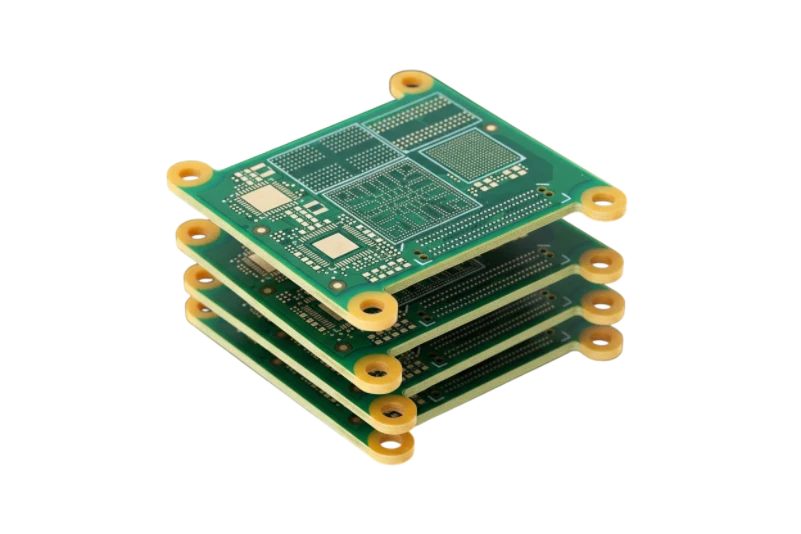
What this playbook covers (and who it's for)
This guide is designed for hardware engineers, packaging architects, and procurement leads tasked with sourcing RDL fan-out substrate routing solutions. As semiconductor scaling slows, the burden of performance shifts to the package. Redistribution Layers (RDL) in Fan-Out packaging (FOWLP/FOPLP) are critical for bridging the gap between nanometer-scale die I/O and millimeter-scale board geometries.
You are likely reading this because standard HDI is no longer sufficient for your I/O density, or you are moving from wire-bond to advanced flip-chip or wafer-level packaging. The transition involves complex trade-offs between line/space resolution, signal integrity, and mechanical reliability. A failure in the RDL layer renders expensive silicon useless.
This playbook moves beyond theory. It focuses on the procurement and engineering validation phase. We outline exactly what specifications to define, where the hidden manufacturing risks lie, and how to audit a supplier like APTPCB (APTPCB PCB Factory) to ensure they can deliver yield at scale. We provide actionable checklists to streamline your decision-making process.
When RDL fan-out substrate routing is the right approach (and when it isn't)
Understanding the specific utility of RDL technology prevents over-engineering and unnecessary cost.
Use RDL Fan-Out when:
- I/O Density is Critical: Your die has a high I/O count that exceeds the area available for standard fan-in bumps. You need to "fan out" connections to a larger area to accommodate standard BGA pitches.
- Form Factor Constraints: You require the thinnest possible package profile. RDL eliminates the need for a separate organic substrate core in some architectures (like wafer-level fan-out).
- Electrical Performance: You need shorter signal paths than wire bonding can provide to reduce parasitic inductance and capacitance for high-speed SerDes or RF applications.
- Heterogeneous Integration: You are combining multiple dies (chiplets) with different process nodes into a single package and need high-density routing to interconnect them.
- Thermal Management: You need direct copper connections from the die face to the system board to improve heat dissipation compared to wire bonds.
Do not use RDL Fan-Out when:
- Low I/O Count: If standard wire bonding or lead-frame packages can handle the connectivity, RDL is an unnecessary cost driver.
- Extreme Cost Sensitivity: For commoditized consumer electronics where standard BGA or QFN packages suffice, the lithography costs of fine-pitch RDL may be prohibitive.
- High Power/Current Requirements: While RDL can handle power, extremely high-current applications might benefit more from heavy copper PCBs or specific power modules with thicker traces than typical RDL processes allow (usually <10µm thickness).
- Large Die Size with High CTE Mismatch: If the die is very large and the board CTE is vastly different, direct fan-out without an interposer or underfill stress relief can lead to solder joint fatigue failures.
Specs & requirements (before quoting)
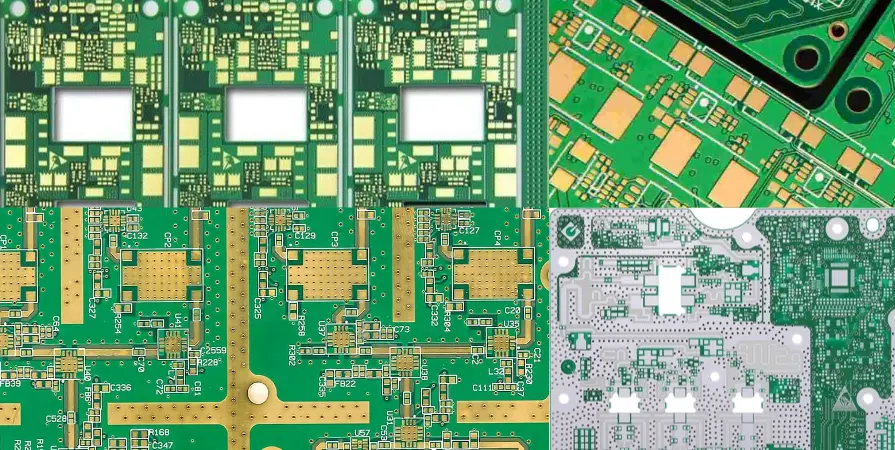
Vague requirements lead to "engineering queries" (EQ) that delay projects by weeks. Define these parameters clearly to get an accurate quote and DFM feedback immediately.
- Line Width and Space (L/S): Define the minimum trace width and spacing. Typical RDL requires 2µm/2µm to 10µm/10µm. Be specific about which layers require the finest pitch.
- RDL Layer Count: Specify the number of redistribution layers (e.g., 1 RDL, 2 RDL, 3+ RDL). More layers increase routing flexibility but significantly increase yield risk and cost.
- Dielectric Material: Specify the polymer type (e.g., Polyimide (PI), PBO, BCB, or ABF). This dictates cure temperatures, dielectric constant (Dk), and moisture absorption rates.
- Via Specifications: Define via type (blind, stacked, staggered), diameter (typically 10µm–50µm for RDL), and capture pad size.
- Copper Thickness: Specify the required copper thickness for signal vs. power planes. RDL copper is often plated semi-additively (SAP) and is thinner than standard PCB foil.
- Surface Finish: Define the finish for the pads (e.g., ENEPIG, OSP, Immersion Tin) to ensure compatibility with the subsequent assembly or solder ball attachment.
- Substrate/Carrier Size: If using panel-level fan-out, specify the panel size (e.g., 510mm x 515mm) to optimize utilization.
- Impedance Control: List target impedance (e.g., 50Ω single-ended, 100Ω differential) and the tolerance (typically ±10%). This forces the supplier to verify stackup heights.
- Warpage Tolerance: Define the maximum allowable warpage at room temperature and reflow temperature (e.g., <100µm across the unit).
- UBM (Under Bump Metallization): Specify the UBM structure if the supplier is responsible for bumping. This is critical for electromigration resistance.
- Inspection Standards: Cite the specific inspection criteria (e.g., AOI resolution down to 1µm, 100% electrical test).
- Traceability Level: Define if you need panel-level or unit-level traceability for materials and process data.
Hidden risks (root causes & prevention)
RDL manufacturing is closer to semiconductor processing than traditional PCB fabrication. The risks are microscopic but have macroscopic impacts.
- Die Shift (Lithography Misalignment):
- Risk: During the molding process (in FOWLP), dies can move slightly. If the subsequent RDL lithography doesn't compensate, vias will miss the die pads.
- Detection: AOI after development; electrical open/short testing.
- Prevention: Use suppliers with "adaptive patterning" or high-accuracy die placement bonders.
- Warpage Induced Delamination:
- Risk: CTE mismatch between the mold compound, silicon die, and RDL dielectric causes the wafer/panel to warp. Excessive warpage leads to delamination between RDL layers.
- Detection: Scanning Acoustic Microscopy (C-SAM); Shadow Moiré warpage measurement.
- Prevention: Careful selection of mold compound CTE; balancing copper density on top and bottom layers.
- Seed Layer Etch Undercut:
- Risk: In the Semi-Additive Process (SAP), the seed layer must be etched away. If etched too aggressively, it undercuts the signal trace, weakening adhesion and increasing resistance.
- Detection: Cross-section analysis (SEM); resistance measurements.
- Prevention: Precise control of etch chemistry and time; use of differential etchants.
- Via Cracking at Interface:
- Risk: Thermal cycling causes stress at the interface between the via bottom and the underlying pad. Poor cleaning (smear) or brittle intermetallics cause cracks.
- Detection: Thermal shock testing followed by resistance monitoring; focused ion beam (FIB) cuts.
- Prevention: Robust plasma desmear processes; in-situ plasma cleaning before plating.
- Dielectric Cracking:
- Risk: Brittle dielectric materials (like some photosensitive epoxies) can crack under mechanical stress or thermal shock.
- Detection: Thermal cycling; visual inspection under magnification.
- Prevention: Use materials with higher elongation to break (e.g., specific Polyimide formulations).
- Electromigration (EM):
- Risk: High current density in very thin RDL traces causes copper atoms to migrate, creating voids (opens) or hillocks (shorts).
- Detection: High-temperature operating life (HTOL) tests; current density simulation.
- Prevention: Design rules that limit current density; use of barrier layers.
- Moisture Absorption (Popcorning):
- Risk: Organic dielectrics absorb moisture. During reflow, this moisture turns to steam and delaminates the RDL (popcorn effect).
- Detection: MSL (Moisture Sensitivity Level) testing; weight gain analysis.
- Prevention: Baking prior to assembly; choosing low-moisture absorption materials (like LCP or specific ABF grades).
- Resolution Limit Yield Loss:
- Risk: Pushing a supplier’s L/S capability to the limit (e.g., asking for 2µm on a 5µm line) results in shorts/opens due to dust or photoresist defects.
- Detection: Yield analysis per wafer/panel; AOI.
- Prevention: Design with a safety margin (e.g., use 5µm L/S if 2µm isn't strictly necessary); cleanroom class enforcement.
Validation plan (what to test, when, and what “pass” means)
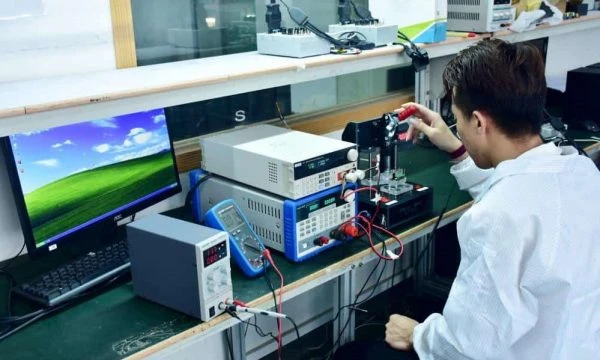
You cannot rely solely on the supplier's Certificate of Compliance (CoC). You must validate the RDL fan-out substrate routing integrity yourself or through a third party.
- Daisy Chain Continuity Test:
- Objective: Verify electrical connectivity of all nets, especially through vias and die contacts.
- Method: Design a test vehicle with daisy-chained interconnects. Measure resistance.
- Acceptance: Resistance within ±10% of simulation; no opens.
- Thermal Cycling (TC):
- Objective: Test fatigue life of copper traces and vias under thermal stress.
- Method: JEDEC JESD22-A104. -40°C to +125°C (or +150°C), 500 to 1000 cycles.
- Acceptance: Resistance change <10% (or <20% depending on class); no cracking in cross-section.
- High Temperature Storage (HTS):
- Objective: Evaluate material stability and intermetallic growth over time.
- Method: JEDEC JESD22-A103. 150°C for 1000 hours.
- Acceptance: No delamination; shear strength of bumps remains within spec.
- Highly Accelerated Stress Test (biased HAST):
- Objective: Test for corrosion and dendritic growth (electrochemical migration) under humidity and bias.
- Method: JEDEC JESD22-A110. 130°C, 85% RH, biased voltage, 96 hours.
- Acceptance: No insulation resistance failure; no dendritic growth visible.
- Drop Test:
- Objective: Assess mechanical robustness of the RDL and solder joints during impact.
- Method: JEDEC JESD22-B111. Board level drop test.
- Acceptance: Survival of a defined number of drops (e.g., 30 drops) without electrical failure.
- Warpage Measurement:
- Objective: Ensure the substrate is flat enough for SMT assembly.
- Method: Shadow Moiré at room temp, 150°C, and 260°C.
- Acceptance: Warpage <100µm (or specific JEITA/JEDEC standard for the package size).
- Cross-Section Analysis (Construction Analysis):
- Objective: Verify physical dimensions and plating quality.
- Method: Mechanical cross-sectioning and SEM imaging.
- Acceptance: Copper thickness, via alignment, and dielectric thickness match drawing tolerances.
- Solderability Test:
- Objective: Ensure pads wet properly during assembly.
- Method: IPC-J-STD-003. Dip and look or wetting balance.
- Acceptance: >95% coverage; uniform wetting.
Supplier checklist (RFQ + audit questions)
Use this checklist when engaging with APTPCB or other advanced manufacturers. It separates capable RDL partners from standard PCB shops.
RFQ Inputs (What you send)
- Gerber/ODB++ Files: Full layout data with clear layer definitions.
- Netlist: IPC-356 format for electrical test verification.
- Stackup Drawing: Explicitly showing dielectric thicknesses, copper weights, and material types.
- Drill/Via Table: Defining blind, buried, and through vias with aspect ratios.
- Impedance Requirements: Specific lines and reference planes.
- Panelization Drawing: If you have specific array requirements for your assembly line.
- Acceptance Specification: Reference to IPC-6012 (Class 2 or 3) or specific internal specs.
- Volume Forecast: EAU (Estimated Annual Usage) to determine pricing tier and production line allocation.
Capability Proof (What they must show)
- Minimum L/S Capability: Can they demonstrate stable production at your required pitch (e.g., 5µm/5µm)? Ask for CpK data.
- Via Aspect Ratio: Can they plate the aspect ratio of your vias (e.g., 1:1 or 2:1 for blind vias) without voids?
- SAP/mSAP Experience: Do they have a dedicated Semi-Additive Process line? (Standard subtractive etching cannot do fine RDL).
- Material Qualification: Have they qualified the specific dielectric (e.g., PI or ABF) you requested?
- Warpage Simulation: Can they run a simulation based on your stackup to predict warpage before fab?
- Cleanroom Class: Is the RDL imaging area Class 100 or Class 1000? (Standard PCB is often unclassified or Class 10k+).
Quality System & Traceability
- AOI Capability: What is the minimum defect size their AOI can catch? (Should be <50% of line width).
- Electrical Test: Do they use flying probe (for proto) or fixture (for volume)? Can they test fine pitch pads?
- Cross-Section Frequency: How often do they perform micro-sections per lot? (Should be at least 1 per lot/panel).
- Certifications: ISO 9001 is minimum. IATF 16949 is preferred for reliability. ISO 13485 for medical.
- Failure Analysis: Do they have in-house SEM/EDX for analyzing defects?
Change Control & Delivery
- PCN Policy: Do they agree to provide Product Change Notification (PCN) for any material or process change?
- Capacity Planning: What is their current utilization rate? (If >90%, lead times will slip).
- Buffer Stock: Are they willing to hold finished goods inventory (VMI) for volume orders?
- Lead Time: What is the standard lead time for RDL builds? (Often 4-6 weeks for complex builds).
Decision guidance (trade-offs you can actually choose)
Every design decision in RDL fan-out substrate routing has a counter-reaction.
- Trade-off: Line Width vs. Yield
- Guidance: If you prioritize cost, choose wider lines (10µm+). Yield drops exponentially as you approach 2-5µm. Only use fine lines where absolutely necessary for breakout.
- Trade-off: Layer Count vs. Warpage
- Guidance: If you prioritize flatness, choose symmetric stackups. An odd number of RDL layers or unbalanced copper distribution creates a bi-metallic strip effect, causing severe warpage.
- Trade-off: Dielectric Material vs. Reliability
- Guidance: If you prioritize thermal cycling reliability, choose Polyimide (PI). It has excellent elongation. If you prioritize fine pitch resolution, choose PBO or BCB, which often allow finer lithography but may be more brittle.
- Trade-off: Via Size vs. Resistance
- Guidance: If you prioritize routing density, choose smaller vias (10-20µm). However, if you prioritize power delivery, choose larger vias or via arrays. Small vias have high resistance and inductance.
- Trade-off: Panel vs. Wafer Format
- Guidance: If you prioritize unit cost at high volume, choose Panel-Level Fan-Out (PLP). The area utilization is better. If you prioritize precision and yield, choose Wafer-Level Fan-Out (WLP). Equipment for wafers is generally more mature and precise.
FAQ
Q: What is the difference between RDL and standard PCB traces? A: RDL (Redistribution Layer) traces are typically much thinner (2-5µm thick) and narrower (2-10µm wide) than standard PCB traces. They are created using semiconductor-like processes (sputtering, photoresist, plating) on a carrier or die, rather than etching copper foil on a laminate.
Q: Can I use standard FR-4 for RDL fan-out? A: Generally, no. Standard FR-4 glass weave is too rough for fine-line RDL lithography. RDL usually requires smooth, spin-on or film-based dielectrics like Polyimide or ABF (Ajinomoto Build-up Film) to achieve the necessary resolution.
Q: What is the typical impedance control tolerance for RDL? A: Achieving ±10% is standard, but ±5% is very difficult due to the thinness of the dielectric layers. Small variations in thickness (e.g., 0.5µm) have a large percentage impact on impedance.
Q: How do I handle thermal management with RDL? A: RDL dielectrics are often thermal insulators. To manage heat, you must design thermal vias that stack directly from the die pad to the package balls. Do not rely on lateral heat spreading through thin RDL traces.
Q: Is RDL fan-out suitable for high-voltage applications? A: Usually not. The dielectric layers are very thin (5-10µm), which limits the breakdown voltage. Check the dielectric strength (V/µm) of the material and ensure sufficient spacing for your voltage requirements.
Q: What is the "Keep Out Zone" (KOZ) for RDL? A: You need a KOZ around the die edge and the package edge. Stress is highest at the die corners. Avoid routing critical high-speed signals or placing small vias exactly at the die corner stress points to prevent cracking.
Q: How does APTPCB handle RDL data security? A: We utilize secure FTP servers and NDA protection. Manufacturing data is compartmentalized, ensuring that your proprietary routing designs are only accessible to the engineering and CAM teams working on your project.
Q: Can RDL be repaired? A: No. Unlike a PCB where a cut-and-jump might be possible for a prototype, RDL is microscopic and encapsulated. A defect in an inner RDL layer results in a scrapped unit. This is why in-process inspection (AOI) is vital.
Related pages & tools
- HDI PCB Capabilities – Understand the foundational high-density interconnect technologies that precede or integrate with RDL strategies.
- Advanced PCB Manufacturing – Explore the broader range of advanced fabrication techniques available for complex designs.
- PCB Stack-up Design – Learn how to structure your layers to balance signal integrity and mechanical stability, crucial for RDL success.
- BGA & Fine Pitch Assembly – Review the assembly challenges downstream of the substrate fabrication to ensure your package can be mounted reliably.
- PCB Quality Control – Details on the inspection standards and certifications that protect your supply chain.
Request a quote
Get a DFM Review & Quote from APTPCB
For an accurate RDL fan-out substrate routing quote, please provide:
- Gerber/ODB++ Files: Complete layer data.
- Stackup Definition: Material types and layer thicknesses.
- Drill/Via Map: Blind/buried via definitions.
- Netlist: For electrical verification.
- Volume & Lead Time: Prototype vs. production targets.
Our engineering team will review your files for "Design for Manufacturing" (DFM) feasibility to identify potential yield risks before production begins.
Conclusion
RDL fan-out substrate routing is the enabler for the next generation of compact, high-performance electronics. It bridges the gap between silicon nanometers and PCB millimeters. However, it requires a shift in mindset from "printed circuit board" to "packaged system." By defining clear specifications for line/space and materials, rigorously validating for thermal and mechanical risks, and auditing your supplier against a strict checklist, you can navigate this complexity safely. Success lies not just in the design, but in the discipline of the execution.