
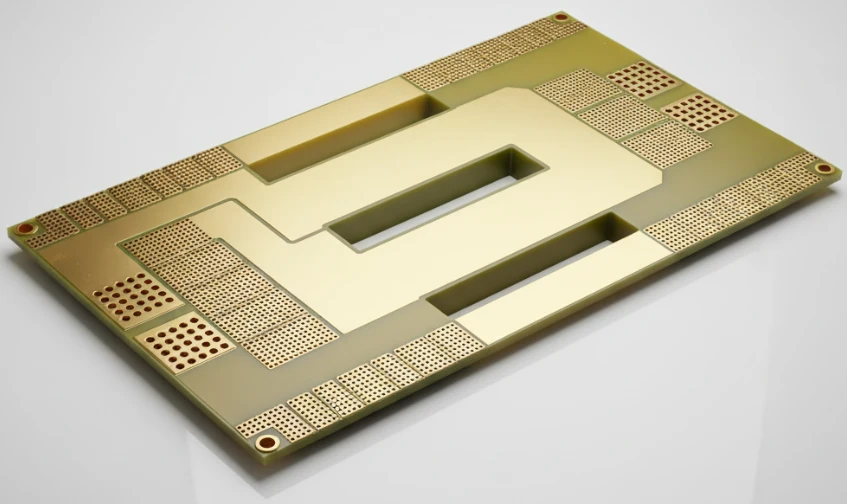
A redundant PSU backplane is the power distribution foundation of high-availability systems. It connects multiple power supply units to a shared load while maintaining operation during PSU failure, replacement, or maintenance.
Unlike a conventional power PCB, a redundant PSU backplane must combine:
- high-current distribution,
- thermal control,
- hot-swap mechanical precision,
- communication reliability for PMBus or monitoring interfaces,
- long-term manufacturing consistency.
The correct design decision depends on system availability requirements, current demand, operating temperature, connector strategy, and production capability.
When does a system need a custom redundant PSU backplane?
Custom redundant PSU backplanes are typically used when downtime has a high operational cost, including:
- servers and storage platforms,
- telecom infrastructure,
- industrial automation systems,
- medical equipment,
- high-availability computing systems.
For lower-current systems without hot-swap requirements, simpler power distribution solutions may provide lower cost and adequate reliability.
The backplane becomes a reliability-critical component because redundant PSUs cannot protect a system if the PCB distribution structure fails.
How do you choose between N+1 and N+N redundant PSU architectures?
The redundancy architecture determines PSU count, PCB current distribution, and fault tolerance.
| Requirement | N+1 architecture | N+N architecture |
|---|---|---|
| Fault tolerance | One PSU failure supported | Multiple PSU failures supported depending on design |
| Cost | Lower hardware cost | Higher cost and complexity |
| Typical use | Enterprise servers, industrial systems | Mission-critical infrastructure |
| Load sharing | Shared load with one spare capacity margin | Independent redundant power paths |
| Backplane complexity | Moderate | Higher isolation and distribution requirements |
For many server and industrial applications, N+1 provides the best balance between availability and cost. Systems requiring continuous operation during multiple power-source failures may require N+N designs with additional isolation and monitoring.
Which redundant PSU backplane design should be selected?
The following selection matrix helps match electrical requirements with PCB construction.
| Design requirement | Recommended approach | Key engineering decision |
|---|---|---|
| Below 100A power distribution | 3oz–4oz heavy copper PCB | Integrated power and signal routing |
| Above 150A distribution | Busbar-assisted or mechanical power structures | Reduce copper loss and thermal stress |
| Hot-swap PSU modules | Press-fit or blind-mate connectors | Tight hole and alignment control |
| High operating temperature | High Tg FR-4 | Reduce thermal expansion stress |
| PMBus/I2C monitoring | Controlled impedance routing | Separate communication from power paths |
| Long-life infrastructure | IPC Class 3 manufacturing | Increase reliability margin |
What PCB specifications should be defined before manufacturing?
A redundant PSU backplane fabrication drawing should define electrical, mechanical, and material requirements before supplier quotation.
What materials and stackup should a redundant PSU backplane use?
High-power backplanes commonly use high Tg FR-4 materials with Tg ≥170°C to improve resistance against thermal cycling.
Typical construction includes:
- 6–14 layer multilayer structures,
- 2.0mm–6.0mm board thickness,
- dedicated power and ground planes,
- balanced copper distribution.
For systems using higher-voltage rails such as 48V DC or 400V DC, define:
- creepage distance,
- clearance requirements,
- CTI requirements,
- insulation system requirements.
A CTI value of ≥600V (PLC 0) may be required for demanding environments.
How should copper thickness be selected?
Copper weight should be selected from current, temperature rise, and resistance requirements rather than PCB cost targets.
Typical choices include:
| Current requirement | Typical construction |
|---|---|
| Moderate high current | 3oz copper |
| Higher continuous current | 4oz copper |
| Extreme current paths | 6oz copper or busbar integration |
For currents above 50A, verify conductor sizing using IPC-2152 methods and thermal analysis. For a first-pass IPC-2221 estimate use the PCB trace width calculator.
What connector and mechanical tolerances matter most?
Hot-swap power systems depend on mechanical precision because connector misalignment can damage contacts or prevent insertion.
Production drawings should define:
- finished hole size tolerance,
- connector manufacturer requirements,
- guide-pin alignment,
- board thickness tolerance,
- press-fit plating requirements.
Press-fit applications commonly require finished hole control around ±0.05mm.
Recommended surface finishes:
- ENIG for reliable contact areas,
- hard gold for repeated mating surfaces.
HASL is generally unsuitable for precision connector interfaces because surface variation can affect mechanical consistency.
What are the main redundant PSU backplane failure modes?
A reliable design process starts by identifying how the board can fail.
| Failure mode | Root cause | Design response |
|---|---|---|
| Layer misregistration | Heavy copper lamination movement | Use controlled stackup and registration coupons |
| Resin voids | Poor resin flow around copper structures | Specify suitable prepreg construction |
| PTH cracking | Thermal expansion stress | Use high Tg materials and qualified plating |
| Connector failure | Incorrect hole control or tooling | Validate connector interface dimensions |
| Thermal hotspots | Insufficient copper spreading | Increase copper area and thermal paths |
| Copper undercut | Heavy copper etching limitations | Apply CAM compensation |
| Board warpage | Uneven copper distribution | Balance stackup construction |
| CAF growth | Moisture and electrical stress | Control materials and spacing |
How should redundant PSU backplanes be validated before production?
A production validation plan should combine electrical, thermal, mechanical, and manufacturing inspection.
Electrical validation tests
Perform:
- 100% continuity testing,
- isolation testing,
- high-potential testing where required.
Typical acceptance criteria:
- no opens or shorts,
- isolation resistance above 100 MΩ at 250V/500V,
- no dielectric breakdown during Hi-Pot testing.
Manufacturing verification
Production coupons should verify:
- copper thickness,
- plating quality,
- stackup construction,
- laminate integrity.
Microsection analysis should confirm:
- copper thickness within drawing requirements,
- acceptable hole-wall plating,
- no delamination or resin defects.
Thermal load validation
Validate the actual operating condition using:
- thermal imaging,
- current loading,
- temperature measurement.
A common engineering target is temperature rise below 30°C at steady-state operation unless system requirements define another limit.
Signal integrity validation
For PMBus and other controlled interfaces:
- verify impedance using TDR,
- test representative coupons,
- maintain separation from high-current switching paths.
A common controlled impedance example is 100Ω differential routing, but the actual target depends on the interface specification.
What supplier checklist should be used for redundant PSU backplane sourcing?
A qualified supplier should demonstrate both PCB manufacturing capability and reliability-control processes.
RFQ package checklist
Provide:
- Gerber or ODB++ files,
- fabrication drawing,
- stackup definition,
- copper weight requirements,
- drill chart,
- IPC classification,
- impedance requirements,
- connector specifications,
- assembly instructions.
Supplier capability checklist
Confirm capability for:
- heavy copper PCB production,
- thick multilayer boards,
- press-fit connector holes,
- AOI inspection,
- X-ray inspection,
- material traceability,
- microsection reporting.
Quality approval checklist
Require:
- ISO 9001 quality system,
- production traceability,
- outgoing inspection records,
- engineering review before fabrication,
- documented material-change notification.
What are the main redundant PSU backplane design trade-offs?
Heavy copper PCB versus busbar design
Heavy copper PCB structures are effective for integrated power distribution below approximately 100A.
When current requirements exceed approximately 150A, busbar solutions may provide improved electrical efficiency and thermal performance.
High Tg FR-4 versus standard FR-4
High Tg materials are preferred for:
- elevated temperatures,
- thick multilayer boards,
- long operational life.
Standard FR-4 may be suitable for lower-stress applications.
Press-fit versus soldered connectors
Press-fit connectors are commonly selected for thick backplanes requiring mechanical durability.
Soldered connectors remain practical for simpler systems with lower mechanical stress.
IPC Class 2 versus IPC Class 3
IPC Class 3 manufacturing is commonly selected for applications where long-term reliability and reduced failure probability are critical.
Frequently asked questions about redundant PSU backplane design
How long does redundant PSU backplane manufacturing take?
Prototype production commonly requires approximately 15–20 working days. Production builds may require 20–25 working days depending on materials, testing requirements, and board complexity.
Does higher copper weight increase PCB cost?
Yes. Higher copper weight increases:
- material cost,
- etching complexity,
- lamination requirements,
- manufacturing processing time.
Can standard FR-4 be used?
Standard FR-4 can work for lower-stress systems, but high-power redundant designs typically benefit from high Tg materials because thermal cycling creates mechanical stress.
What files are needed for supplier DFM review?
The key files are:
- fabrication drawing,
- stackup,
- connector specifications,
- drill information,
- copper requirements,
- testing requirements.
Related resources for redundant PSU backplane engineering
- Backplane PCB Manufacturing
- Heavy Copper PCB Capabilities
- High Tg PCB Materials
- DFM Guidelines
- PCB Quality System
Request a redundant PSU backplane DFM review
A successful redundant PSU backplane requires alignment between electrical requirements, mechanical tolerances, fabrication capability, and validation testing.
Send:
- Gerber or ODB++ files.
- Fabrication drawing with copper and material requirements.
- Expected production volume.
- Required testing methods.
Click here to Request a Quote and get a technical response within 24 hours.
Conclusion
A redundant PSU backplane is a reliability-critical power structure, not simply a connector board.
The strongest designs define the redundancy architecture early, select copper and materials according to electrical demand, validate suppliers before production, and verify performance through electrical, thermal, and mechanical testing.
Treating the backplane as part of the system reliability strategy creates a stronger foundation for servers, telecom platforms, industrial equipment, and other high-availability applications.