
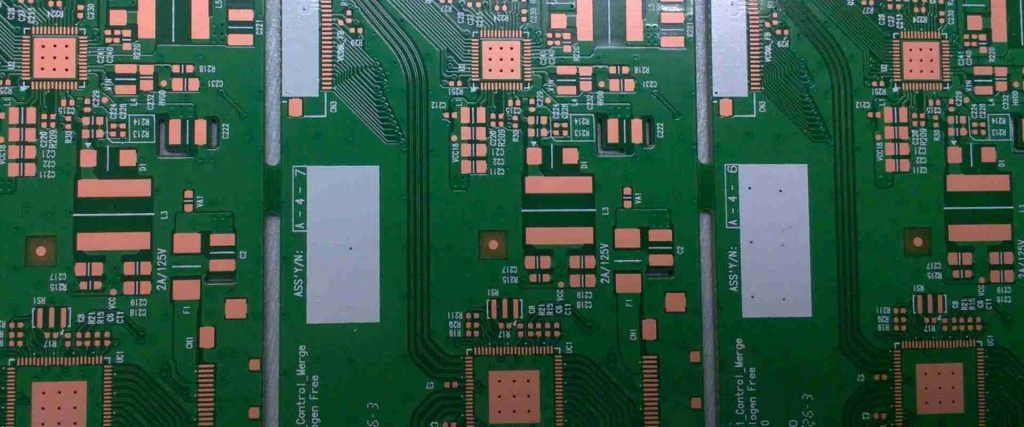
What is RF calibration traceability for PCB manufacturing?
RF calibration traceability connects every high-frequency measurement on a PCB to a controlled measurement system with known standards, uncertainty, and production history. For RF boards operating from GHz frequencies into mmWave ranges, a supplier’s measurement result is only useful when the customer can verify how that result was created.
A traceable RF PCB measurement chain links:
- The manufactured PCB or test coupon
- The measurement fixture and reference plane
- The calibrated VNA, TDR, or RF test equipment
- The calibration standards used by the equipment
- The documented uncertainty and production record
This matters because simulated RF performance depends on real manufacturing variables. Copper roughness, dielectric constant variation, etching accuracy, laminate batches, and connector launches can all change insertion loss, impedance, and phase behavior.
For aerospace, defense, automotive radar, phased array systems, and 5G infrastructure, RF calibration traceability is not simply a quality document. It is the evidence that the delivered PCB matches the electrical model used during design.
When does RF calibration traceability become necessary?
RF calibration traceability is most valuable when manufacturing variation can affect system performance.
| Application requirement | Traceability level | Key validation data |
|---|---|---|
| Sub-1GHz consumer electronics | Standard impedance control | Basic impedance report |
| High-speed digital links | Controlled impedance and loss testing | TDR and insertion loss data |
| 5G infrastructure | RF characterization | VNA data, PIM testing, material verification |
| Automotive radar at 77GHz | Advanced RF traceability | High-frequency S-parameters, controlled process data |
| Aerospace and defense | Mission-critical traceability | Serialized boards, raw RF data, calibration records |
Projects operating above 10GHz typically require more detailed RF characterization because small changes in geometry, dielectric properties, and conductor losses become measurable system effects.
What RF specifications should be included in an RF PCB supplier RFQ?
A supplier cannot provide traceable results from a vague request for “good RF performance.” The RFQ should define measurable requirements.
| Parameter | Supplier requirement | Why it matters |
|---|---|---|
| Impedance | Define target impedance such as 50Ω single-ended or 100Ω differential with tolerance | Confirms controlled transmission line performance |
| Insertion loss | Specify maximum loss at operating frequency, such as dB/inch limits at 40GHz | Verifies real signal attenuation |
| Dielectric constant | Require production-panel verification rather than only datasheet values | Captures material variation |
| Copper roughness | Define acceptable copper profile such as VLP or HVLP requirements | Controls conductor loss |
| Test coupon design | Match coupon structures to active RF traces | Reduces coupon-to-board correlation errors |
| Calibration method | Require calibrated equipment using standards such as SOLT or TRL | Establishes measurement confidence |
| Temperature | Define measurement conditions, commonly 25°C ±2°C | Controls environmental variation |
| Data format | Request raw S-parameter files such as.s2p or.s4p | Enables engineering review |
| Serialization | Link PCB ID to test results | Enables production traceability |
| PIM requirements | Define PIM limits when applicable | Protects sensitive RF systems |
What are the main RF calibration traceability failure modes?
RF performance failures often come from gaps between measurement and manufacturing reality.
| Failure mode | Root cause | Detection method | Prevention |
|---|---|---|---|
| Calibration drift | Equipment temperature change or aging components | Golden sample verification | Scheduled calibration checks |
| Coupon mismatch | Coupon geometry differs from active circuitry | Cross-section analysis | Match coupon structures to PCB traces |
| Probe wear | Repeated RF probe contact changes measurement behavior | Contact resistance monitoring | Control probe life cycles |
| Cable instability | Phase changes from cable movement | Fixture verification tests | Use phase-stable cables |
| Magnetic contamination | Metal particles create PIM issues | PIM testing and contamination controls | Dedicated clean processing controls |
| Material variation | Laminate batch properties change | Incoming material testing | Lock qualified materials |
| De-embedding errors | Incorrect fixture modeling | Known standard verification | Validate RF models before production |
| Operator variation | Manual test inconsistency | Gage R&R analysis | Automated measurement systems |
| Data loss | Only summary reports retained | Traceability audit | Store raw measurement files |
| Environmental stress | Thermal cycling changes RF behavior | Reliability testing | Validate harsh-environment performance |
How should RF PCB suppliers prove calibration traceability?
A supplier should provide more than a certificate of conformance. A production-ready RF traceability package should include:
- Equipment model and operating frequency range
- Current calibration certificates
- Calibration method and standards used
- Test fixture information
- Measurement temperature and environmental conditions
- Raw RF measurement files
- PCB or coupon serial number mapping
- Material batch records
- Production panel identification
- Data retention policy
Metrological traceability requires a documented relationship between the measurement result and reference standards, including uncertainty contributions.
What validation plan should be used before RF production release?
A practical RF validation sequence combines material verification, process control, and electrical testing.
Material validation
Verify laminate properties before production:
- Dielectric constant and loss characteristics
- Copper foil specification
- Resin content and material batch consistency
Manufacturing geometry validation
Confirm that the physical PCB matches the RF model:
- Trace width measurement
- Etch factor analysis
- Layer registration verification
- Microsection inspection
RF electrical validation
Perform:
- TDR impedance testing for controlled impedance structures.
- VNA testing for insertion loss and return loss.
- S-parameter extraction using calibrated measurement setups.
- PIM testing for cellular infrastructure applications.
- Thermal reliability testing for demanding environments.
For space and extreme-temperature applications, specialized testing such as a cryogenic thermal cycling test may be required to verify that material and interconnect performance remains stable.
How do you compare RF PCB suppliers?
Use this supplier decision matrix during qualification.
| Capability | Basic supplier | RF-capable supplier | Mission-critical supplier |
|---|---|---|---|
| Impedance testing | Coupon reports | Controlled impedance data | Full traceability package |
| RF measurement | Limited testing | VNA/TDR capability | Serialized RF characterization |
| Data delivery | PDF reports | Measurement summaries | Raw S-parameter files |
| Material control | Datasheet-based | Batch tracking | Locked materials and verification |
| Process control | Standard QC | RF-specific controls | Full audit trail |
| Environmental testing | Limited | Reliability testing | Qualification testing |
What questions should be asked during an RF PCB supplier audit?
RF capability checklist
- Does the supplier operate VNA equipment covering the required frequency range?
- Are TDR and VNA systems calibrated with documented standards?
- Can the supplier provide raw.s2p or.s4p files?
- Are test coupons representative of actual RF structures?
- Can every PCB be linked to its measurement record?
Manufacturing control checklist
- Are laminate batches tracked?
- Are copper roughness specifications controlled?
- Are process changes documented?
- Are measurement results stored by serial number?
- Are failed measurements investigated with documented root causes?
Reliability checklist
- Is magnetic contamination control available for PIM-sensitive applications?
- Can environmental stress testing be supported?
- Can cryogenic thermal cycling test requirements be coordinated for extreme applications?
- Are reliability results connected to production data?
What trade-offs should engineers make when defining RF traceability?
RF traceability requirements should match application risk.
High-volume commercial products may use sampled testing and standard reports.
High-frequency communication systems may require:
- More frequent RF measurement
- Raw measurement files
- More detailed material tracking
- Additional reliability testing
Mission-critical aerospace or defense systems may justify:
- Serialized board-level traceability
- Independent laboratory validation
- Expanded uncertainty analysis
- Long-term data retention
The correct level depends on the cost of failure, operating frequency, and field environment.
FAQ: RF calibration traceability for PCB buyers
Is impedance testing enough for RF PCB qualification?
No. Impedance testing confirms transmission line characteristics, but high-frequency systems may also require insertion loss, return loss, phase, and material verification.
Why are raw S-parameter files important?
A PDF pass/fail report hides measurement detail. Raw S-parameter files allow engineers to review frequency response and correlate manufacturing performance with simulation models.
What is the difference between TDR and VNA testing?
TDR measures impedance behavior in the time domain and is useful for locating discontinuities. A VNA measures frequency-domain behavior such as insertion loss and return loss.
How does magnetic contamination affect RF boards?
Metallic contamination can increase passive intermodulation (PIM), creating interference in sensitive receiver systems. Magnetic contamination control helps maintain low-noise RF performance.
Can RF traceability be applied to production volume?
Yes. The process is scalable when test structures, equipment calibration, data storage, and serialization are defined during product introduction.
Related pages & tools
- High Frequency PCB Manufacturing – Deep dive into materials and processes for RF boards.
- PCB Quality Control Systems – How we maintain traceability and standards across production.
- Aerospace & Defense PCB Solutions – Specifics on high-reliability manufacturing requirements.
- Rogers PCB Materials – Information on the most common high-frequency laminates.
- Impedance Calculator – A tool to estimate your initial stackup and trace widths.
- Testing & Quality Assurance – Overview of our testing capabilities for assembled boards.
Request a quote
Ready to validate your high-frequency design? APTPCB provides DFM reviews to ensure RF specifications are manufacturable and testable.
For a precise RF quote, provide:
- Gerber Files (RS-274X).
- Fabrication Drawing with stackup and impedance tables.
- RF Test Requirements including frequency range, loss limits, and required data format.
- Volume and lead time expectations.
Click here to Request a Quote and start your DFM review.
Conclusion
RF calibration traceability turns RF PCB manufacturing from a confidence-based process into a measurable engineering system. By defining the correct RF specifications, validating measurement methods, and requiring supplier evidence, engineers can reduce production surprises and ensure that manufactured boards perform as designed.
For high-frequency applications where signal integrity, reliability, and repeatability matter, traceable RF measurement is the foundation for predictable PCB performance.