
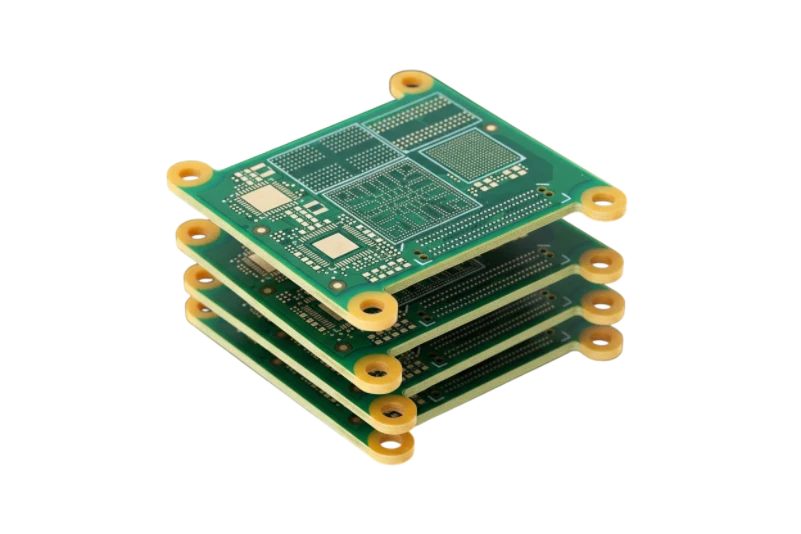
What is rigid-flex impedance control and why does stackup planning matter?
Rigid-flex impedance control is the process of designing a hybrid PCB structure that maintains predictable electrical performance while combining rigid FR4 sections with flexible polyimide sections.
Unlike a standard rigid PCB, a rigid-flex design contains multiple material systems with different dielectric properties, copper behavior, and mechanical stresses. The final impedance depends on the complete structure: copper thickness, dielectric height, polyimide core, coverlay, adhesive layers, reference planes, and transition geometry.
For engineers designing USB, HDMI, PCIe, MIPI, Ethernet, RF, or other high-speed interfaces, the stackup is part of the electrical circuit. A trace width calculated from an FR4-only model may fail when applied to a flex region because the dielectric environment changes.
This guide helps hardware engineers, PCB designers, and procurement teams define a manufacturable rigid-flex design before fabrication.
When does a rigid-flex PCB need controlled impedance?
Controlled impedance is typically required when signal integrity affects product performance.
| Application condition | Impedance control requirement |
|---|---|
| USB 3.x/USB4, HDMI, PCIe, MIPI, Ethernet | Define differential impedance and validate with coupons |
| RF signals above 1GHz | Control dielectric properties, loss, and reference planes |
| Long flex sections acting as transmission lines | Model flex geometry separately from rigid areas |
| Dynamic bending assemblies | Balance electrical stability with mechanical reliability |
| Power, GPIO, low-speed I2C/UART only | Standard routing may be sufficient |
A rigid-flex design that combines high-speed signals with repeated movement requires both electrical simulation and mechanical validation. The stackup must support the intended bend radius, cycle life, and assembly process.
How do you choose rigid-flex materials and stackup construction?
The correct material combination depends on the priority: signal integrity, flexibility, cost, or production reliability.
| Design parameter | Typical selection | Engineering impact |
|---|---|---|
| Flex dielectric | Polyimide (PI) | Provides thermal stability and mechanical flexibility |
| High-speed flex construction | Adhesiveless PI | Reduces dielectric variation and signal loss |
| Dynamic bend copper | Rolled Annealed (RA) copper | Improves resistance to repeated bending |
| Static flex copper | RA or ED copper | ED copper may be acceptable for fixed applications |
| Coverlay | 12.5µm or 25µm PI systems | Changes effective dielectric thickness |
| Rigid section laminate | FR4/high-Tg materials | Controls rigidity and thermal reliability |
| Connector stiffener | FR4 or PI stiffener | Supports assembly without entering bend zones |
The impedance model must use the finished composite structure. The effective dielectric environment includes polyimide, adhesive, coverlay, and copper geometry rather than only the base laminate datasheet value.
What stackup details must be defined before fabrication?
A fabrication drawing should define the electrical and mechanical structure together.
Include:
- Target impedance values:
- 50Ω single-ended.
- 90Ω differential USB.
- 100Ω differential Ethernet.
- Signal layers requiring impedance control.
- Reference plane locations.
- Copper thickness.
- Finished dielectric thickness.
- Coverlay thickness.
- Adhesive system.
- Flex and rigid boundaries.
- Transition-zone geometry.
- Bend radius and bend direction.
- Stiffener locations.
- Test coupon requirements.
The transition between rigid FR4 and flexible polyimide is especially important. The stackup drawing should clearly show layer transitions, coverlay overlap, and the intended rigid-flex construction.
Which rigid-flex stackup decisions affect impedance and reliability?
| Decision | Electrical effect | Mechanical effect |
|---|---|---|
| Solid copper reference plane | More predictable impedance and EMI performance | Reduced flexibility |
| Hatched ground plane | Lower stiffness | Requires modified impedance modeling |
| Adhesiveless flex core | Lower dielectric loss | Higher material cost |
| Additional flex layers | More routing capability | Increased stiffness and lower bend life |
| Symmetrical stackup | Better impedance consistency | Reduced warpage |
| Stiffener placement | Can affect local impedance | Improves connector durability |
For impedance-controlled designs, maintain a consistent reference plane through the flex region whenever possible. Changes in dielectric height or reference structure create impedance discontinuities.
What are the main rigid-flex impedance and manufacturing failure modes?
| Failure mode | Root cause | Detection method | Prevention |
|---|---|---|---|
| Transition impedance discontinuity | Changing dielectric height or reference plane | TDR profile variation | Maintain controlled layer transition |
| Coverlay press-out effect | Adhesive filling trace gaps | Cross-section analysis | Include coverlay in impedance model |
| Copper cracking | Excessive bending stress or incorrect copper type | Bend-cycle testing | Use RA copper and proper routing |
| Adhesive flow | Lamination pressure and resin movement | Visual inspection and microsection | Define controlled bonding areas |
| Via cracking | Vias placed in active bend zones | Electrical intermittence testing | Keep vias outside dynamic flex |
| Delamination | Moisture or thermal stress | Reflow simulation | Control baking and material handling |
| EMI failure | Incorrect reference plane assumptions | EMC testing | Model shielding structure accurately |
How should rigid-flex impedance validation be performed?
Production approval should include measurable verification, not only a certificate of compliance.
| Test | Purpose | Typical acceptance approach |
|---|---|---|
| TDR impedance testing | Confirms electrical impedance | Verify target impedance within specified tolerance |
| Microsection analysis | Confirms stackup construction | Match approved dielectric and copper dimensions |
| Thermal stress testing | Checks lamination reliability | No blistering or delamination |
| Peel testing | Confirms copper adhesion | Meet IPC-6013 requirements |
| Dynamic bend testing | Validates flex life | Confirm resistance stability after cycling |
| Dimensional stability testing | Confirms registration accuracy | Verify critical dimensions remain within limits |
| Electrical continuity testing | Detects opens and shorts | 100% production testing |
For most controlled-impedance rigid-flex projects, ±10% impedance tolerance is a realistic production target. Tighter tolerances require tighter process control, specialized materials, and stronger supplier capability.
What should be included in a rigid-flex PCB supplier DFM checklist?
A supplier review should confirm both manufacturing capability and communication quality.
Design package checklist
- Gerber or ODB++ fabrication files
- Complete rigid-flex stackup drawing
- Impedance requirement table
- Drill drawing
- Flex-zone definition
- Bend radius and cycle requirements
- IPC-6013 class requirement
- STEP model showing mechanical installation
Supplier capability checklist
- Stackup simulation capability
- Controlled impedance testing capability
- TDR reporting availability
- Microsection capability
- RA copper processing experience
- Adhesiveless material experience
- Flex lamination capability
- Material traceability system
Production quality checklist
- Panel-level impedance coupons
- Batch test records
- Material certificates
- Engineering change process
- Moisture-controlled packaging
- Production inspection reports
How do you choose between common rigid-flex design options?
| Design choice | Best fit |
|---|---|
| Adhesiveless vs adhesive flex | Adhesiveless for high-speed and low-loss designs; adhesive systems for cost-focused applications |
| Solid vs hatched ground | Solid copper for signal integrity; patterned grounds when flexibility is the dominant requirement |
| Bonded vs loose flex layers | Bonded structures for stable impedance; specialized constructions for maximum bend freedom |
| FR4 vs PI stiffeners | FR4 for connector support; PI for controlled thickness and ZIF interfaces |
| Symmetrical vs asymmetrical stackup | Symmetrical structures for flatness and predictable processing |
The best rigid-flex design is the one that satisfies electrical requirements without creating manufacturing problems during lamination, assembly, or field operation.
How much does rigid-flex impedance control affect cost and lead time?
Controlled impedance adds cost because the manufacturer must manage tighter stackup control, impedance coupons, testing, and specialized materials.
Rigid-flex boards are typically more expensive than standard rigid PCBs because they require:
- Multiple lamination cycles.
- Flexible material processing.
- Additional inspection steps.
- Specialized tooling.
Typical production lead times depend on layer count, material availability, testing requirements, and supplier capacity.
What files are required for a rigid-flex PCB quote?
A complete RFQ package should include:
- Gerber or ODB++ data.
- Stackup drawing.
- Impedance table.
- Mechanical outline.
- Bend requirements.
- Material preferences.
- Quantity forecast.
- Testing requirements.
A 3D STEP file is highly recommended for assemblies involving folding, hinges, or complex mechanical packaging.
Related pages & tools
- Rigid-Flex PCB Capabilities – Detailed breakdown of layer counts, minimum bend radii, and material options available at APTPCB.
- PCB Stackup Design – Learn how to balance copper and dielectrics to prevent warpage and ensure signal integrity.
- Impedance Calculator Tool – A quick tool to estimate trace width and spacing based on your dielectric materials.
- DFM Guidelines – Essential design rules to ensure your rigid-flex board is manufacturable at scale.
- High-Speed PCB Manufacturing – Insights into material selection and routing for high-frequency signal transmission.
Request a quote (Design for Manufacturability (DFM) review + pricing)
Ready to move from design to production? Request a Quote from APTPCB today to get a comprehensive DFM review and accurate pricing for your rigid-flex project.
To ensure the fastest and most accurate quote, please include:
- Gerber Files / ODB++: Complete fabrication package.
- Stackup Drawing: Rigid and flex layers with impedance targets.
- Volume: Prototype and production quantities.
- Special Requirements: TDR testing, IPC class, or specific materials.
Conclusion
Reliable rigid-flex impedance control requires coordinated electrical, mechanical, and manufacturing planning. The most successful designs define the finished stackup early, model the actual dielectric environment, control transition zones, and validate production boards with measurable testing.
By combining material selection, impedance planning, DFM review, and supplier qualification, engineers can reduce redesign cycles and move rigid-flex products into volume manufacturing with higher confidence.