
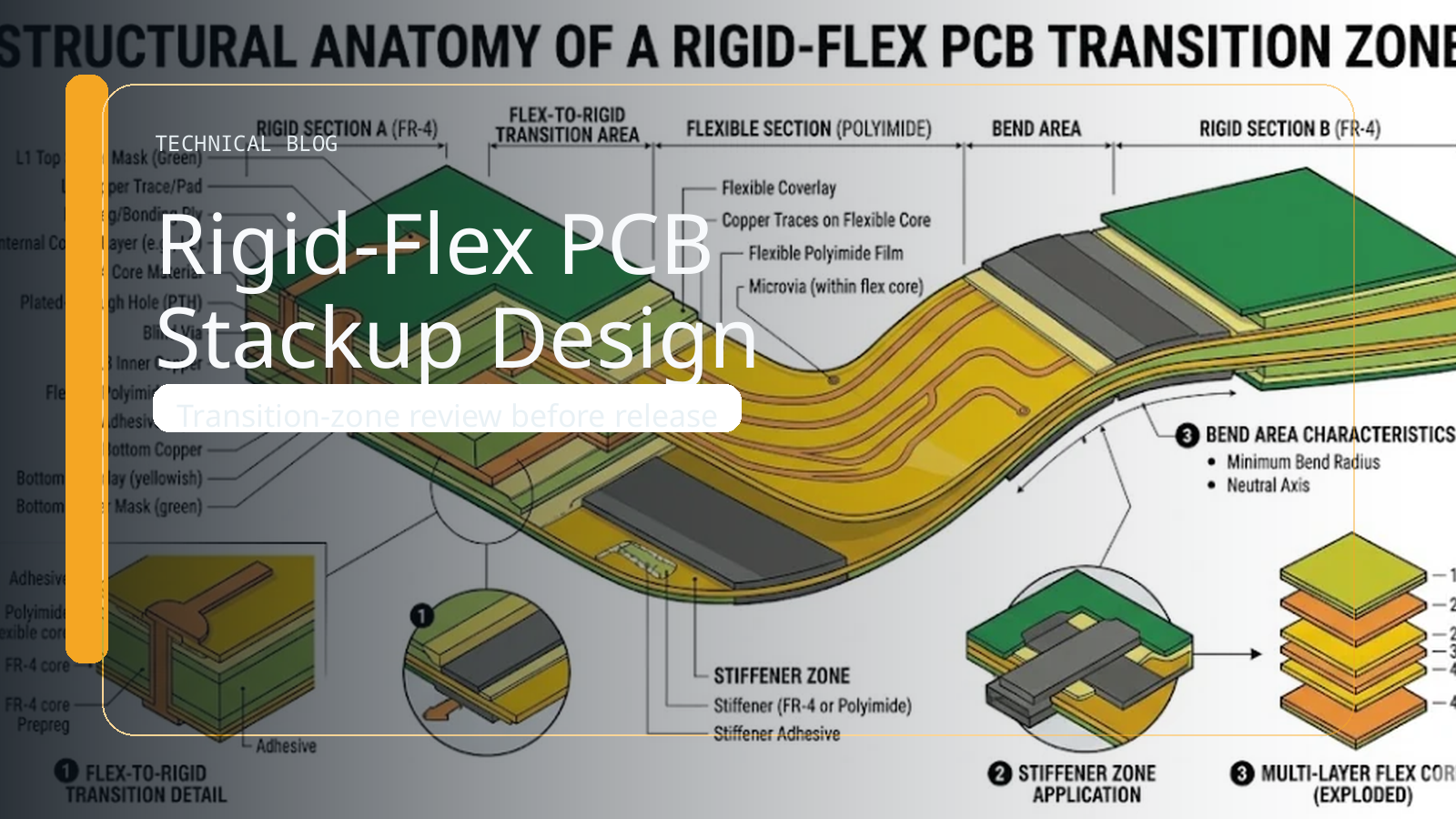
A rigid-flex PCB stackup review is a release decision, not only a layer-count exercise.
The stackup defines how rigid sections, flex sections, coverlay, stiffeners, copper structures, vias, and HDI features behave when they meet at the most mechanically sensitive area of the board: the rigid-to-flex transition zone.
The key engineering question is:
Does the released construction clearly define where stiffness changes, where bending occurs, how support is provided, and what evidence confirms the transition is ready for production?
A rigid-flex board can pass electrical testing and still develop reliability problems during assembly, folding, vibration, thermal cycling, or enclosure installation. Most latent issues begin where construction changes rapidly.
What should be reviewed in a rigid-flex PCB stackup before release?
A complete rigid-flex stackup review should answer five decisions:
- Where does the board change from rigid behavior to flex behavior?
- Where is bending permitted, restricted, or prohibited?
- How do coverlay, stiffeners, copper distribution, and layer transitions interact?
- How close are HDI structures to mechanically sensitive areas?
- What supplier evidence is required before production approval?
A fabrication drawing alone is not enough. The release package should communicate engineering intent so manufacturing decisions do not move into CAM interpretation.
Why is the rigid-flex transition zone the highest-risk area?
A rigid-flex PCB combines two different mechanical environments.
Rigid sections provide component support, routing density, and dimensional stability. Flex sections provide movement and three-dimensional packaging capability. The transition between them must gradually manage the change in stiffness, thickness, copper behavior, and support conditions.
The transition area often contains multiple competing requirements:
- copper routing entering the flex region;
- coverlay openings;
- stiffener edges;
- connector support areas;
- impedance structures;
- HDI vias or dense escape routing;
- assembly handling forces.
When these decisions are reviewed independently, the final construction can create unexpected stress concentration.
A successful stackup review identifies not only the layers, but also the mechanical purpose of each region.
What transition-zone decisions should be frozen before RFQ?
Use the following decision matrix during design release.
| Decision area | Engineering question | Release evidence |
|---|---|---|
| Rigid/flex boundary | Where does mechanical behavior change? | Mechanical layer marking rigid and flex zones |
| Bend region | Where will movement occur? | Bend line, bend radius, and keep-out definition |
| Stackup balance | Are materials and copper distribution controlled? | Complete stackup drawing with material callouts |
| Coverlay design | Are protection and access requirements compatible? | Coverlay openings and registration details |
| Stiffener placement | Does support match assembly and product needs? | Stiffener material, location, and thickness map |
| HDI adjacency | Are vias creating mechanical conflicts? | Via structure review near transitions |
| Assembly support | How is the board handled before installation? | Carrier, fixture, and assembly constraints |
The purpose of this review is not to eliminate all mechanical variation. It is to ensure that the supplier receives enough information to build and validate the intended construction.
What rigid-flex failures commonly appear after release?
Many rigid-flex failures occur because several individually acceptable design choices overlap in a small transition area.
| Failure mode | Typical design condition | Resulting issue |
|---|---|---|
| Conductor cracking | Copper enters a high-strain bend region | Intermittent electrical opens |
| Coverlay lifting | Protection boundary overlaps a stressed area | Local peeling or contamination exposure |
| Delamination | Abrupt stiffness or thickness change | Layer separation after thermal or mechanical stress |
| Via-related stress | HDI or plated structures approach flex transition | Mechanical fatigue around interconnects |
| Assembly damage | Insufficient support during handling | Damage before final installation |
The important point is that electrical continuity testing does not fully confirm transition quality. The mechanical construction must also be reviewed.
How do coverlay and stiffeners affect rigid-flex reliability?
How should coverlay be reviewed?
Coverlay protects exposed flex copper and influences the local mechanical structure.
Review:
- coverlay opening locations;
- protection requirements;
- pad accessibility;
- registration tolerance;
- relationship between openings and bend locations.
A coverlay opening that is acceptable from an electrical perspective may create a different mechanical condition when the board flexes.
How should stiffeners be reviewed?
Stiffeners provide support for connectors, components, and assembly operations. They also create stiffness changes.
Review:
- stiffener material;
- thickness;
- edge location;
- bonding method;
- distance from active bend areas.
The design objective is not simply adding reinforcement. The support transition must match how the product is assembled and used.
How does HDI change rigid-flex stackup review?
HDI and rigid-flex solve different engineering problems.
HDI increases routing density through advanced via structures and layer construction. Rigid-flex enables mechanical packaging and movement. Combining both can create compact electronics, but it increases transition-zone review complexity.
HDI requires additional attention when:
- microvias approach flex boundaries;
- dense copper areas create stiffness changes;
- build-up layers change local thickness;
- assembly forces interact with constrained regions.
The key question is:
Can the HDI structure coexist with the mechanical requirements of the rigid-flex transition?
A design that reviews HDI and rigid-flex separately may miss problems created by their interaction.
What materials should be considered in a rigid-flex stackup?
There is no universal rigid-flex stackup. The correct construction depends on the product environment.
Important inputs include:
- static or dynamic flex requirements;
- installation geometry;
- assembly process;
- component support requirements;
- thermal environment;
- reliability expectations.
Material decisions should follow the mechanical role of each area.
Examples:
- Flex materials should be selected based on bending requirements.
- Copper type should match expected movement conditions.
- Coverlay should match protection and access requirements.
- Stiffeners should support actual assembly and product loads.
The stackup succeeds when each material supports the intended mechanical behavior.
What should be included in a rigid-flex PCB RFQ package?
A supplier cannot fully evaluate a rigid-flex design from manufacturing files alone.
Include:
| RFQ input | Purpose |
|---|---|
| Stackup drawing | Defines construction intent |
| Rigid/flex zoning | Defines mechanical regions |
| Bend-sensitive areas | Protects critical movement zones |
| Coverlay definitions | Clarifies protection and access |
| Stiffener map | Defines reinforcement strategy |
| HDI and via information | Identifies transition-sensitive structures |
| Impedance requirements | Connects electrical and construction requirements |
| Assembly constraints | Defines handling conditions |
For supplier review, provide the complete design context rather than only Gerber or ODB++ files.
Relevant support pages include APTPCB's rigid-flex PCB page, flex PCB page, flex-rigid-flex assembly page, HDI PCB page, and DFM guidelines.
How should a rigid-flex supplier review be evaluated?
Before approving production, confirm that the supplier can answer:
| Supplier review question | Required evidence |
|---|---|
| Does the stackup match rigid/flex zoning? | Reviewed stackup drawing |
| Are coverlay and stiffeners understood? | Construction confirmation |
| Are transition areas mechanically reviewed? | DFM feedback |
| Are HDI structures near transitions evaluated? | Via and layer review |
| Are inspection requirements defined? | Validation plan |
| Are assembly conditions understood? | Handling and fixture discussion |
The goal is not only confirming manufacturing capability. It is confirming that the supplier and design team share the same interpretation of the board structure.
How should rigid-flex transition quality be validated?
A practical validation sequence includes:
- Confirm stackup, zoning, coverlay, and stiffener documentation describe the same construction intent.
- Review transition areas where stiffness, routing density, or support conditions change.
- Inspect first-build construction quality and alignment.
- Use cross-section review, X-ray inspection, or other structural analysis methods when complex HDI or reinforcement structures require deeper verification.
- Include assembly handling and final installation conditions in the release discussion.
Validation confirms that the manufactured board matches the intended design. It does not replace incomplete stackup definition.
FAQ: Rigid-flex PCB stackup design review
Can rigid-flex PCBs use the same review process as rigid PCBs?
No. Rigid-flex designs require additional review of mechanical transitions, bending behavior, support conditions, and construction changes.
When should supplier review happen?
Supplier review should occur before tooling and production release, while stackup, zoning, and reinforcement decisions can still be adjusted.
Does fewer PCB layers always reduce rigid-flex risk?
No. Layer count is only one factor. Transition construction, copper distribution, support design, and assembly handling also influence reliability.
What information helps suppliers identify transition risks?
The most useful inputs are stackup details, rigid/flex boundaries, coverlay definitions, stiffener locations, HDI information, and product installation requirements.
Next steps
Rigid-flex PCB success depends on controlling the transition before manufacturing begins.
A complete release package should include the ODB++ or IPC-2581 manufacturing package, rigid-flex stackup details, coverlay definitions, and any 3D bending or enclosure information that affects the board structure.
Send the design package through the rigid-flex PCB release readiness review request for supplier review focused on transition-zone construction, manufacturability, and release readiness.
Public references
IPC flex and rigid-flex standards overview
Supports rigid-flex construction terminology and transition-sensitive design considerations.APTPCB Rigid-Flex PCB page
Supports manufacturing context for rigid/flex zoning and supplier handoff.APTPCB Flex PCB page
Supports flex construction and handling considerations.APTPCB HDI PCB page
Supports HDI adjacency and combined rigid-flex review considerations.APTPCB DFM Guidelines
Supports manufacturability review and release-package preparation.
Author and review information
- Author: APTPCB rigid-flex, HDI, and DFM content team
- Technical review: rigid-flex construction, transition-zone, and assembly-planning engineering team
- Last updated: 2026-05-15