
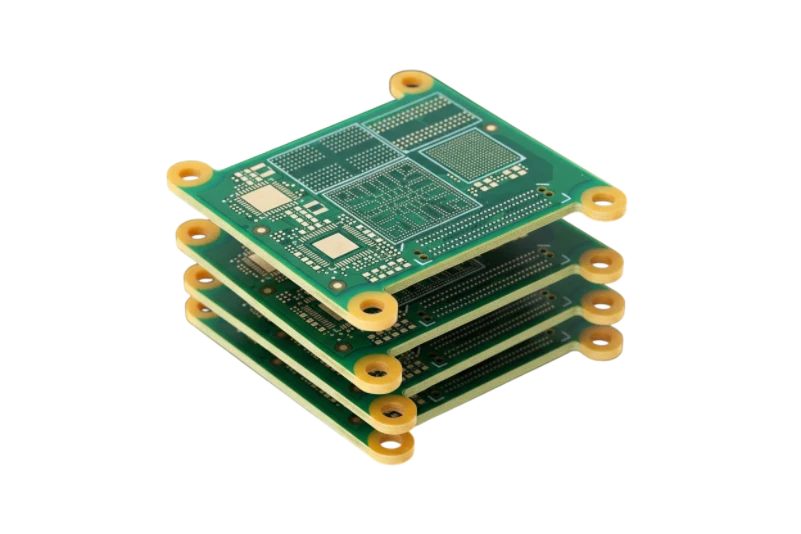
A robot voice assistant PCB should be designed as part of an acoustic, electrical, mechanical, and software system—not as a microphone carrier board in isolation. Before freezing the PCB, decide where audio processing occurs, how microphones couple to the enclosure, which robot subsystems can inject noise, and what evidence will release the design to production.
For most production robots, the critical question is not whether the board can record speech on a bench. It is whether microphone-array performance remains repeatable after reflow, enclosure assembly, motor operation, vibration, environmental exposure, firmware updates, and volume manufacturing.
This guide gives hardware engineers, NPI teams, and procurement teams a decision framework for moving from a prototype microphone array to a manufacturable robot voice platform.
Should you use a custom robot voice assistant PCB or a module?
A custom PCB is justified when the robot's geometry, microphone spacing, interfaces, environmental sealing, service architecture, or production volume cannot be served efficiently by an off-the-shelf module.
The choice should be made from system requirements rather than an assumed volume threshold.
| Decision factor | Off-the-shelf module is usually stronger when… | Custom PCB is usually stronger when… |
|---|---|---|
| Mechanical integration | Available module geometry fits the enclosure | Microphone position and board outline must follow the robot housing |
| Acoustic geometry | Generic near-field pickup is acceptable | Beamforming depends on controlled microphone spacing and orientation |
| Interfaces | USB or another module interface is acceptable | Direct PDM, I2S/TDM, SPI, or another system-specific interface is required |
| Development risk | Fast prototype validation matters most | Product architecture is stable enough to justify custom engineering |
| Environmental design | Module protection meets the application | Acoustic ports, gaskets, coating, and enclosure sealing must be co-designed |
| Service strategy | Entire module can be replaced | Audio board needs defined diagnostics, connectors, or field replacement |
| Product cost | Engineering effort dominates | Integration, BOM, assembly, or mechanical savings justify customization |
Do not treat a custom board as automatically cheaper at a particular quantity. The break-even point depends on electronics, tooling, testing, certification, assembly yield, sourcing, and the commercial cost of the alternative module.
What architecture should you freeze before PCB layout?
The highest-value decision is defining the boundary of the voice subsystem. A robot may use a microphone-only daughterboard, a microphone-plus-codec board, or a complete local voice-processing board containing the DSP/SoC.
Keeping heavy processing away from the microphone array can simplify thermal and electrical isolation. Local processing can reduce the amount of raw audio transported across the robot and may support lower-latency functions, but it adds heat, power-distribution, memory, firmware, and high-speed layout requirements near the acoustic system.
For mechanically complex heads or articulated assemblies, consider whether cabling and connectors introduce more risk than the PCB technology itself. Rigid-Flex PCB Manufacturing is relevant when eliminating interconnects provides a genuine packaging or vibration advantage; otherwise, a rigid replaceable microphone board may give NPI and field-service teams a cleaner module boundary.
Before layout starts, freeze these interfaces in the system specification: microphone type and port orientation, microphone coordinates, audio interface, clock ownership, power rails, debug/programming access, enclosure opening and gasket geometry, mounting points, coating restrictions, and the location of major interference sources.
How should the microphone PCB be designed around the acoustic path?
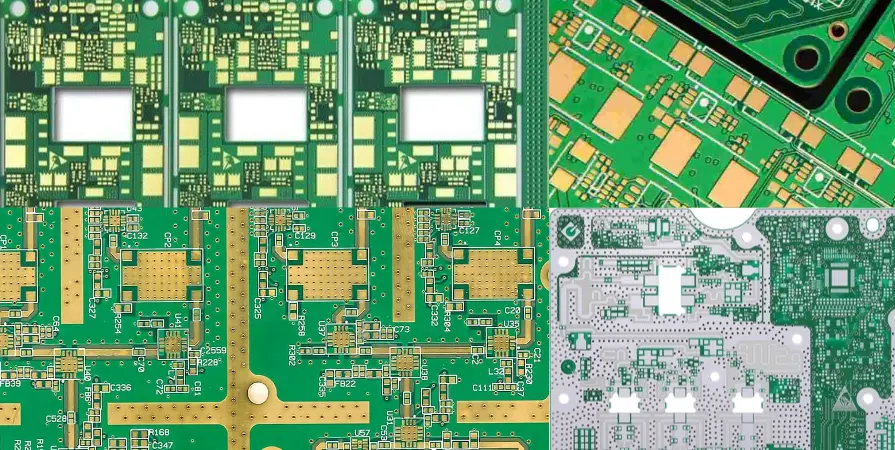
For a bottom-port MEMS microphone, the PCB forms part of the acoustic path. That makes the microphone footprint, board opening, enclosure channel, gasket, and surrounding cavity one coupled design problem.
The microphone manufacturer's current datasheet and assembly guidance should control the land pattern, stencil, port dimensions, reflow conditions, and handling requirements. Do not turn a dimension from another microphone family—or a generic internet rule—into a fabrication standard.
Array designs also require geometric consistency. Variations in microphone placement, port geometry, gasket compression, or enclosure channels can produce channel-to-channel differences that PCB electrical testing alone will not detect.
Treat the fabrication package as the interface between acoustic engineering and manufacturing. It should identify the microphone sound openings, solder-mask requirements, mechanical datums, critical alignment dimensions, coating keep-outs, and any areas where panelization or depanelization stress could affect the sensors.
Surface finish, laminate, thickness, layer count, and copper weight should likewise be selected from package, assembly, structural, thermal, routing, and reliability requirements. ENIG can be appropriate for many fine-pitch assemblies, for example, but it should not be declared universally mandatory for every MEMS microphone design.
How do you keep motors and digital electronics out of the audio path?
A robot creates interference conditions that a stationary voice product may never experience: motor PWM, servo current steps, DC/DC converters, cameras, wireless radios, speakers, heaters, displays, and long internal cables can all operate close to the microphone system.
The first defense is architecture and placement. Give sensitive microphone circuitry a clean reference and deliberate return-current path, place local decoupling according to component guidance, and keep switching nodes and aggressive clocks away from vulnerable analog circuitry. Avoid casually splitting ground planes: a broken return path can create more coupling rather than less.
For digital microphone buses and processor interfaces, determine whether traces actually behave as controlled-impedance transmission lines from their edge rate, topology, length, stackup, and receiver requirements. Do not assign a generic impedance simply because the signal is digital. Where controlled impedance is required, define it with the stackup and verify geometry using the Impedance Calculator during design rather than after routing is frozen.
The important robot-level test is coexistence. Exercise traction motors, servos, wireless radios, speakers, the robot vision RGBD PCB, charging circuits, and any robot battery heater PCB while capturing synchronized audio and power-rail data.
Robot voice PCB risk-to-evidence matrix
The following matrix is a practical release asset: each major failure mechanism is tied to evidence that can confirm or reject the design.
| Risk | What may cause it | What the team should verify | Evidence for release |
|---|---|---|---|
| Blocked or inconsistent microphone port | Paste, flux, coating, enclosure misalignment, gasket movement | Acoustic path after assembly | Visual inspection plus channel sensitivity/frequency-response data |
| Motor-related buzz or recognition degradation | Conducted or radiated coupling, shared return path | Audio while motors and converters change operating state | Spectrum/audio capture correlated with robot operating modes |
| Array mismatch | Placement, port, gasket, or component variation | Channel-to-channel consistency | Multi-channel acoustic comparison against approved limits |
| MEMS damage during assembly | Incorrect reflow, handling, cleaning, or rework | Sensor performance after PCBA | Assembly records plus functional acoustic test |
| Intermittent connector behavior | Vibration, insufficient retention, cable stress | Interface continuity under motion | Vibration/functional test and connector inspection |
| Coating-related audio failure | Material entering acoustic opening | Coating process and mask effectiveness | Post-coating visual and acoustic verification |
| Firmware recovery failure | Interrupted update or corrupted image | Recovery path under controlled fault injection | Successful rollback/recovery test |
| Mechanical resonance or structure-borne noise | Mounting, chassis, speaker, fan, or motor vibration | Audio across representative mechanical states | Robot-level acoustic test under defined motion conditions |
This matrix intentionally separates manufacturing evidence from product performance. A PCB supplier can demonstrate that the assembly was built to the released package; only project-level testing can establish that the assembled robot meets its acoustic requirements.
How should conformal coating and environmental protection be specified?
An environmental requirement such as IPX4 applies to the relevant product or enclosure configuration, not automatically to an individual PCB. The PCB can support the protection strategy through coating, sealing interfaces, connector selection, and controlled keep-out areas, but system-level qualification remains the product owner's responsibility.
For microphone assemblies, the acoustic path requires special process control because protective material must not unintentionally obstruct the sensor. Provide explicit coating drawings and mask requirements rather than relying on an assembler's interpretation of a general note.
If coating is part of the design, review available PCB Conformal Coating processes against the selected microphone, connectors, test points, acoustic ports, and rework policy before approving the production traveler.
What should be validated before production release?
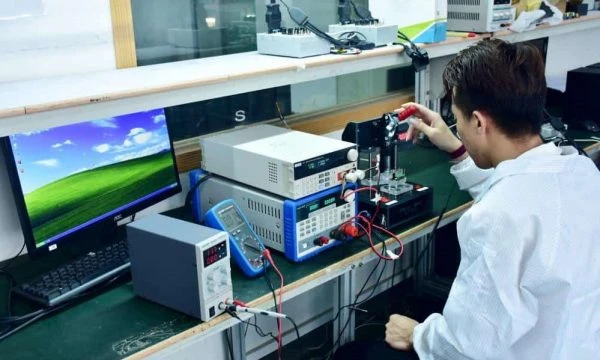
A useful validation plan follows the failure mechanisms rather than applying arbitrary universal pass limits. Acceptance criteria should come from the selected components, interface specifications, system acoustic targets, and product environment.
EVT — prove the architecture. Verify microphone operation, clocks and data interfaces, power behavior, acoustic geometry, noise coupling, DSP/codec communication, and enclosure interaction. Run the robot through operating combinations likely to expose interference rather than testing the voice board alone.
DVT — prove the design margin. Test production-intent PCBAs and mechanical parts across defined temperature, humidity, supply, vibration, and operating conditions. Validate the coating or sealing configuration, microphone consistency, update recovery, connector robustness, and interactions with nearby subsystems.
PVT — prove repeatability. Use production tooling and processes. Confirm that assembly inspection, programming, traceability, acoustic functional testing, and failure handling can separate acceptable units from defects without relying on engineering judgment at every station.
For fine-pitch processors or hidden solder joints, X-ray may be appropriate; for solder-paste control, SPI may be valuable. Neither method substitutes for functional audio testing because an electrically well-assembled microphone can still be acoustically compromised.
What should engineering and procurement send in the RFQ?
A strong RFQ enables a supplier to quote the actual manufacturing problem instead of guessing at requirements. If the voice PCB is unusually dense, HDI PCB Capabilities may be relevant, but HDI should follow routing and packaging necessity rather than being specified as a premium feature by default.
Send one controlled data package containing fabrication data, fabrication drawing, approved stackup or stackup constraints, impedance requirements where applicable, BOM with manufacturer part numbers and approved substitutions, centroid data, assembly drawings, microphone-port details, coating/masking drawing, programming requirements, test specification, mechanical/panel constraints, revision identification, forecast quantity, and required traceability.
Then ask the supplier to return the evidence needed for your release process: DFM findings before build, proposed stackup and impedance method, component or laminate substitutions for approval, inspection plan, microphone handling/assembly controls, coating controls if used, test coverage, traceability level, and nonconformance/change-notification workflow.
If component sourcing and assembly are combined with PCB fabrication, review the responsibilities included in Turnkey Assembly Services and make BOM ownership, substitution approval, programming, functional testing, and supplied documentation explicit in the quotation.
What belongs to the manufacturer, and what belongs to product qualification?
This boundary should be written into the project before purchase orders are released.
Manufacturer responsibility covers building and inspecting the PCB/PCBA against the released drawings, BOM, process requirements, acceptance criteria, and agreed quality records.
Project feasibility covers whether a proposed material, stackup, finish, panel, component combination, coating process, tolerance, and test method can be manufactured reliably. This requires DFM and engineering review; a general capability statement does not prove that every requested combination is feasible.
Product or system qualification remains with the product owner unless explicitly contracted otherwise. Voice-recognition accuracy, acoustic performance inside the final enclosure, ingress protection, regulatory compliance, expected service life, OTA behavior, and robot-level reliability cannot be inferred from PCB fabrication acceptance alone.
FAQ
Do all robot voice PCBs need a DSP on the microphone board?
No. A microphone-only board can be preferable when central processing already exists and the interface remains robust. Local DSP processing is useful when the system architecture benefits from local filtering, beamforming, preprocessing, or reduced audio transport. Choose the partition before PCB layout because it changes power, thermal, firmware, memory, and routing requirements.
Does a voice PCB need a dedicated diagnostics interface?
Not necessarily a dedicated connector, but production and service teams need a defined way to access power measurements, programming, logs, and relevant digital interfaces. Those signals may be routed through the robot's existing robot diagnostics connector PCB rather than adding another field connector.
How should OTA recovery affect the PCB design?
The hardware should support the recovery architecture defined by the system team. Depending on the processor and firmware design, this may involve boot-control signals, debug/programming access, stable power during nonvolatile-memory operations, watchdog behavior, or a recovery image. The OTA robot firmware PCB requirement therefore needs to be defined jointly by hardware and firmware teams.
Should the voice board also carry cameras or other sensors?
Only when integration improves the system without compromising acoustic placement, thermal behavior, serviceability, or noise performance. Combining the voice electronics with a robot vision RGBD PCB can reduce connectors, but it can also place high-speed interfaces and heat sources close to sensitive microphone circuitry.
What should change when moving from prototype modules to a custom board?
Freeze the interfaces that the prototype previously hid: microphone geometry, acoustic path, clocks, power quality, enclosure tolerances, programming, test access, assembly handling, and system-level acceptance criteria. A successful USB microphone prototype demonstrates the application concept; it does not automatically validate the production PCB architecture.
Request a production review
Before requesting a production quote, make the RFQ package specific enough that fabrication, assembly, and test assumptions are visible. Contact APTPCB for a DFM Review with your PCB data, BOM, assembly drawings, microphone and acoustic-port requirements, stackup constraints, test requirements, coating instructions if applicable, and expected build quantity.
The objective of DFM is to establish manufacturability and expose production risks before release. Final acoustic performance, environmental compliance, firmware robustness, and complete robot qualification remain project-specific validation activities.
Conclusion
A production-ready robot voice assistant PCB is successful when its acoustic geometry, electronics, mechanical integration, manufacturing process, and validation evidence agree.
Start by deciding the subsystem architecture and microphone geometry. Then design the PCB around the selected microphone's documented requirements, test it while the robot's real noise sources are operating, and convert each credible failure mechanism into measurable release evidence. Finally, send suppliers a controlled RFQ package that distinguishes manufacturing acceptance from system qualification.
That process gives engineering, NPI, and procurement teams a more useful question than “Can this PCB be manufactured?”: Can this exact voice subsystem be built repeatedly, verified objectively, and released without hiding acoustic or production risk?