
Contents
- The Context: What Makes Robotic Retail PCB Challenging
- The Core Technologies (What Actually Makes It Work)
- Ecosystem View: Related Boards / Interfaces / Manufacturing Steps
- Comparison: Common Options and What You Gain / Lose
- Reliability & Performance Pillars (Signal / Power / Thermal / Process Control)
- The Future: Where This Is Going (Materials, Integration, Ai/automation)
- Request a Quote / DFM Review for Robotic Retail PCB (What to Send)
- Conclusion
A "good" Robotic Retail PCB is defined not just by its electrical connectivity, but by its ability to survive thousands of hours of vibration and thermal cycling without signal degradation. For manufacturers like APTPCB (APTPCB PCB Factory), success lies in balancing the miniaturization required for sleek robot chassis with the durability needed for industrial-grade uptime.
Highlights
- Mechanical Endurance: How boards withstand the constant vibration of wheel motors and robotic arms.
- Power Integrity: Managing high-current spikes from actuators alongside sensitive sensor data.
- Sensor Fusion: Integrating LiDAR, cameras, and RFID inputs on a single or distributed PCBA architecture.
- Thermal Strategy: Dissipating heat in enclosed plastic shells without bulky active cooling.
The Context: What Makes Robotic Retail PCB Challenging
Retail environments are deceptively harsh. Unlike a server room with controlled temperature and zero movement, a retail robot operates in a dynamic, "messy" world. The PCB must handle three distinct pressures simultaneously: physical constraints, power limitations, and signal interference.
First, space is always at a premium. Retail robots are designed to be unobtrusive and friendly, meaning the chassis is often curved and compact. This forces engineers to move away from standard rectangular boards toward complex shapes or multi-board stacks connected by flex cables.
Second, the power profile is erratic. The robot might be idling one second and driving high-torque motors the next to avoid an obstacle. The PCB's power distribution network (PDN) must handle these rapid load transients without causing voltage drops that could reset the main processor.
Finally, the electromagnetic environment is noisy. The robot is a moving source of EMI (from its own motors) operating in a store full of fluorescent lights, refrigeration units, and Wi-Fi signals. Ensuring the integrity of low-voltage sensor signals in this chaos is a primary design challenge.
The Core Technologies (What Actually Makes It Work)
To address these challenges, the industry relies on a specific set of PCB technologies. These are not experimental features but proven methods adapted for mobile robotics.
Rigid-Flex Construction: Instead of using bulky connectors and wire harnesses that can rattle loose over time, many retail robots utilize Rigid-Flex PCB designs. This allows the board to fold into tight spaces (like a camera gimbal or a wheel arm) and eliminates points of failure. The flexible polyimide layers carry signals directly between rigid sections, improving reliability under vibration.
High-Density Interconnect (HDI): The "brain" of the robot—usually an NVIDIA Jetson or similar compute module—requires HDI PCB technology. Microvias and fine-pitch routing allow designers to place powerful processors and memory chips in a very small footprint, leaving more room for batteries and payload.
Heavy Copper & Thermal Vias: For the motor driver boards, thermal management is critical. Using 2oz or 3oz copper layers helps spread heat laterally, while dense arrays of thermal vias conduct heat away from MOSFETs to the bottom layer or a chassis heatsink. This passive cooling is essential since fans are often potential failure points in dusty retail environments.
Ecosystem View: Related Boards / Interfaces / Manufacturing Steps
A robotic retail system is rarely a single board. It is an ecosystem of specialized PCBs working in concert. Understanding the interfaces between these boards is as important as the design of the mainboard itself.
Typically, the architecture consists of a Main Compute Unit (high-layer count, HDI), several Sensor Interface Boards (cameras, LiDAR, ultrasonic), and Motor Controller Boards (high power, heavy copper).
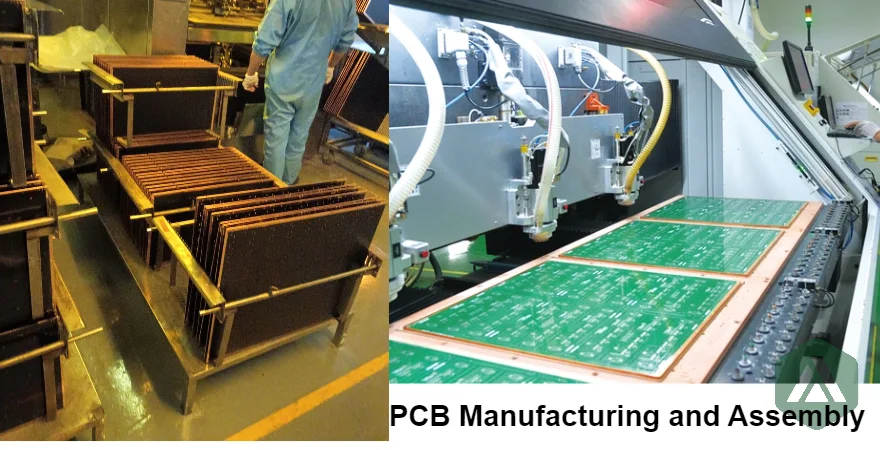
The manufacturing process for these boards often involves mixed technologies. For instance, the sensor boards might require specialized Turnkey Assembly processes to handle delicate optical components that cannot withstand standard reflow profiles. Furthermore, the assembly process must account for conformal coating. Since these robots might encounter spilled liquids or high humidity near refrigeration sections, a selective coating is often applied to protect sensitive areas while leaving connectors and test points accessible.
Comparison: Common Options and What You Gain / Lose
When designing for retail robotics, engineers face several trade-offs. The most common decision points revolve around material selection and interconnect strategy. Do you use a cheaper FR4 material and add a heatsink, or switch to a Metal Core PCB? Do you use connectors for modularity, or solder directly for reliability?
Below is a decision matrix helping to visualize these trade-offs in a practical context.
Decision Matrix: Technical Choice → Practical Outcome
| Technical choice | Direct impact |
|---|---|
| Rigid-Flex vs. Cable Harnesses | Rigid-flex reduces assembly time and weight but increases initial board cost. Harnesses are cheaper but prone to vibration failure. |
| ENIG vs. HASL Finish | ENIG provides a flat surface for fine-pitch BGAs (AI chips) and better corrosion resistance; HASL is cheaper but uneven for dense components. |
| Metal Core (MCPCB) vs. FR4 | MCPCB offers superior heat dissipation for motor drivers/LEDs but limits routing layers. FR4 requires external heatsinks for high power. |
| 0201 vs. 0402 Components | 0201 saves massive space for compact designs but requires higher precision assembly (AOI/SPI) and is harder to rework manually. |
Reliability & Performance Pillars (Signal / Power / Thermal / Process Control)
Reliability in retail robotics is binary: the robot either works autonomously, or it becomes a nuisance requiring human intervention. To ensure the former, APTPCB emphasizes four pillars during the Testing & Quality phase.
- Signal Integrity (SI): The high-speed lines connecting the camera to the processor (often MIPI CSI-2) are susceptible to noise. Impedance control must be strictly verified (usually ±8% or ±10%) to prevent data packet loss which causes the robot to "blindly" stop.
- Power Integrity (PI): The PDN must have low impedance. Decoupling capacitors are placed as close as possible to the power pins of the ICs to act as local energy reservoirs during motor startup transients.
- Thermal Cycling: Robots charge (heat up) and operate (cool down/heat up) repeatedly. The CTE (Coefficient of Thermal Expansion) mismatch between components and the board can cause solder joints to crack. Underfill is often used on large BGAs to mechanically reinforce them.
- Vibration Resistance: Standard drop tests are not enough. Random vibration testing simulates the "rumble" of rolling over tiled floors for years. Connectors with locking mechanisms or additional glue reinforcement are standard requirements.
The Future: Where This Is Going (Materials, Integration, Ai/automation)
The trend in retail robotics is toward "Edge AI"—processing data on the robot rather than sending it to the cloud. This reduces latency but drastically increases the thermal and routing density of the PCB. We are also seeing a shift toward integrating antennas directly into the PCB structure or chassis to improve connectivity in metal-heavy warehouse aisles.
5-Year Performance Trajectory (Illustrative)
| Performance metric | Today (typical) | 5-year direction | Why it matters |
|---|---|---|---|
| Layer Count (Mainboard) | 6-10 Layers | 12-16 Layers (Any-layer HDI) | Accommodates complex AI chips with smaller BGA pitches (0.35mm). |
| Material Selection | Standard High-Tg FR4 | Low-Loss / High-Frequency Materials | Required for 5G/6G integration and faster internal data buses. |
| Assembly Integration | SMT + Manual Assembly | Fully Automated 3D Assembly | Reduces human error and allows for components to be embedded inside the PCB. |
Request a Quote / DFM Review for Robotic Retail PCB (What to Send)
When you are ready to move from prototype to production, clarity in your documentation is key to avoiding delays. A DFM Review at the early stage can save weeks of redesign. When submitting your RFQ to APTPCB, please ensure the following details are included:
- Gerber Files: RS-274X or ODB++ format.
- Stackup Requirements: Specify impedance control lines (e.g., 90Ω USB, 100Ω LVDS).
- BOM (Bill of Materials): Include manufacturer part numbers, especially for connectors and sensors.
- Pick & Place File: Centroid data for automated assembly.
- Environment Specs: Mention if the robot operates in refrigerated areas (requires specific conformal coating).
- Vibration/Shock Criteria: If you have specific IPC Class 2 or 3 requirements for reliability.
- Volume & Lead Time: Prototype (5-10 units) vs. Mass Production (1000+ units).
Conclusion
Robotic Retail PCBs are the silent workhorses of the automation revolution. They bridge the gap between sophisticated AI software and the physical reality of moving wheels, spinning LiDARs, and charging batteries. Designing them requires a holistic view that considers mechanical stress, thermal loads, and signal integrity as interconnected problems, not isolated specs.
Whether you are building a shelf-scanning drone or a customer service droid, the quality of your PCB determines the reliability of your fleet. Partnering with an experienced manufacturer ensures that your design intent survives the harsh reality of the retail floor.