
What This Guide Covers and Who Should Read It
High-frequency PCB design reaches a practical boundary when performance requirements collide with budget constraints. Building an entire multilayer board from Rogers or PTFE laminates delivers superior RF performance but punishes the bill of materials — a 12-layer all-Rogers build can cost 3–5× more than a hybrid alternative. The Rogers/PTFE hybrid stackup layout combines high-performance RF layers with standard FR-4 layers, balancing signal integrity, mechanical rigidity, and cost. But mixing materials with drastically different thermal expansion coefficients, resin chemistries, and mechanical properties introduces manufacturing risks — delamination, registration errors, via cracking, and impedance drift — that do not exist in single-material builds.
This guide is written for RF/microwave PCB engineers, hardware architects, and procurement leads who need to source hybrid boards without sacrificing reliability. It moves beyond the conceptual ("mix Rogers with FR-4 to save money") into the specifics of execution: which material pairings actually work, what prepreg to use at the interface, how to prevent delamination during reflow, and what validation steps prove the hybrid bond is sound.
At APTPCB, we process hundreds of hybrid designs annually for automotive radar (77 GHz), 5G mmWave infrastructure, satellite communication, and aerospace RF systems. The most common cause of hybrid board failure is not the material itself — it is a mismatch between the designer's assumptions and the manufacturer's actual lamination process. This guide serves as the bridge between those two worlds.
By the end of this playbook, you will have a clear specification checklist for your RFQ, a set of audit questions that separate experienced hybrid fabricators from those who will learn at your expense, and a validation plan that ensures your Rogers/PTFE hybrid stackup layout performs as simulated — from prototype through volume production.
When a Hybrid Stackup Is the Right Approach (and When It Is Not)
Before committing to the complexity of a hybrid build, validate that it is the correct architectural decision for your product. Hybrid stackups solve specific engineering and commercial problems — they are not a universal upgrade over single-material builds.
The Rogers/PTFE hybrid stackup layout is the right choice when:
- Cost optimization is a priority. You need the low dissipation factor (Df < 0.004) of Rogers RO4350B or RO3003 for RF signal paths, but using it for all 12 layers of a mixed digital/RF board would triple the material cost. Placing Rogers only on the outer RF layers and FR-4 on internal digital/power layers can save 30–60% on material.
- Mechanical rigidity is required. Pure PTFE boards (RO3003, RT/duroid) are soft, flexible, and difficult to assemble with standard SMT processes. Adding rigid FR-4 layers provides the stiffness needed for BGA assembly, connector mounting, and enclosure integration.
- Digital routing complexity is high. High-density digital control lines, power distribution, and communication buses do not benefit from expensive RF materials. Routing these on FR-4 layers saves money and uses standard prepregs with better inter-layer adhesion.
- Thermal management is a design requirement. Some hybrid designs place high-Tg FR-4 or metal-core layers in the center of the stackup to serve as heat spreaders, providing thermal performance that a pure PTFE stack cannot match.
The hybrid approach is likely wrong when:
- Layer count is extremely high (> 24 layers). The accumulated stress from CTE mismatch between FR-4 and PTFE across many layers becomes unmanageable in very thick boards, leading to via cracking during thermal cycling.
- The operating environment involves extreme thermal cycling. If the board undergoes rapid, deep thermal cycling (e.g., –65°C to +150°C in minutes, as in some military/aerospace applications), the interface between dissimilar materials becomes the highest-risk failure point.
- Qualification cost exceeds material savings. For low-volume, high-margin aerospace programs, the NRE and qualification testing required for a new hybrid material combination may outweigh the raw material savings compared to an all-Rogers build.
How to Specify a Rogers/PTFE Hybrid Stackup for Manufacturing
Sending Gerber files with a note saying "use Rogers on the RF layers" is the most common path to a failed hybrid build. The manufacturer will make assumptions about prepreg type, lamination profile, and scaling factors — and those assumptions may be wrong. A manufacturable Rogers/PTFE hybrid stackup layout requires 10 explicit specifications in your fabrication documentation.
1. Exact Material Designators by Layer: Do not write "Rogers equivalent" or "high-Tg FR-4." Specify "Rogers RO4350B, 10 mil core" for Layers 1–2 and "Isola 370HR, 1080 prepreg" for internal digital layers. Mixing generic materials with specific RF laminates creates CTE mismatches that cause field failures.
2. Prepreg Compatibility at the Hybrid Interface: The prepreg bonding the Rogers core to the FR-4 core is the most critical material choice in the entire stackup. It must be compatible with the cure temperature of both materials and provide adequate adhesion to the PTFE or ceramic-filled surface. For RO4000 series (thermoset ceramic-filled hydrocarbon), standard FR-4 prepregs work well because the RO4000 chemistry is designed for FR-4 process compatibility. For RO3000 series (pure PTFE), you need high-adhesion bonding films or Rogers-specific prepregs (e.g., RO4450F) that are formulated for PTFE bonding.
3. Stackup Symmetry: Define a balanced structure relative to the center of the Z-axis. If the top two layers are Rogers cores, the bottom should have a balancing structure — either another Rogers core or copper density that matches the thermal expansion characteristics. An asymmetric stackup will warp during reflow, causing assembly defects and potentially cracking solder joints.
4. CTE Matching Between Materials: Specify that the FR-4 material's Z-axis CTE must be relatively close to the Rogers/PTFE material. The CTE mismatch target depends on layer count and via density — as a general rule, keep the Z-axis CTE difference below 50 ppm/°C between adjacent dissimilar cores. Large mismatches shear plated through-holes during the thermal excursion of lead-free reflow.
5. Plasma Desmear Requirement: Mandate plasma etching in the fabrication notes. PTFE smears differently from epoxy when drilled — the PTFE melts and recoats the hole wall, while FR-4 creates a carbonized ash. Standard chemical desmear (permanganate) cleans FR-4 ash effectively but cannot remove PTFE smear. Plasma etching uses ionized gas to clean both material types, ensuring reliable copper-to-copper interconnection through the via barrel.
6. Lamination Press Profile: Require the supplier to provide their proposed hybrid lamination thermal profile for your review before fabrication begins. The ramp rate, peak temperature, hold time, and pressure must be optimized for both materials simultaneously — too fast and the FR-4 cures before the Rogers bond is formed; too slow and the total thermal exposure degrades the PTFE.
7. Dimensional Stability Tolerances: Hybrid boards shrink and stretch differently from standard FR-4 because the two materials have different in-plane CTE values. Relax registration tolerances slightly if possible (±4 mil instead of ±3 mil for inner layers), or require post-etch punch registration to maintain layer-to-layer alignment.
8. Copper Balance: Require greater than 80% copper coverage on internal layers, using thieving (dummy copper fills) where necessary. Uniform copper distribution ensures even pressure during lamination, preventing resin starvation in the RF layers where large copper clearances exist for impedance reasons.
9. Surface Finish Selection: Specify ENIG or Immersion Silver — both are compatible with high-frequency signals. Avoid HASL, which creates uneven pad surfaces that degrade RF performance and subjects the hybrid bond to additional thermal shock during the solder leveling process.
10. Impedance Control and Reporting: Require TDR (Time Domain Reflectometry) verification of the RF signal lines on the Rogers layers. If any controlled-impedance traces cross the hybrid interface (Rogers-to-FR-4 transition), request impedance measurements specifically at that transition point. Standard impedance calculators that assume a uniform Dk will give incorrect results for hybrid stackups — the manufacturer must use a 2D field solver that supports multiple dielectric layers with different Dk values.
What Hidden Risks Exist in Hybrid PCB Manufacturing (and How to Prevent Them)
Moving from a working prototype to repeatable production with a Rogers/PTFE hybrid stackup layout exposes failure modes that simulation software cannot predict. These risks arise from the physical reality of combining dissimilar chemistries under heat and pressure.
1. Delamination at the Material Interface
Risk: The bond between a PTFE core and an FR-4 prepreg separates during reflow or thermal cycling. Root cause: PTFE is inherently non-stick — its surface energy is too low for standard epoxy adhesion. Even with surface treatments, if the lamination temperature ramp rate or pressure is incorrect, the chemical bond will be weak. Detection: Board "pops" or blisters during reflow soldering (popcorning); visible separation during thermal shock testing. Prevention: Use high-adhesion prepregs specifically designed for hybrid builds. Require the manufacturer to perform plasma surface treatment on all PTFE cores before lamination. Verify bond strength with peel testing per IPC-TM-650 2.4.8.
2. Via Barrel Cracking from CTE Mismatch
Risk: The copper barrel inside the plated through-hole fractures, creating an open circuit. Root cause: Rogers materials and FR-4 expand at different rates when heated. The Z-axis CTE of standard FR-4 above Tg can be 250+ ppm/°C, while Rogers RO4350B remains at approximately 46 ppm/°C. This differential expansion pulls the copper barrel apart at the material interface. Detection: Intermittent resistance increases at elevated temperature; confirmed by thermal cycling testing. Prevention: Select FR-4 materials with low Z-axis CTE (high-Tg, low-CTE grades like Isola 370HR or IT-180A). Ensure plating ductility meets IPC-6012 Class 3 specifications. For high-reliability designs, use plating with elongation greater than 18%.
3. Resin Starvation in RF Layers
Risk: Voids or dry spots in the insulation layers between RF traces and reference planes. Root cause: RF layouts often have large copper clearances (for impedance matching), creating cavities that absorb resin during lamination. Standard FR-4 prepreg may flow excessively into these gaps, starving adjacent areas of resin and leaving voids. Detection: Hi-Pot failure at lower-than-expected voltage; visible white spots or voids in cross-section. Prevention: Use low-flow or no-flow prepregs where the copper pattern creates large open areas. Alternatively, increase the resin content specification in the prepreg selection. Ensure copper balance exceeds 80% on internal layers.
4. Layer-to-Layer Registration Errors
Risk: Drills miss internal pads, causing opens or reduced annular ring. Root cause: PTFE is soft and deformable under pressure; FR-4 is rigid. They scale (shrink/stretch) differently during the heat and pressure of lamination. A standard scaling factor applied uniformly to all layers will not account for the differential movement. Detection: X-ray inspection shows drill-to-pad misalignment; cross-section reveals reduced annular ring. Prevention: The manufacturer must apply different scaling factors to the artwork of Rogers layers versus FR-4 layers. This requires characterization data specific to the material combination and lamination profile — ask the supplier for their scaling factor database.
5. Inconsistent Desmear Across Material Types
Risk: Poor electrical connection between the inner-layer copper and the via barrel copper. Root cause: Mechanical drilling creates friction heat. PTFE melts and recoats the hole wall; FR-4 carbonizes. Chemical permanganate desmear removes FR-4 carbon effectively but does not clean melted PTFE. The result is a smear layer that prevents copper adhesion. Detection: Microsection shows a visible smear line between the inner-layer copper pad and the via plating. Prevention: Plasma etching is non-negotiable for any hybrid stackup containing PTFE. Plasma uses ionized gas that cleans both material types simultaneously through chemical and physical sputtering.
How to Validate a Rogers/PTFE Hybrid Stackup Build
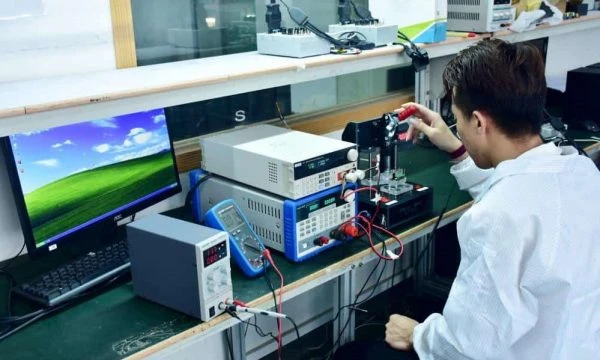
A standard Certificate of Compliance is insufficient for hybrid builds. The interface between dissimilar materials requires specific validation tests that prove the hybrid bond is mechanically and electrically sound.
1. Microsection Analysis (Cross-Section) Objective: Verify bond quality between Rogers core and FR-4 prepreg, hole wall integrity, and plating thickness. Method: Vertical slice through representative vias at the hybrid interface. Acceptance: No visible separation between dissimilar layers, no resin smear on inner-layer interconnects, plating thickness meets IPC Class 2 or Class 3.
2. Thermal Shock Testing Objective: Stress the CTE mismatch to reveal via cracking or delamination. Method: Thermal cycling between –40°C and +125°C (or higher per application requirement) for 100+ cycles. Acceptance: Daisy-chain via resistance change less than 10%, no visible delamination.
3. Peel Strength Test Objective: Verify copper adhesion on the Rogers/PTFE surface layers. Method: IPC-TM-650 2.4.8. Acceptance: Meets the base laminate datasheet specification (typically > 0.8 N/mm for treated PTFE surfaces).
4. TDR Impedance Verification Objective: Confirm that the hybrid lamination process did not alter dielectric thickness enough to shift RF impedance. Method: Time Domain Reflectometry on test coupons or actual traces on the Rogers layers. Acceptance: Impedance within ±5% or ±10% of design target, depending on application class.
5. Solder Float Test Objective: Simulate the thermal stress of reflow or wave soldering on the hybrid bond. Method: Float a sample coupon in molten solder at 288°C for 10 seconds. Acceptance: No blistering, measling, or delamination on any layer.
6. Passive Intermodulation (PIM) Testing (If Applicable) Objective: For sensitive RF/antenna designs, verify that the material interface is not generating nonlinear mixing products. Method: Apply two high-power carriers and measure intermodulation products. Acceptance: PIM levels below –150 dBc (or the specific design target).
How to Qualify a Supplier for Hybrid Stackup Manufacturing
When selecting a vendor for Rogers/PTFE hybrid stackup layout fabrication, use this checklist to filter experienced hybrid manufacturers from those who will be learning on your project.
RFQ Inputs (What You Provide)
- Gerber files (RS-274X or ODB++)
- Fabrication drawing clearly marked "Hybrid Stackup" in the title block
- Material table listing manufacturer and grade for every layer (e.g., Rogers RO4350B / Isola 370HR)
- Stackup diagram showing copper weights, dielectric thicknesses, and prepreg types at each interface
- Drill chart distinguishing plated, non-plated, and any back-drilled holes
- Impedance control table listing target ohms, trace widths, spacing, and reference layers
- IPC Class designation (Class 2 standard or Class 3 high-reliability)
- Testing requirements explicitly requesting TDR reports and microsection analysis
Supplier Capability Verification
- Plasma etching: In-house plasma desmear capability (not outsourced) — this is the single most critical capability for hybrid reliability
- Hybrid lamination experience: Request case studies or references for similar Rogers/FR-4 combinations with the same layer count
- Vacuum lamination press: Programmable thermal profiles with vacuum capability for void-free lamination
- X-ray drill registration: X-ray alignment systems for compensating differential scaling between dissimilar materials
- Material stock: Do they stock the specific Rogers and FR-4 materials, or do they procure on demand? (Directly affects lead time by 2–4 weeks)
- Engineering support: Pre-production CAM review with stackup simulation capability
Quality System and Traceability
- ISO 9001 as minimum; AS9100 preferred for high-reliability or aerospace hybrid builds
- Material certificates of conformance from Rogers, Isola, Taconic, or other specified laminate suppliers
- Microsection retention on file for at least 1 year
- 100% AOI on all inner layers, including the Rogers/PTFE cores
Change Control and Delivery
- Stackup locking: Written guarantee not to change prepreg type or lamination profile without approval
- Sub-tier management: Disclosure if any process steps (plating, drilling) are outsourced
- Vacuum-sealed packaging with desiccant to prevent moisture absorption (PTFE materials are sensitive to moisture uptake before assembly)
How to Navigate Trade-offs in Hybrid Stackup Design
Engineering is the discipline of making optimal compromises. In a Rogers/PTFE hybrid stackup layout, you frequently must trade one benefit for another. Here is how to make those decisions.
Symmetry vs. RF performance: RF engineers often want Rogers on the top layer only (microstrip configuration) with FR-4 everywhere else. Manufacturers want a symmetric build (Rogers–FR-4–Rogers) to prevent warping. If flatness is critical for BGA assembly, prioritize symmetry. If cost is paramount and the board is small (< 100mm × 100mm), an asymmetric build may be acceptable with modest bow and twist — but verify with your assembler first.
Prepreg flow vs. thickness control: High-flow prepreg fills copper pattern gaps well (good for reliability) but varies in pressed thickness (bad for impedance accuracy). Low-flow or no-flow prepreg has consistent thickness but risks voids in areas with uneven copper distribution. For tight impedance specifications (±5%), prioritize low-flow prepreg and ensure copper balance exceeds 80%. For maximum reliability in harsh environments, prioritize high-flow prepreg and accept wider impedance tolerance (±10%).
Material cost vs. CTE reliability: Standard FR-4 is inexpensive but has high Z-axis CTE (especially above Tg). High-Tg, low-CTE FR-4 (e.g., Isola 370HR, IT-180A) matches Rogers CTE characteristics better but costs more. For boards with more than 10 layers or significant thermal stress, low-CTE FR-4 is worth the premium — the material cost increase is far less than the cost of a field failure or qualification re-test.
Lead time vs. material specificity: You want a specific Rogers laminate grade. The factory has a "close enough" alternative in stock. During prototyping, accepting the stock alternative accelerates learning cycles and gets you functional hardware faster. For production, insist on the specific material and plan for the lead time — RF performance at 77 GHz is sensitive to Dk variations between material grades.
FAQ
Q: Can I use standard FR-4 prepreg with Rogers cores? A: Yes — this is the definition of a hybrid. The key constraint is that the FR-4 prepreg cure temperature must not damage the Rogers core, and the bond strength at the interface must be adequate for the thermal cycling requirements. RO4000 series materials are specifically designed for compatibility with standard FR-4 processing.
Q: How much money does a hybrid stackup actually save? A: It depends on how many layers use Rogers material. For a 4-layer board with 2 Rogers layers, savings are typically 20–30% versus all-Rogers. For a 12-layer board where only the top 2 layers are Rogers, savings can exceed 50–60%.
Q: What is the most common manufacturing defect in hybrid boards? A: Delamination during assembly reflow. This is typically caused by moisture absorbed into the board during storage (PTFE materials are moisture-sensitive), inadequate plasma treatment before lamination, or incorrect lamination temperature profiles.
Q: Does APTPCB handle material sourcing for hybrid builds? A: Yes. We can evaluate stackups specifying Rogers, Isola, Taconic, or other specialty laminates. Material identity, availability, certificates, and lot traceability are confirmed for the quoted order rather than assumed from a permanent supply arrangement.
Q: Can I use blind and buried vias in a hybrid stackup? A: Yes, but it adds significant complexity. Each additional lamination cycle required for sequential build-up increases the thermal stress on the hybrid bond. Registration challenges also increase because each press cycle introduces differential scaling between the dissimilar materials.
Q: What surface finish works best for Rogers/PTFE hybrid boards? A: ENIG is the standard choice — it provides flat pad surfaces for fine-pitch components and does not oxidize during storage. Immersion Silver offers slightly better RF performance (no ferromagnetic nickel layer) but requires careful handling and nitrogen-sealed packaging to prevent tarnishing.
Q: How do I calculate impedance for a hybrid stackup? A: You must use a 2D electromagnetic field solver (e.g., Polar SI, Saturn PCB, or the solver built into Altium/Allegro) that allows different Dk values for different dielectric layers. Standard impedance calculators that assume a uniform Dk will produce incorrect results for hybrid stackups because the Dk of Rogers (Dk ≈ 3.48 for RO4350B) differs from the FR-4 prepreg (Dk ≈ 4.2–4.5) and any bonding film at the interface.
Q: Is plasma treatment always required? A: For any hybrid involving PTFE-based materials (RO3000 series, RT/duroid), plasma treatment is mandatory. For ceramic-filled hydrocarbon materials like the RO4000 series, which process more like FR-4, plasma treatment is not strictly required but is still best practice for maximum interconnect reliability.
Related Resources
- High Frequency PCB Manufacturing: Capabilities for RF and microwave board fabrication.
- PCB Stackup Design: Fundamentals of layer arrangement for balanced hybrid structures.
- Rogers PCB Materials: Specifications for Rogers laminates that APTPCB can evaluate and process; exact grade, availability, source, and lot documents are confirmed for the RFQ.
- Multilayer PCB Structure: Understanding multilayer lamination helps visualize hybrid bonding risks.
- DFM Guidelines: General design rules for ensuring hybrid layouts are manufacturable.
Request a Rogers/PTFE Hybrid Stackup Quote
Ready to validate your Rogers/PTFE hybrid stackup layout? At APTPCB, we provide a comprehensive DFM review before cutting material, ensuring your hybrid design is optimized for yield and cost.
For the most accurate quote, provide:
- Gerber files (RS-274X or ODB++)
- Stackup with material types and thicknesses per layer
- Quantity and lead time requirements
- Testing requirements (TDR, microsection, IPC Class)
Request a Quote and DFM Review
Conclusion
A successful Rogers/PTFE hybrid stackup layout is a strategic advantage — it delivers high-frequency RF performance at a fraction of the cost of an all-Rogers build. But realizing that advantage requires moving beyond standard PCB design practices to engage with the physics of CTE mismatch, PTFE adhesion, and differential material scaling. By specifying exact materials, mandating plasma desmear, enforcing stackup symmetry, and validating the hybrid bond through microsection and thermal testing, you can scale your hybrid designs from prototype to production with confidence. Whether you are building 77 GHz automotive radar, 5G mmWave base stations, or satellite communication payloads, the path to a reliable hybrid board runs through a manufacturer who has demonstrated experience with the specific material combination in your stackup.