
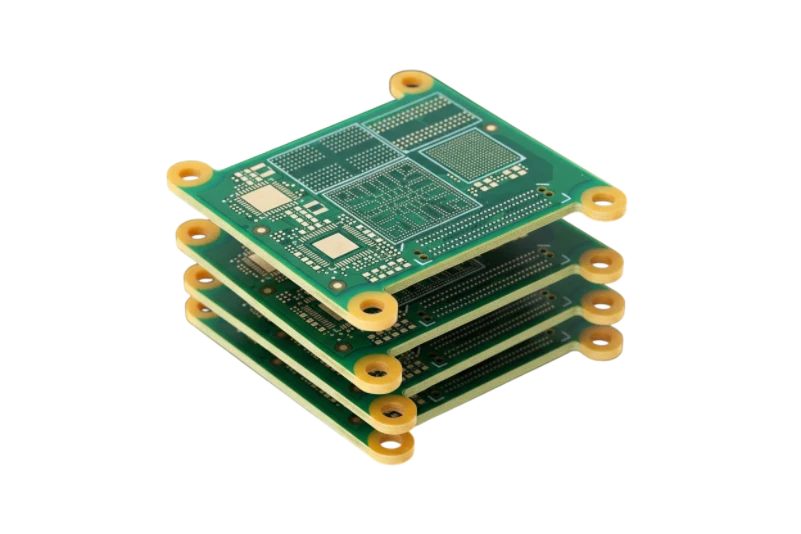
A Rogers/PTFE hybrid PCB stackup combines high-frequency laminate materials with conventional PCB materials such as FR-4 to place advanced RF performance only where it is required.
This construction is widely used in radar modules, wireless infrastructure, antenna arrays, aerospace electronics, and RF/digital mixed-signal systems. The engineering challenge is not only choosing a low-loss laminate. The finished board must maintain adhesion, dimensional stability, impedance control, and reliability after drilling, plating, lamination, assembly, and thermal cycling.
A reliable hybrid design depends on:
- selecting compatible RF and structural materials,
- creating a mechanically balanced stackup,
- controlling PTFE interfaces and lamination processes,
- validating electrical performance on production hardware.
How do I choose a Rogers/PTFE hybrid PCB stackup?
A hybrid stackup uses different dielectric systems in the same multilayer PCB. RF layers typically use Rogers materials while FR-4 layers support power distribution, digital routing, and mechanical structure.
Typical combinations include:
| RF material | Supporting material | Typical application |
|---|---|---|
| Rogers RO4350B | High-Tg FR-4 | RF modules, wireless equipment, mixed RF/digital boards |
| Rogers RO3003 | FR-4 or structural laminates | Automotive radar, antenna arrays |
| RT/duroid PTFE | Polyimide or FR-4 structures | Aerospace, satellite, microwave systems |
| Low-loss laminate | Standard FR-4 | Cost-optimized RF and high-speed products |
The correct choice depends on frequency, insertion-loss requirements, thermal conditions, mechanical constraints, and manufacturing capability.
Rogers RO4350B vs RO3003 vs RT/duroid: which material fits the design?
Material selection should start with the electrical role of each layer.
| Design requirement | Preferred material approach | Main trade-off |
|---|---|---|
| Cost-sensitive wireless products | Rogers RF layer with FR-4 support layers | Requires careful stackup balance |
| 77 GHz automotive radar | RO3003/PTFE-based RF layers | Higher RF stability with more complex processing |
| RF power amplifiers | RO4350B with thermal management structure | Requires thermal and CTE review |
| Aerospace RF systems | RT/duroid PTFE with compatible structural materials | Highest RF performance with increased fabrication complexity |
| RF plus high-speed digital | RF laminate only where needed | Requires detailed impedance modeling |
For more details on specific material properties, review our guide on Rogers PCB materials.
What manufacturing risks affect Rogers/PTFE hybrid boards?
Hybrid PCB failures usually occur at material transitions where different thermal and mechanical properties interact.
| Failure mode | Root cause | Detection method |
|---|---|---|
| Interface delamination | Poor adhesion, incorrect bonding process, incompatible materials | Thermal stress testing, visual inspection, microsection |
| Via cracking | CTE mismatch during thermal cycling | Cross-section analysis, reliability testing |
| Plating voids | Insufficient PTFE activation before copper plating | Microsection inspection |
| Impedance shift | Dielectric thickness variation or incorrect Dk assumptions | TDR measurement |
| Layer registration errors | Different material shrinkage during lamination | X-ray registration inspection |
| Board warpage | Unbalanced copper or asymmetric construction | Bow and twist measurement |
How should PTFE surfaces be prepared before lamination?
PTFE-based laminates have low surface energy and require specialized surface preparation before reliable copper bonding.
The fabrication process should include:
- PTFE surface activation,
- controlled cleaning,
- validated adhesion testing,
- microsection verification.
Standard FR-4-focused processes are not sufficient for PTFE interfaces because PTFE does not naturally bond well with conventional epoxy systems.
What stackup rules improve Rogers/PTFE hybrid reliability?
Specify exact materials and thicknesses
Manufacturing documentation should identify:
- Rogers material family and grade,
- FR-4 grade and Tg requirement,
- dielectric thickness,
- copper weight,
- target impedance,
- operating frequency.
Example stackup specification:
Layer 1-2: Rogers RO4350B 10 mil
Layer 3-6: High-Tg FR-4 prepreg/core structure
This prevents uncontrolled material substitutions during fabrication.
Balance the mechanical structure
Hybrid boards should be designed around the mechanical center of the PCB.
Balanced copper distribution and symmetrical layer construction reduce:
- warpage,
- layer movement,
- stress concentration,
- registration problems.
Review drilling and via structures early
Mixed-material boards require drilling parameters based on the complete stackup.
Important manufacturing considerations include:
- drill wear monitoring,
- feed and speed optimization,
- hole-wall quality,
- via aspect ratio.
Deep, narrow vias increase plating difficulty because the material layers respond differently during fabrication and thermal cycling.
Control lamination cycles
Lamination must account for different resin systems and thermal expansion behavior.
The press profile should control:
- temperature ramp,
- pressure application,
- resin flow,
- cooling conditions.
A hybrid board requires a validated lamination process for the exact material combination rather than a standard FR-4-only recipe.
How do I validate impedance and RF performance after fabrication?
RF validation should confirm that the manufactured PCB matches the simulated design.
| Parameter | Purpose | Measurement |
|---|---|---|
| Controlled impedance | Confirms trace geometry and dielectric performance | TDR testing |
| Dk consistency | Confirms dielectric behavior | Material characterization |
| Insertion loss | Measures RF attenuation | VNA testing |
| Layer registration | Confirms RF structure alignment | X-ray inspection |
| Thermal reliability | Confirms assembly durability | Thermal cycling or solder stress testing |
TDR coupons should represent the actual RF trace geometry instead of a generic coupon design.
Many RF applications target impedance control around ±5% when tighter performance is required, while less sensitive applications may accept wider limits such as ±10%.
What should be included in a Rogers/PTFE hybrid PCB supplier DFM checklist?
Before approving a supplier, confirm the following capabilities:
| Review item | Supplier capability to confirm |
|---|---|
| Material handling | Can the supplier process the exact Rogers/PTFE grades specified? |
| Stackup engineering | Will the supplier review material compatibility before production? |
| Plasma processing | Is PTFE surface activation available and controlled? |
| Lamination | Does the supplier have validated hybrid press recipes? |
| Registration | Are dimensional scaling factors controlled between materials? |
| RF testing | Are TDR, impedance, or VNA tests available? |
| Documentation | Are stackup drawings, material certificates, and inspection reports provided? |
What files are required for Rogers/PTFE hybrid PCB review?
A complete manufacturing package should include:
- Gerber files in RS-274X format.
- Complete stackup drawing.
- Exact material specifications.
- Layer-by-layer impedance requirements.
- Operating frequency.
- Surface finish requirement.
- Reliability requirements.
- Required test coupons.
Learn more about how we handle complex builds in our PCB fabrication process overview.
What are the most common questions about Rogers/PTFE hybrid stackups?
Can any FR-4 material be combined with Rogers?
No. The FR-4 system must match the Rogers laminate requirements, including thermal behavior, resin compatibility, and lamination conditions.
High-Tg FR-4 materials are commonly selected because they provide improved thermal stability.
Is PTFE processing different from RO4350B processing?
Yes. PTFE-based materials require specialized surface preparation because of their low surface energy. RO4350B uses a different material system with different fabrication requirements.
Does a hybrid stackup change impedance performance?
Yes. Impedance depends on dielectric thickness, Dk, copper geometry, and reference-plane spacing.
The transition between dielectric systems must be included during simulation and stackup review.
Can hybrid construction reduce PCB cost?
Yes. Placing premium RF laminate only on critical layers can reduce material cost while preserving RF performance.
Can Rogers/PTFE hybrid boards use HDI structures?
Yes. Blind and buried vias are possible, but additional lamination cycles increase material movement risk.
See our HDI PCB designs guide for more information.
Which surface finish is preferred?
ENIG and immersion silver are commonly selected for RF applications because they provide suitable surface flatness and solderability.
Related pages & tools
- Rogers PCB Materials – Detailed specifications for RO4350B, RO3003, and other RF laminates.
- PCB Stackup Design – General multilayer configuration guidance.
- High Frequency PCB Capabilities – RF manufacturing capabilities.
- Impedance Calculator – Estimate controlled impedance requirements.
Glossary
| Term | Definition |
|---|---|
| Hybrid Stackup | PCB construction using two or more laminate systems. |
| PTFE | Polytetrafluoroethylene, a low-loss dielectric material. |
| CTE | Coefficient of Thermal Expansion. |
| Prepreg | Resin-coated fiberglass bonding material. |
| Core | Fully cured laminate with copper layers. |
| Plasma Etching | Surface activation process used to improve PTFE adhesion. |
| Desmear | Process removing drilling residue before plating. |
| Dk | Dielectric constant affecting signal propagation. |
| Df | Dissipation factor representing dielectric loss. |
| Tg | Glass transition temperature of resin systems. |
| TDR | Time Domain Reflectometry used for impedance verification. |
How do I release a reliable Rogers/PTFE hybrid design?
A successful hybrid PCB release combines:
- correct laminate selection,
- controlled lamination,
- PTFE surface preparation,
- balanced mechanical construction,
- RF validation testing.
Before fabrication, provide:
- Gerber files.
- Complete stackup drawing.
- Exact laminate part numbers.
- Impedance targets and reference layers.
A Rogers/PTFE hybrid design succeeds when electrical requirements and manufacturing capability are engineered together from the beginning.