
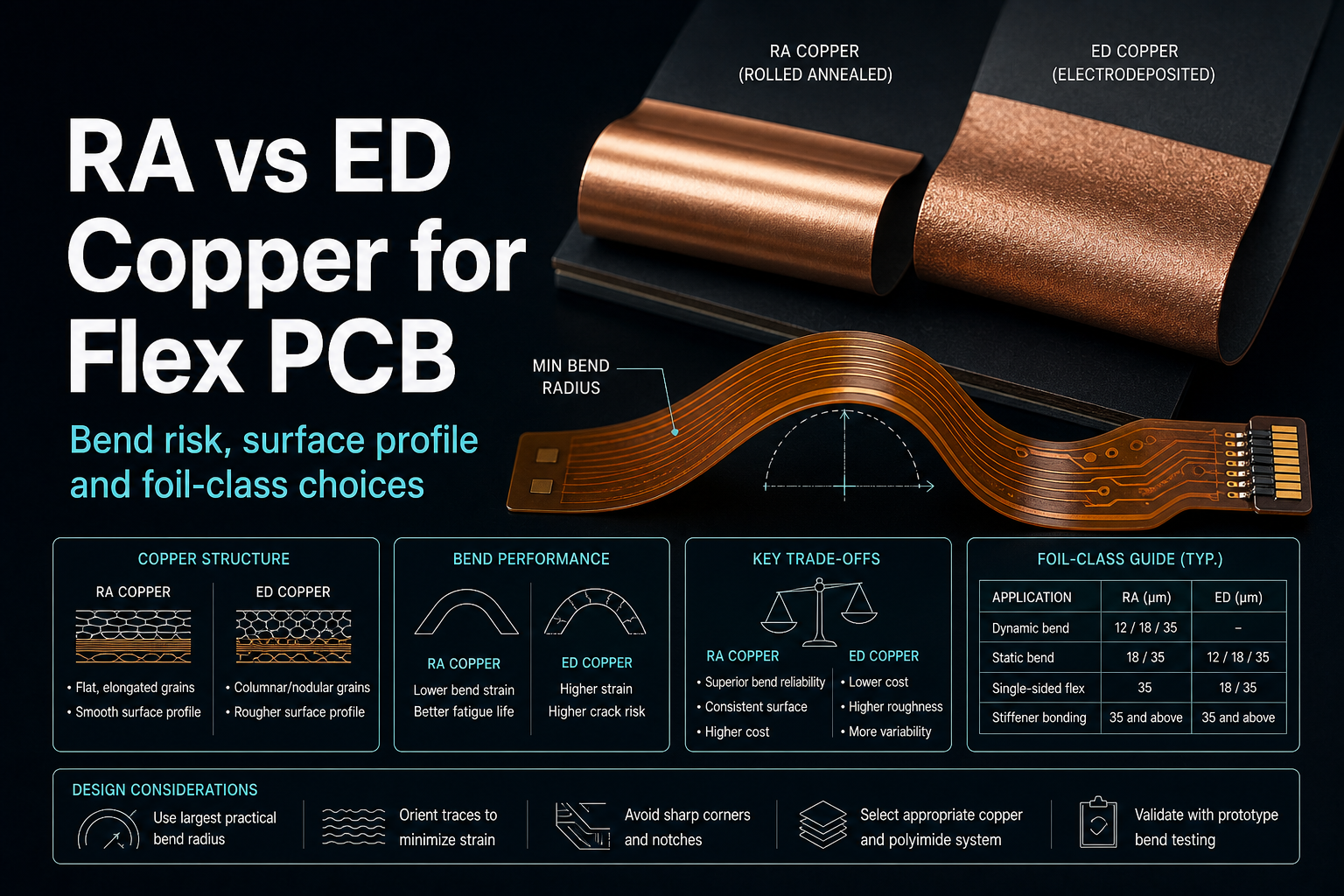
RAandEDcopper should be treated as copper-foil classes first, not as automatic performance promises.- The decision usually gets clearer when the team separates bend duty, copper profile, laminate route, and assembly constraints.
- The most useful comparison is not
Which foil wins in general?It isWhich foil class fits this flex architecture and this failure mode?
Quick Answer Rolled annealed and electro-deposited copper are distinct foil classes used in flex-circuit discussions. Teams often look first at
RAwhen the design has meaningful bend duty, whileEDremains common where the board is mostly static or easier to process as a standard flex build. Exact bend life, signal impact, and adhesion outcomes still depend on the full stackup, foil profile, routing direction, coverlay, and use case.
For the broader materials context, start with the Advanced PCB Materials and Substrates Guide. For APTPCB product and architecture context, see Flex PCB and Rigid-Flex PCB.
Table of Contents
- What should engineers decide before naming the foil?
- What does RA versus ED mean here?
- Why foil class must stay separate from flex architecture
- How to compare RA and ED without overclaiming
- What matters in bend zones and static zones
- What should be frozen before RFQ and DFM review?
- Related flex copper and surface-finish decisions
- Next steps with APTPCB
- FAQ
What should engineers decide before naming the foil?
Start with these four questions:
- Is the board truly flex, or is it rigid-flex with only local flex sections?
- Is the bend condition static or dynamic?
- Is the copper conversation about fatigue risk, surface profile, or manufacturability?
- Which release notes must be explicit before quoting?
That order matters because foil choice is only one part of the flex-material decision. A weak release package often treats copper type as the whole story and leaves bend radius, grain direction, coverlay, and stiffener placement vague.
| Review boundary | What it answers | What it does not prove |
|---|---|---|
| Architecture | Whether the design is flex or rigid-flex | The final foil class |
| Bend duty | Whether fatigue is a first-order risk | Exact cycle life |
| Foil class | Whether RA or ED is the better starting point |
Universal performance ranking |
| Release notes | Whether the supplier can review the actual build intent | Guaranteed yield or field outcome |
What does RA versus ED mean here?
The foil terms are used conservatively here:
rolled annealedcopper is a rolled-foil class used in flex-circuit discussions where flexibility and surface profile are part of the reviewelectro-depositedcopper is an electrodeposited foil class widely used across PCB and flex material systems
The local fact base supports class vocabulary such as foil type, foil profile, bond-enhancement treatment, and roughness posture. It does not support universal tables for bend cycles, insertion loss, peel strength, or roughness values across all foil suppliers and grades.
That means the safe public posture is:
- keep the comparison at class level
- tie stronger claims to the exact product and test condition
- avoid promising that one foil class is always lower loss, more flexible, or easier to build
Why foil class must stay separate from flex architecture
Flex PCB and rigid-flex PCB are architecture routes. RA and ED are foil classes. Those are different layers of meaning.
The same program can contain both a rigid section and a flex section, and the engineering priorities change across those areas. A rigid-flex release may discuss:
- flex-zone fatigue
- plated-through transitions between rigid and flex sections
- coverlay and stiffener behavior
- local bend-area routing rules
That is why RA versus ED should not be written as if it can be solved without the architecture context.
| Term | Treat it as | Do not collapse it into |
|---|---|---|
| Flex PCB | board architecture | one foil class |
| Rigid-flex PCB | board architecture | a material name |
| RA copper | foil class | guaranteed dynamic-flex success |
| ED copper | foil class | guaranteed low-cost or low-risk success |
How to compare RA and ED without overclaiming
A practical comparison usually starts with the main design risk:
If the dominant risk is repeated bending
Teams often begin with RA as the first review candidate because rolled foil is commonly positioned around flexibility-oriented use. That is a starting point, not final proof. The outcome still depends on:
- copper thickness
- grain direction relative to the bend
- bend radius
- coverlay and adhesive system
- trace shape in the bend area
If the dominant risk is standard manufacturability in a mostly static flex
ED often stays in the conversation because it is widely used in mainstream flex-material systems and may align better with standard processing routes. That still does not prove it is the right answer for every static-flex program.
If the dominant risk is high-frequency conductor behavior
Keep the claim narrow: surface profile and foil class matter. Do not claim that one foil always gives lower loss. Exact conductor-roughness and loss discussions need product-specific data and test context.
| Main concern | Better starting question |
|---|---|
| Dynamic bend life | Does the bend zone justify an RA-first review? |
| Static install flex | Is ED adequate once bend duty is defined clearly? |
| Surface-profile sensitivity | Which exact foil profile is being specified, and under what test context? |
| RF or high-speed loss | Are we still at class-level wording, or do we now need product-specific data? |
What matters in bend zones and static zones
The foil decision gets much better when the board is split into usage zones rather than treated as one generic flex part.
Bend-zone questions
- Is the bend one-time install, limited-service flex, or continuous dynamic motion?
- Are traces crossing the bend directly, or is the bend area being structurally protected?
- Does the release package define routing direction and copper weight in the bend area?
- Are stiffeners and local thickness transitions creating extra stress near the bend?
Static-zone questions
- Is the board mostly folded once and left in place?
- Are assembly temperatures, rework, or connector loads more important than flex fatigue?
- Is the layout constrained by shielding, impedance, or component density more than by repeated motion?
This split matters because RA can be justified by bend duty, while ED can remain perfectly reasonable in other zones or programs. The design review should reflect that instead of forcing one blanket statement across the whole build.
The failure chain is usually mechanical and release-driven: foil class is named without locking bend duty, routing direction, and stiffener transitions -> the supplier or layout team treats the flex as a simpler static build than it really is -> local strain concentrates at the bend or transition zone -> copper cracking, intermittent opens, or early validation failure appears after handling or first cycling.
The harsher factory-floor version appears when a team pays extra for RA copper to solve dynamic-bend fatigue in a robotic cable, hinge module, or foldable device, but forgets to freeze the Grain Orientation in the fabrication notes. To improve panel utilization, CAM rotates the flex image by 90 degrees. Now the rolling direction is parallel to the bend axis instead of perpendicular. The expensive foil is still on the board, but its fatigue advantage has been neutralized by panelization. In dynamic test, the circuit starts Micro-cracking in well under 1000 cycles and dies faster than the cheaper ED construction the team was trying to avoid. The same release discipline failure shows up at the stiffener boundary. If the rigid stiffener edge lands directly on the bend transition without adhesive strain relief or teardrop buffering, the edge becomes a physical Stiffener Guillotine. The first real bend does not just stress the copper. It cuts into the conductor layer at the transition and creates immediate opens. That is why buying RA copper does not buy reliability by itself. Reliability appears only when grain direction, stiffener transition, and bend radius are all locked in the DFM package.
What should be frozen before RFQ and DFM review?
Before asking for a serious supplier review, freeze these items:
- flex versus rigid-flex architecture
- static versus dynamic bend intent
- copper foil class for each affected layer
- copper weight and stackup family
- bend-area routing notes, including directionality where relevant
- coverlay, stiffener, and reinforcement notes
- any impedance or high-frequency sensitivity that changes the foil-profile discussion
Those notes are more valuable than a vague request for best copper for flex PCB, because they let the DFM review focus on the real risk owner.
APTPCB's published flex pages are useful for routing the conversation into flex or rigid-flex architecture, but exact foil availability and the suitability of a specific RA or ED grade still need to be confirmed against the released stackup.
Related Flex Copper and Surface-Finish Decisions
Use the next step that matches the actual decision owner:
- If the main question is architecture, continue to Flex PCB or Rigid-Flex PCB.
- If the main question is finish compatibility or pad treatment outside the bend discussion, continue to PCB Surface Finishes.
- If the team still has not frozen the material route at all, return to the Advanced PCB Materials and Substrates Guide.
Next steps with APTPCB
If your team is facing dynamic-flex fatigue risk, still debating RA versus ED, or worried that a rigid-flex transition may tear itself apart during assembly or first motion test, do not reduce the decision to foil price alone. The real failure usually sits in the interaction between copper class, grain direction, stiffener geometry, and bend radius long before the first prototype is built.
Send the Gerber or ODB++ package, stackup intent, stiffener plan, and bend-radius requirements to [email protected] or through the flex PCB material and design review request.
APTPCB's Flex CAM and materials engineering team will return a Flex Transition & Grain Orientation Review within 24 hours. We will identify stiffener-edge stress concentrators, verify the usable panel orientation for rolled copper, and help you lock the real dynamic-bend life of the design before expensive Polyimide material is turned into a flex assembly that fails in motion.
Useful related reading:
FAQ
Is rolled annealed copper always better for flex PCB?
No. It is often reviewed first for meaningful bend duty, but the right answer still depends on the full stackup, routing, and use case.
Is electro-deposited copper only for cheap flex boards?
No. ED is a broad foil class and remains common in many standard flex constructions. The article does not reduce it to a budget-only material.
Does this article give bend-cycle limits for RA and ED?
No. Class-level sources do not support universal bend-cycle tables across foil suppliers and grades.
Can I decide the foil before defining bend radius and stiffeners?
You can make an early hypothesis, but a dependable release decision usually needs the mechanical context frozen first.
Does foil choice automatically determine high-speed performance?
No. Surface profile matters, but exact signal claims need product-specific data and test conditions.
What usually causes confusion during RFQ?
The most common issue is a request that names RA or ED but leaves the bend duty, stackup, and zone-specific routing rules undefined.
Public references
IPC flex and rigid-flex standards overview Supports the public flex-construction vocabulary used for bend duty, reinforcement, and release-package framing.
APTPCB Flex PCB page Supports the flex-architecture context used when copper foil choice must stay attached to actual bend duty.
APTPCB Rigid-Flex PCB page Supports the rigid-flex branch where foil choice interacts with transition zones and mixed rigid/flex stackups.
APTPCB PCB surface finishes page Supports the separation between foil class and later finish or pad-treatment decisions.
Author and review information
- Author: APTPCB flex materials and DFM content team
- Technical review: copper-foil, bend-zone, and stackup-planning engineering team
- Last updated: 2026-05-15