
Key Takeaways
- Definition: Scale PCB refers to the strategic transition of a circuit board design from initial prototyping to high-volume mass production, ensuring consistency and cost-efficiency.
- Critical Metrics: Success is measured by First Pass Yield (FPY), Defect Density, and Time-to-Market (TTM), not just unit cost.
- Material Impact: Selecting materials like FR4 versus Rogers early in the design phase prevents costly re-spins during the scaling phase.
- Validation: Utilizing tools like an AC Power Analyzer and Accelerometer Test PCB fixtures ensures that performance remains stable across thousands of units.
- Partner Selection: Working with a capable manufacturer like APTPCB (APTPCB PCB Factory) ensures that Design for Manufacturing (DFM) principles are applied before volume production begins.
- Common Pitfall: The most frequent mistake is assuming that a prototype that works once will work perfectly when manufactured 10,000 times without design adjustments.
What Scale PCB really means (scope & boundaries)
To understand how to successfully execute a Scale PCB project, we must first define the boundaries between simple prototyping and true volume manufacturing.
In the electronics industry, "Scale PCB" describes the engineering and logistical process of taking a functional prototype and optimizing it for mass production. While a prototype focuses on "does it work?", scaling focuses on "can we build 50,000 units reliably, quickly, and cheaply?". This phase involves rigorous Design for Manufacturing (DFM), supply chain validation, and automated testing strategies. It is the bridge where engineering creativity meets industrial reality.
For companies like APTPCB, this process is not just about printing more boards; it is about ensuring that the thermal profile, impedance control, and component tolerances are robust enough to handle the natural variations found in large-scale manufacturing. A design that is not properly scaled will suffer from high failure rates, leading to recalls and lost revenue.
Having established the definition and scope of scaling, we must next examine the specific data points used to track success.
Metrics that matter (how to evaluate quality)
Effective scaling requires moving away from subjective assessments and relying on concrete data to ensure production stability.
The following table outlines the critical metrics engineers and procurement managers must monitor during a Scale PCB project.
| Metric | Why it matters | Typical Range / Factors | How to measure |
|---|---|---|---|
| First Pass Yield (FPY) | Indicates the percentage of boards that pass testing without rework. Low FPY kills profit margins. | Target: >98% for mature products. <90% indicates DFM issues. | (Units Passed / Total Units Entered) × 100. |
| Defect Density | Measures the number of defects relative to the complexity of the board. | Measured in Defects Per Million Opportunities (DPMO). | Automated Optical Inspection (AOI) logs. |
| Impedance Consistency | Critical for high-speed signals; variations cause data loss. | ±10% is standard; ±5% is precision. | TDR (Time Domain Reflectometry) testing on coupons. |
| Thermal Stress Reliability | Ensures the PCB won't delaminate during soldering or operation. | T260/T288 times (time to delamination at temp). | Thermal cycling tests. |
| Solderability Shelf Life | Determines how long bare boards can be stored before assembly. | 6–12 months depending on finish (ENIG vs. OSP). | Wetting balance test. |
| Test Coverage | The percentage of the circuit actually verified by automated tests. | Target: >90% for critical safety devices. | ICT (In-Circuit Test) analysis software. |
With these metrics in hand, the next challenge is determining which manufacturing approach fits your specific product requirements.
Selection guidance by scenario (trade-offs)
Choosing the right path for a Scale PCB project depends heavily on the volume, complexity, and end-use environment of the device.
Different industries require different scaling strategies. Below are common scenarios and the recommended approach for each.
1. Consumer Electronics (High Volume, Cost Sensitive)
- Scenario: Smart home devices or toys.
- Trade-off: Prioritize lowest unit cost over extreme durability.
- Recommendation: Use standard FR4 materials and HASL finishes. Panelization is critical here to maximize material usage.
- Risk: Lower grade materials may have higher variance in dielectric constant.
2. Industrial Control Systems (Medium Volume, High Reliability)
- Scenario: Factory automation controllers or power analyzers.
- Trade-off: Higher cost is acceptable for longevity and robustness.
- Recommendation: Use high-Tg FR4 (Tg > 170°C) and ENIG finish for flat pads and corrosion resistance.
- Risk: Long-term component availability must be secured early.
3. High-Frequency / RF Applications
- Scenario: 5G base stations or radar systems.
- Trade-off: Material cost is high, but signal integrity is non-negotiable.
- Recommendation: Hybrid stackups using materials like Rogers PCB combined with FR4.
- Risk: Mixing materials can lead to warping during reflow if the stackup is not balanced.
4. Medical Devices (Low Volume, Critical Safety)
- Scenario: Patient monitoring systems.
- Trade-off: Extensive documentation and traceability are required, increasing lead time.
- Recommendation: IPC Class 3 manufacturing standards. 100% E-test and AOI.
- Risk: Regulatory compliance (FDA/ISO) often freezes the design, making post-scale changes impossible.
5. Wearables (High Volume, Space Constrained)
- Scenario: Smartwatches or fitness trackers.
- Trade-off: Manufacturing complexity is high due to miniaturization.
- Recommendation: Rigid-Flex PCBs or HDI (High Density Interconnect) with blind/buried vias.
- Risk: Mechanical stress on flex points can cause cracks if the bend radius is too tight.
6. Precision Measurement (Specialized Low Volume)
- Scenario: Digital scales or Accelerometer Test PCB units.
- Trade-off: Noise reduction is the priority over size or cost.
- Recommendation: Multi-layer boards with dedicated ground planes and shielding.
- Risk: Parasitic capacitance can drift measurement results if the layout isn't optimized.
Once the strategy is selected based on these scenarios, the focus shifts to the tactical execution of the manufacturing process.
From design to manufacturing (implementation checkpoints)
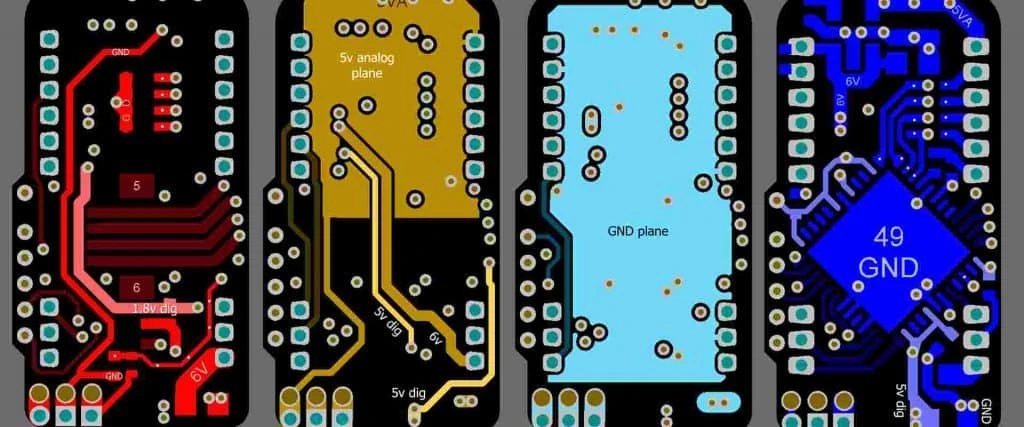
Successfully executing a Scale PCB run requires a disciplined step-by-step approach to catch errors before they become expensive scrap.
Follow these checkpoints to ensure a smooth transition from design files to finished pallets.
Design Freeze & BOM Scrub:
- Action: Lock the schematic and layout. No more "nice-to-have" changes.
- Risk: Changing a component footprint after the stencil is ordered.
- Acceptance: All stakeholders sign off on the final Gerber files.
DFM Review (Design for Manufacturing):
- Action: Submit files to APTPCB for a DFM check. Look for acid traps, slivers, and insufficient annular rings.
- Risk: A design that is "manufacturable" but has a low yield rate.
- Acceptance: A clean DFM report with no critical violations. DFM Guidelines should be consulted here.
Impedance Validation:
- Action: Verify trace widths against the manufacturer's stackup capabilities.
- Risk: Signal reflection in high-speed lines.
- Acceptance: Use an Impedance Calculator to confirm theoretical values match production reality.
Test Fixture Development:
- Action: Design the "Bed of Nails" or functional test jig.
- Risk: Waiting until boards arrive to think about how to test them.
- Acceptance: A working test plan that covers power rails, logic states, and communication ports.
Prototype / Engineering Validation Test (EVT):
- Action: Produce a small run (10–50 units) using the mass production process.
- Risk: Hand-soldered prototypes behave differently than reflowed production units.
- Acceptance: Functional verification using an AC Power Analyzer to check efficiency and stability under load.
Design for Assembly (DFA) Check:
- Action: Verify component spacing for pick-and-place machines.
- Risk: Tall components shadowing smaller ones during reflow, causing cold solder joints.
- Acceptance: Confirmation from the assembly house that the centroid file matches the PCB orientation.
Pilot Run (DVT/PVT):
- Action: A medium run (100–500 units) to test the assembly line speed and quality.
- Risk: Identifying a high failure rate in a specific component batch.
- Acceptance: Statistical validation of yield rates (Cpk > 1.33).
Mass Production Release:
- Action: Full volume order placement.
- Risk: Supply chain disruptions for key ICs.
- Acceptance: Continuous monitoring of yield and field failure rates.
Even with a rigorous process, errors can occur; identifying common pitfalls helps prevent them.
Common mistakes (and the correct approach)
Many Scale PCB projects fail or face delays because teams overlook subtle details that only appear at high volumes.
Mistake 1: Relying on Prototype Tolerances.
- Context: A prototype built by hand might work with a loose tolerance, but machines need precision.
- Correction: Always design with maximum material condition (MMC) in mind. Assume the manufacturer will use the full tolerance range allowed.
Mistake 2: Ignoring Panelization.
- Context: Designers often send single-board files.
- Correction: Design the panel array early. Poor panelization wastes material (increasing cost) and can make the PCB too flimsy for the conveyor belt.
Mistake 3: Single-Sourcing Critical Components.
- Context: Designing a board around a specific chip that has no pin-compatible alternative.
- Correction: Identify alternates for all passives and standard ICs in the BOM before scaling.
Mistake 4: Neglecting Thermal Management.
- Context: A board works on the bench but overheats inside an enclosure.
- Correction: Perform thermal simulation. Ensure thermal reliefs are used for soldering, but heat sinks are adequate for operation.
Mistake 5: Inadequate Test Points.
- Context: No room for test probes on the final board.
- Correction: Add test points to all critical nets. If space is tight, use test pads on the bottom layer or edge connectors.
Mistake 6: Forgetting the Stencil Design.
- Context: Using default aperture openings for all pads.
- Correction: Adjust stencil apertures for specific components (e.g., reducing paste for QFN center pads to prevent bridging).
Mistake 7: Over-specifying Materials.
- Context: Specifying expensive high-frequency laminates for low-speed digital sections.
- Correction: Use hybrid stackups or standard FR4 where possible to reduce the Scale PCB cost.
Mistake 8: Lack of Fiducials.
- Context: Pick-and-place machines cannot align the board accurately.
- Correction: Always include global fiducials on the panel rails and local fiducials near fine-pitch components.
To further clarify the nuances of scaling, we address the most frequent questions from engineers and buyers.
FAQ
Q: What is the minimum quantity required to "scale" a PCB project? A: While "scaling" implies large volumes, the process usually starts at the "Pilot" level, which can be as few as 50 to 100 units. True mass production typically begins at 1,000+ units.
Q: How does scaling affect the price per unit? A: Scaling drastically reduces price per unit due to amortization of setup costs (NRE) and bulk purchasing of components. However, the initial tooling cost is higher.
Q: Can I change the PCB design after starting mass production? A: It is highly discouraged. A "running change" requires scrapping old stencils, updating test fixtures, and potentially scrapping existing inventory. It is expensive and risky.
Q: What is the difference between an Accelerometer Test PCB and a standard PCB? A: An Accelerometer Test PCB is a specialized fixture used to validate motion sensors. It requires extreme flatness and rigidity to ensure that the sensor data reflects the device's movement, not the board's flexing.
Q: Why do I need an AC Power Analyzer for PCB scaling? A: When scaling power supplies or industrial controllers, you must verify that the power efficiency remains consistent across thousands of units. An analyzer checks for harmonic distortion and power factor issues that might not appear on a single prototype.
Q: How long does it take to transition from prototype to mass production? A: Typically 4 to 12 weeks, depending on the complexity of the DFM review, component lead times, and qualification testing requirements.
Q: Does APTPCB handle the assembly (PCBA) as well as fabrication? A: Yes, integrated services streamline the scaling process by resolving communication gaps between the bare board fab and the assembly floor.
Q: What file formats are needed for a Scale PCB quote? A: Gerber files (RS-274X), Drill files, BOM (Bill of Materials), Pick-and-Place (Centroid) file, and Assembly drawings.
Q: How do I ensure my impedance is correct during scaling? A: Specify the target impedance and the specific layers in your fabrication notes. The manufacturer will adjust the trace width slightly to match their material's dielectric constant.
Q: What is a "Golden Sample"? A: A Golden Sample is a unit from the pilot run that has been thoroughly tested and verified. It serves as the standard against which all mass-produced units are compared.
Understanding the terminology is the final step to mastering the scaling process.
Glossary (key terms)
| Term | Definition |
|---|---|
| BOM (Bill of Materials) | A comprehensive list of all parts, items, assemblies, and other materials required to create a product. |
| DFM (Design for Manufacturing) | The engineering practice of designing products in such a way that they are easy to manufacture. |
| Fiducial Marker | A circuit board feature (usually a copper circle) used by assembly machines as a reference point for alignment. |
| Gerber File | The standard file format used by the PCB industry software to describe the printed circuit board images. |
| HASL (Hot Air Solder Leveling) | A common surface finish where the board is dipped in molten solder and leveled with hot air knives. |
| ENIG (Electroless Nickel Immersion Gold) | A surface finish offering a flat surface and excellent corrosion resistance, ideal for fine-pitch components. |
| NRE (Non-Recurring Engineering) | One-time costs for research, design, developing, and testing a new product (e.g., stencils, tooling). |
| Panelization | The process of arranging multiple PCB copies on a larger panel to improve assembly throughput. |
| Pick-and-Place | The automated machine process of picking up components and placing them onto the PCB. |
| Reflow Soldering | A process in which solder paste is used to temporarily attach components, then the assembly is heated to melt the solder. |
| Stackup | The arrangement of copper layers and insulating material layers that make up a PCB. |
| Via | An electrical connection between different layers of a printed circuit board. |
| V-Score | A groove cut into the PCB panel to allow for easy separation of individual boards after assembly. |
| Yield Rate | The percentage of manufactured units that function correctly and meet all specifications. |
Conclusion (next steps)
Scaling a PCB project is a multidimensional challenge that extends far beyond simple circuit design. It requires a holistic view of materials, manufacturing tolerances, testing strategies, and supply chain logistics. Whether you are building a high-precision Accelerometer Test PCB or a consumer gadget, the principles of Scale PCB remain the same: validate early, standardize processes, and monitor metrics relentlessly.
To ensure your transition to volume production is seamless, prepare your documentation thoroughly. This includes your Gerber files, a finalized BOM, and a clear test plan.
If you are ready to move your design from the prototype bench to the production line, APTPCB offers the expertise and infrastructure to handle complex scaling requirements. From PCB Manufacturing to advanced assembly, we ensure your product is built to scale.