
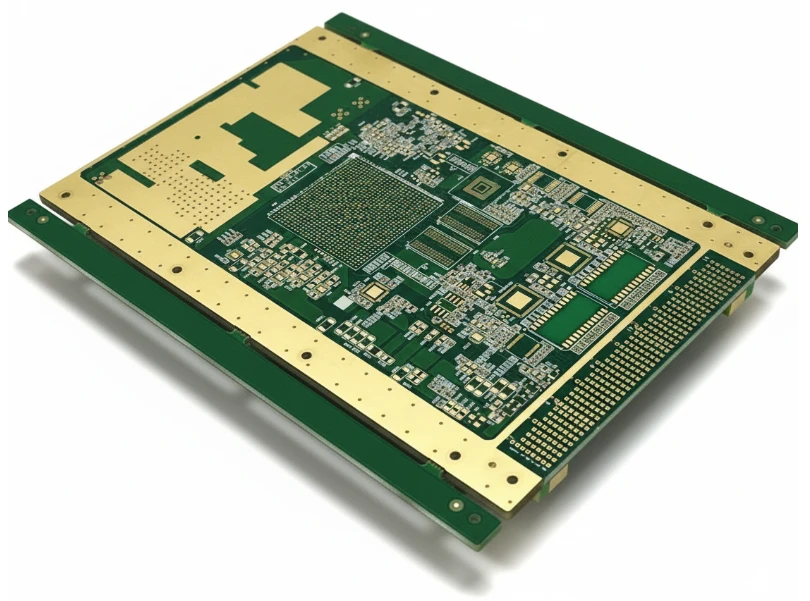
A Scene Control PCB coordinates inputs such as touch, sensors, voice, apps, or automation rules and converts them into synchronized outputs such as lighting, blinds, HVAC, relays, or audiovisual control. The difficult part is rarely the scene logic itself. The real engineering challenge is integrating wireless RF, sensitive audio or sensor circuits, processors, switching power, and sometimes mains-connected loads without allowing one subsystem to degrade another.
For buyers, the most useful specification is therefore not simply “4-layer FR-4 with Wi-Fi.” Define the system architecture, antenna environment, power/load boundary, interfaces, enclosure constraints, firmware/test requirements, and acceptance evidence before requesting a quote.
The practical decision sequence is:
- Choose module-based or chip-down wireless architecture.
- Separate RF, low-noise signal, digital, and power-switching constraints.
- Freeze the stackup only after impedance and routing requirements are known.
- Define manufacturing tests separately from finished-product performance tests.
- Request objective release evidence rather than relying on a generic “tested” statement.
What should you define before designing a Scene Control PCB?
A scene controller may be a simple low-voltage gateway or a densely integrated Wireless Control PCB with radios, microphones, local processing, relays, sensors, and power conversion. Those products should not receive the same PCB specification.
Use this decision matrix before committing to the board architecture:
| Design question | Lower-complexity path | Higher-complexity path | Evidence to request |
|---|---|---|---|
| Wireless implementation | Pre-certified radio module | RF SoC or chip-down radio | Module integration requirements or RF layout review |
| Antenna | Module/PCB antenna with defined keep-out | Chip, external, or custom antenna | Stackup, antenna keep-out, matching provision, RF validation plan |
| Control electronics | Low-voltage logic only | Logic plus relay, dimmer, motor, or mains circuitry | Isolation drawing and applicable safety requirements |
| Voice interface | No microphone or digital microphone module | Analog/digital microphone array and audio processing | Acoustic/mechanical interface and functional test definition |
| Board density | Standard multilayer | Fine-pitch BGA/QFN, HDI or constrained geometry | DFM review, X-ray plan, via structure |
| Production release | Electrical test plus visual inspection | Programming, FCT, RF or load verification | Test coverage and serialized results where required |
This matrix matters because a manufacturer can fabricate a PCB exactly to the supplied files while the finished controller still fails RF, acoustic, thermal, safety, or interoperability requirements.
How should the RF architecture be selected?
For many new products, a qualified wireless module is the lower-risk starting point. It reduces RF layout work because the radio, matching network, and often the antenna are already integrated. It does not, however, make the host PCB RF-independent.
Module positioning, ground copper, nearby connectors, displays, metalwork, cables, power inductors, and the enclosure can change antenna performance. Radio-vendor hardware guidelines commonly specify antenna clearance and placement rules and require verification in the actual host product.
A chip-down implementation can reduce board area or BOM cost in the right production program, but it transfers more responsibility to the product team. RF matching, reference layout adherence, antenna tuning, emissions, and certification planning must then be treated as development tasks rather than routine PCB fabrication.
For either architecture, define the following before layout:
- radio technology and exact device or module;
- antenna type and mechanical location;
- controlled-impedance nets and target values;
- approved PCB stackup or stackup constraints;
- antenna and RF keep-out areas;
- enclosure materials and nearby metal;
- matching-network provisions;
- required end-product RF verification.
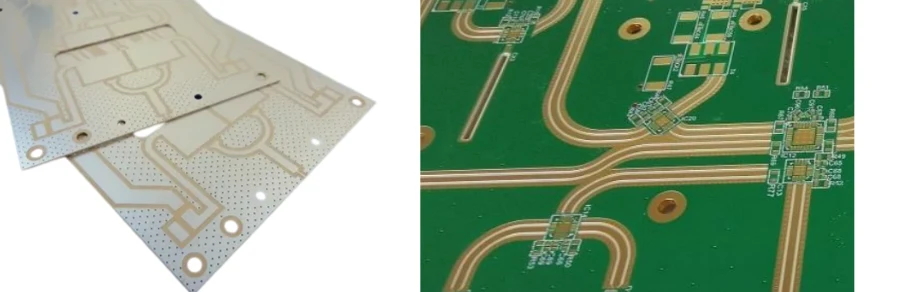
Do not select a high-frequency laminate solely because the product uses Wi-Fi or another GHz-band protocol. Short RF interconnects can often be implemented on a suitable FR-4 PCB when the stackup, dielectric properties, geometry, loss budget, and radio vendor's design rules support it. Material selection should follow the actual RF path rather than the protocol name.
What stackup and layout decisions reduce interference?
A four-layer construction is a common starting point for compact wireless controllers because it can provide a continuous reference plane while separating routing and power distribution. More layers may be justified by routing density, multiple interfaces, power distribution, EMI control, or component escape requirements.
Do not specify “4–6 layers” as a purchasing rule. Ask the fabricator to confirm a manufacturable stackup against the impedance and finished-thickness requirements.
The layout should give special attention to three interference paths.
RF versus digital noise: Keep the antenna and RF feed away from clocks, switching nodes, high-speed interfaces, and other strong noise sources. Maintain the reference plane required by the radio vendor and avoid casually routing through an antenna keep-out region.
Audio or low-level sensors versus power: A Voice Control PCB can place microphones only centimeters from DC/DC converters, displays, radios, and load-control circuitry. Protect low-level signals through component placement, controlled return paths, appropriate filtering, and the microphone manufacturer's layout guidance. Avoid applying a generic “split analog and digital ground” rule without analyzing return-current paths; an unnecessary plane split can create its own signal-integrity problems.
Logic versus switched loads: Relays, MOSFETs, triacs, motors, and power converters create fast current changes and thermal concentration. Partition those functions physically from sensitive logic and RF sections and design return paths intentionally.
For dense products requiring blind vias or other advanced structures, evaluate HDI PCB only when routing or form-factor constraints justify the added process complexity.
When do power and safety requirements change the PCB design?
Some scene controllers are entirely SELV/low voltage. Others directly interface with mains power. That distinction must be made before PCB quotation because it can affect spacing, slots, materials, connectors, protective components, testing, and regulatory evaluation.
Do not apply a universal creepage or clearance number. Required distances depend on factors such as working voltage, insulation function, pollution degree, material group, overvoltage category, product construction, and the standard applicable to the finished equipment.
The RFQ should therefore identify:
| Input | Why the PCB/PCBA supplier needs it |
|---|---|
| Maximum working voltage | Establishes the electrical design boundary |
| Isolation requirement | Identifies basic, supplementary, reinforced, or project-defined separation |
| Load type and current | Affects copper geometry, switching devices, connectors, and thermal review |
| Applicable product standard | Prevents generic PCB rules from replacing system-level safety requirements |
| Protective coating or potting | May change manufacturing process and inspection |
| Enclosure/airflow constraints | Needed when assessing temperature rise |
Where higher temperature capability is genuinely needed because of component temperatures, reflow requirements, or the application environment, evaluate a suitable High Tg PCB rather than treating high-Tg material as a universal solution to thermal problems. Laminate Tg does not compensate for an undersized thermal path or excessive component dissipation.
Which failures should be found before production?
The most expensive Scene Control PCB failures often appear only after the PCB is installed in the enclosure. Use a failure-mode table to connect each risk to an early verification step.
| Failure symptom | Likely contributors | Check before release | Useful evidence |
|---|---|---|---|
| Short wireless range or intermittent connection | Antenna detuning, RF noise, poor feed geometry, enclosure interaction | Test assembled product in representative enclosure | RF test data and antenna configuration |
| Receiver performance worsens when loads switch | Converter or switching noise coupling into RF | Exercise loads while monitoring wireless performance | Functional/RF coexistence results |
| False or missed voice commands | Acoustic path, electrical noise, microphone placement, firmware | Test representative enclosure and background conditions | Defined voice test results |
| Resets during transmission or switching | Supply droop, transient load, inadequate decoupling | Capture rails during worst-case operating modes | Oscilloscope records or functional logs |
| Hot spots near load-control circuitry | Device loss, copper limitation, enclosure temperature | Measure temperatures at maximum specified operating load | Thermal measurements |
| Intermittent BGA/QFN faults | Assembly process or hidden solder defects | Define process controls and inspection appropriate to package | X-ray/AOI records where required |
| Production units fail pairing or scene execution | Programming, BOM, assembly, or test-coverage issue | Run controlled end-of-line functional tests | Serialized or batch FCT results |
This approach is more useful than specifying an arbitrary wireless range, audio SNR, temperature cycle, or endurance duration without defining the actual product requirement.
What should the manufacturer test versus the product team?
Manufacturing acceptance and finished-product qualification are different responsibilities.
The PCB fabricator can verify board construction through electrical testing, dimensional inspection, impedance verification when specified, and other agreed fabrication controls. The PCBA supplier can inspect assembly, program devices, and perform fixture-based electrical or functional tests when the customer provides a test specification.
The product owner remains responsible for defining whether the completed device satisfies its RF, acoustic, software, safety, interoperability, environmental, and regulatory requirements. A successful FCT Test does not automatically prove regulatory compliance or end-product qualification.
A useful release plan separates three gates:
| Gate | Primary question | Typical outputs |
|---|---|---|
| PCB fabrication | Was the bare board built to the released fabrication data? | E-test, dimensional and impedance evidence as specified |
| PCBA manufacturing | Are the correct components assembled and does the board perform defined production functions? | AOI/X-ray as applicable, programming record, FCT results |
| Product qualification | Does the complete device meet system and market requirements? | RF, EMC, safety, acoustic, environmental or interoperability reports as applicable |
If radio modules are used, also review the module manufacturer's integration instructions and the regulatory requirements for the final host product. Modular approval should not be interpreted as automatic approval of every finished device configuration.
How should component sourcing be controlled?
Wireless modules, processors, power devices, connectors, microphones, and security devices can become schedule or revision risks. Resolve these before a production PO rather than after assembly starts.
The BOM should identify manufacturer part numbers, approved alternates, lifecycle concerns, customer-supplied parts, programming requirements, and parts that cannot be substituted without engineering approval. For critical components, define whether a proposed alternate requires electrical review, firmware validation, RF retesting, thermal requalification, or regulatory assessment.
A turnkey supplier's Component Sourcing service can reduce procurement workload, but sourcing authority and engineering-change authority should remain explicit.
What should you ask a Scene Control PCB supplier to prove?
Supplier evaluation should focus on evidence relevant to the actual board rather than a generic list of factory capabilities.
Confirm that the supplier can review the proposed stackup and controlled-impedance requirements, assemble the selected package types, manage any HDI or special via structures, inspect hidden solder joints where necessary, program firmware using the required security process, and implement the specified production test.
For each important requirement, ask what record will accompany qualification or production. Depending on the project, that might include impedance results, electrical-test records, inspection results, programming logs, FCT output, material traceability, or component lot information.
If the enclosure requires a non-planar interconnect, Rigid-Flex PCB can eliminate connectors and cables, but it should be selected because the mechanical architecture benefits from it—not merely as a reliability upgrade.
What files should be included in the RFQ?
A quote becomes more comparable when every supplier receives the same engineering package. Use the DFM Guidelines as a baseline, then add Scene Control PCB-specific information.
Send fabrication data such as Gerber or ODB++ files, drill data, fabrication drawing, board outline, stackup requirements, finished thickness, copper requirements, material constraints, surface finish, controlled-impedance nets, and relevant mechanical restrictions.
For assembly, include the BOM with manufacturer part numbers, centroid/pick-and-place data, assembly drawings, approved substitutions, firmware/programming instructions, and any special handling requirements.
For testing, identify test points and provide a functional specification stating the power conditions, interfaces, commands, outputs, expected results, firmware version, logging requirements, and pass/fail rules. If wireless behavior must be checked in production, specify the test setup rather than writing only “Wi-Fi test required.”
The supplier should also know annual or build quantities, prototype versus production status, panel constraints if fixed, required traceability, packaging expectations, and the records required for lot acceptance.
FAQ
Is ENIG always required for a Scene Control PCB?
No. ENIG can be useful where component geometry, connector/contact requirements, storage considerations, or assembly processes favor a flat surface, but OSP, HASL, and other finishes may also be appropriate. Select the finish from assembly, reliability, contact, lifecycle, and cost requirements.
Does every Scene Control PCB need ICT?
No. ICT is valuable when sufficient test access and production volume justify a fixture, but it is not automatically the best strategy. Prototypes and lower-volume products may combine bare-board electrical testing, AOI, flying probe, programming, and functional testing instead.
How should firmware updates be handled during manufacturing?
Define the programming stage, firmware revision control, programming interface, verification method, and any treatment of credentials or security keys before production. Post-assembly programming through a controlled fixture can be combined with functional testing when the product architecture supports it.
Should conformal coating be specified for indoor smart-home electronics?
Only when the product's environment and reliability requirements justify it. Coating changes process flow, connector and test-point masking, rework, inspection, and sometimes RF behavior, so the material and keep-out requirements should be documented rather than added as a generic protection step.
What changes when a pre-certified wireless module is replaced?
Treat a module substitution as an engineering change, not a routine purchasing alternate. Check footprint, power, firmware, antenna implementation, host integration instructions, RF behavior, and regulatory implications before approving the replacement.
Scene Control PCB sourcing: the final decision
The best Scene Control PCB specification begins with the finished product, not with a default layer count or laminate.
Define how the controller communicates, where its antenna sits, what it switches, which signals are noise-sensitive, how it is powered, how it fits inside the enclosure, and what the completed product must prove. Then translate those decisions into stackup, material, assembly, sourcing, and test requirements.
For procurement, the final comparison should be evidence-based: Can each supplier build the released design, control the identified manufacturing risks, execute the required tests, and return the records needed to release the lot?
That boundary also keeps responsibilities clear. The manufacturer is responsible for producing and testing against the agreed manufacturing specification. Engineering must confirm that the design is feasible for the actual application. The product owner must qualify the complete system for its intended environment, performance, safety, and regulatory requirements.
A complete RFQ built around those three responsibilities gives both engineering and purchasing a much stronger basis for selecting a Scene Control PCB manufacturing partner.