
What Is a Server System Board and Why Does Selection Matter?
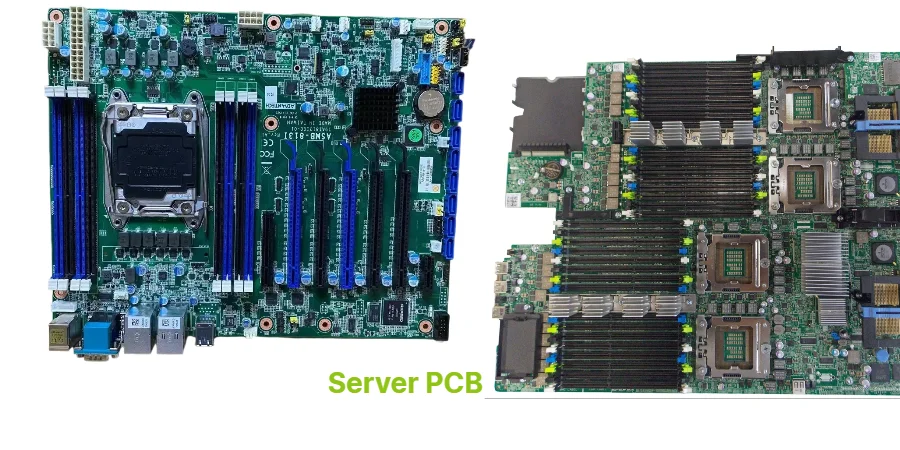
A server system board is the central electrical platform connecting processors, memory, storage, networking, expansion cards, and management controllers. Unlike consumer motherboards, server boards are designed for continuous operation, high current delivery, high-speed communication, and long service life.
Modern server system boards commonly integrate:
- Multi-core CPUs and accelerator interfaces
- DDR5 memory channels
- PCIe Gen 5/Gen 6 expansion
- High-current processor power delivery networks
- BMC management controllers
- Storage and networking interfaces
- High-density risers and backplane connections
The correct board design depends on more than PCB layer count. Engineers must balance:
- Signal integrity
- Power integrity
- Thermal performance
- Mechanical reliability
- Manufacturing yield
- Long-term supply capability
For many platforms, the board architecture begins with a Server and Data Center PCB strategy that aligns electrical requirements with production capability.
How Should Engineers Select a Server System Board Architecture?
The application determines the required PCB structure. A compact edge server and an AI training platform may both use server-class hardware, but their board priorities are different.
| Application | Design priority | Main PCB challenge |
|---|---|---|
| 1U Server PCB | Maximum compute density in limited height | Thermal concentration, routing congestion, airflow constraints |
| 2U Server PCB | Expansion flexibility and balanced cooling | PCIe routing, riser reliability, connector integrity |
| 4U Server PCB | Large accelerators and storage capacity | Power delivery, mechanical support, thermal distribution |
| AI Server PCB | Extreme bandwidth and current delivery | Low-loss channels, advanced cooling, high layer count |
A reliable selection process starts with the system architecture:
- Define CPU and accelerator requirements.
- Determine DDR5 memory topology.
- Map PCIe lanes and expansion requirements.
- Establish power delivery requirements.
- Select PCB construction based on electrical and manufacturing limits.
Layer count should be the result of these requirements, not the starting assumption.
What Layer Count and Materials Are Required for Server Motherboards?
High-performance server boards commonly use 12 to 24+ layers. AI accelerator platforms and advanced networking systems may require even higher layer counts.
A higher layer count provides routing capacity, but increases:
- Lamination complexity
- Registration requirements
- Manufacturing cost
- Yield risk
The stackup directly affects:
- Controlled impedance
- Signal loss
- Power plane performance
- Thermal expansion behavior
- Mechanical stability
Typical material decisions include:
| Design choice | Benefit | Trade-off |
|---|---|---|
| Standard FR-4 vs low-loss laminate | Lower cost vs improved high-speed performance | Low-loss materials increase material cost and process requirements |
| 1oz copper vs 2oz/3oz copper | Lower weight vs higher current capacity and thermal spreading | Heavy copper affects etching and impedance control |
| Through-hole vias vs HDI structures | Lower fabrication complexity vs higher routing density | HDI requires tighter registration and additional processes |
| ENIG vs OSP finish | Flat surface and storage stability vs lower cost | Finish selection affects assembly compatibility |
High-speed designs may require materials such as Megtron PCB laminates or equivalent low-loss materials.
For dense processor packages, HDI PCB structures using microvias, blind vias, and buried vias can provide the routing density required for advanced server platforms.
How Do PCIe and DDR5 Requirements Change Server PCB Design?
At modern server speeds, PCB traces behave as controlled transmission lines.
Important design requirements include:
- Controlled impedance routing
- Continuous reference planes
- Low-loss dielectric materials
- Differential pair matching
- Crosstalk control
- Via transition optimization
PCIe Gen 5 operates at 32 GT/s per lane, making insertion loss, copper roughness, connector transitions, and via stubs increasingly important.
DDR5 memory interfaces also require careful routing, impedance control, and topology management.
Back-drilling removes unused plated-through-hole sections that create signal reflections. It must be controlled precisely because excessive drilling depth can damage active layers.
What Power Delivery Features Should a Server System Board Have?
Server CPUs and accelerators can require hundreds of watts, creating demanding power delivery requirements.
A stable power distribution network requires:
- Low-inductance power and ground planes
- Proper decoupling capacitor placement
- Sufficient copper thickness
- Controlled voltage delivery during current transitions
Heavy copper layers improve current handling and thermal spreading. However, copper thickness changes trace geometry and must be included in impedance calculations.
Power delivery design should be reviewed together with:
- VRM placement
- Processor socket layout
- Thermal solution
- Plane structure
- Capacitor strategy
How Are Server PCB Reliability Risks Evaluated?
Server boards operate continuously through repeated thermal cycles. Differences in expansion between copper, laminate, solder, and components create mechanical stress.
Key reliability factors include:
- High-Tg laminate selection
- Balanced stackups
- Copper distribution control
- Reliable via plating
- Warpage management
- Assembly process control
Server System Board Failure Mode Decision Table
| Failure mode | Primary cause | Design or manufacturing focus |
|---|---|---|
| PCIe signal errors | Excessive loss, impedance variation, via stubs | Material selection, back-drilling, TDR validation |
| CPU voltage instability | High PDN impedance or insufficient decoupling | Power plane design and capacitor strategy |
| Via cracking | Thermal cycling and weak barrel reliability | Plating quality and reliability testing |
| BGA solder defects | Warpage or poor reflow control | Stackup balance and assembly profiling |
| Connector failure | Mechanical tolerance problems | Mechanical validation and fabrication control |
How Should a Server PCB Supplier Be Evaluated?
Selecting a manufacturing partner requires evaluating process capability, not only quoted price.
A server PCB supplier should demonstrate:
| Evaluation area | Required capability |
|---|---|
| High layer fabrication | Proven 12–24+ layer production experience |
| Signal integrity control | Controlled impedance testing and TDR validation |
| HDI manufacturing | Microvia, blind via, and buried via capability |
| Registration control | Layer alignment capability for dense multilayer boards |
| Heavy copper processing | Reliable fabrication with controlled impedance |
| Assembly capability | BGA inspection, X-ray analysis, and thermal profiling |
| Reliability validation | Cross-section analysis and thermal cycling support |
The supplier should review the design before production and confirm:
- Stackup feasibility
- Material availability
- Drill capability
- Impedance requirements
- Assembly constraints
- Production yield risks
How Does the Server System Board Connect to the Complete Hardware Platform?
A server system board is part of a larger electrical and mechanical ecosystem.
Important interfaces include:
- Storage backplanes
- PCIe risers
- Networking assemblies
- Power distribution systems
- Cooling structures
The Backplane PCB interface is especially important in rack systems because connector alignment and signal continuity affect system reliability.
PCIe risers introduce additional signal transitions that must maintain impedance and insertion-loss requirements.
During assembly, PCBA processes must support large processors, dense memory sockets, and heavy copper structures. X-ray inspection and controlled reflow profiling are commonly required because many critical solder joints are hidden beneath packages.
What Manufacturing Validation Should Be Completed Before Production?
A production-ready server system board requires electrical, mechanical, and manufacturing validation.
Recommended validation includes:
- Impedance testing
- Cross-section analysis
- Registration verification
- Thermal cycling evaluation
- Assembly inspection
- Reliability testing appropriate to the application
For demanding high-speed platforms, High Speed PCB manufacturing capability directly affects final system performance.
What Information Should Be Included in a Server PCB RFQ?
A complete RFQ and DFM review should include:
- Gerber files in RS-274X or ODB++ format
- Complete stackup diagram
- Copper weights and dielectric thicknesses
- Required laminate information
- Single-ended and differential impedance targets
- Drill chart with plated, non-plated, and backdrilled holes
- Via structure details including HDI requirements
- Surface finish requirements such as ENIG, Immersion Silver, or Hard Gold
- Prototype or production quantities
- Delivery requirements
Following DFM Guidelines early reduces redesign cycles and improves production readiness.
How Will AI Infrastructure Change Server System Board Requirements?
AI workloads are increasing demands on every part of server board architecture.
Future server boards will require:
- Higher bandwidth interconnects
- More accelerator connectivity
- Higher-current power delivery
- Advanced cooling compatibility
- More complex multilayer structures
| Performance factor | Current server designs | Future direction |
|---|---|---|
| PCIe bandwidth | PCIe Gen 5/Gen 6 class systems | Higher-speed interconnect generations |
| Layer count | 12–24+ layers | More complex high-density stackups |
| Cooling | Advanced air cooling | Liquid and immersion-compatible platforms |
| Routing density | CPU and memory focused | Accelerator and high-bandwidth fabric focused |
Conclusion: How to Select the Right Server System Board Partner
A successful server system board combines electrical performance, thermal stability, reliability, and manufacturability.
The strongest designs use:
- Appropriate materials
- Controlled impedance routing
- Stable power delivery networks
- Reliable multilayer fabrication
- Production-focused validation
For enterprise servers, cloud infrastructure, and AI computing platforms, PCB capability directly influences uptime and system performance. A qualified manufacturing partner helps convert complex electrical requirements into a reliable production platform.