
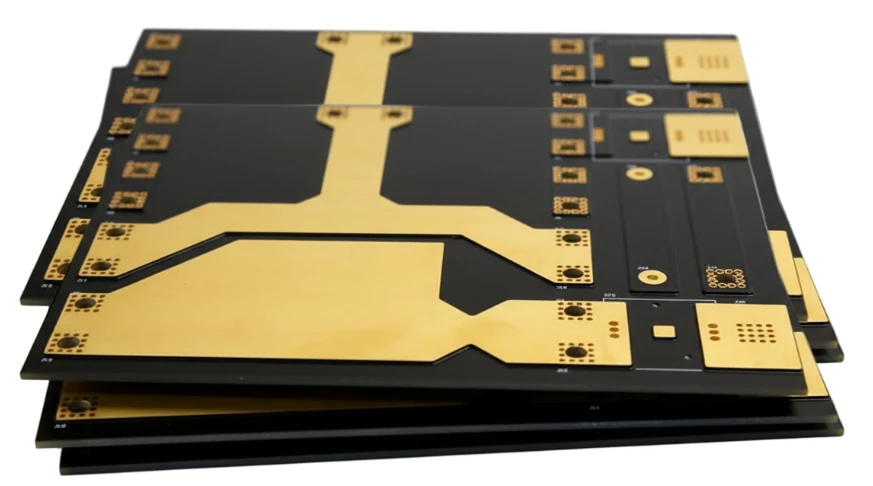
Servo motor driver PCB testing is not simply an electrical inspection step. A servo drive combines high-current switching, sensitive feedback measurement, power conversion, and safety protection circuits on the same board.
A PCB can pass continuity testing and still fail when connected to a real motor because the actual operating environment introduces:
- inductive load behavior
- Back-EMF during regeneration
- switching voltage spikes
- thermal cycling
- encoder signal disturbance
- mechanical vibration
A production-ready validation plan must prove that the PCB can survive electrical stress, thermal stress, and manufacturing variation.
What does Servo motor driver PCB testing verify?
A reliable servo driver test program validates three connected systems:
Power stage performance
- MOSFET, IGBT, or power module switching behavior
- current handling capability
- voltage spike control
- thermal performance
Control and feedback accuracy
- MCU/DSP operation
- encoder or resolver feedback
- current sampling accuracy
- communication stability
Protection response
- over-current shutdown
- over-voltage protection
- short-circuit handling
- thermal protection
A basic open/short test only confirms manufacturing connectivity. It does not prove that the driver can safely control an inductive motor load.
Which Servo motor driver PCB tests should be used for each application?
Different applications require different validation depth. A CNC servo axis, medical actuator, and consumer gimbal cannot share the same production test strategy.
| Application | Primary concern | Recommended testing |
|---|---|---|
| Industrial robotics and CNC | Continuous operation reliability | ICT + FCT + thermal load + burn-in |
| Consumer motion products | Cost and throughput | ICT + sampling FCT + functional spin test |
| Automotive motion systems | Traceability and environment | FCT + ESS + thermal cycling + vibration |
| Medical servo systems | Safety and precision | Full functional validation + fault simulation |
| Prototype/NPI | Design discovery | Oscilloscope analysis + thermal imaging + manual load testing |
| High-voltage servo drives | Electrical safety | Isolation test + controlled high-voltage functional testing |
The correct test level depends on voltage, current, safety requirements, operating environment, and expected lifetime.
Which parameters define Servo motor driver PCB quality?
The following parameters are commonly reviewed during prototype and production validation.
| Metric | Why it matters | Measurement method |
|---|---|---|
| RDS(on) consistency | Prevents uneven heating between switching devices | Four-wire Kelvin measurement |
| Thermal rise (Δ T) | Determines whether components exceed temperature limits | Thermal camera during load test |
| PWM rise/fall time | Controls switching loss and EMI behavior | High-bandwidth oscilloscope |
| Isolation voltage | Protects control circuits from power-stage faults | Hi-Pot testing |
| Feedback noise level | Prevents encoder errors and position instability | Signal measurement and spectrum analysis |
| Current sense accuracy | Maintains torque-control accuracy | Precision current injection test |
For high-power servo systems, thermal design and switching behavior usually determine long-term reliability.
How should a Servo motor driver PCB validation flow be organized?
A production validation process should follow the product lifecycle.
Prototype validation
The prototype stage focuses on finding design weaknesses.
Typical activities:
- measure gate-drive waveforms
- verify dead-time margin
- inspect switching overshoot
- measure thermal hot spots
- confirm current-sense accuracy
- validate encoder signal quality
At this stage, engineering teams need measurement access more than production speed.
Pilot production validation
The pilot stage confirms that the design can be manufactured consistently.
Important checks include:
- AOI inspection
- SPI inspection for thermal pads
- X-Ray inspection for hidden solder joints
- ICT coverage review
- functional test fixture validation
- assembly process capability review
Mass production testing
Production testing should focus on repeatability.
Typical production coverage:
- automated electrical test
- programmed functional test
- motor or electronic-load simulation
- protection verification
- traceable test records
What failure modes should Servo motor driver PCB testing detect?
| Failure mode | Possible cause | Detection method |
|---|---|---|
| MOSFET overheating | Poor copper design, excessive switching loss, insufficient cooling | Thermal load test |
| Motor vibration or unstable control | Feedback noise or poor sampling layout | Encoder analysis and FCT |
| Immediate power failure | Short circuit, wrong component, solder defect | ICT and controlled power-up |
| Intermittent operation | Connector issue, solder fatigue, vibration stress | Burn-in and environmental testing |
| Excessive EMI | Large switching loop, poor return path | Oscilloscope and EMC testing |
| Protection failure | Incorrect threshold or firmware response | Fault injection test |
Why is Functional Circuit Testing (FCT) essential for servo drivers?
ICT verifies whether components and connections are correct. FCT verifies whether the assembled board behaves like a real servo controller.
A proper FCT setup may include:
- simulated motor load
- encoder feedback simulation
- communication commands
- current measurement
- torque response verification
- fault-condition testing
A servo driver that works without load may still fail during acceleration, braking, or regenerative operation.
How should manufacturers prepare a Servo motor driver PCB for testing?
Testing success starts during PCB design.
Design for Test (DFT)
Provide access points for:
- gate signals
- DC bus voltage
- current sense outputs
- communication lines
- feedback signals
Poor test accessibility increases debugging time and makes production troubleshooting expensive.
Thermal construction review
High-current servo boards often require:
- heavy copper PCB structures
- optimized thermal vias
- high-Tg FR4 materials
- suitable heatsink interfaces
For high-power designs, review manufacturing capability together with thermal targets. See:
Assembly inspection planning
Power-stage assembly requires attention to:
- thermal pad solder volume
- large component placement accuracy
- hidden solder quality
- connector reliability
Related inspection resources:
What supplier documents should be frozen before production release?
A reliable servo motor driver PCB supplier should receive:
- Gerber files with complete fabrication data.
- BOM including critical power devices.
- Assembly drawings with polarity and mechanical requirements.
- Functional test specifications.
- Copper weight and stack-up requirements.
- Required inspection standards.
- Traceability requirements.
A clear release package reduces production variation and prevents repeated engineering changes.
Servo motor driver PCB testing mistakes engineers should avoid
Testing only with resistive loads
A resistor cannot reproduce:
- Back-EMF
- inductive current behavior
- regeneration events
Functional testing should include a motor or equivalent dynamic load.
Measuring power circuits incorrectly
High-current switching nodes require:
- suitable probes
- short ground connections
- isolated measurement equipment
Incorrect probing can create false results.
Running thermal tests without final cooling conditions
A PCB should be tested with realistic:
- heatsink mounting
- airflow conditions
- enclosure limitations
Thermal results from an unrealistic setup may not represent field behavior.
Skipping protection verification
Fault conditions should be intentionally tested:
- motor stall
- over-current
- abnormal feedback conditions
The protection circuit must respond within the specified timing requirement.
FAQ: Servo motor driver PCB testing
How much does servo driver testing add to manufacturing cost?
A complete validation plan including ICT, FCT, and reliability testing increases manufacturing cost, but reduces expensive field failures and warranty risks.
How long does functional test development take?
A production fixture commonly requires engineering development before volume manufacturing. The timeline depends on motor type, communication protocol, and required automation level.
What PCB materials support reliable servo testing?
Common choices include:
- high-Tg FR4 (Tg above 170°C for demanding environments)
- heavy copper PCB structures
- metal-core solutions for extreme thermal requirements
Can 400V+ servo drivers be tested safely?
Yes. High-voltage testing requires controlled environments, isolation equipment, protective enclosures, and trained operators.
Related Servo Motor Driver PCB Resources
Servo motor driver PCB testing glossary
| Term | Definition |
|---|---|
| Back-EMF | Voltage generated by a rotating motor that can affect the driver during regeneration. |
| Dead Time | Switching delay preventing simultaneous conduction of bridge devices. |
| DFT | Design method that improves production test access. |
| Encoder | Feedback device providing position and speed information. |
| FOC | Field-oriented control method requiring accurate current feedback. |
| H-Bridge | Switching topology used for motor direction and control. |
| ICT | Automated electrical test checking assembly correctness. |
| IGBT | High-power switching transistor used in motor drives. |
| MOSFET | Semiconductor switch used in many motor drivers. |
| PWM | Pulse-width modulation used for power control. |
| Shoot-Through | Fault condition where bridge switches conduct simultaneously. |
Conclusion: Building a reliable Servo motor driver PCB testing strategy
Servo motor driver PCB testing must connect electrical performance, thermal reliability, assembly quality, and production repeatability.
The strongest validation plans combine:
- PCB-level inspection
- ICT coverage
- functional motor simulation
- thermal testing
- protection verification
- reliability screening
For production release, prepare complete manufacturing data, define acceptance criteria, and select testing depth based on application risk.
To request a DFM and testing review, prepare:
- Gerber files.
- BOM with power components.
- Assembly drawings.
- Required functional test conditions.
- Stack-up and copper specifications.