
What this guide covers (and who it’s for)
High-power motor controllers and drives create aggressive electromagnetic environments. Managing noise is not just about compliance; it is about preventing catastrophic control failures. This playbook focuses specifically on the shielding and grounding fences motor PCB strategy—using via fences (picket fences) and dedicated ground planes to isolate sensitive logic from high-current switching noise.
This guide is written for Engineering Managers, PCB Layout Engineers, and Procurement Leads who need to source reliable motor control boards. You are likely dealing with high-voltage switching (IGBT or SiC MOSFETs) and need to ensure your PCB fabrication partner can execute tight via stitching and robust grounding without introducing manufacturing defects like CAF (Conductive Anodic Filament) or cracks.
We move beyond basic theory into the procurement reality. You will find specific material requirements, a breakdown of hidden manufacturing risks, validation protocols, and a supplier audit checklist. APTPCB (APTPCB PCB Factory) has structured this guide to help you transition from a functional prototype to a mass-producible, reliable component.
When fences/shielding work (and when they don’t)
Effective noise suppression relies on choosing the right mechanical and electrical architecture. Before finalizing your stackup, confirm that a shielding and grounding fences motor PCB design aligns with your specific constraints.
Use this approach when:
- High dV/dt Switching: Your motor drive uses fast-switching components (GaN or SiC) that generate steep voltage transients, requiring immediate containment via close-proximity ground fences.
- Mixed-Signal Integration: Your board combines high-power motor phases (400V+) with low-voltage MCU logic (3.3V) on the same substrate, necessitating a physical "fence" of vias to block radiated emissions.
- Space Constraints: You cannot afford bulky metal shielding cans and must rely on the PCB structure itself (via stitching and internal layers) to form a Faraday cage effect.
- Compliance Failures: Previous iterations failed radiated emissions testing at specific harmonic frequencies, indicating a need for tighter
shielding and ground fences.
Reconsider or augment this approach when:
- Extreme Voltage Isolation: If the creepage distance required between the high-voltage section and the fence violates safety standards (e.g., UL 60950), a physical slot or separation is safer than a conductive fence.
- Thermal Expansion Mismatch: In environments with extreme thermal cycling, excessive via stitching can create stress points that lead to barrel cracks. A
shielding and ground strategymust account for CTE (Coefficient of Thermal Expansion) mismatches. - Cost Sensitivity: High-density via fences increase drill counts significantly. If the application is low-frequency and low-cost, simple trace separation might suffice.
Specs & requirements (before quoting)
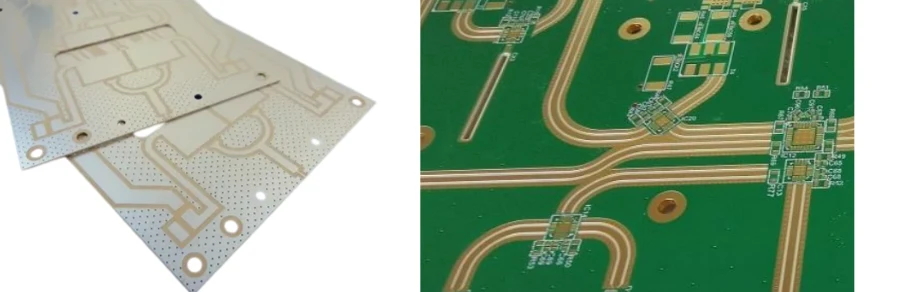
To get an accurate quote and a reliable board, you must translate "good shielding" into quantifiable manufacturing data. Ambiguity here leads to poor shielding effectiveness measurement results later.
- Via Fence Pitch and Diameter: Define the maximum center-to-center distance for fence vias. Typically, this should be less than $\lambda/20$ of the highest frequency of interest. Specify drill diameter (e.g., 0.3mm) and aspect ratio (e.g., 8:1).
- Ground Plane Continuity: Specify that ground planes connecting the fences must be solid copper, not hatched, unless necessary for board warping control. Interruptions in the reference plane destroy shielding effectiveness.
- Dielectric Material (Dk/Df): Specify the laminate material. For high-speed switching noise, standard FR4 might be too lossy or inconsistent. Consider materials with stable Dk to maintain impedance control near the fences.
- Copper Weight: Motor PCBs often require heavy copper (2oz, 3oz, or more). Explicitly state the finished copper weight, as this affects the minimum spacing between the via fence and adjacent tracks.
- Plating Thickness: Demand a minimum of 25µm (1 mil) copper in the via barrels. Thin plating in fence vias increases resistance and reduces the current-handling capability of the shield during fault conditions.
- Solder Mask Dam: Define the minimum solder mask dam between fence vias if they are not tented. This prevents solder bridging during assembly.
- Tenting Requirements: Clearly state if fence vias should be fully plugged, tented, or left open. Plugged vias prevent solder wicking but increase cost.
- Clearance to High Voltage: Specify the minimum clearance between the grounded via fence and high-voltage traces to satisfy
insulation resistance and hipot motor PCBrequirements. - Layer Stackup Symmetry: Ensure the stackup is balanced to prevent warping. A warped board can stress the via fences, leading to latent failures.
- Drill Positional Tolerance: Tighter tolerances (e.g., ±3 mil) are often needed for fences placed close to signal lines to avoid impedance discontinuities.
- Cleanliness Standards: Specify ionic contamination limits (e.g., <1.56 µg/cm² NaCl equivalent). Residues trapped near via fences can cause electrochemical migration.
- Documentation: Require a drill map that explicitly identifies the fence vias versus signal vias, allowing the CAM engineer to optimize the drill path.
Hidden risks (root causes & prevention)
Scaling up a shielding and grounding fences motor PCB introduces risks that do not appear in simulation. These issues often emerge during mass production or field operation.
Risk: Conductive Anodic Filament (CAF) Growth
- Why it happens: Via fences place plated holes in close proximity. If the glass fiber weave aligns with the via-to-via path and moisture is present, copper filaments can grow between vias.
- How to detect early: Perform CAF testing on a coupon with the specific via pitch used in the fence.
- Prevention: Use CAF-resistant materials and rotate the artwork 45 degrees relative to the weave if possible.
Risk: Via Barrel Cracking
- Why it happens: Motor PCBs undergo thermal cycling. The Z-axis expansion of the FR4 exerts stress on the copper barrel. Dense fences concentrate this stress.
- How to detect early: Interconnect Stress Testing (IST) or extensive thermal shock cycling (-40°C to +125°C).
- Prevention: Ensure aspect ratios are below 10:1 and enforce strict plating thickness controls (Class 3 standard).
Risk: Solder Wicking / Starved Joints
- Why it happens: If fence vias are close to component pads and not tented, solder can wick down the via, leaving the component pad with insufficient solder.
- How to detect early: DFM review of solder mask openings; X-ray inspection of first articles.
- Prevention: Require via plugging (Type VII) or strict tenting for all fence vias near SMT pads.
Risk: Impedance Discontinuity
- Why it happens: Placing a ground fence too close to a controlled impedance trace changes the reference coupling, altering the characteristic impedance.
- How to detect early: TDR (Time Domain Reflectometry) simulation and testing on coupons.
- Prevention: Maintain a "keep-out" zone between the signal trace and the via fence calculated by a field solver.
Risk: Resonant Cavities
- Why it happens: A via fence can inadvertently create a resonant cavity at specific frequencies if the spacing matches a wavelength multiple.
- How to detect early: 3D Electromagnetic simulation; near-field scanning of the prototype.
- Prevention: Add "randomizing" vias or stitching capacitors to break up resonant modes.
Risk: Ground Loops
- Why it happens: Connecting the fence to chassis ground at multiple points with different potentials can induce current loops that radiate noise.
- How to detect early: Review the grounding schematic; measure ground currents during operation.
- Prevention: Implement a single-point ground strategy or a hybrid grounding scheme (DC isolation, AC coupling).
Risk: Drill Breakout
- Why it happens: High drill density increases the chance of drill bit deflection or wandering, causing breakout on internal layers.
- How to detect early: Microsection analysis of the first production lot.
- Prevention: Use X-ray drill verification and limit stack height during drilling.
Risk: Incomplete Plating in Deep Vias
- Why it happens: If the PCB is thick (common for high power), plating solution may not circulate well in the center of the via barrel.
- How to detect early: Cross-sectioning (microsection) looking for "dog-boning" or voids.
- Prevention: Specify high-throw plating baths and aspect ratios compatible with the manufacturer's capability.
Risk: Thermal Traps
- Why it happens: Dense via fences can act as a thermal barrier, preventing heat from spreading laterally across the board.
- How to detect early: Thermal imaging of the operating board showing hot spots.
- Prevention: Ensure internal copper planes are thick enough to spread heat around the fence obstacles.
Risk: High Voltage Arcing
- Why it happens: Dust or humidity accumulation between the fence and high-voltage nodes can bridge the gap if solder mask is compromised.
- How to detect early: HiPot testing under humid conditions.
- Prevention: Apply conformal coating and ensure creepage distances meet pollution degree requirements.
Validation & acceptance (tests and pass criteria)

You cannot rely on visual inspection alone. A robust validation plan for shielding and grounding fences motor PCB verifies both mechanical integrity and electromagnetic performance.
Objective: Verify Shielding Continuity
- Method: DC Resistance measurement from the first via in the fence to the last via.
- Acceptance Criteria: Resistance must be < 100 mΩ (or calculated value based on copper weight). No open circuits.
Objective: Confirm Dielectric Strength
- Method: HiPot (High Potential) test between the ground fence and the nearest high-voltage net.
- Acceptance Criteria: No breakdown or leakage current > 1mA at the specified test voltage (e.g., 1500V + 2xRated).
Objective: Assess Thermal Durability
- Method: Thermal Shock Testing (e.g., 500 cycles, -40°C to +125°C).
- Acceptance Criteria: Change in resistance < 10%; no barrel cracks visible in microsection.
Objective: Validate Plating Quality
- Method: Microsection analysis (cross-section) on a sample from the panel edge.
- Acceptance Criteria: Minimum 25µm copper thickness average; no voids, cracks, or separation.
Objective: Check for CAF Vulnerability
- Method: Temperature-Humidity-Bias (THB) testing on a test coupon.
- Acceptance Criteria: Insulation resistance remains > 100 MΩ after 500 hours.
Objective: Measure Impedance Impact
- Method: TDR measurement on traces running parallel to the fence.
- Acceptance Criteria: Impedance within ±10% of the design target (e.g., 50 Ω or 100 Ω differential).
Objective: Verify Solderability
- Method: Solder float test.
- Acceptance Criteria: 95% coverage, no de-wetting, no blistering of the solder mask near the fence.
Objective: Inspect Drill Registration
- Method: X-ray inspection of internal layers.
- Acceptance Criteria: Drill breakout < 90 degrees (or Class 2/3 requirement); annular ring requirements met.
Objective: EMI/EMC Pre-compliance
- Method: Near-field probe scanning over the fence area while the motor is running.
- Acceptance Criteria: Noise attenuation matches simulation models; no unexpected hotspots.
Objective: Cleanliness Verification
- Method: Ion Chromatography (IC) test.
- Acceptance Criteria: Ionic residues < 1.56 µg/cm² NaCl equivalent to prevent dendritic growth.
Supplier checklist (RFQ + audit questions)
Use this checklist to vet potential partners like APTPCB. It ensures they understand the specific demands of shielding and grounding fences motor PCB production.
RFQ Inputs (What you send)
- Gerber Files: RS-274X or ODB++ format with clear drill files.
- Fabrication Drawing: Explicitly marking the via fence areas and critical tolerances.
- Stackup Diagram: Specifying material type (Tg, CTI), copper weights, and layer order.
- Netlist: IPC-356 format to verify connectivity of the ground fence.
- Drill Table: Separating plated vs. non-plated holes, with aspect ratios calculated.
- Impedance Requirements: Listing traces affected by the fence proximity.
- Finishing Requirements: ENIG, HASL, or Immersion Silver (ENIG preferred for flatness).
- Testing Requirements: Specific HiPot voltages and TDR coupons.
- Volume Estimates: Prototype vs. Mass Production quantities.
- Packaging: Vacuum sealing with desiccant and humidity indicator cards.
Capability Proof (What they must demonstrate)
- Minimum Drill Pitch: Can they drill the required pitch without webbing fractures?
- Aspect Ratio: Can they plate the required aspect ratio (e.g., 10:1) reliably?
- Heavy Copper Experience: Do they have a track record with 3oz+ copper plating?
- Registration Accuracy: What is their layer-to-layer registration tolerance?
- Via Plugging: Do they offer IPC-4761 Type VII (filled and capped) vias?
- Material Stock: Do they stock high-CTI or CAF-resistant laminates?
- Drill Capacity: Do they have enough spindles to handle the high drill count of fences?
- Automated Optical Inspection (AOI): Is AOI capable of inspecting inner layers for fence shorts?
Quality System & Traceability
- Certifications: ISO 9001, IATF 16949 (for automotive), UL listing.
- Cross-Sectioning: Do they perform microsections on every panel or every lot?
- Electrical Test: Is 100% flying probe or bed-of-nails testing mandatory?
- Material Traceability: Can they trace the laminate batch to the finished board?
- Calibration: Are TDR and HiPot testers calibrated regularly?
- Non-Conforming Material: What is the procedure for quarantining bad panels?
Change Control & Delivery
- PCN Policy: Will they notify you before changing material suppliers or drill bits?
- Capacity Planning: Can they handle a sudden 2x increase in volume?
- DFM Support: Do they provide a detailed DFM report before starting production?
- Lead Time: Is the lead time guaranteed for complex stackups?
- Logistics: Do they have experience shipping heavy copper boards (weight considerations)?
- RMA Process: What is the turnaround time for failure analysis?
Decision guidance (trade-offs you can choose)
Engineering is about compromise. Here is how to navigate the trade-offs in shielding and grounding fences motor PCB design.
Pitch Density vs. Cost:
- If you prioritize maximum shielding: Choose a tight via pitch ($\lambda/20$).
- Trade-off: This increases drill time and cost significantly.
- Alternative: Use a looser pitch ($\lambda/10$) and add a secondary internal ground plane.
Via Filling vs. Assembly Risk:
- If you prioritize assembly yield: Choose conductive or non-conductive epoxy filled vias (Type VII).
- Trade-off: This adds process steps and cost.
- Alternative: Use tented vias, but accept the risk of solder wicking or entrapped chemistry.
Material Selection vs. Durability:
- If you prioritize reliability: Choose high-Tg, CAF-resistant material.
- Trade-off: Higher raw material cost.
- Alternative: Use standard FR4 but increase spacing between fence vias (reduces shielding effectiveness).
Copper Weight vs. Fine Pitch:
- If you prioritize current handling: Choose heavy copper (3oz+).
- Trade-off: Etching resolution decreases; you cannot have fine lines near the fence.
- Alternative: Use standard copper (1oz) and reinforce current paths with busbars or solder build-up.
Solid vs. Hatched Ground Planes:
- If you prioritize shielding: Choose solid copper pours connecting the fence.
- Trade-off: Potential for board warping during reflow.
- Alternative: Use hatched copper, but ensure the hatch grid is much smaller than the wavelength of noise.
Blind/Buried Vias vs. Through Vias:
- If you prioritize isolation: Use blind vias to create fences only on specific layers.
- Trade-off: High manufacturing complexity and cost (HDI process).
- Alternative: Use through-hole vias and route around them on other layers.
FAQ
Q: What is the ideal spacing for via fences in a motor PCB? A: A common rule of thumb is $\lambda/20$ of the highest frequency harmonic you need to block. For general motor noise, 3mm to 5mm spacing is often a starting point, but tighter spacing (1mm-2mm) is better for high-speed switching.
Q: Can I use non-plated holes for the fence?
A: No. Shielding and ground fences rely on conductivity to form a Faraday cage. Non-plated holes do not provide an electrical barrier to electromagnetic waves.
Q: How does the via fence affect the impedance of nearby traces? A: The fence acts as a reference plane. If placed too close, it increases the capacitance, lowering the trace impedance. You must model this in your stackup design.
Q: Should the fence be connected to chassis ground or signal ground? A: This depends on your grounding strategy. Typically, the fence connects to the noisy power ground or a chassis ground to shunt energy away, but beware of ground loops.
Q: What is the risk of "shielding can and fence vias" combined? A: If you solder a metal shield can to the via fence, ensure the thermal mass doesn't prevent proper solder reflow. Use thermal relief spokes if current handling allows.
Q: How do I measure shielding effectiveness measurement on a bare PCB?
A: It is difficult to measure directly on a bare board. You typically validate it through S-parameter measurements (isolation) between ports or by testing the assembled unit in an anechoic chamber.
Q: Does insulation resistance and hipot motor PCB testing damage the board?
A: Properly designed HiPot testing is non-destructive. However, repeated testing at breakdown voltages can degrade the insulation material over time.
Q: Can via fences cause board breakage? A: Yes, a straight line of closely spaced holes creates a perforation line (like a stamp). Do not place fences across areas of high mechanical stress or bending.
Related pages & tools
- Industrial Control PCB Manufacturing
- Why this helps: Understand the broader context of motor drive fabrication, including reliability standards for industrial environments.
- Heavy Copper PCB Capabilities
- Why this helps: Motor PCBs often require thick copper; this page details the limits and design rules for 2oz+ copper weights.
- PCB Stack-up Design
- Why this helps: Proper layer planning is critical for grounding strategies; learn how to balance your stackup to prevent warping.
- PCB Quality Control System
- Why this helps: Review the specific certifications and inspection protocols (like microsectioning) used to validate via integrity.
- DFM Guidelines for PCB
- Why this helps: Get specific design rules for via spacing, annular rings, and solder mask dams to ensure your fence is manufacturable.
Request a quote (Design for Manufacturability (DFM) review + pricing)
Get a comprehensive DFM review from APTPCB engineers before you commit to tooling. To ensure the most accurate analysis for your shielding and grounding fences motor PCB, please include:
- Gerber Files (RS-274X or ODB++)
- Fabrication Drawing (highlighting fence locations and tolerances)
- Stackup Details (Material, Copper Weight, Impedance)
- Netlist (IPC-356)
- Estimated Annual Volume
Conclusion (next steps)
Implementing a robust shielding and grounding fences motor PCB strategy is a decisive step toward electromagnetic compliance and operational reliability. By defining clear specifications for via pitch and plating, anticipating risks like CAF and thermal stress, and rigorously validating the manufacturing process, you secure the foundation of your motor drive system. Use the checklist provided to align with your supplier, ensuring that your design intent translates perfectly into the final hardware.