
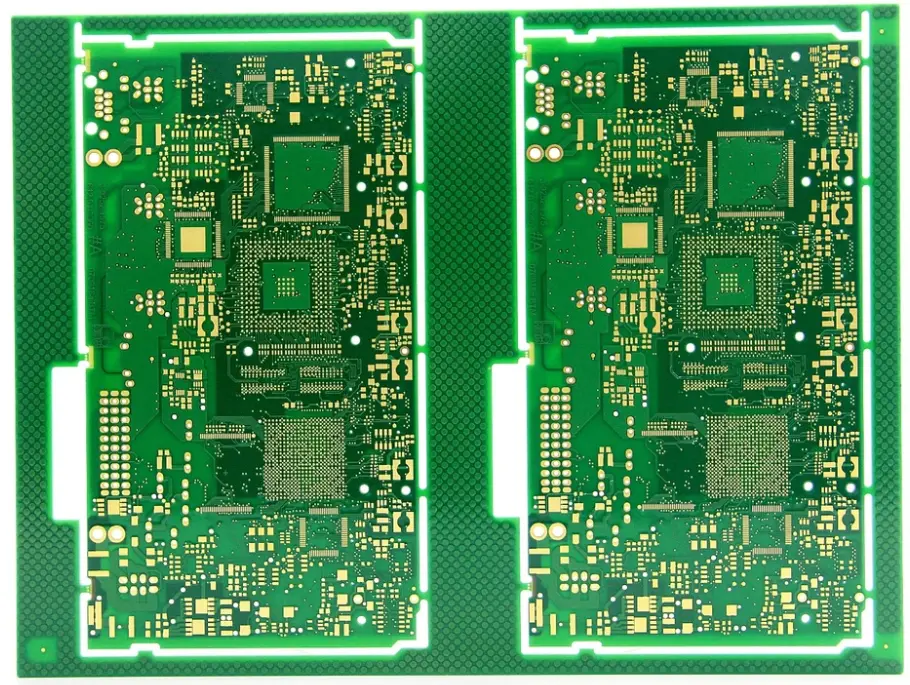
A high-speed PCB does not pass signal integrity signoff because a simulation file looks clean. It passes when the complete channel—from transmitter package through PCB routing, vias, connectors, and receiver input—has verified electrical margin and can be manufactured consistently.
A practical SI signoff checklist connects three engineering decisions:
- Design decision: Does the channel meet protocol requirements?
- Manufacturing decision: Can the PCB factory build the required structures repeatedly?
- Validation decision: Do simulation results match physical measurements?
This checklist applies to interfaces including DDR, PCIe, Ethernet, USB, SerDes links, RF mixed-signal boards, HDI designs, and multi-board systems.
What does an SI signoff checklist verify?
An SI signoff checklist is a release gate that confirms signal quality before fabrication. It covers pre-layout planning, PCB routing, simulation, manufacturing tolerances, and laboratory correlation.
A complete SI signoff includes:
- Stackup definition and impedance planning.
- Material selection based on loss requirements.
- Controlled impedance verification.
- Crosstalk analysis.
- Insertion loss and return loss evaluation.
- Eye diagram and jitter analysis.
- Power-aware SI analysis.
- Manufacturing tolerance review.
- TDR/VNA measurement correlation.
A design rule check (DRC) confirms that the PCB follows layout rules, but it does not prove that a high-speed channel will operate correctly. Signal behavior depends on transmission-line effects including dielectric loss, copper roughness, via discontinuities, and return-path continuity.
What are the key SI signoff metrics?
The following metrics define whether a high-speed PCB channel has sufficient electrical margin.
| Metric | Why it matters | Typical considerations | Validation method |
|---|---|---|---|
| Characteristic Impedance (Z0) | Controls reflections caused by impedance discontinuities. | 50Ω single-ended, 85Ω or 100Ω differential targets are common. Tolerance is often ±10% or tighter depending on interface requirements. | Field solver, TDR simulation, coupon testing |
| Insertion Loss (IL) | Measures signal attenuation through the channel. | Depends on trace length, frequency, dielectric loss, copper roughness, and material choice. | S-parameters (S21), VNA, simulation |
| Return Loss (RL) | Shows reflected energy from discontinuities. | Improved by controlling vias, connectors, transitions, and impedance changes. | S-parameters (S11) |
| Crosstalk (NEXT/FEXT) | Measures coupling between neighboring signals. | Influenced by spacing, layer geometry, reference planes, and parallel routing length. | 3D field simulation |
| Eye Diagram Height/Width | Shows receiver voltage and timing margin. | Must satisfy the interface-specific mask requirement. | IBIS-AMI or transient simulation |
| Jitter | Measures timing uncertainty. | Includes random and deterministic components. | Eye analysis and compliance testing |
| PDN Impedance | Shows power delivery quality during switching events. | Important for preventing supply noise from reducing signal margin. | Power-aware SI/PI analysis |
Which SI signoff decisions matter most by interface?
Different interfaces consume SI margin in different ways. Use the channel requirement to determine where engineering effort should be concentrated.
| Interface type | Primary signoff focus | Design decision |
|---|---|---|
| DDR4/DDR5 | Timing skew, topology, power noise | Prioritize timing closure, fly-by routing validation, and power-aware analysis |
| PCIe, Ethernet, USB, SerDes | Loss budget, reflections, via transitions | Allocate channel loss across traces, vias, connectors, and materials |
| HDI PCB | Crosstalk, return paths, microvia behavior | Validate dense routing structures and reference-plane continuity using HDI PCB technology |
| Analog/RF mixed signal | Isolation and noise floor | Validate coupling paths between digital and sensitive analog sections |
| Flex and rigid-flex | Impedance stability during bending | Account for changing geometry in Rigid-Flex PCB stackups |
| Multi-board systems | Connector and cable effects | Perform multi board si correlation across the complete channel |
How do you choose PCB materials for SI performance?
Material selection becomes a signoff decision when channel loss approaches the interface limit.
Specify exact materials, thickness, and electrical properties during stackup planning. Important parameters include:
- Dielectric constant (Dk).
- Dissipation factor (Df).
- Copper roughness.
- Resin content.
- Finished dielectric thickness.
For moderate-speed designs, standard FR-4 may provide sufficient margin. Higher-speed SerDes channels may require lower-loss materials such as Megtron-class laminates or Rogers materials.
Use PCB materials selection together with the expected si channel budget, because every trace segment and via consumes part of the available loss margin.
What should be included in an SI signoff supplier checklist?
A PCB manufacturer review should confirm that the factory can reproduce the electrical structures used in simulation.
| Supplier review item | Required decision |
|---|---|
| Stackup approval | Confirm layer structure, dielectric thickness, copper weight, and material grade |
| Controlled impedance capability | Confirm target impedance values and manufacturing tolerance |
| Material availability | Confirm approved laminate source and electrical specifications |
| Via capability | Confirm through-hole, blind via, buried via, or backdrill requirements |
| Test requirements | Define TDR coupons, impedance reports, and inspection requirements |
| Simulation correlation | Provide measured data for comparison with design assumptions |
This early stackup and si co design process prevents late stackup changes that invalidate routing constraints.
What are the main SI signoff checkpoints before fabrication?
Pre-layout SI planning
Define:
- Interface specifications.
- Maximum channel length.
- Loss budget.
- Impedance targets.
- Layer strategy.
- Material selection.
Use an Impedance Calculator during early planning to estimate trace geometry, then finalize values with the PCB manufacturer's stackup data.
Layout SI verification
Review:
- Continuous reference planes.
- Differential-pair spacing.
- Length matching requirements.
- Via transitions.
- Return-path continuity.
- Connector launches.
For high-speed channels, minimize unnecessary vias and remove problematic via stubs with backdrilling when required.
Post-layout simulation
Verify:
- Extracted channel models.
- S-parameters.
- IBIS/IBIS-AMI simulation results.
- Eye diagrams.
- Jitter.
- Worst-case manufacturing corners.
3D extraction is especially valuable for complex vias, connectors, and dense routing regions.
What SI failures commonly appear after fabrication?
| Failure mode | Root cause | Signoff improvement |
|---|---|---|
| Excessive reflections | Impedance discontinuity or poor transitions | Validate impedance profile with TDR and simulation |
| Eye closure | Excessive loss, jitter, or power noise | Perform channel simulation and power-aware SI analysis |
| Unexpected crosstalk | Dense routing or insufficient spacing | Include aggressor/victim analysis |
| Simulation mismatch | Incorrect material models or missing connector effects | Correlate simulation with measured S-parameters |
| Link instability across boards | Missing connector or cable models | Perform multi board si correlation |
How does power-aware SI analysis affect signoff?
Modern interfaces cannot be verified by looking only at signal traces. Switching currents create voltage fluctuations in the power distribution network, and those fluctuations can reduce eye opening.
Power aware si analysis combines signal behavior with realistic power delivery conditions. It evaluates whether simultaneous switching noise (SSN), PDN impedance, and decoupling strategy affect receiver margin.
This is especially important for:
- DDR memory buses.
- High-speed processors.
- FPGA systems.
- Large parallel interfaces.
What information should be provided for SI review?
A complete SI review package should include:
- Gerber or ODB++ manufacturing files.
- PCB stackup definition.
- Material specifications.
- Controlled impedance requirements.
- Critical net list.
- Simulation models.
- Connector and cable models when applicable.
- Measurement requirements such as TDR or VNA testing.
For High-Speed PCB projects, these documents create a direct connection between simulation assumptions and production reality.
SI signoff FAQ
At what speed does SI signoff become necessary?
SI effects depend on edge rate, not only clock frequency. When signal rise times become short enough that transmission-line behavior matters, formal SI analysis is required. Modern DDR, PCIe, Ethernet, and SerDes designs typically require structured signoff.
Why does simulation fail to match measurement?
Common causes include inaccurate material properties, missing connector models, manufacturing variation, copper profile differences, and incomplete channel extraction.
Do all nets require full-wave simulation?
No. Prioritize critical nets with high data rates, long routes, complex via structures, connectors, or narrow timing margins.
How does backdrilling help SI?
Backdrilling removes unused via barrels that behave as stubs. This reduces reflections and resonance effects on high-speed channels.
Conclusion: What does a successful SI signoff achieve?
A successful SI signoff proves that the PCB design, manufacturing process, and validation plan are aligned.
The goal is not simply a passing simulation. The goal is a first-pass manufacturing result with measurable electrical margin.
Before release, confirm:
- The stackup matches the simulation model.
- The channel meets impedance and loss requirements.
- Critical nets have verified eye margin.
- Manufacturing tolerances are included.
- Physical measurements can validate the design.
A structured SI signoff checklist reduces prototype failures and helps engineering teams move high-speed designs into production with confidence.