
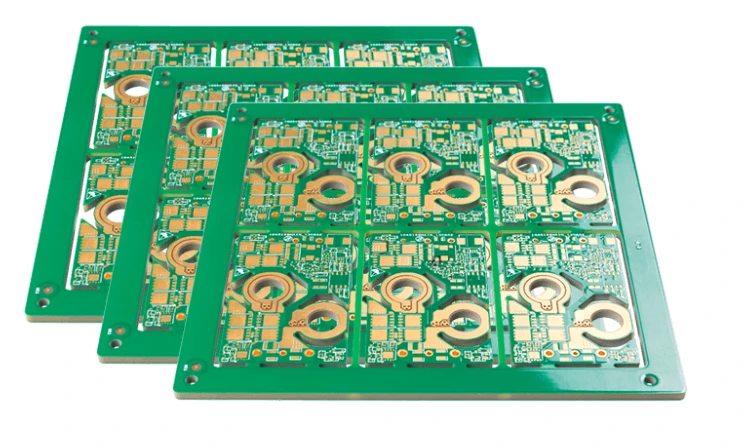
Silicon Carbide (SiC) MOSFETs deliver higher switching efficiency than silicon IGBTs, but the same characteristics that improve performance also expose PCB design weaknesses. Fast voltage transitions, high dV/dt, low gate thresholds, and high-frequency current loops make the gate driver PCB part of the switching system.
A successful SiC inverter gate driver PCB design requires decisions around four areas:
- low-inductance gate routing
- high CMTI isolation performance
- controlled switching behavior
- manufacturing verification
This guide provides the engineering criteria needed to move from schematic completion to PCB release.
What are the most important SiC inverter gate driver PCB design priorities?
The highest-impact design decisions are:
| Design Area | Target | Why It Matters | Verification Method |
|---|---|---|---|
| Gate loop inductance | <10 nH, target <5 nH | Limits ringing and overshoot | Field simulation, layout review |
| Gate resistor distance | <5 mm from gate pin | Improves damping effectiveness | PCB inspection |
| Gate trace length | Preferably <20 mm | Reduces parasitic inductance | Layout measurement |
| CMTI rating | >100 kV/µs | Protects isolated control signals | Driver datasheet review |
| Turn-off voltage | -3 V to -5 V typical | Prevents Miller-induced turn-on | Oscilloscope measurement |
| Driver decoupling distance | <2 mm preferred | Maintains stable gate current supply | Placement review |
| Gate-path vias | 0 preferred | Minimizes added inductance | CAD review |
When does a SiC inverter gate driver PCB require high-speed layout rules?
These practices are especially important for:
- 400 V and 800 V EV traction inverters
- solar and energy-storage inverters
- industrial motor drives
- high-frequency DC-DC converters
- designs with switching transitions above approximately 50 V/ns
Traditional silicon IGBT layouts may tolerate longer gate paths because switching edges are slower. SiC designs typically require tighter control because parasitic PCB elements become electrically significant.
How should the SiC gate loop be routed?
The gate loop includes:
- gate driver output
- gate resistor
- SiC MOSFET gate pin
- Kelvin source return
The loop area should be minimized by placing the driver, resistor network, and device connection close together.
Recommended layout decisions:
- Place the gate driver IC within millimeters of the SiC device connection.
- Route gate and Kelvin return together as a tightly coupled path.
- Keep the gate return separate from the high-current source path.
- Minimize vias in the gate current path.
- Use a solid reference plane beneath sensitive gate-drive routing.
A Kelvin source connection prevents power-loop voltage drops from appearing in the gate-drive return path.
How should engineers select SiC gate driver PCB parameters?
Use the following decision matrix during design review:
| Parameter | Design Selection | Production Check |
|---|---|---|
| PCB layer count | 4-layer or 6-layer stackup depending on isolation and routing complexity | Confirm stackup matches released fabrication data |
| PCB material | High-Tg FR4 commonly suitable; higher-performance materials for demanding applications | Verify Tg and CTI requirements |
| Copper weight | 1 oz typically sufficient for gate signals; 2 oz or 3 oz when carrying higher current | Confirm thermal requirements |
| Isolation spacing | Based on voltage, pollution degree, altitude, and applicable standards | Perform CAD clearance/creepage review |
| Gate resistor package | Select for switching frequency power dissipation | Verify pulse and thermal rating |
| Connector strategy | Short board connection preferred over long harnesses | Validate inductance impact |
How do CMTI and isolation affect SiC gate driver PCB design?
SiC switching nodes can generate extremely fast common-mode voltage changes. If the isolation barrier cannot reject these transients, the controller may experience false switching commands.
Specify:
- isolated drivers with appropriate CMTI rating
- physical isolation barriers with correct creepage and clearance
- no unintended copper paths crossing isolation boundaries
- controlled parasitic capacitance across isolation regions
For high-voltage designs, creepage and clearance should follow the applicable safety standard requirements, such as IEC 60664-1 and PCB spacing guidance.
What causes SiC gate driver PCB failures?
| Failure Mode | Typical Cause | Detection Method | Design Correction |
|---|---|---|---|
| Parasitic turn-on | Miller coupling raises gate voltage | Measure Vgs during switching | Add negative bias, improve Kelvin routing, consider Miller clamp |
| Gate ringing | Excessive loop inductance | Oscilloscope waveform inspection | Reduce loop area, adjust gate resistance |
| Driver latch-up | Isolation or CMTI failure | Observe control-side disturbances | Improve isolation design and shielding |
| Desat false trips | Noise coupling into protection circuit | Probe desaturation signal | Improve filtering and routing |
| Gate resistor overheating | Excess switching losses | Thermal calculation | Increase resistor rating or parallel devices |
| Insulation breakdown | Insufficient spacing | Hi-Pot testing | Increase creepage, clearance, or add slots |
What PCB manufacturing checks are required before SiC inverter production?
A SiC gate driver PCB supplier should verify:
Electrical checks
- open and short testing
- isolation verification where required
- impedance control when applicable
- high-voltage testing for isolated designs
Mechanical checks
- stackup matches design data
- controlled dielectric thickness
- correct copper weight
- plated through-hole reliability
Layout checks
- gate loop geometry preserved
- isolation barrier maintained
- no accidental copper bridges
- Kelvin source routing unchanged from validated design
For production validation, use APTPCB DFM tools before manufacturing release.
How should SiC gate driver PCB materials be selected?
Standard high-Tg FR4 is suitable for many SiC gate driver control boards when thermal and insulation requirements are satisfied.
Important material considerations include:
- Tg above 170°C for thermally stressed inverter environments
- suitable CTI rating for compact high-voltage layouts
- dielectric thickness supporting required isolation voltage
- stable dimensional performance during thermal cycling
For specialized high-frequency or extreme-voltage designs, consider specialized PCB materials.
What testing validates a SiC gate driver PCB design?
The most common validation method is the double pulse test.
Engineers should measure:
- gate voltage waveform
- drain-source voltage overshoot
- switching transition time
- ringing frequency
- switching losses
- false turn-on behavior
Testing should confirm that the PCB layout performs correctly under realistic switching conditions, not only under static electrical checks.
SiC inverter gate driver PCB release checklist
Before production approval, confirm:
- Gate loop inductance target reviewed
- Kelvin source connection verified
- Gate resistor placement confirmed
- CMTI rating exceeds system requirement
- Creepage and clearance reviewed
- Isolation barrier inspected
- Driver decoupling placement verified
- Gate-path vias minimized
- Double pulse testing completed
- PCB supplier DFM review completed
FAQ
Why is negative gate voltage used with SiC MOSFETs?
SiC MOSFETs often have lower threshold voltage margins than silicon devices. A negative turn-off voltage, commonly around -3 V to -5 V, improves immunity against Miller-induced false turn-on.
Can standard FR4 be used for SiC gate driver PCBs?
Yes. Many applications use high-Tg FR4 successfully. The design must still satisfy thermal, insulation, and reliability requirements.
How close should the gate driver be to the SiC MOSFET?
The driver should be placed as close as practical. Many designs target gate-path lengths below approximately 20 mm, with gate resistors positioned within a few millimeters of the device gate connection.
What is the purpose of a Kelvin source connection?
A Kelvin source separates the gate return current from the high-current switching path, preventing source voltage variation from disturbing the gate signal.
Does every SiC design require an active Miller clamp?
Not every design. Negative gate bias, optimized routing, and appropriate driver selection may provide sufficient protection. Extremely high dV/dt systems may benefit from active Miller clamping.
How does via inductance affect SiC switching?
Vias introduce additional inductance into the gate loop. In fast SiC switching applications, even small parasitic elements can contribute to ringing and overshoot.
Should PWM inputs use differential signaling?
Differential signaling can improve noise immunity in electrically harsh inverter environments.
Glossary
| Term | Definition |
|---|---|
| CMTI | Common Mode Transient Immunity, the ability of an isolator to withstand fast voltage changes between domains. |
| dV/dt | Rate of voltage change over time during switching transitions. |
| Kelvin Connection | Dedicated low-noise return connection separated from high-current paths. |
| Miller Effect | Gate voltage coupling caused by gate-drain capacitance during switching. |
| Parasitic Inductance | Unwanted inductance from PCB traces, vias, and component connections. |
| Creepage | Surface distance between conductive points. |
| Clearance | Air distance between conductive points. |
| Desaturation | Fast protection method detecting abnormal MOSFET conduction conditions. |
| Ringing | Oscillation caused by parasitic inductance and capacitance. |
Conclusion
A reliable SiC inverter gate driver PCB is created by controlling every high-speed current path, isolation boundary, and manufacturing variable. The most important decisions are reducing gate loop inductance, maintaining Kelvin routing, selecting appropriate isolation performance, and validating the final PCB through switching tests.
Whether developing an EV inverter, renewable-energy converter, or industrial drive, PCB fabrication quality directly affects switching reliability. APTPCB provides high-reliability PCB manufacturing capabilities for demanding power electronics applications.
Submit Gerber files for a quick quote or request engineering support for a DFM review.