
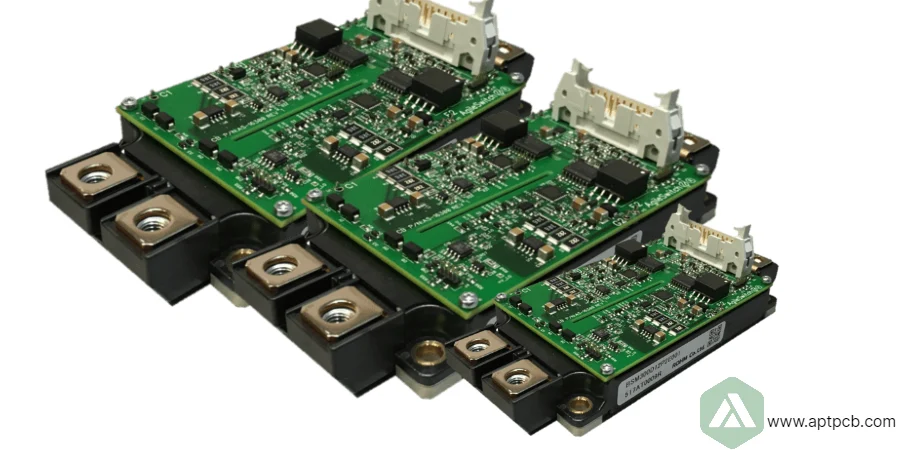
Silicon carbide (SiC) MOSFETs enable higher switching frequency, lower switching losses, and greater power density than traditional silicon IGBT solutions. However, the semiconductor itself is only one part of the reliability equation.
A SiC gate-driver PCB must control extremely fast voltage and current transitions while maintaining stable gate voltage, low parasitic inductance, electrical isolation, EMI performance, and thermal reliability.
For EV traction inverters, DC fast chargers, renewable-energy converters, and industrial motor drives, PCB manufacturing quality directly affects switching performance and long-term field reliability.
A qualified SiC gate-driver PCB supplier must understand both PCB manufacturing and power semiconductor behavior. The right evaluation process should verify low-inductance production capability, high-voltage isolation control, assembly quality, and validation processes before production begins.
What should engineers evaluate when selecting a SiC gate driver PCB manufacturer?
The most important supplier decision factors are not limited to copper thickness or layer count. SiC applications require manufacturing control over electrical performance parameters that directly influence switching behavior.
SiC Gate Driver PCB Supplier Selection Matrix
| Evaluation Area | Engineering Requirement | Manufacturing Evidence |
|---|---|---|
| Gate loop inductance | <5nH preferred | Layout review capability, controlled impedance routing, high-frequency measurement experience |
| Power loop inductance | <10nH preferred | Optimized multilayer structures and switching waveform validation |
| Gate current capability | 5–10A peak typical | High-current assembly process and solder joint inspection |
| Isolation performance | Application dependent | Hi-pot testing, creepage and clearance control |
| Operating temperature | Industrial and automotive ranges | Thermal materials, component qualification, reliability testing |
| EMI control | Fast dv/dt and di/dt switching environments | Grounding strategy, return path control, validation testing |
| Traceability | Production reliability | Process records, inspection reports, lot tracking |
The best supplier is one that can translate electrical requirements into repeatable PCB manufacturing processes.
Why does low-inductance PCB layout matter for SiC MOSFET gate drivers?
SiC devices can switch in extremely short time intervals, creating high di/dt and dv/dt conditions. Even small parasitic inductances can produce voltage overshoot, ringing, EMI problems, and false turn-on events.
Typical SiC gate-driver systems operate with:
- 650V to 1700V device ratings
- 10–100ns switching transitions
- 20–100kHz or higher switching frequencies
- 5–10A peak gate-drive currents
- 175–200°C semiconductor junction temperatures
The PCB manufacturing process must preserve the intended current paths from the design stage through final production.
Low-Inductance Layout Requirements
A production SiC gate-driver PCB commonly requires:
- Short gate traces between driver IC and MOSFET
- Kelvin-source connections for gate return current
- Wide copper paths for power current loops
- Controlled layer stack-up with continuous return paths
- Decoupling capacitors positioned close to driver supply pins
- Symmetrical routing for parallel switching devices
The gate driver should be placed as close as practical to the SiC device to minimize loop area.
APTPCB supports advanced layouts including:
- low-inductance multilayer structures
- heavy copper PCB construction
- controlled impedance routing
- optimized power and gate return paths
Related capabilities:
How do negative gate bias and protection circuits affect PCB manufacturing?
Many SiC MOSFET systems use negative gate bias during turn-off to improve immunity against parasitic turn-on caused by high dv/dt switching conditions.
Typical gate-drive voltages include:
- Positive turn-on voltage: +15V to +20V
- Negative turn-off voltage: -2V to -5V
Negative bias improves switching robustness but increases requirements for power supply isolation, voltage monitoring, and gate protection.
Negative Gate Bias Implementation Checklist
| Design Area | Manufacturing Consideration |
|---|---|
| Isolated gate-drive supply | Verify isolation design, spacing, and voltage testing |
| Dual-rail supply | Confirm stable positive and negative voltage generation |
| Gate oxide protection | Validate voltage limits and transient behavior |
| Startup sequencing | Test undervoltage and abnormal conditions |
| Gate waveform quality | Verify turn-on and turn-off timing |
A reliable PCB supplier should understand how layout decisions affect gate voltage stability.
What protection features should a SiC gate-driver PCB support?
SiC switching speeds require protection systems that respond faster than traditional silicon designs.
SiC Gate Driver Failure Mode Analysis
| Failure Mode | Root Cause | PCB Design Response |
|---|---|---|
| Gate ringing | Excess loop inductance | Short gate loop and damping components |
| False turn-on | High dv/dt coupling | Kelvin routing and negative bias support |
| Voltage overshoot | Power loop inductance | Optimized power planes and switching paths |
| Thermal drift | Component stress | Temperature-rated materials and components |
| EMI failure | Fast switching edges | Controlled return paths and grounding |
| Short-circuit damage | Slow protection response | Desaturation and soft shutdown circuits |
Common protection implementations include:
- Desaturation detection
- Overcurrent protection
- Soft turn-off control
- Gate voltage monitoring
- Undervoltage lockout
- Transient voltage suppression
- Fault communication interfaces
A manufacturing partner should be able to support inspection and testing of these protection-critical circuits.
How should SiC gate-driver PCBs be manufactured for high-temperature reliability?
SiC power devices are designed for high-temperature operation, but supporting PCB materials, components, and assemblies must maintain reliability through thermal cycling.
Important manufacturing considerations include:
Component and Material Selection
Production designs should evaluate:
- Automotive or industrial temperature-rated ICs
- Stable ceramic capacitors
- Low-temperature-coefficient resistors
- High-reliability solder materials
- Qualified connectors and insulation systems
Thermal Management Structures
PCB solutions may include:
- Heavy copper layers
- Thermal vias
- Heat-spreading structures
- Aluminum-core solutions where appropriate
- Temperature monitoring points
Related applications:
What manufacturing tests should a SiC gate driver PCB supplier provide?
Electrical validation is essential because SiC performance depends on switching behavior, not only PCB appearance.
A qualified supplier should support:
| Validation Area | Purpose |
|---|---|
| High-voltage testing | Verify insulation integrity |
| Electrical testing | Confirm circuit functionality |
| Thermal cycling | Evaluate reliability under temperature stress |
| Solder inspection | Confirm high-current connection quality |
| Waveform analysis | Verify switching behavior |
| Production traceability | Support failure analysis and lifecycle control |
Suppliers should provide documented inspection results and manufacturing records for production builds.
How are SiC gate-driver PCBs used in EV and fast charging systems?
SiC technology is widely adopted in:
- EV traction inverters
- onboard chargers
- DC fast chargers
- industrial drives
- renewable-energy converters
EV applications typically require:
- 400V–800V battery systems
- high efficiency
- compact thermal design
- automotive reliability
- long production lifecycles
DC fast charging systems require:
- continuous high-power operation
- reliable isolation
- low-loss switching
- environmental durability
These applications require PCB suppliers that can support both engineering development and stable volume manufacturing.
What questions should engineers ask before approving a SiC PCB supplier?
Supplier qualification should include technical questions that connect PCB capability with system performance.
SiC Gate Driver PCB Supplier Checklist
| Evaluation Area | Questions to Ask |
|---|---|
| Layout capability | Can you support sub-nanohenry current-loop optimization? |
| Manufacturing | Do you manufacture heavy copper and multilayer power PCB structures? |
| Assembly | How are high-current solder joints inspected? |
| Testing | Which electrical and thermal validation methods are available? |
| Reliability | What qualification data supports long-life operation? |
| Documentation | Can you provide traceability and process records? |
A supplier with experience in conventional PCB fabrication may not have the process discipline required for high-speed SiC switching applications.
Final decision criteria for SiC MOSFET gate driver PCB manufacturing
Selecting a SiC PCB manufacturing partner requires evaluation of the complete power electronics reliability chain:
- Low-inductance PCB design execution
- High-voltage isolation capability
- Thermal material selection
- High-current assembly quality
- Electrical validation testing
- Production traceability
SiC MOSFET technology delivers maximum efficiency and power density only when the gate-driver PCB is manufactured with the same engineering discipline as the semiconductor system it controls.