
Key Takeaways
- Definition Scope: SiC MOSFET gate driver PCB testing extends beyond simple electrical continuity; it involves validating signal integrity under high dV/dt (voltage change rates) and ensuring robust isolation.
- Critical Metric: Common Mode Transient Immunity (CMTI) is the single most important metric to verify, as low CMTI leads to false triggering in noisy SiC environments.
- Layout Impact: Parasitic inductance in the gate loop is the primary cause of ringing and overshoot; testing must confirm that the PCB layout minimizes this loop area.
- Measurement Technique: Standard passive probes often fail in high-side measurements; optically isolated or high-bandwidth differential probes are required for accurate validation.
- Manufacturing Partner: Working with a specialized manufacturer like APTPCB (APTPCB PCB Factory) ensures that material selection (like High-Tg FR4) meets the thermal demands of SiC applications.
- Validation Method: The Double Pulse Test (DPT) remains the industry standard for characterizing switching energy and verifying gate driver performance under load.
What this testing covers (scope & boundaries)
To understand why SiC MOSFET gate driver PCB testing is distinct from standard silicon-based testing, we must first look at the unique behavior of Silicon Carbide (SiC) devices. Unlike traditional silicon IGBTs or MOSFETs, SiC devices switch at incredibly high speeds with very low switching losses. This capability allows for smaller, more efficient power converters, but it introduces significant challenges in the Printed Circuit Board (PCB) environment.
The scope of testing a SiC gate driver board is not limited to checking if the driver IC turns on and off. It encompasses the validation of the entire signal chain in a high-noise environment. SiC MOSFETs can generate voltage transients (dV/dt) exceeding 100 V/ns. If the gate driver PCB is not tested for immunity against these transients, the noise can couple back into the control logic, causing catastrophic shoot-through events.
Therefore, effective testing covers three main boundaries:
- Signal Integrity: Verifying that the gate voltage stays within safe limits (typically -4V to +15V) without excessive ringing.
- Isolation Robustness: Ensuring the galvanic isolation barrier on the PCB can withstand the high-voltage potentials and fast transients.
- Thermal Management: Confirming that the PCB layout effectively dissipates heat from the driver IC and the gate resistors.
At APTPCB, we emphasize that the physical layout is as critical as the schematic. A perfect schematic on a poorly laid-out PCB will fail during the rigorous demands of SiC switching.
Metrics that matter (how to evaluate quality)
Building on the definition of scope, the quality of a SiC driver board is quantified by specific performance metrics that must be measured during the prototype and production phases.
The following table outlines the critical metrics for SiC MOSFET gate driver PCB testing, explaining why they are vital for system reliability.
| Metric | Why it matters | Typical Range / Factors | How to Measure |
|---|---|---|---|
| CMTI (Common Mode Transient Immunity) | SiC switches create massive ground shifts. Low CMTI causes the driver to lose signal sync or latch up. | > 100 kV/µs is standard for SiC. Influenced by PCB coupling capacitance across the isolation barrier. | Apply high dV/dt pulses across the isolation barrier and monitor output stability. |
| Gate Loop Inductance | High inductance causes ringing and voltage overshoot, potentially exceeding the MOSFET's gate oxide breakdown voltage. | < 10 nH is the target. Influenced by trace length and width between driver and MOSFET. | Measure using an impedance analyzer or infer from voltage overshoot during switching. |
| Propagation Delay Matching | In bridge configurations, mismatched delays between high-side and low-side drivers cause dead-time distortion. | < 5 ns mismatch. Critical for high-frequency (>100 kHz) switching. | Measure time difference between input logic edge and output gate voltage edge. |
| Peak Source/Sink Current | Determines how fast the Miller capacitance is charged/discharged, directly affecting switching speed. | 2A to 10A+. Dependent on the gate charge ($Q_g$) of the SiC module. | Use a current probe on the gate line during a switching event. |
| Isolation Voltage (Viso) | Safety requirement to prevent high voltage from jumping to the low-voltage control side. | 2.5 kVrms to 5 kVrms. Dependent on PCB creepage/clearance and material. | Hi-Pot testing (Dielectric Withstand Voltage test). |
| Desaturation (Desat) Response Time | How quickly the driver detects a short circuit and shuts down the SiC MOSFET to prevent destruction. | < 2 µs. SiC dies faster than IGBTs, so this must be extremely fast. | Simulate a fault condition and measure the time to shutdown. |
Selection guidance by scenario (trade-offs)
Once you understand the metrics, the next step is selecting the right PCB design strategy and testing approach based on your specific application scenario. Not all SiC designs require the same level of complexity.
Here are six common scenarios and the associated trade-offs in SiC MOSFET gate driver PCB design and testing:
1. EV Traction Inverter (High Power, High Reliability)
- Scenario: Driving 800V bus motors.
- Trade-off: Prioritizes reliability and thermal management over cost.
- Guidance: Use Heavy Copper PCBs to handle high gate currents and improve thermal spreading. Testing must include rigorous thermal cycling and vibration testing.
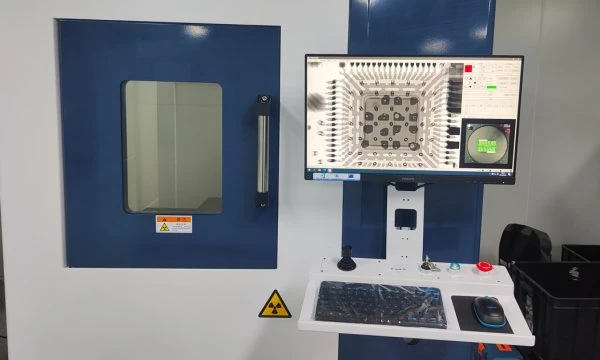
- Key Test: 100% Automated Optical Inspection (AOI) and X-Ray for solder joints on high-power components.
2. On-Board Charger (OBC) / DC-DC Converter
- Scenario: High switching frequency (200kHz+) to reduce magnetics size.
- Trade-off: Prioritizes low parasitic inductance and compact layout.
- Guidance: Requires a multilayer stackup (4-6 layers) to utilize inner planes for shielding.
- Key Test: Signal integrity testing to ensure no crosstalk between high-density traces.
3. Solar String Inverter
- Scenario: Cost-sensitive, high efficiency required.
- Trade-off: Balances performance with manufacturing cost.
- Guidance: Standard FR4 TG170 materials are often sufficient, but creepage distances must be strictly maintained for safety standards.
- Key Test: Isolation voltage testing is paramount due to grid-connection safety requirements.
4. Industrial Motor Drive (Retrofit)
- Scenario: Noisy industrial environment, long cable runs.
- Trade-off: Prioritizes noise immunity (CMTI) over extreme switching speed.
- Guidance: Use differential signaling for logic inputs. The PCB layout should focus on robust ground planes.
- Key Test: EMI/EMC pre-compliance testing to ensure the driver doesn't emit excessive noise or succumb to external interference.
5. High-Temperature Downhole/Aerospace
- Scenario: Ambient temperatures exceeding 150°C.
- Trade-off: Material limitations. Standard FR4 will fail.
- Guidance: Utilize Ceramic PCBs or Polyimide for extreme thermal stability.
- Key Test: High-temperature operating life (HTOL) testing of the assembled PCB.
6. Laboratory Prototype / R&D
- Scenario: Frequent changes, testing different SiC modules.
- Trade-off: Flexibility over compactness.
- Guidance: Include test points for every signal. Use a modular design where the driver card plugs into the power stage.
- Key Test: Functional testing with a Double Pulse Test setup to characterize switching losses.
From design to manufacturing (implementation checkpoints)

After selecting the right strategy, the focus shifts to the execution phase, ensuring the design intent survives the manufacturing process.
To ensure successful SiC MOSFET gate driver PCB testing and production, follow this checkpoint list. Each point includes a recommendation, the associated risk, and the acceptance method.
Placement of Driver IC
- Recommendation: Place the driver IC as close to the SiC MOSFET gate/source pins as physically possible (< 20mm).
- Risk: Long traces introduce inductance ($L = \mu \cdot length$), causing ringing.
- Acceptance: Visual inspection of Gerber files before fabrication.
Kelvin Connection for Source
- Recommendation: The driver return path must connect directly to the source pin of the MOSFET (Kelvin Source), separate from the power loop current path.
- Risk: Common Source Inductance (CSI) will provide negative feedback, slowing down switching and increasing losses.
- Acceptance: Layout review verifying separate traces for power source and driver return.
Isolation Barrier Width (Creepage)
- Recommendation: Maintain > 8mm creepage for 800V systems (or per IPC-2221B standards).
- Risk: Arcing across the PCB surface, leading to catastrophic failure.
- Acceptance: Design Rule Check (DRC) and physical measurement on the bare board.
PCB Material Selection
- Recommendation: Use High-Tg (>170°C) and Low-CTI (Comparative Tracking Index) materials.
- Risk: Dielectric breakdown or thermal delamination under high-power operation.
- Acceptance: Review material datasheet provided by APTPCB during the quote phase.
Gate Resistor Power Rating
- Recommendation: Use MELF or multiple parallel SMT resistors to handle high pulse power.
- Risk: Resistors burning out due to high peak currents during switching.
- Acceptance: Bill of Materials (BOM) review and thermal imaging during load testing.
Miller Clamp Implementation
- Recommendation: Ensure the active Miller clamp trace is short and low impedance.
- Risk: Parasitic turn-on of the MOSFET due to high dV/dt (Miller Effect).
- Acceptance: Simulation of the gate circuit and validation via DPT.
Flux Residue Cleaning
- Recommendation: Implement strict washing protocols for PCBA.
- Risk: No-clean flux residues can become conductive at high voltages/temperatures, compromising isolation.
- Acceptance: Ionic contamination testing (ROSE test).
Test Point Accessibility
- Recommendation: Design MMCX or probe-tip adapters for Gate and Source signals.
- Risk: Engineers using long ground leads on probes during testing, resulting in false measurement data.
- Acceptance: Physical verification of test point placement.
Layer Stackup Symmetry
- Recommendation: Ensure balanced copper distribution to prevent warping.
- Risk: Warped boards cause stress on ceramic capacitors (cracking) and poor contact with heatsinks.
- Acceptance: PCB Stack-up analysis.
Final Functional Test (FCT)
- Recommendation: Automated test rig that checks UVLO (Under Voltage Lock Out), Desat, and PWM propagation.
- Risk: Shipping defective units that pass static tests but fail dynamically.
- Acceptance: 100% Pass rate on FCT rig.
Common mistakes (and the correct approach)
Even with a solid checklist, engineers often encounter specific pitfalls during SiC MOSFET gate driver PCB testing. Recognizing these early saves time and budget.
1. The "Long Ground Lead" Fallacy
- Mistake: Using the 6-inch alligator ground clip on an oscilloscope probe to measure the gate signal. This creates a large loop antenna that picks up switching noise.
- Result: The scope shows massive ringing that isn't actually there, leading engineers to over-damp the gate (increasing resistance), which increases switching losses.
- Correction: Use a spring-tip ground or a tip-and-barrel method for short, low-inductance measurement.
2. Ignoring the "Miller Effect"
- Mistake: Designing the gate turn-off circuit without considering the Miller capacitance ($C_{gd}$).
- Result: When the opposing switch turns on, the high dV/dt injects current through $C_{gd}$ into the gate, potentially turning the device back on (shoot-through).
- Correction: Implement an Active Miller Clamp or use a negative turn-off voltage (e.g., -4V or -5V).
3. Over-reliance on Simulation
- Mistake: Assuming the SPICE model perfectly represents the physical PCB parasitics.
- Result: The real board oscillates because the simulation didn't account for the 5nH inductance of a via or trace.
- Correction: Always perform Flying Probe Testing or functional validation on the physical prototype to correlate with simulations.
4. Poor Decoupling Capacitor Placement
- Mistake: Placing the decoupling capacitor for the driver supply too far away.
- Result: The driver cannot draw the peak current (amps) needed instantly, causing the supply voltage to dip (droop) and the gate drive to be sluggish.
- Correction: Place ceramic capacitors directly at the supply pins of the driver IC.
5. Routing Gate Signals Under High-Voltage Nodes
- Mistake: Running the sensitive gate signal trace on a layer directly beneath the high-voltage drain copper pour.
- Result: Capacitive coupling injects noise into the gate signal.
- Correction: Keep gate signals away from high-voltage switching nodes. Use ground planes to shield them.
6. Neglecting Thermal Vias
- Mistake: Relying solely on the copper trace to cool the driver IC.
- Result: The driver overheats and enters thermal shutdown.
- Correction: Use arrays of thermal vias connected to internal ground planes to spread heat effectively.
FAQ
Q: Why is negative voltage (e.g., -5V) recommended for SiC gate drivers? A: Unlike Silicon MOSFETs, SiC devices have a lower threshold voltage ($V_{th}$). A negative turn-off voltage provides a safety margin to prevent accidental turn-on caused by noise or the Miller effect during high-speed switching.
Q: Can I use standard FR4 for SiC gate driver PCBs? A: Yes, for many applications standard FR4 is acceptable. However, for high-voltage (>800V) or high-temperature environments, materials with higher CTI (Comparative Tracking Index) and Tg (Glass Transition Temperature) are recommended to prevent tracking and thermal failure.
Q: What is the Double Pulse Test (DPT)? A: DPT is a standard method to characterize the switching behavior of power devices. It involves pulsing the gate twice to measure turn-on energy, turn-off energy, and reverse recovery characteristics under controlled load conditions.
Q: How does APTPCB handle impedance control for gate driver boards? A: We use advanced modeling software to calculate trace width and spacing based on your stackup requirements. We then verify this using Time Domain Reflectometry (TDR) during the PCB Quality assurance process.
Q: What is the difference between Desaturation protection and Overcurrent protection? A: Desaturation protection monitors the voltage across the switch ($V_{ds}$) while it is on. If $V_{ds}$ rises excessively (indicating a short circuit or high current), the driver shuts down. It is faster than traditional current sensor-based overcurrent protection.
Q: Why do I see ringing on my gate signal? A: Ringing is usually caused by the resonance between the gate loop inductance and the input capacitance of the MOSFET. Reducing trace length (inductance) and adjusting the external gate resistor ($R_g$) can dampen this ringing.
Q: Do I need to test every single board in mass production? A: For critical power electronics (like automotive or industrial drives), 100% functional testing (FCT) is standard. For less critical applications, a combination of In-Circuit Testing (ICT) and statistical sampling may suffice.
Q: What probe bandwidth do I need for SiC testing? A: Since SiC rise times can be in the nanosecond range, a bandwidth of at least 200 MHz (preferably 500 MHz or higher) is recommended to capture the true shape of the signal without attenuation.
Glossary (key terms)
| Term | Definition |
|---|---|
| SiC (Silicon Carbide) | A wide-bandgap semiconductor material allowing for higher voltage, temperature, and frequency operation compared to Silicon. |
| dV/dt | The rate of change of voltage with respect to time. High dV/dt is characteristic of SiC but generates significant EMI. |
| CMTI | Common Mode Transient Immunity. The ability of an isolator to reject fast transient noise between its input and output grounds. |
| Miller Effect | The phenomenon where the drain-to-gate capacitance ($C_{gd}$) causes the gate voltage to rise during turn-off, potentially causing false turn-on. |
| Kelvin Connection | A layout technique using separate traces for the current path and the voltage sensing/driving path to eliminate the effect of trace resistance/inductance. |
| Desaturation (Desat) | A fault condition where the MOSFET operates in the active region instead of saturation, leading to massive power dissipation. |
| Dead Time | The time interval where both high-side and low-side switches in a half-bridge are off to prevent short circuits (shoot-through). |
| Gate Charge ($Q_g$) | The amount of charge required to raise the gate voltage to a level that fully turns on the MOSFET. |
| Parasitic Inductance | Unwanted inductance inherent in PCB traces and component leads that opposes changes in current. |
| Creepage | The shortest distance between two conductive parts along the surface of the solid insulating material. |
| Clearance | The shortest distance between two conductive parts through the air. |
| UVLO | Under Voltage Lock Out. A safety feature that disables the driver if the supply voltage drops below a safe operating level. |
Conclusion (next steps)
SiC MOSFET gate driver PCB testing is a multidimensional challenge that bridges the gap between theoretical circuit design and real-world physics. As we have explored, success relies on understanding the unique demands of SiC—specifically the high dV/dt and the need for robust isolation—and translating that into rigorous metrics like CMTI and low-inductance layouts.
From selecting the right PCB materials to executing the Double Pulse Test, every step matters. A failure in the gate driver is a failure of the entire power system.
When you are ready to move from prototype to production, APTPCB is here to support you. To ensure the fastest and most accurate DFM review and quote, please prepare the following:
- Gerber Files: Including all copper layers, drill files, and outline.
- Stackup Requirements: Specify if you need controlled impedance or specific dielectric materials (e.g., High Tg).
- Assembly Specs: BOM with clear part numbers for the driver ICs and SiC modules.
- Test Requirements: Define if you need ICT, FCT, or specific isolation voltage testing.
By partnering with an experienced manufacturer, you ensure that your high-performance SiC designs are built on a foundation of reliability and quality.