
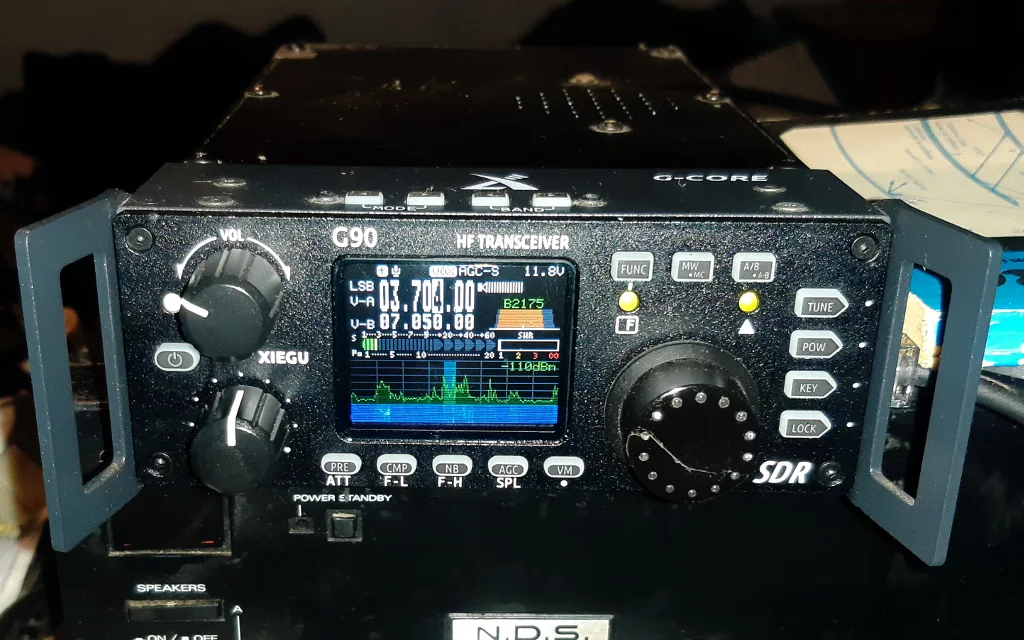
- A software defined radio PCB is best understood as a single board that has to host three different electrical worlds at once: an RF front-end, a data-converter (ADC/DAC) bridge, and a digital baseband built around an FPGA or SoC.
- The hard part is not any one block. It is the boundary between blocks, where return paths, power domains, and clock lines decide whether the RF signal stays clean.
- A board can route correctly and pass continuity yet still carry coupled noise that quietly degrades receiver sensitivity, because the failure lives in domain isolation, not in a broken net.
- The right review treats domain partitioning, return-path continuity, and clock distribution as the primary signal-integrity questions, not as afterthoughts.
- This is a board-level explainer. It does not claim a specific noise figure, dynamic range, EVM, or frequency ceiling, because those depend on stackup, material, and converter choices and are confirmed per design.
Quick Answer A
software defined radio PCBcarries an RF front-end, an ADC/DAC converter stage, and an FPGA or SoC digital baseband on one substrate. The practical design question is notDo the nets connect?It isDoes every domain keep a continuous, uncontaminated return path so digital and converter switching noise never reaches the RF signal path?The boards that perform well are the ones where partitioning, grounding, power separation, and clock routing are decided early and held through layout, not patched after the first bring-up.
Table of Contents
- What an SDR PCB actually is (and is not)
- The physical boundary: where RF, data-converter, and digital domains meet
- Layout rules that protect the signal path
- Release implications: what to verify before you trust the board
- FAQ
- Public references
- Author and review information
What an SDR PCB actually is (and is not)
A software defined radio moves work that older radios did in fixed analog hardware into reconfigurable digital processing. Mixing, filtering, and modulation that once lived in discrete stages now happen in software running on an FPGA or SoC, fed by high-speed data converters. That architecture is what makes the radio flexible, and it is also what makes the board difficult.
It helps to be precise about what the PCB is.
An SDR PCB is a mixed-signal carrier with three coupled domains:
- an RF front-end with low-noise amplifiers, filters, mixers, a local-oscillator or synthesizer, and transmit gain stages, handling small analog signals where any added noise matters
- a data-converter stage built around the ADC and DAC, the bridge between the analog RF world and the digital one, sensitive on both sides of that bridge
- a digital baseband built around an FPGA or SoC, with high-speed serial links such as JESD204 (named here only as an interface), DDR memory, and switching logic that is an aggressive noise source
An SDR PCB is not a generic high-speed digital board with an antenna attached, and it is not a pure RF board with a processor bolted on. Treating it as either one is the common mistake. If you design it as a digital board, the RF front-end inherits switching noise. If you design it as an RF board, the high-speed digital links and converter timing get starved of disciplined return paths and clean power. The board only works when the three domains are planned together but kept electrically distinct.
It is also worth saying what the board does not prove on its own. The PCB sets the physical conditions for good performance, but it does not by itself guarantee a given sensitivity, dynamic range, or error-vector magnitude. Those depend on the converter, the front-end parts, the stackup, and the material, and they are confirmed per design rather than promised by layout alone. For the broader high-frequency context, the starting reference is the High Frequency PCB page, with High Speed PCB covering the digital side.
The physical boundary: where RF, data-converter, and digital domains meet
The center of SDR board design is the seam between domains. Each domain has its own appetite: the RF front-end wants quiet, the digital baseband generates noise, and the converter stage sits exactly in between with one foot in each world. The board has to give each domain a clean home and then control what crosses the boundary.
Floorplanning sets the boundary first. Before any routing, the board is partitioned into physical zones, usually RF front-end, converter, digital, and power management, laid out so the RF signal path is short and direct and so the digital zone is kept away from sensitive analog nodes. A good floorplan means most isolation work is already done by geometry. A vague floorplan means the rest of the layout becomes a series of reactive fixes.
Return paths are the real boundary, not the silkscreen line. Every signal current returns through the reference plane beneath it. When a trace crosses a gap, a plane split, or a poorly stitched region, its return current is forced to detour, and that detour radiates and couples into neighbors. This is where the primary risk on an SDR board lives. If domain isolation is weak or a return path breaks between the RF front-end, the ADC/DAC, and the digital baseband, switching and clock energy couples onto the RF path as added noise, spurs, or clock contamination. The result is degraded sensitivity or signal quality that a continuity check will never catch, because every net still rings out as connected. Those boards can pass static electrical tests and then show intermittent receiver performance at bring-up, when the converters clock and the FPGA fabric switches under real load. The fault is not a broken connection; it is a contaminated reference.
The ground strategy follows from the return-path view. The older instinct to physically split analog and digital ground often does more harm than good, because a split forces return currents to find a longer path and can inject the very noise it was meant to block. A continuous reference plane with disciplined component placement and stitching is usually the more reliable approach, with the converter placed so its analog and digital pins each sit over the appropriate quiet region. The exact grounding choice depends on the converter and the stackup and is confirmed per design, but the governing principle is constant: keep return current short, local, and uninterrupted. The PCB Stack-Up page covers how plane assignment and layer order support this.
Power is a third domain that crosses everything. The RF front-end, the converter, and the digital logic each need supply rails, and digital switching noise riding on a shared rail is a direct path into the RF section. Power-domain separation, local filtering, and dedicated regulation for the sensitive analog and RF rails keep that noise from migrating. The specifics, which rails get ferrite isolation, where the quiet regulators sit, depend on the parts and are decided in design, but the boundary thinking is the same as for signals: do not let one domain's noise become another domain's input.
Layout rules that protect the signal path
Once the domains are partitioned and the return-path strategy is set, a handful of layout disciplines do the work of protecting the signal. None of them rely on a universal number; the right value always depends on stackup, material, and the converter or front-end parts, and is confirmed per design.
Controlled impedance on the lines that need it. RF traces and high-speed differential digital links both run as controlled-impedance transmission lines, referenced to a clean plane. The target impedance and the trace geometry that achieves it are a function of the dielectric, layer spacing, and copper, so they are set against the chosen stackup rather than assumed. The point is consistency: an impedance discontinuity, at a connector, a via transition, or an abrupt corner, reflects energy and degrades the line. Keeping transitions smooth and references continuous matters more than hitting any single textbook figure. The PCB Impedance Control page covers how this is specified and verified.
Guarding and shielding around the quiet zones. Via fencing along RF traces and ground stitching around the RF section build a local cage that contains fields and blocks coupling from neighboring channels. Where isolation has to be stronger, board-level shielding such as footprints for metal cans over the front-end is planned during footprint creation, not retrofitted after layout. These structures raise isolation between the noisy and quiet domains, reinforcing the same boundary the floorplan and grounding already defined.
Clock distribution is its own discipline. Clocks and the local-oscillator or synthesizer output are among the most dangerous nets on the board, because they are periodic, energetic, and rich in harmonics. A clock line that wanders near the RF front-end, or whose return path breaks, becomes a spur source that lands directly in the receive band. Clock and LO routing is kept short, well referenced, and away from sensitive analog nodes, and the high-speed serial links between the converter and the FPGA are treated with the same care so their switching edges stay contained. Skew between clock and data on those links is a timing concern, but from the signal-path view the bigger issue is keeping their fields from leaking into the RF chain.
Material choice is a tradeoff, not a slogan. RF layers often use a low-loss laminate while digital and power layers can use standard FR4 in a hybrid stackup, which balances RF behavior against cost. Whether a given material is appropriate depends on the frequency range, the loss budget, and the mechanical build of the specific design; no single material is universally best. The RF & Rogers materials and Megtron PCB pages describe the options and where each fits.
Across all of these, the through-line is the same one from the boundary discussion: protect the reference, keep the RF path short and quiet, and stop any domain's noise from reaching another. The numbers shift with the design; the discipline does not.
Release implications: what to verify before you trust the board
Because the dangerous SDR failures hide in coupling rather than in broken nets, a release review has to check the things a netlist test cannot see. The goal is to confirm that the physical conditions for clean performance actually survived layout, not to claim a performance result.
| Verify before release | What to confirm | Why it is a release issue |
|---|---|---|
| Domain partition is real | RF front-end, converter, and digital zones are physically separated as the floorplan intended, with the RF path short and direct | A vague partition pushes isolation problems into every later routing decision |
| Return paths are continuous | High-speed and RF lines reference a continuous plane with no crossed splits or unstitched gaps | A broken return path couples noise onto RF without breaking any connection a continuity check sees |
| Power domains are separated | RF, converter, and digital rails have appropriate isolation and local filtering so switching noise does not migrate | A shared or under-filtered rail carries digital noise straight into the RF section |
| Clock and LO routing is contained | Clock, synthesizer, and high-speed serial links are short, well referenced, and away from sensitive analog nodes | Clock harmonics are a leading spur source that lands in the receive band |
| Impedance and transitions are clean | Controlled-impedance lines match the chosen stackup and transitions avoid abrupt discontinuities | Reflections and mismatches degrade both RF and high-speed digital links |
| Stackup and material match intent | The fabricated stackup, dielectric, and layer assignment match what the design assumed | RF and impedance behavior depend on the real build, not the intended one |
| Review language stays at board level | The board review covers layout, isolation, and manufacturability, not radio certification or guaranteed performance figures | A board review misread as a performance guarantee sets false expectations |
A useful release package exposes both the electrical intent and the physical build: fabrication data with stackup intent, placement that makes the RF, converter, digital, and power zones easy to read, BOM context for the front-end and converter parts, and any board-level inspection or functional-test expectations. With those inputs, the manufacturing review can speak to the real SDR problem, whether the intended isolation and return paths still exist in the built board, rather than to generic manufacturability. For validation and inspection language at board level, the Testing & Quality and Functional Circuit Test (FCT) pages cover scope. For application context, see Communication Equipment PCB and Aerospace & Defense PCB.
If your SDR design is ready for a manufacturing-side review of stackup, impedance, and domain isolation, you can share the fabrication package through the software defined radio PCB review request.
FAQ
What makes a software defined radio PCB harder than a normal RF or digital board?
It has to host three electrical domains at once: a quiet RF front-end, a data-converter bridge, and a noisy digital baseband. The difficulty is the boundary between them. Isolation, return paths, and power separation decide whether the digital and converter switching noise stays out of the RF path, and those are easy to get wrong even when every net connects correctly.
Why does my board pass continuity but still have poor receiver sensitivity?
Because the failure is coupling, not a broken connection. A return-path break or weak domain isolation lets switching or clock energy reach the RF front-end as added noise or spurs. Every net still rings out as connected, so a continuity check passes, while sensitivity is already degraded. This often shows up as intermittent performance at bring-up when the converters and FPGA run under load.
Should I split the analog and digital ground planes?
Usually not by default. A physical split can force return currents into long detours that inject more noise than they block. A continuous reference plane with careful component placement and stitching is often more reliable, with the converter placed so its analog and digital pins sit over the right regions. The correct choice depends on the converter and stackup and is confirmed per design.
How do I keep clock and local-oscillator noise out of the RF chain?
Treat clock, synthesizer, and LO nets as among the most dangerous on the board. Keep them short, well referenced to a continuous plane, and routed away from sensitive analog nodes, and contain the high-speed serial links between converter and FPGA the same way. The aim is to stop their periodic, harmonic-rich fields from leaking into the receive band.
What impedance and material should I use?
There is no universal answer. Controlled-impedance targets and the trace geometry that hits them depend on the dielectric, layer spacing, and copper in your stackup, and material choice depends on your frequency range, loss budget, and mechanical build. A hybrid stackup with a low-loss RF layer over FR4 digital layers is a common tradeoff, but the right values are set against your specific design and confirmed in fabrication.
Does the PCB alone determine SDR performance like noise figure or dynamic range?
No. The board sets the physical conditions, clean references, isolated domains, contained clocks, that allow good performance, but the actual figures depend on the converter, the front-end parts, the stackup, and the material. The PCB review confirms the layout and isolation are sound; it does not by itself guarantee a specific performance number.
Public references
High Frequency PCB Support-page context for high-frequency construction and RF-layer planning.
PCB Impedance Control Support-page context for specifying and verifying controlled-impedance lines.
PCB Stack-Up Support-page context for layer order, plane assignment, and reference continuity.
Communication Equipment PCB Application-page context for communication and RF system board work.
Testing & Quality Support-page context for board-level inspection and validation language.
Author and review information
- Author: APTPCB editorial team
- Technical review: RF / high-speed PCB engineering review team
- Review scope: Board-level domain partitioning, return-path and isolation review, controlled-impedance and material consistency, and release-boundary language for software defined radio PCBs