
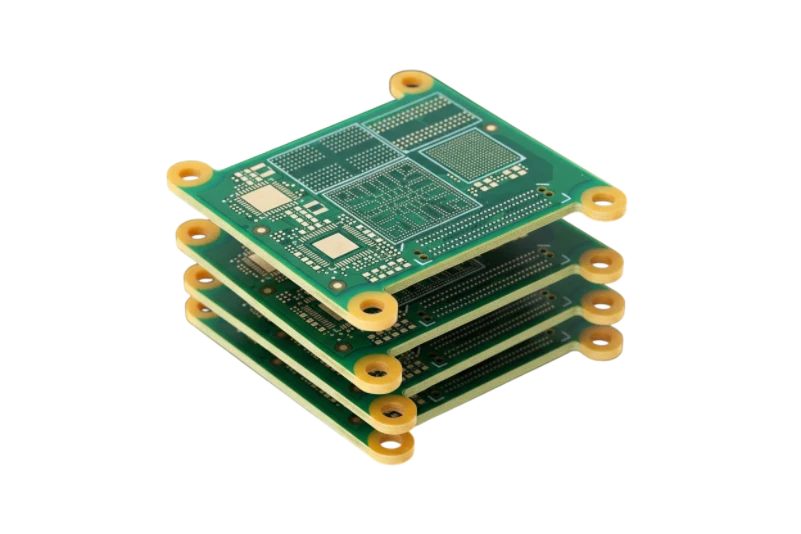
What is a stitching capacitor matrix and when should engineers use one?
A stitching capacitor matrix is a PCB structure that creates controlled high-frequency return paths between reference planes that cannot be directly connected at DC.
High-speed signals normally return through the nearest reference plane because this minimizes current-loop area and inductance. When a signal changes reference layers, crosses a plane boundary, or transitions between different power domains, the return current path can become discontinuous.
A stitching capacitor provides an AC connection between those reference structures.
The design objective is not simply adding capacitance. The matrix controls:
- return-current continuity
- transition impedance
- electromagnetic radiation
- power distribution network behavior
- signal integrity margin
Stitching capacitors are typically considered for:
- PCIe Gen4/Gen5 and higher-speed serial interfaces
- DDR4/DDR5 memory routing
- FPGA and processor platforms
- high-speed networking boards
- RF-sensitive products requiring EMI margin
A continuous ground reference with proper layer planning remains the preferred solution. A capacitor matrix is normally introduced when the reference change cannot be eliminated.
How should a stitching capacitor matrix configuration be selected?
The correct structure depends on signal speed, stackup geometry, available routing space, and manufacturing capability.
| Design priority | Recommended approach | Key specification | Tradeoff |
|---|---|---|---|
| Lowest parasitic inductance | VIPPO connection | Capacitor pad connected directly through filled and plated-over microvia structure | Higher PCB fabrication cost |
| Balanced performance and cost | Short dog-bone fanout | Minimal trace length between capacitor and reference planes | Moderate inductance increase |
| Maximum density | 0201 or 01005 MLCC | Small package with reduced mounting inductance | Requires advanced SMT capability |
| Broad frequency coverage | Multiple capacitor values | Combination such as 1nF, 10nF, 100nF | Requires PI simulation |
| Mechanical reliability | Soft-termination MLCC | Improved resistance to board flex stress | Increased component cost |
| Reduced discrete components | Embedded capacitance structure | Thin dielectric plane arrangement | Higher material complexity |
The physical connection usually has more influence than the nominal capacitance value. A poorly connected 100nF capacitor with long routing may perform worse than a smaller capacitor with a lower-inductance path.
What capacitor specifications should be defined?
A production stitching capacitor matrix should define electrical, mechanical, and assembly requirements.
Important capacitor parameters include:
- package size
- capacitance value
- dielectric type
- voltage rating
- temperature rating
- tolerance
- termination style
Common selections include:
- 0201 and 01005 packages for low-inductance high-speed applications
- X7R or X5R dielectric MLCCs for temperature-stable operation
- voltage ratings selected with sufficient operating margin
- ±10% or ±20% tolerance for many general applications
- tighter tolerance when resonance behavior requires control
- soft termination where mechanical reliability is critical
The capacitor value is selected according to the frequency range being controlled. Many high-speed applications use values in the 10nF to 100nF range, while some interface and EMI implementations use values below 1µF depending on the design objective.
How should the PCB stackup support a stitching capacitor matrix?
The matrix and stackup must be designed together because the PCB geometry determines the return-current path.
Define:
- dielectric thickness
- reference plane locations
- copper weight
- controlled impedance targets
- material selection
- plane overlap conditions
High-speed boards often benefit from:
- closely coupled signal and reference layers
- thin dielectric spacing between power and ground planes
- controlled impedance structures
- low-loss laminate materials where required
The stackup decision affects:
- capacitor connection inductance
- plane capacitance
- signal transition behavior
- PDN resonance
A stitching capacitor added after routing is complete often becomes a correction rather than an optimized design element.
Where should stitching capacitors be placed?
Placement determines whether the capacitor actually improves the return path.
The preferred placement is:
- directly beside the reference transition
- close to layer-change vias
- close to plane boundaries
- with the shortest possible connection to both planes
A long trace between the capacitor and reference connection adds inductance and reduces high-frequency effectiveness.
For differential pairs:
- maintain symmetry
- keep both paths electrically similar
- avoid introducing unequal return paths
The placement priority should normally be:
- Return-path continuity for critical high-speed signals
- Local power integrity improvements
- Secondary filtering structures
What DFM risks should be reviewed before manufacturing?
Dense stitching capacitor arrays create additional PCB fabrication and assembly requirements.
| Failure mode | Root cause | Detection method | Prevention |
|---|---|---|---|
| Tombstoning | Unequal heating on small MLCC packages | SPI and AOI inspection | Balanced pad design and thermal control |
| Solder bridging | Excessive density or insufficient spacing | AOI inspection | Controlled land patterns |
| High inductance | Long capacitor connection path | Simulation and measurement | Short routing or VIPPO |
| Via reliability failure | Excessive aspect ratio or poor plating | Microsection and IST testing | Controlled via design |
| Plane resonance | Incorrect capacitor combinations | PI simulation | Optimize capacitor network |
| Ceramic cracking | Mechanical stress during assembly | Failure analysis | Soft termination and placement control |
| Solder voiding | Via-in-pad solder movement | X-ray inspection | Proper filled VIPPO process |
| EMI increase | Broken return path | Near-field scan | Restore reference continuity |
How should stitching capacitor matrices be validated?
A complete validation plan combines simulation, inspection, electrical testing, and reliability testing.
PDN impedance validation
Use:
- impedance extraction
- VNA measurements
- power integrity simulation
The objective is maintaining acceptable impedance across the intended operating frequency range.
Return-path and signal-integrity validation
Use:
- TDR measurement
- eye-diagram testing
- insertion-loss analysis
Confirm:
- transition discontinuities remain within the signal budget
- impedance remains controlled
- differential behavior remains balanced
Assembly validation
Use:
- SPI inspection
- AOI inspection
- X-ray inspection
Confirm:
- all matrix components are installed
- solder joints meet requirements
- hidden via-in-pad structures are acceptable
Reliability validation
Use:
- thermal cycling
- IST testing
- microsection analysis
Confirm:
- via structures remain reliable
- solder joints survive environmental stress
- electrical performance remains stable
EMI validation
Use:
- near-field scanning
- radiated emissions testing
- compliance chamber testing
The objective is verifying that the matrix reduces unwanted emissions caused by return-path discontinuities.
What should be included in a stitching capacitor matrix RFQ package?
A complete supplier package should include:
- Gerber or ODB++ fabrication files
- IPC-2581 data when available
- drill files
- PCB stackup drawing
- impedance requirements
- BOM with manufacturer part numbers
- pick-and-place coordinates
- assembly drawings
- VIPPO requirements
- inspection requirements
Manufacturing formats such as ODB++ and IPC-2581 reduce interpretation errors compared with incomplete fabrication packages.
How should a supplier be qualified for stitching capacitor matrix production?
Engineering capability checklist
- High-speed PCB design review capability
- Return-path analysis experience
- Controlled impedance engineering
- HDI and VIPPO capability
- 0201/01005 assembly experience
- Stackup optimization support
Manufacturing capability checklist
- High-accuracy SMT placement
- SPI inspection
- AOI inspection
- X-ray inspection
- Controlled reflow profiling
- Microvia fabrication capability
Quality checklist
- Component traceability
- Material change notification process
- First article inspection reporting
- Microsection documentation
- ESD-controlled production area
- Reliability testing support
What are the main cost and performance tradeoffs?
A stitching capacitor matrix is a balance between electrical performance and manufacturing complexity.
VIPPO provides the lowest connection inductance but increases PCB cost.
0201 and 01005 components improve high-frequency performance but require tighter SMT process control.
Multiple capacitor values expand frequency coverage but require simulation to prevent unwanted resonance.
Embedded capacitance structures reduce component count but increase material and stackup complexity.
The best design is the one that achieves the required EMI and signal-integrity margin with a controlled production process.
Frequently asked questions about stitching capacitor matrices
Does a stitching capacitor replace a ground via?
No. Ground vias connect conductors at the same potential. Stitching capacitors provide AC coupling between structures that cannot be directly connected.
What capacitor values are commonly used?
Common values include 10nF, 100nF, and application-specific values selected through simulation and measurement.
Can stitching capacitors be placed on the bottom side?
Yes. Bottom-side placement is possible when routing density requires it, but via transitions and assembly accessibility must be considered.
Does a stitching capacitor matrix increase PCB cost?
Yes. Cost increases depend on capacitor density, package size, HDI requirements, inspection requirements, and assembly complexity.
Related resources
- High-Speed PCB Manufacturing: Understand the fabrication capabilities required to support gigabit signal integrity and tight impedance control.
- PCB Stackup Design: Learn how to configure layers and prepregs to maximize inter-plane capacitance and support your matrix.
- HDI PCB Capabilities: Explore High Density Interconnect options like microvias and VIPPO that are essential for low-inductance stitching.
- SMT Assembly Services: Review the assembly precision available for placing 0201/01005 components in dense matrices.
- DFM Guidelines: Access design rules to ensure your stitching matrix is manufacturable without yield loss.
Request a quote for stitching capacitor matrix manufacturing review
Send:
- Gerber or ODB++ files
- stackup requirements
- BOM
- impedance targets
- VIPPO requirements
- assembly documentation
A manufacturing review can identify layout risks before fabrication and assembly begin.
Conclusion
A stitching capacitor matrix is a controlled return-path structure, not simply a group of capacitors. Reliable designs combine correct capacitor selection, optimized stackup geometry, low-inductance connections, manufacturable assembly rules, and measurable validation.
When electrical requirements and manufacturing capability are aligned, stitching capacitor matrices provide predictable EMI control and signal-integrity performance for advanced high-speed PCB applications. Which follow-up would help more: competitor SEO gap analysis or a stronger APTPCB commercial conversion version?